





































Can One Breach Really Trigger Fines Under Both NIS 2 and GDPR?
Picture the moment your systems grind to a halt from a targeted attack. Personal data is being syphoned off just as your critical online services flicker and fail. In this scenario, the impact is dual-and so is the oversight. Today’s regulatory landscape is engineered for overlap: with GDPR safeguarding personal data, and NIS 2 enforcing security and continuity for essential digital or operational services, an incident rarely sits in a single legal silo.
One event, two sanctions: effective compliance teams treat the NIS 2 and GDPR edge as a playing field, not a series of traps.
What makes dual enforcement predictable-and risky-is the integrated nature of modern operations. Most essential services (think healthcare, finance, energy, cloud infrastructure, digital service providers) handle volumes of personal data, sitting directly at the intersection of both GDPR and NIS 2. A single ransomware surge that exfiltrates customer identity data and disrupts core functions? You’ve instantly entered both legal spheres. For most, this is not theoretical. ENISA confirms that multi-vector threats (from ransomware to supply chain breaches) regularly activate privacy and continuity triggers together (ENISA, enisa.europa.eu).
The muscle-move for compliance officers: never view GDPR or NIS 2 in isolation. Reporting windows overlap (72 hours for GDPR, 24 + 72 for NIS 2), and national authorities may communicate but rarely merge their investigations. GDPR elevates the protection of data, while NIS 2 focuses on the survival and reliability of your services. Both demand prompt notification, internal readiness, and robust, traceable evidence. Failing one regime’s requirements will not excuse you in the other.
| Regulatory Trigger | Category Impacted | Common Overlap | Authority |
|---|---|---|---|
| Personal data leak | Confidentiality breach | Service outage (NIS 2 + GDPR) | DPA + NIS 2 |
| Ransomware halts ops | Essential service interruption | Mass data exposure | DPA + NIS 2 |
| Supply chain breach | Data processors, business ops | Data & continuity loss | DPA (+ NIS 2) |
The bottom line: one event, two lenses. Your organisation’s survival isn’t about ticking one compliance box. It’s about harmonising the demands and evidence for both-simultaneously.
What Real-World Breach Scenarios Drive Dual Enforcement?
Walk through a modern breach, and you’ll see the domino effects firsthand: ransomware hits your hospital’s IT, encrypts records (NIS 2: operational impact) and leaks patient information (GDPR: privacy impact). Or, a cloud provider suffers credential theft exposing client PII; recovery stalls, and systems go dark for hours. Here, both regimes snap to attention.
- Credential theft: disabling critical systems and revealing user profiles
- Malicious insider: alters system integrity and accesses restricted data
- Supplier breakdown: interrupts payroll/HR operations while exposing fines and employee data
- Misconfigured cloud storage: leads to public data leaks and forced service downtime
Dual notification is not just policy-it's your insurance against regulatory blind spots.
Each regulatory framework operates on its own triggers. GDPR launches investigations when personal data is at risk; NIS 2 acts when the continuity of an essential service falters. In parallel, dual reporting is expected: DPAs manage data harm; sector/national cyber authorities demand recovery for operational failures. Failure to notify either is an unsparing invitation for double fines-a point hammered home by legal advisories across Europe (twobirds.com, dlapiper.com).
| Breach Scenario | Trigger Points | Fines Possible | Reporting Obligations |
|---|---|---|---|
| Data exfiltration + system lockout | GDPR Art.33 + NIS 2 Art.23 | Both (dual) | DPA & NIS 2 Authority |
| Data-only incident, business steady | GDPR only | Single | Data Protection Authority |
| System outage, no data involved | NIS 2, maybe GDPR alert | Single | Sector/National NIS 2 Auth. |
Multi-entity structures face even sharper risks. If your business model or group structure spans several countries, expect overlapping engagement from multiple DPAs and sector authorities. Separate entities may each receive direct fines-local compliance doesn’t always shield the global parent. This fragmented landscape is responsive, not forgiving.

Master NIS 2 without spreadsheet chaos
Centralise risk, incidents, suppliers, and evidence in one clean platform.
How Do Enforcement Authorities Coordinate (Or Not)?
Expectation: joint-up government action. Reality: overlapping but largely separate investigations. DPAs and NIS 2 authorities are designed to collaborate, but operate under different frameworks and with separate mandates. For complex incidents, this means double the requests, double the deadlines, and potentially divergent remediation plans.
- Data Protection Authorities (DPAs): Protect individuals, demand clarity, notification discipline, and rapid remediation of data harm.
- NIS 2 Authorities/Sector Regulators: Restore service, analyse root causes, demand supply chain and technical hardening.
One breach, multiple conversations-each with its own tempo and pressure.
Sometimes, information is shared between authorities. GDPR Article 60 and NIS 2 Article 37 encourage, but do not require, alignment in investigation. Cross-border fallout from supply chain breaches or multinational operations can quickly draw in authorities from each affected state. Expect friction over who leads, the calculation of fines (entity turnover, local impact, parent-vs-subsidiary status), and how corrective orders are sequenced (CMS Law, Clifford Chance, Dentons).
Practical outcome: expect requests for distinct evidence sets, action plans, and remediation proof for each regime. Where authorities coordinate, it’s often slow and unpredictable.
How Are Dual Fines Quantified-And When Are They Imposed?
GDPR and NIS 2 each set their own, formidable fine scales:
- GDPR: Up to €20 million or 4% of global revenue per infringement.
- NIS 2: Up to €10 million or 2% (or even 1.4% for important entities) of turnover, per incident.
Crucially, there’s no statutory cap on cumulative fines. Where both breaches stem from a single event, and the facts support separate findings (personal data lost; service continuity broken), both fines can be stacked. National implementations may vary on exact percentages-always check the local NIS 2 law-but the risk is clear: double exposure (PwC Legal, Clifford Chance, Osborne Clarke).
Insurers increasingly classify dual fines as a baseline scenario, not edge case.
Mitigation is possible but not guaranteed. Prompt notification, demonstrable control effectiveness, and clear documentation may persuade authorities to show proportionality-but there’s no legal requirement to limit your total penalty to one regime’s ceiling. Failures in both regimes are always a risk in complex group structures with fragmented accountability.
| Regulation | Max Fine/Turnover | Scope/Trigger | Fines Stack? |
|---|---|---|---|
| GDPR | €20m / 4% global | Per entity, each breach | Yes |
| NIS 2 | €10m / 2% (1.4%) turnover | Per operator, each breach | Yes |
| Breach Event | Risk Change | ISO 27001/SoA Control | Example Evidence |
|---|---|---|---|
| Ransomware (data + service) | Dual-track obligation | A.5 (Incident mgmt) | Logs, notifications, SoA update |
| Customer complaint | DPIA review, risk re-score | A.5.4 (Mgmt responsibility) | DPIA, meeting records |
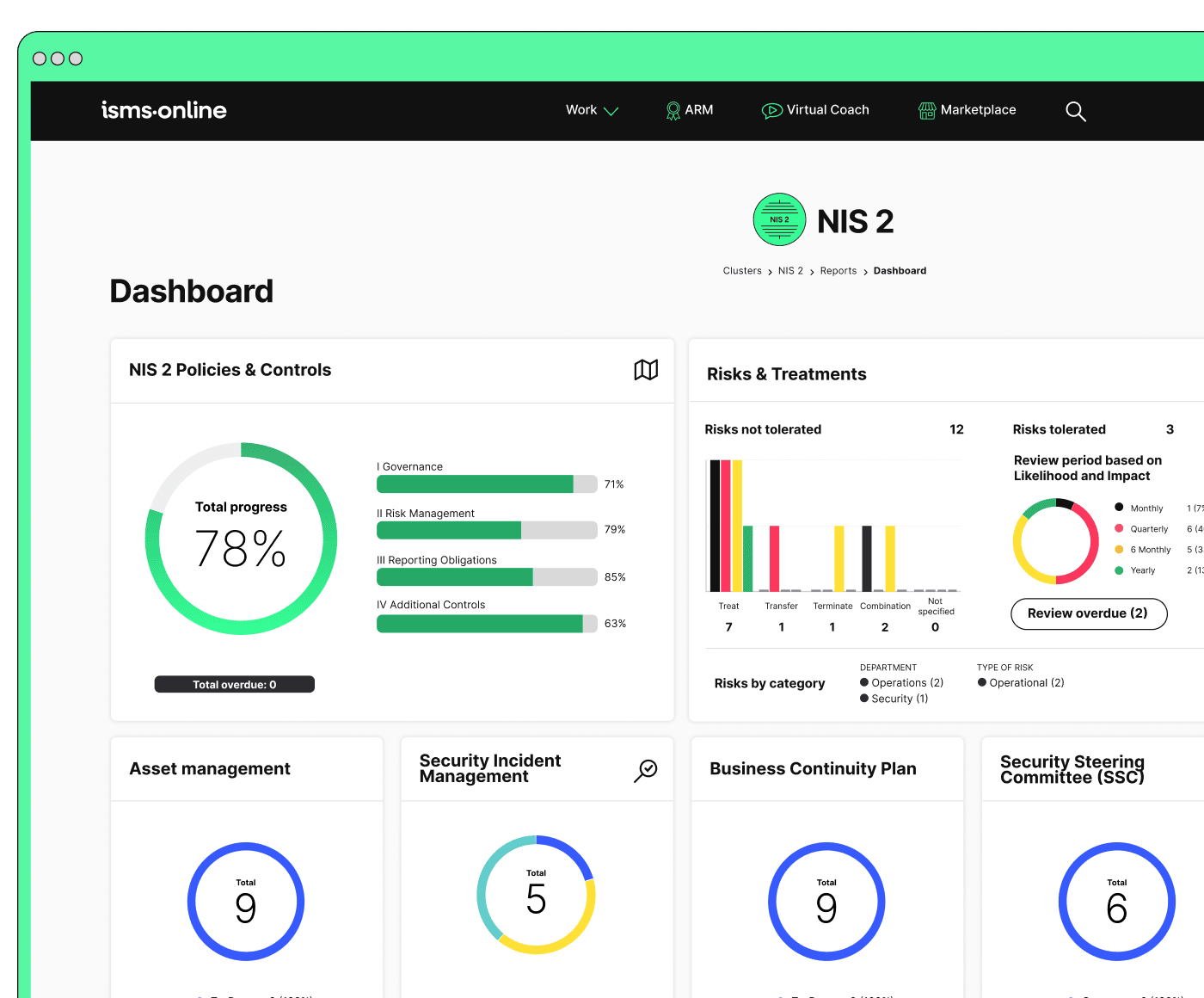
Be NIS 2-ready from day one
Launch with a proven workspace and templates – just tailor, assign, and go.
What Legal Mechanisms Mitigate Double Jeopardy?
Organisations often ask: “Aren’t two fines for one incident unfair?” The reality: European law leans toward proportionality and coordination, not immunity. GDPR Article 83 and NIS 2 Recital 148 both instruct regulators to seek proportionality, consider total impact, and avoid “manifestly excessive” cumulative fines. In practise, this places a burden on the organisation to demonstrate well-managed, cross-framework compliance and evidence of robust notification and remediation.
- Proportionality: You can appeal fines as excessive, but must show best-practise compliance and cooperation. Only egregiously high total penalties stand much chance of being reduced.
- Sector prioritisation: In rare edge cases, where sector-specific law is seen as lex specialis, it might override GDPR, but this is exceptional and unpredictable.
- Legal recourse: Document all processes; appeals are usually slow, so don’t rely solely on court reversal.
Your documentation record is your insurance policy-if it's ambiguous, regulators will default to full penalty.
Quick ISO 27001 Table-Mitigating Cumulative Fine Risk
| Principle | Ready Action | ISO 27001 Link |
|---|---|---|
| Proportionality | Prove cross-system evidence and effort | A.5.4, A.5 |
| Dual Regime Alerts | Maintain logs, dual notifications, SoA mapping | A.5.4, A.5, A.5.29 |
| Specialist Override | Prepare sector mapping, don’t assume immunity | NIS 2 Art 23, A.5 |
What Proactive Controls and Documentation Prove Dual Compliance?
Regulators now expect “living” controls-documented, up-to-date, and demonstrably in use during incidents, not just sitting in a policy folder. Your best tools are:
- Tabletop exercises: tested against both GDPR and NIS 2 incidents (e.g., ransomware).
- Management review minutes: showing board-level oversight of risk updates and incident handling.
- SoA (Statement of Applicability) and DPIA (Data Protection Impact Assessments): cross-referenced to match controls, risks, and real event log entries.
- Dual notification registers: -maintaining proof of timely alerts to both DPA and NIS 2 authorities.
- Training logs: indicating staff awareness of multiple regimes and reporting horizons.
- Live dashboards: and audit trails mapping incidents, notifications, evidence, and ongoing actions.
Controls only build resilience if they’re acted on, recorded, and regularly improved.
A platform like ISMS.online integrates incident logs, role-driven notifications, risk mapping, and evidence linkage-delivering a “breach-to-board” evidence trail. Tabletop exercises simulated in-platform mean you’re never scrambling for proof in the aftermath.
| Audit Expectation | ISMS.online Proof Elements | ISO 27001 Reference |
|---|---|---|
| Incident/notification record | Linked Work, live log, audit trail | A.5, A.5.29 |
| Board/management engagement | Mgmt Review Board, reminders | Clause 5, A.5.4 |
| Policy-user engagement | To-dos, tracked acknowledgements | A.6.3, A.7.2, A.8.8 |
| Control traceability | Framework mapping, evidence bank | A.8.9, A.8.10, A.8.24 |
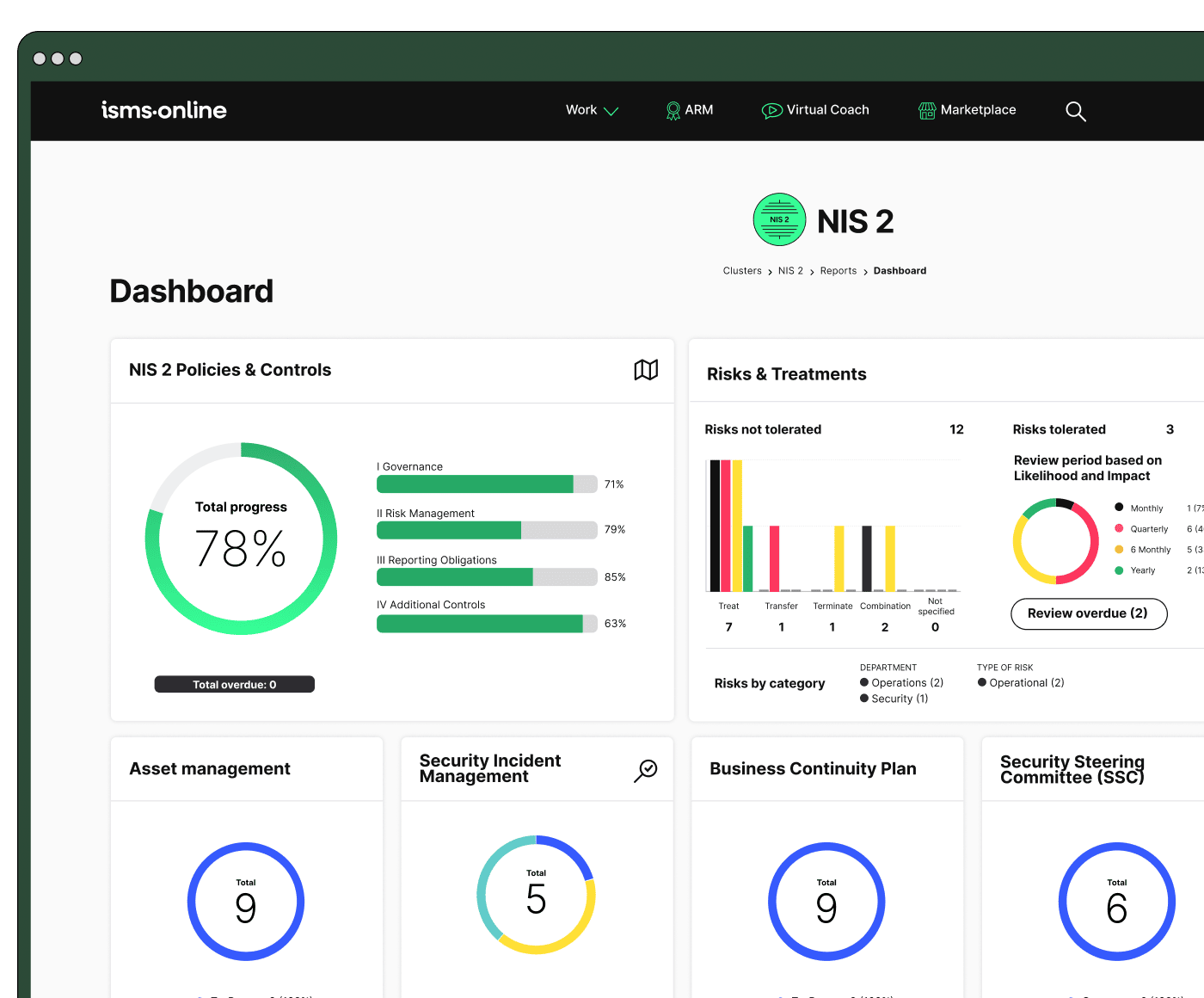
All your NIS 2, all in one place
From Articles 20–23 to audit plans – run and prove compliance, end-to-end.
What Do Enforcement Trends and Recent Cases Reveal?
Parallel enforcement is not hypothetical. GDPR and ePrivacy fines have been issued for the same telecom and digital platform incidents, running into millions (TechCrunch, BCG, Politico). With NIS 2 now live, we can expect a steep acceleration in cross-framework enforcement-especially as supply chain and critical infrastructure become priority targets.
Coordinated investigations are increasing-but rarely reduce penalty exposure without robust evidence of cross-framework control and improvement.
The compliance trend for the next year: expect wider agency cooperation, more complex evidence requests, and an enlarged focus on automated, continuous compliance loops-spanning Security (ISO 27001), Privacy (GDPR/ISO 27701), and soon, AI governance.
Organisations ready to survive and thrive under dual scrutiny build platforms, not paperwork-and unify Security, Privacy, and resilience.
Ready to Replace Double Jeopardy with Defensible Resilience? Discover ISMS.online
You don’t have to face dual fines or divergent regulators without a safety net. ISMS.online equips your team to bridge NIS 2 and GDPR: every incident, every risk, every action mapped, logged, and audit-ready-across Security, Privacy, and beyond.
Experience a platform where notifications, evidence trails, stakeholder reminders, and role-anchored responsibilities converge-arming you not only against two regulatory frontlines but building confidence with your board, partners, and auditors.
Move beyond compliance anxiety. Make defensible resilience your default. Start a guided walkthrough of ISMS.online today-where your documentation lives, your risks are mapped, and your team leads, not just survives, when the next incident tests your readiness.
Frequently Asked Questions
Who is actually liable for both NIS 2 and GDPR fines when one cyber incident strikes?
Your organisation can be fined under both NIS 2 and GDPR if a single incident disrupts essential or important services and compromises the personal data of EU residents. Liability is not limited to a single business unit or the “victim” of the breach. Each legally distinct entity in a group, every arm of a supply chain, and any service provider with a role in the incident comes under regulatory scrutiny. NIS 2 targets organisations that provide critical and important services-from hospitals to managed IT, telecoms, finance, and cloud platforms-while GDPR applies to any entity processing the data of EU residents, whether as a controller or processor. The result: in one event (such as ransomware that knocks out a utility’s digital operations and leaks client data), multiple organisations could each face penalties if found noncompliant in their distinct duties. Authorities examine not only the immediate cause, but also each entity’s preparation, oversight, and post-event action.
When both systems and personal data are hit, every linked organisation in your chain is potentially in the regulatory spotlight.
Key exposure zones for dual fines:
- Essential and important service providers: -utilities, digital providers, finance, health, logistics.
- Data controllers/processors: -any company handling EU data.
- Multinational groups: -each affiliate assessed individually.
- Subcontractors and SMEs: -not immune if part of the service/data flow.
How do NIS 2 and GDPR authorities coordinate-and does that reduce the risk of double fines?
Under both NIS 2 Article 35 and GDPR Recital 150, regulators are required to coordinate their investigation and sanctioning processes to avoid disproportionate, duplicative penalties for the same incident and conduct. This coordination includes synchronised evidence-gathering, joint decision-making, and, where possible, appointing a lead authority (“one-stop-shop” for cross-border or group cases). Tools like the European Data Protection Board (EDPB), ENISA, and Memoranda of Understanding (MoUs) between authorities support these harmonised efforts. However, coordination aims at fairness, not immunity-separate fines may still be justified if authorities identify distinct failings or legal interests (for example, a breach that causes both data loss and operations breakdown). Documentation showing that you have responded to both regimes as an integrated event greatly increases your chances of a single, proportionate penalty-and frequently drives authorities to simplify their approach.
Coordination in practise:
- Lead authority: -Single point for multinational cases.
- Joint investigation teams: -Authorities pool findings and negotiate sanction balance.
- Notification protocols: -Shared deadlines and evidence templates.
- Right of independent action: -Each authority can still act for its specific legal remit.
Can your organisation be fined twice for the same incident-or does ‘double jeopardy’ apply?
European law embeds the “ne bis in idem” (double jeopardy) principle: no one should face two sanctions for the same misconduct where facts and legal interests are truly the same. In practise, if both authorities review the same incident, only one penalty should be issued-but this depends on documented unification in your response. If you fail to notify or engage with both authorities using the same evidence register, or if your service and privacy responses are siloed, regulators may view these as independent breaches and apply cumulative fines. Clarity in incident logs, notification flowcharts, and board oversight records (proving you treated the event as one crisis, across both regimes) is vital. Separately, if multiple legal entities fail their unique responsibilities, fines can stack-especially in cross-border or supply chain incidents.
Regulators don’t just penalise the breach; they scrutinise the story your audit trail tells from detection to resolution.
When can penalties stack?
- Authorities identify clearly distinct failings (e.g., data loss and loss of service).
- Entities respond in silos with poor cross-authority communication or evidence.
- Multiple legal persons (in a group or supply chain) fail independently.
What operational steps help protect your organisation from dual fines and audit exposure?
Securing your organisation against dual-regime penalties demands a unified compliance approach. Centralise incident reporting across NIS 2 and GDPR in a single evidence bank and notification log. Align your breach response playbook to satisfy both the fastest notification window and the strictest documentation standards (often under 24–72 hours for each authority). Assign, in advance, clear roles for data protection and system resilience so that legal, IT, and operations work together at each escalation. Prepare and practise breach simulations that hit both data and operational triggers, ensuring your team runs drills where dual notifications and audit records are generated as a matter of course. Always err toward transparency and coordinated engagement-late or partial notifications risk heavier penalties than over-reporting. For every major incident, document every decision’s rationale and the evidence produced, ready for both authorities.
Dual compliance action checklist:
- Maintain a unified, timestamped incident and notification register.
- Map workflow to cover both privacy and operational triggers.
- Establish direct board oversight and regular dual-regulator drills.
- Use audit-ready platforms (see (https://www.isms.online)) to automate reporting, log retention, and outcome tracking.
- Regularly review and update escalation and documentation templates.
How are fines under NIS 2 and GDPR actually determined, and how high can penalties go?
Fines under GDPR reach up to €20 million or 4% of global turnover for severe violations, while NIS 2 caps essential entity fines at €10 million or 2%, and important entity fines at €7 million or 1.4%-per regime and per entity. Both frameworks price penalties based on the gravity of compliance failure, scale of harm, intentionality, prior record, and whether you took prompt and effective mitigation measures. Although regulators aim for proportionality and coordinated total sanction, no hard legal ceiling prevents both GDPR and NIS 2 fines being issued for the same broad incident. Multinational groups and entities with critical supply chain roles face particular risk: authorities in each country or sector may fine separately for local failings, and “combined stacking” can exceed 4% of group-wide turnover if not actively managed. The difference between one streamlined sanction and a patchwork of fines often comes down to proactive, real-time evidence logs and metallic coordination with all relevant regulators.
Fines Table: GDPR vs. NIS 2
| Framework | Focus | Essential Entity Max | Important Entity Max |
|---|---|---|---|
| GDPR | Privacy rights | €20M / 4% turnover | (same) |
| NIS 2 | Service continuity | €10M / 2% turnover | €7M / 1.4% turnover |
What does regulator-proof, defensible compliance look like for both NIS 2 and GDPR?
Defensible compliance under dual regimes means you can produce a clear, complete, and interconnected audit trail that covers every action-detection, escalation, notification, board oversight, remediation, and improvement-across both legal frameworks. Your evidence should map, step by step, to GDPR and NIS 2 obligations, with all decision points, logs, and polices interlinked and ready to present in real time. This is where audit-ready platforms like ISMS.online create decisive value: every notification, management review, and post-incident policy revision is timestamped, assigned, and traceable to both primary frameworks and their controls. Such joined-up records not only reduce regulatory friction and the time needed for official reviews, but also serve as your strongest argument for any appeal or negotiation if fines are proposed.
Each record in your incident log builds the case for resilience, clarity, and proportionality-regulators follow that trail step by step.
ISO 27001 / Annex A Bridge Table (Summary)
| Expectation | Operationalization | ISO 27001 / Annex A Ref |
|---|---|---|
| Dual notification | Unified notification log and workflow | Cl. 6.1.3, A.5.24 |
| Centralised evidence | Incident / action logs with risk linkage | Cl. 8.2, A.5.25, A.5.26 |
| Board & escalation | Management review minutes, escalation logs | Cl. 9.3, A.5.35 |
| Control improvement | Policy update and retraining cycle | Cl. 10.1, A.5.27 |
Compliance Traceability Table
| Trigger | Risk Update | Control / SoA Link | Evidence Logged |
|---|---|---|---|
| Data breach & outage | Notification begun | A.5.24, A.8.8 | Incident log, notification copy |
| Immediate detection | Escalation documented | A.5.26 | Timestamp, comms record |
| Board review | Decision, follow-up | 9.3, A.5.27 | Minutes, action update |
| Policy change | Staff retrained | 10.1, A.5.35 | Training logs, updated policy |
Resilience is not proven by slogans but by the clarity and completeness of your evidence register at the point of investigation.
Ready to stop fearing dual-regime fines and build audit-ready confidence across NIS 2 and GDPR?
Centralise your compliance, evidence, and notification processes for both regimes now. ISMS.online equips your team to automate dual authority notifications, unify incident records, and generate audit-ready evidence that stands up under scrutiny-transforming overlapping regulatory anxiety into a confident, integrated resilience strategy. Make your next audit a moment of proof, not panic-see how convergence creates the strongest defence.






