





































Can Multiple Countries Fine You for the Same NIS 2 Breach?
If your organisation is subject to the NIS 2 Directive and operates in more than one EU member state, a security incident is never simply a “local” event. It rapidly becomes a multi-jurisdictional crisis, as each country where your business is established, serves customers, or is deemed a “relevant entity” opens its own regulatory file-and each regulator applies their national version of NIS 2, with full autonomy over investigations and penalty decisions.
Unlike the GDPR’s “one-stop shop” mechanism that designates a lead authority to coordinate cross-border action, NIS 2 offers no such single shield. The result? You must answer to every national regulator where your entity is in scope-there’s no fungibility, no passport, and rarely any grace period for resolving duplicative oversight (Bird & Bird).
One breach, multiple fronts: in NIS 2, every authority leads its own charge.
Authorities do share information (as per the Directive’s mutual assistance provisions), and formally, EU law restricts “double jeopardy,” but in practise, each country pursues its own process, timeline, findings, and fines (Fieldfisher). There is no continent-wide penalty cap or single procedure to tie up all loose ends, so your team must expect to handle overlapping but distinct investigations and sanction exposures.
A breach that impacts Germany, France, and Italy? You face three separate sets of interviews, document demands, evidence files, and response deadlines-all with their own local statutory maximum fines. The potential for additive burden is real: the Harmonising force is only the law against “ne bis in idem” (double jeopardy)-and its application is narrow and inconsistently enforced (White & Case).
National Fines Overview Table
Each country can apply its own maximum NIS 2 fine, with cross-border breaches exposing entities to cumulative penalties.
| Country | Max NIS 2 Fine (2024) | Lead Authority? | Additional Sectoral Regs? |
|---|---|---|---|
| Germany | €10m or 2% global turnover | No | Yes-BfSI plus Länder |
| France | €10m or 2% global turnover | No | Yes-ANSSI plus sectoral |
| Italy | €10m or 2% global turnover | No | Yes-AGID plus sectoral |
Statutory maxima are as per national transpositions; sectoral overlays can increase fines in critical infrastructure, health, or financial domains.
How Do Breach Investigations Multiply Across Borders?
From the moment a cross-border incident is detected, your team faces a daunting reality: each relevant member state expects a timely, regulator-specific notification, typically in the mandated local language and format (Norton Rose Fulbright). Sending one generic email to all “shoulder regulators” is a blueprint for confusion-every actor expects full compliance with their own protocol.
Every regulator expects their checklist completed, their clock obeyed.
After notification, expect a parallel-and rarely synchronised-cascade of investigative steps. Each regulator initiates an inquiry, issues document summons, interviews staff, and insists on local standards of evidence and remediation. This means conflicting or duplicative instructions, overlapping deadlines, and the increased risk that a procedural slip in one jurisdiction amplifies scrutiny everywhere else (CMS). Even within a single group of entities, each corporate registration (each entity or branch) may be investigated independently.
Breach Rollout Example: Multi-Country Sequence
- Event detected (e.g., major ransomware or data exfiltration).
- Notification clock starts-distinct (often 24h, sometimes 72h) for each member state.
- Separate forms, evidence requirements, and interview lists received.
- Regulatory proceedings commence in parallel; inquiries deepen as new facts emerge locally.
- Once investigations conclude, each regulator makes findings-these can be inconsistent, and each state sets its own fine.
Carelessness, conflicting statements, or missing evidence in one inquiry can cascade, escalating exposure and reducing goodwill everywhere (Noerr).

Master NIS 2 without spreadsheet chaos
Centralise risk, incidents, suppliers, and evidence in one clean platform.
Can Fines Actually Stack-And When Do They?
Yes-cumulative fines are not “rare accidents” under NIS 2 but the practical default. Unless the principle of “ne bis in idem” (prohibition on double jeopardy) strictly applies-and other states agree that the matter has been fully resolved-a single breach can yield a separate penalty in every strategically implicated country (Clifford Chance). There is no continent-wide fuse, so the national maxima aggregate:
Example: Vendor data breach implicates Germany, France, and Italy:
- Each issues a €10m (or up to 2% of global turnover) fine.
- Company faces up to €30m in exposure for the same triggering event.
Local law and sectoral regulation can affect whether “2% turnover” or a fixed amount is used; individual consultation with counsel is essential to set cap expectations (Linklaters).
Closure in one state doesn't protect you in the rest-the risk is inherently additive.
Mini-table: Breach → Cumulative Fine Exposure
Each row represents a frequent multi-country NIS 2 fine scenario; all evidence and SoA references support audit-readiness.
| Breach Type | Countries Involved | Max Stack Potential | Key SoA / Control Link | Essential Evidence |
|---|---|---|---|---|
| Ransomware/Lockout | DE, FR, IT | €30m | A.5.24 (Cmd/Plan) | Log, notification, SoA update |
| Vendor compromise | NL, ES | €20m | A.5.19 (Supplier) | Contract, audit, vendor log |
| Large-scale exfil | FR, DE, PL | €30m | A.8.13, A.5.34 | Forensics, backup log, DPIA |
*Assumes all reach statutory maxima; numbers for illustrative context.
Which Legal Defences Limit Multi-Country Action?
The narrow escape valve for entities is the doctrine of “ne bis in idem” or double jeopardy. If one national proceeding fully and finally adjudicates the facts and regulators in other relevant countries accept that their local interests are fully redressed, then-possibly-fines may be limited (Debevoise). Yet in practise, this nuanced legal relief is rarely invoked successfully, as each regulator can argue their national legal standard, facts, or sectoral impact differs (Garrigues).
Winning once almost never means you’re off the hook everywhere.
Unlike the GDPR’s single lead authority, NIS 2 has no EU-wide “passport”-if France closes its file, Germany or Italy may proceed regardless (HSF). Appeals can be protracted; there is no assurance of harmonisation or procedural outcome parity.
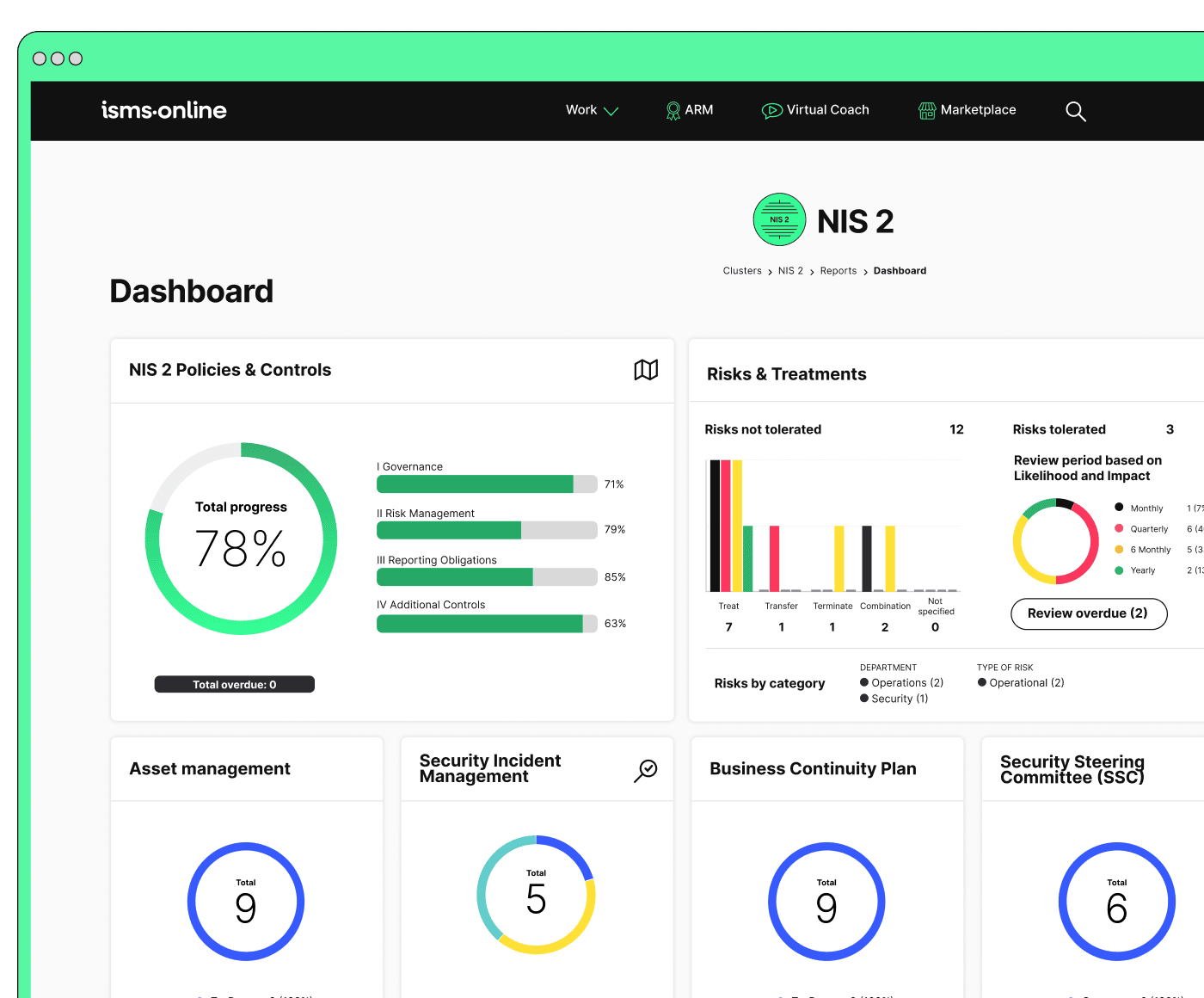
Be NIS 2-ready from day one
Launch with a proven workspace and templates – just tailor, assign, and go.
How Do Country and Sector Nuance Shape Your Risk?
NIS 2 sets a high bar for all in-scope entities-but leaves member states latitude to tighten requirements, overlay sectoral rules, and interpret obligations differently (BakerLaw). Sector-specific agencies (e.g., for finance, health, energy) often augment the core directive. Fines may also be adjusted according to criticality or prior history.
A board’s challenge: Even the same factual breach can produce divergent demands-France may want proof of supply chain risk management (e.g., updated A.5.19 controls), Germany a forensic backup log (A.8.13), while a sectoral regulator can issue its own timeline for remediation or fine for “organisational failure.”
Mini-table: Country/Sector Evidence and Risk Update Flow
Intro: For each incident type, immediate ownership, evidence, and control mapping support faster, defensible responses.
| Incident Type | Countries Affected | Immediate Owner | Key Action | Control/SoA Link | Required Evidence |
|---|---|---|---|---|---|
| Privileged account theft | FR, DE | IT/Security Practitioner | Lock accounts, notify authorities | A.5.15 (Access) | Logs, alert chain |
| Vendor system outage | FR, IT, ES | Supply Chain / IT Lead | Escalate, audit trail, vendor notify | A.5.19 (Supplier) | Contract, audit log |
| Backup data loss | DK, SE | Backups Owner/Practitioner | Restore, verify, communicate | A.8.13 (Backup) | Restore log, backup record |
| Credential sprawl | ES | Practitioner | MFA deploy, policy update | A.8.5 (Auth) | MFA register, change logs |
What Should Your Multi-State Fine Defence Drill Include?
Before a breach, map and practise your multi-country response plan. This includes:
- Distinct incident logs and evidence files for each jurisdiction, with language and contact fields filled for all in-scope regulators.:
- Clear mapping of actions to responsible persons (Practitioner, IT Lead, DPO, Board) for each country and sector.:
- Dry-runs (“tabletop exercises”): that simulate 2–3 regulators running simultaneous inquiries, demanding role-mapped evidence.
- Automated, time-stamped documentation: -from notification to final board approval-aids consistent, rapid production.
A single misstep or omission in one country can magnify risk everywhere else.
If you rely on “hero staffers” or ad-hoc logs, expect confusion, missed deadlines, and an_“amplified” fine profile_ (CMS Law Now). Drill ownership, documentation, and escalation for every key role; readiness is the only shield against additive penalties.
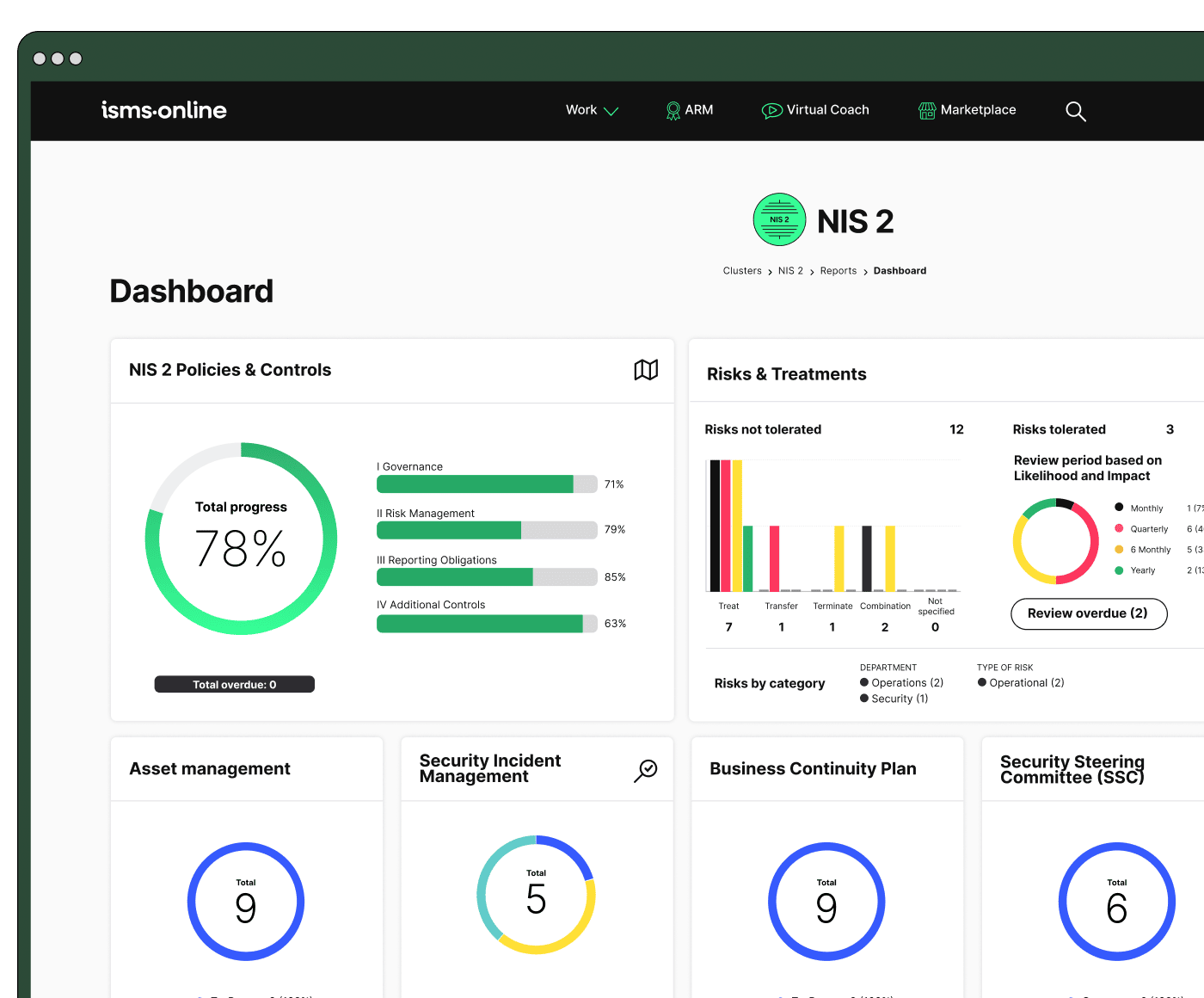
All your NIS 2, all in one place
From Articles 20–23 to audit plans – run and prove compliance, end-to-end.
How Do ISO 27001, NIS 2, and Automation Combine for Proof?
ISO 27001 certification offers a foundation-but NIS 2 expects not static “policy on shelf,” but live, role-mapped, and automated documentation. Automated ISMS platforms (like ISMS.online) make this possible by:
- Centralising logs, notifications, and evidence by country and sector.:
- Providing exportable, time-stamped files for every incident and update.:
- Linking each action to ISO 27001 / SoA references, with mapped evidence.:
- Documenting board-level reviews and sign-offs, providing “managerial discipline” that mitigates penalty outcomes.:
You fight stacking fines with unstoppable readiness, not unread policies.
A mismatch between documentation and what actually happened shatters credibility, making cumulative fines the likely outcome (Grant Thornton).
ISO 27001 – NIS 2 Bridge Table
Intro: Each operational expectation must be traceable to live action, mapped by owner and control; this is now the new audit normal.
| Expectation | Operationalisation | ISO 27001 / Annex A Ref. |
|---|---|---|
| Evidence on demand | Live, centralised event log | A.8.15, A.7.2 |
| Board-level security decisions | Logged reviews, SoA change log | A.9.3, A.5.12 |
| Vendor cyber due diligence | Contract evidence, supplier audit | A.5.19, A.5.20, A.5.21 |
| Incident command & role traceability | Names, logs, timestamps per role | A.5.24, A.5.4 |
How Do You Craft a Defensible, Cross-Border Playbook?
Meeting NIS 2’s cross-border, additive fine risk requires turned-in, practised incident management discipline and automated evidence capture with role mapping. No more “document and forget.” Instead:
- Living logs: Every incident, task, and decision is mapped to owner, timestamped, flagged for country/sector, and updated in real time.
- Dynamic SoA: Each change, evidence submission, policy update, or board review is traceable and indexable across frameworks and jurisdictions.
- Exercised roles: Each staff group (IT Practitioner, Board, DPO) knows its evidence, notification, and escalation expectations for every scenario.
- Scenario drills: Regular test runs to surface (and document) gaps before regulators do.
Real compliance shines when three regulators ask for evidence at once.
ISMS.online’s advantages emerge here: every file, approval, and notification is tagged and exportable for any jurisdiction-ensuring your organisation is not just policy-compliant, but “fine-resilient” in the face of multi-country regulatory scrutiny (Sygnia; Marsh).
Traceability Table: Breach to Evidence Mapped
Intro: For each breach trigger, tightly document the risk update, relevant control, and evidence logged, using ISMS.online to link each step.
| Breach Trigger | Risk Update | Control / SoA Link | Evidence Logged (Example) |
|---|---|---|---|
| Supply chain exploit | Supplier risk score ↑ | A.5.19, SoA record | Contract, audit, vendor mail |
| Credential theft | MFA/Access control enforced | A.5.15, A.8.5 | Access logs, MFA logs |
| Backups tested/restored | Business continuity escalation tested | A.8.13, A.5.29 | Restore log, BC drill log |
| Incident analysis complete | IR plan/management review updated | A.5.24, A.9.3 | Incident log, board mins |
From documentation to discipline-this is the new normal for surviving NIS 2 across borders.
Thrive Across Borders-ISMS.online Today
Readiness must be your default. Multi-jurisdictional compliance is not a theoretical scenario-it’s here, and penalty risk is additive and acute. Surviving and thriving means operationalising compliance: map every action to an owner and a control, keep living logs, and drill your team to respond in lock-step across borders.
When three regulators come knocking, compliance isn’t concepts-it’s capability demonstrated in real time.
Don’t wait for a fine to test your systems. Let ISMS.online handle the complexity: automate your evidence flows, map your accountabilities, and turn multi-country risk into continuous business advantage. Compliance is what you prove-when and where it’s demanded.
Frequently Asked Questions
Who decides if NIS 2 fines are cumulative or capped for a cross-border cyber breach?
National regulators in each EU country independently determine NIS 2 penalties, so fines for the same incident are cumulative across all impacted jurisdictions-there is no EU-wide cap. Unlike GDPR’s “one-stop-shop” approach, NIS 2 puts enforcement in the hands of each country’s supervisory authority, like Germany’s BSI, France’s ANSSI, or Italy’s CSIRT-ITA (Bird & Bird, 2023). If a breach affects multiple member states, you may face separate investigations and penalties in every affected country, each up to €10 million or 2% of global turnover-potentially multiplied for each authority. Each regulator’s findings stand alone, with no harmonised penalty cap.
What multiplies your risk?
- Each regulator acts independently: , so a breach in Germany, France, and Italy could bring three parallel fines and compliance audits.
- No coordinated evidence or penalty system: means you must satisfy multiple sets of requirements.
- Smart compliance teams use platforms like ISMS.online to map every jurisdiction, prepare tailored evidence, and avoid surprises.
A cross-border breach doesn’t just double your paperwork-it multiplies your regulatory and financial exposure country by country.
Can you prevent double jeopardy or overlapping penalties for the same cross-border NIS 2 incident?
Real-world protection against multiple fines is limited; only a final court decision in one country can sometimes block others, thanks to the “ne bis in idem” (no double jeopardy) rule-but this is rarely automatic. Other regulators typically continue their investigations unless all conditions are perfectly aligned: the parties, facts, and legal interests must match; the first decision must be final; and other authorities must agree to close their own actions (White & Case, 2023). In practise, overlapping investigations and redundant penalties are common until a lengthy legal process concludes.
What should you expect?
- Settlements or appeals in one country don’t block others: -you still face parallel scrutiny elsewhere.
- Only closed, recognised court judgments fully shield you from repetition.:
- Managing risk means preparing for overlapping processes, not assuming one investigation will close the others.
Even strong legal arguments are no shield against parallel penalties until late in the process-plan for multi-country exposure from day one.
What should you expect during a cross-border NIS 2 investigation?
Multiple regulators will launch their own, separate investigations, each with different evidence requirements, timelines, interviews, and sanction processes (Norton Rose Fulbright, 2024). Article 37 of NIS 2 promotes some cooperation (principally information sharing), but there is no single procedure. You will submit notification forms, artefacts, and logs independently to each authority.
Example: Parallel Breach Investigation Workflow
| Step | Germany (BSI) | France (ANSSI) | Italy (CSIRT-ITA) |
|---|---|---|---|
| Notification deadline | 24 hrs, BSI online | 24 hrs, formal letter | 24 hrs, web portal |
| Evidence demanded | Access logs, SoA, BC Plan | Supplier/IT records | Incident timeline/Q&A |
| Audit/review method | Remote/onsite check | Onsite audit | Written documentation |
| Penalty calculation | National + sectoral max | National max | Regional/sectoral |
No two regulators handle the same case identically. You’ll juggle divergent deadlines, evidence standards, and communications for each country.
How do national and sector rules impact cumulative NIS 2 penalty risk?
Local and sector-specific laws can significantly increase or modify NIS 2 penalty exposure, often creating additional caps, faster timelines, or specific documentation requirements (Mayer Brown, 2023). For example, France applies stricter healthcare deadlines and reporting standards, Germany overlays Bundesland (state) requirements for public sector organisations, and Italy involves regional sector authorities.
| Country | Max Fine | Sector Regulator | Special Variations |
|---|---|---|---|
| Germany | €10M/2% t/o | BSI, Länder | IT/finance overlays, stackable at state level |
| France | €10M/2% t/o | ANSSI | Healthcare, energy, finance deadlines stricter |
| Italy | €10M/2% t/o | CSIRT-ITA, Regions | Regional overlays, distinct public sector enforcement |
| Spain | €10M/2% t/o | CCN-CERT | Hybrid regime for essential/important entities |
The right evidence and response for one country may not satisfy another, even in the same sector. Deep mapping and preparation are essential.
Which audit and evidence practises can reduce your NIS 2 cumulative penalty risk?
Transitioning to a dynamic, jurisdiction-mapped audit system is critical-static certifications are not enough. Effective practises include:
- Centralising all incident logs and evidence by country, control (Annex A/SoA mapping), and responsible owner.:
- Automating notification and evidence workflows per jurisdiction (e.g., Germany’s BSI, France’s ANSSI).:
- Linking every action and breach to its correct Statement of Applicability entry and documentation.:
- Running regular, scenario-based incident drills across jurisdictions to close documentation and procedural gaps.:
Real-world Evidence Mapping Table
| Incident | Affected Countries | Control(s) | Responsible Role | Evidenced Artefact |
|---|---|---|---|---|
| Ransomware attack | FR, DE, ES | A.5.24, A.8.7 | IT Sec Leader | BC plan, SoA, drill |
| Cloud backup loss | IT, ES | A.8.13, A.5.29 | Practitioner | BC test logs, BC docs |
Regular, proven scenario-based audits can pre-empt penalty stacking by identifying issues before a real breach multiplies regulatory demands (Deloitte, 2023; Accenture, 2022).
Can ISO 27001 certification alone shield you from cumulative NIS 2 fines?
No-ISO 27001 is persuasive but not sufficient; NIS 2 compliance is measured by live, jurisdiction-specific, incident-based evidence, not by certification (KPMG, 2023). Certification demonstrates best practises but doesn’t provide immunity from national authorities demanding immediate, mapped evidence. Automated compliance management and precise evidence mapping are essential to minimising penalty scope.
Will EU legal reform harmonise or cap NIS 2 penalties across borders soon?
Such reforms are not imminent. While harmonisation remains a political goal, as of 2025 each EU country maintains its own NIS 2 enforcement power and penalty cap (Simmons & Simmons, 2024). Mutual recognition between authorities is rare, and there is no current cross-border “passport.” Every jurisdiction must be treated as a unique risk until new EU-wide mechanisms become law.
Until enforcement harmonises, your ISMS must be as local as every regulator demands-in every country and sector where you operate.
What actions should management take now to lower cumulative NIS 2 fine exposure?
- Precisely map all jurisdictions and sectors where you operate, including local and sector overlays.:
- Assign responsible owners for every incident, evidence artefact, and compliance requirement by country.:
- Automate and document workflows: Move beyond static files-use platforms that provide unified, country-mapped audit trails.
- Run scenario-based, cross-border incident drills: Build readiness muscle by simulating regulatory demands from multiple authorities.
- Benchmark incident response performance against sector peers and previous audits.:
- Trial ISMS.online to see mapped, export-ready compliance and close the readiness gap before a breach triggers enforcement.:
Don’t let fragmented rules multiply your risk. Invest in dynamic, mapped audit trails-so you can prove compliance everywhere, every day, before regulators come calling.






