





































Where Did NIS 1 Fall Short for Multinational Teams-and Why Does It Matter Now?
The first wave of the EU’s Network and Information Systems Directive (NIS 1) was crafted when digital supply chains were simpler, cyber-attacks were easier to contain, and compliance felt different depending on which border you crossed. That fractured compliance landscape became a critical vulnerability as technology advanced. Multinational teams learned, often painfully, that cyber-security standards fragmented by national whims were no shield against borderless attacks-or the rising pressure from boards demanding clear, consistent answers.
When regulation fragments, it’s not just hackers who spot the gap-your risk register does too.
NIS 1 let each EU Member State define “essential” differently, set unique thresholds for reporting, and interpret risk management at their discretion. The result? A compliance officer in Berlin faced a different threat surface-sometimes even a different compliance expectation-than their peer in Barcelona, despite serving the same supply chain. Definitions and key obligations diverged in a way that made coordinated response almost impossible.
Surveys found that over 40% of regulated organisations judged oversight as fragmented, opaque, or needlessly duplicative. The shared experience was familiar: box-checking replaced confidence, and last-minute jurisdictional confusions left organisations exposed during crises. If you tried mapping your own risk profile or legal status against another Member State’s framework, the disparities-sometimes subtle, sometimes glaring-spoke volumes.
In a world where risk never respects national boundaries, this model failed the reality test. Boardrooms and CISOs still carry the legacy: an ingrained anxiety about which rules truly apply, and a realism that until systems harmonise, risk management remains a patchwork. Getting this wrong wasn’t just “history.” It explains why the next stage-a harmonised approach-became non-negotiable for a modern Europe.
What Forced Europe’s Hand to Create NIS 2-And Why Coordination Is Now a Survival Skill
Cyber threats leapt ahead of compliance regimes. The digital world accelerated, while regulatory frameworks clung to analogue pace. Attackers adapted swiftly, collaborating across continents and time zones. EU digital defences, meanwhile, were left trapped in national silos-responding piecemeal to supply chain attacks, ransomware, and malware campaigns that cared nothing for national law.
A fragmented defence is an open invitation to agile threat actors.
NIS 2 is not just another directive; it’s Europe’s attempt to close the chasm left open by slow audits, patchwork incident reporting, and the national “every team for themselves” mentality (ENISA). Incidents like high-profile ransomware attacks and the surge in supply-chain exploitations proved that adversaries exploited these fragmented systems-moving along the path of least resistance, crossing national boundaries with ease. Each time a new breach occurred, regulators, compliance heads, and auditors were forced to coordinate after-the-fact, losing the precious minutes that often make the difference between contained risk and a national headline.
NIS 2 speaks the language of convergence: an obligation for continuous information-sharing, the dawn of cross-border response teams, mandatory threat intelligence, and real-time risk management for all essential sectors. The statistics are blunt-supply chain compromises doubled in 2022, and breached organisations in more than one country often faced a regulatory “fog of war”.
Boardrooms and GRC teams need to rethink accountability: does your incident response rely on national boundaries, or does it coordinate at European speed? If your process still depends on local rules or inconsistent oversight, NIS 2 signals a pressing need to adapt-or risk being the weak link.

Master NIS 2 without spreadsheet chaos
Centralise risk, incidents, suppliers, and evidence in one clean platform.
Who Is Actually Covered? Why NIS 2’s Scope Rewrite Matters for Every Sector
NIS 2 breaks with the “old guard” of regulated entities by pulling a far wider circle into its purview. While NIS 1 left many out-especially sectors not previously labelled “critical”-the new directive brings cloud, SaaS, food, digital infrastructure, pharmaceutical, water, energy, and waste management directly under the microscope. For multinationals and technology businesses spanning member states, this is more than a regulatory expansion: it’s a change in existential risk exposure.
Risk is now measured by your ecosystem, not just your in-house firewalls.
The distinction between “essential” and “important” entities is sharply defined, with sector schedules making it plain who is on the frontline. You can no longer depend on jurisdictional or sector exemptions. The days of arguing “we’re outside scope” because of company size, sector, or home country are gone. Instead, board-level accountability lands squarely on the ISMS owner’s desk, and the role itself is now mandatory and provable-regulators expect formal designation in minutes, policies, and audit logs.
The regulatory wild card-“harmonised enforcement”-shuts down country-specific safe harbours. Any covered entity, regardless of where in Europe it operates, may be audited or sanctioned for lapses, evidence gaps, or incidents affecting the essential or important functions identified under NIS 2. For compliance, privacy, or IT leaders, the upshot is immediate: prepare for a world where any board may be called on to “show the receipts” for controls-on demand, across borders.
ISO 27001 and NIS 2 Scope Bridge Example Table
| Sector/entity | NIS 2 Scope Status | ISO 27001 Annex A reference |
|---|---|---|
| Cloud / SaaS providers | Essential/Important | A.5.13, A.8.22, A.8.23 |
| Digital infrastructure | Essential | A.8.20, A.8.21, A.8.22 |
| Pharmaceuticals | Essential | A.7.1, A.7.5, A.8.24 |
| Food production | Essential | A.8.13, A.8.14, A.5.29 |
| Waste management | Important / Essential | A.8.14, A.8.31, A.5.19 |
Map your sector-or your top five suppliers-against this bridge. If they appear here, your board’s accountability and evidence requirements just scaled up.
Why Continuous Risk Management Became the Board’s Unavoidable Everyday Duty
Tick-box compliance is dead. NIS 2 accelerates the move from annual reviews to always-on oversight, demanding that audit readiness-historically a scramble, now a constant state-becomes a leadership imperative by default. Every board, every compliance team, and every CISO must treat every day as a potential audit day.
What decides your compliance isn’t a once-a-year test-it’s how you handle risk every morning.
NIS 2 codifies continuous risk assessment, living threat management, and board-level reporting aligned precisely with ISO 27001:2022 (isms.online). Combining board attention with technical procedures, this model brings risk and incident logs into the heart of decision-making.
Supply chain risk has been recast as a board-level topic, not a background operational task. NIS 2 recognises that outsourcing risk is not a shield-annual evidence reviews, contractual guarantees, and real-time risk updates for vendors are now core duties. The “best available techniques” principle (BAT) makes it essential to show not just that you manage risk, but that your policies, controls, and technical measures actually match current threats-anything less is non-compliance. Board minutes and compliance reviews need to reflect this shift: if you’re still relying on an annual report, you’ve already fallen behind.
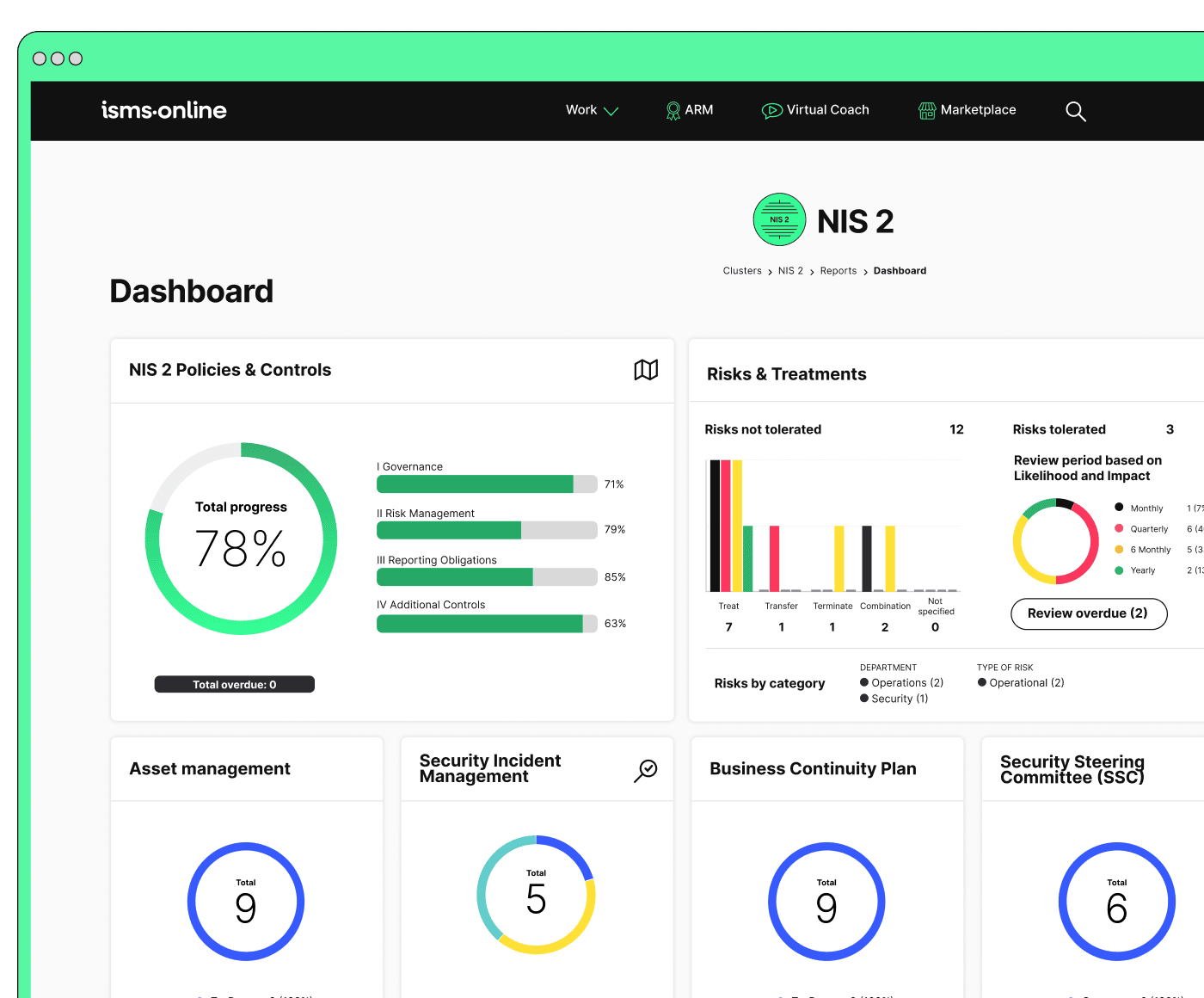
Be NIS 2-ready from day one
Launch with a proven workspace and templates – just tailor, assign, and go.
Why NIS 2 Turns Every Supplier Into a Direct Boardroom Risk
The elevation of supplier risk to a leadership responsibility is one of NIS 2’s most disruptive changes. Boards must reckon with the reality that any supplier’s shortcomings-no matter how deep in the stack-can draw direct regulatory scrutiny and enforcement. Vendor audits, breaches, or compliance failures are now the business of every essential or important entity, not just the supplier’s direct oversight team.
Your due diligence is now a living dossier. One supplier lapse can expose your entire organisation.
Organisations must build, evidence, and maintain robust third-party risk oversight. Supply chain contracts must now hard-code cyber requirements, mandate annual certifications, and create audit trails linking supplier performance directly to board review. Even outside the EU, non-compliant partners can derail your risk profile and trigger cross-border regulatory involvement.
Traceability Table (Supplier Risk Chain Example)
| Event/trigger | Required risk update | Control / SoA reference | Audit log entry |
|---|---|---|---|
| Vendor fails cyber audit | Update supplier risk rating | A.5.20, A.5.21 | Supplier assessment, action filed |
| Late supplier incident report | Flag board on response gap | A.5.26, A.5.27 | Incident action log / timeline |
| Contract update requirement | Update risk, revise terms | A.5.19, A.5.20 | Signed addendum, contract filed |
Every supplier event now drives direct board accountability and regulatory scrutiny. Compliance is a chain; every link counts.
Could your board produce current supplier risk assessments and incident logs on demand? If not, it’s time to review whether your risk management system supports the required traceability.
Why Boards-and Individual Directors-Are Now Exposed to Compliance Risk Like Never Before
Today’s compliance is not just about your company. NIS 2 lifts the curtain on board-level responsibility, driving accountability directly to directors’ desks, with real consequences for lapses. Temporary suspension, personal liability, and direct regulatory attention are no longer distant threats, but real possibilities.
When compliance lives at the board table, no one can hide from risk-or from regulators.
Under NIS 2, the board’s ISMS owner must evidence their designation, engagement, and review cycles with written records and audit logs (isms.online). Audits don’t just show up during annual cycles-they can arrive any day. In cases of gross negligence, suspensions and formal censure are a built-in feature, not an empty threat. Directors need D&O insurance that covers cyber liability, but oversight no longer shields the unwary.
Final self-check: When did your board last review and sign-off on the ISMS? Is every management review and board accountability record documented and accessible? If not, prioritise a scheduled review this quarter to avoid personal risk escalation.
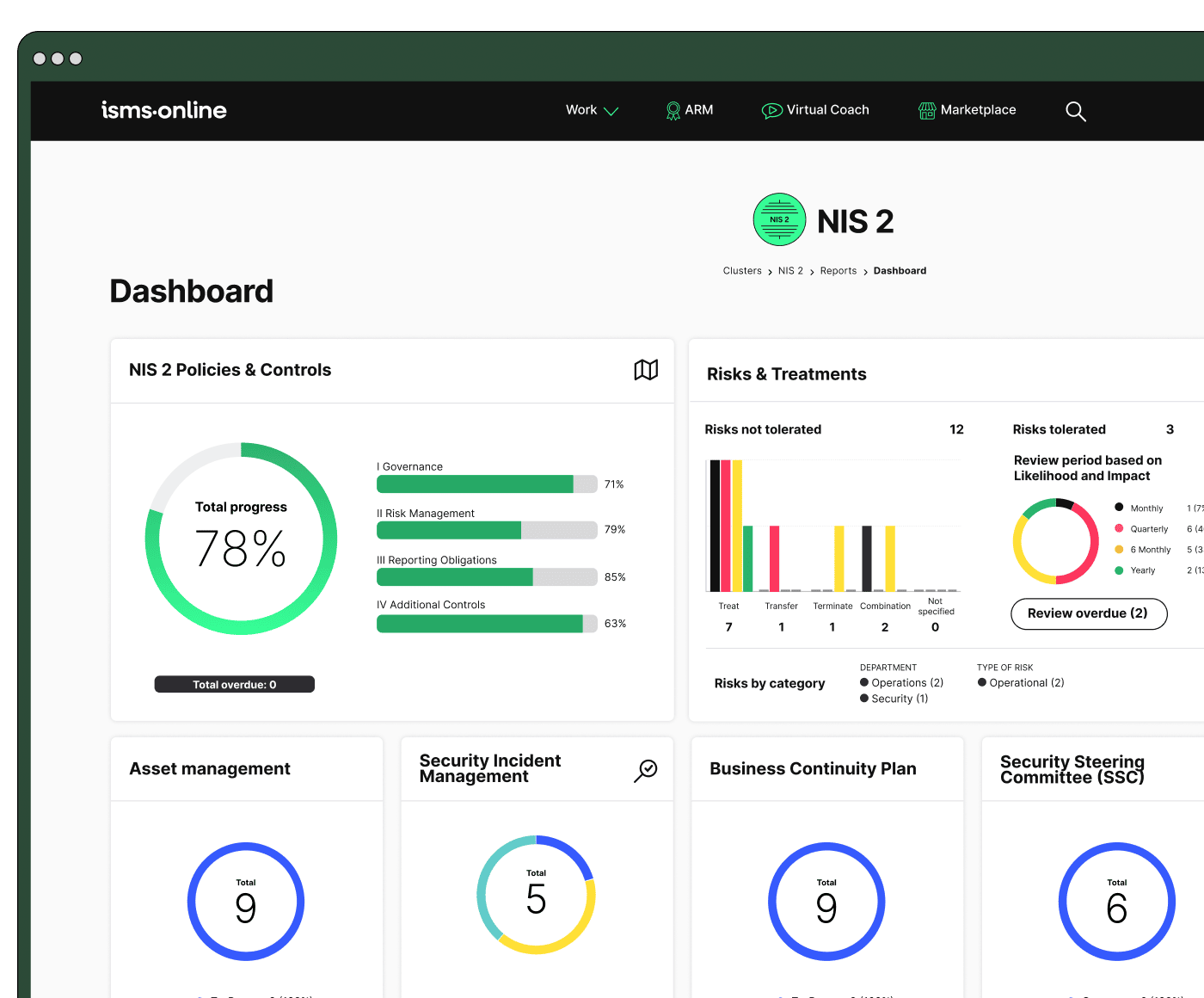
All your NIS 2, all in one place
From Articles 20–23 to audit plans – run and prove compliance, end-to-end.
Why Fines, Surprise Audits, and Real-Time Operations Are Now a United Reality
Gone are the days when compliance was a once-a-year hurdle. NIS 2’s fines are built to sting, and enforcement is now continuous. Board members and leadership teams must stay ready for “any day audits” where missing logs, unreviewed risks, or manual-only controls can result in immediate failures and public regulatory sanctions. For essential entities, fines can reach €10 million or 2% of worldwide turnover; for important entities, €7 million or 1.4%-and those numbers stack on top of other regulatory regimes.
Compliance is now a living practise-so are fines and regulatory scrutiny.
Supervisors expect incident logs, vendor reviews, and board minutes to be export-ready by control, date, and responsible owner (isms.online). If you can’t produce this evidence on demand, it’s a flag for enforcement and a warning sign for insurance coverage. Surprise audits test not just technical systems but also your workflows-manual and spreadsheet-based evidence trails are an “own goal.”
Think ahead: Does your team know exactly where every control and risk log lives? Can you triangulate evidence from supplier through control to board sign-off? If not, it’s not just an IT headache-it’s a C-suite and board risk. Prioritise investing in automated compliance platforms that turn daily operations into an audit-ready routine.
How Integrated Control Mapping Transforms Compliance from Burden to Competitive Asset
The ever-widening scope-NIS 2, GDPR, DORA, ISO 27001-may look like pressure, but it’s equally a lever: a gateway to harmonise, automate, and demonstrate compliance excellence. Smart teams see multi-framework compliance not as “box-checking doom,” but as a roadmap for operational efficiency, resilience, and commercial leverage.
Outpace the regulatory curve by turning daily compliance into your board’s proof of trust.
Integrated platforms transform evidence, risk management, and reporting into a single workflow. Teams using unified management systems like ISMS.online report a drastic drop in audit cycle duration (up to 60%) and consistently translate daily work into credible audit outputs (isms.online). The goal is clear: evidence logs, risk updates, and supplier assessments should cross-pollinate across standards-no double-entry, no missed beats.
Compliance Traceability & ROI Table (Sections 6 and 8)
| Trigger | Response action | ROI for compliance teams |
|---|---|---|
| New regulation | Automap/align controls | Simultaneous multi-framework readiness |
| Incoming audit | Export dashboard logs | Instant board + regulator confidence |
| Supplier incident | Contract + risk update | Audit-ready evidence, swifter recovery |
| Framework update | Remap/relink controls | Reduces controls drift, fast adoption |
Quiz your security, privacy, or IT lead: how much evidence is reused across frameworks? If you’re duplicating controls or scrambling at every new audit, the ROI from modernising your compliance system is both operational and reputational.
Why ISMS.online Makes NIS 2 Compliance an Everyday Confidence Signal-For the Board and Beyond
NIS 2 is both a challenge and an opportunity. Security, privacy, and compliance leaders who embrace automation, unified control mapping, and evidence-centric workflows are already reframing compliance from a cost centre to a point of reputational strength.
The strongest message to the board: our compliance isn’t a hurdle, it’s a daily proof of trust.
ISMS.online is at the forefront-enabling scale-ups and industry leaders to execute NIS 2, GDPR, DORA, and ISO 27001 on a single, integrated system. Customers retire manual processes, link controls across standards, surface evidence logs and export-ready dashboards, and become audit-confident-365 days a year (isms.online). With more than 25,000 users, the platform stands as a beacon for organisations ready to demonstrate resilience to regulators, boards, and their own customers.
Position your compliance as the market’s new confidence signal-raise the standard not just for audit season, but for every board meeting and leadership decision ahead. Own the daily compliance loop, and set a new benchmark for NIS 2 resilience and trust.
Frequently Asked Questions
How has NIS 2 fundamentally changed cyber oversight compared to NIS 1?
NIS 2 replaces fragmented national regimes and ambiguous supplier coverage with rigorous, harmonised standards, turning cyber-security from a periodic paper exercise into an all-organisational, board-driven priority. In practise, NIS 1 left each country to define who was “in scope” and what risk management meant-producing inconsistent, sometimes minimal requirements, especially around third-party supply chains and reporting timelines. NIS 2 closes these gaps by setting pan-European thresholds, binding rules for “essential” and “important” sectors, and clear incident disclosure windows (24h/72h/1 month). Every regulated organisation must now keep live risk, supplier, and incident registers, make supplier compliance a board responsibility, and show evidence that’s exportable and audit-ready for both national and EU regulators (ENISA, 2022). Gone are the days of hiding weak links behind local standards or deferring tough supplier questions; under NIS 2, every boardroom or audit table works from the same, sharply defined playbook.
At a Glance: NIS 1 vs. NIS 2
| Requirement | NIS 1 (2016) | NIS 2 (2024) |
|---|---|---|
| Sectors Covered | Broad, with opt-outs, local lists | 18+ sectors, unified EU scope |
| Supplier Risk | Rarely assessed, optional | Contracted, logged, board-level |
| Reporting | “Undue delay” | 24h/72h/1mo, fixed rapid steps |
| Evidence & Audit | Local/informal, ad hoc | Board-reviewed, exportable, cross-mapped |
What new board and CISO expectations does NIS 2 enforce-and how does this alter daily compliance?
NIS 2 uplifts cyber from an annual sign-off to a continuous duty-making cyber training, supply chain oversight, and provable risk management direct responsibilities of the whole board, not just the CISO or IT function. Board members are now required to undertake periodic training, personally approve key risk frameworks, and provide evidence of their engagement in supplier compliance and incident discussions (ISMS.online, 2024). For CISOs, this means that risk and supplier registers must remain active, policy changes logged, and evidence-from contracts to incident timelines-always ready to present to both internal and external reviewers. Static “policy on a shelf” compliance is out; ongoing, audit-ready traceability is the new standard.
Every security gap or supplier slip is now traceable up to the board, with personal liability if left unmanaged.
Day-to-Day Changes
- Send board-level cyber training and sign-off documentation at least annually.
- Maintain continuous supplier risk analysis logs-no more once-a-year reviews.
- Develop rapid incident-response playbooks with clear board communication steps.
- Prepare evidence exports and policy change logs for regulator requests, anytime.
Which organisations and suppliers must comply-and what’s the practical test for “in scope” under NIS 2?
NIS 2 casts a wide net: all medium and large entities (usually >50 staff or €10+ million turnover) in 18 sectors-from cloud and SaaS to energy, pharma, health, digital infrastructure, waste, food, and finance-are included (InsidePrivacy, 2023). Annex I/II defines “essential” and “important” entities based on activity and criticality; non-EU suppliers are covered if they serve the EU’s infrastructure or digital backbone. Digital, logistics, and public sector IT now face the same rigour. To confirm if you’re in scope:
Quick-Check Table
| Indicator | If Yes, You’re in Scope? |
|---|---|
| Is your sector listed in Annex I/II? | Yes |
| Over 50 staff or €10M turnover? | Yes |
| Supplier critical to regulated operations/services? | Yes |
| Serve EU digital/critical supply chain from abroad? | Yes |
If in scope, you must identify accountable directors, contract and log every critical supplier, keep risk registers live and board-reviewed, and ensure all evidence can be produced on demand for audits.
How does NIS 2 change supply chain contract management and procurement operations?
Boards are now required to proactively oversee supply chain and vendor risk: contracts with critical suppliers must include NIS 2-aligned clauses-right to audit, forced notification, and remediation commitments-and must be reviewed and logged regularly (EY, 2023). Procurement can no longer “set and forget”: every supplier’s status, breach notification workflow, and audit outcome must be documented and available for both board and regulator review. Supply chain directors are tasked with keeping vendor audits scheduled and contract evidence up to date, while compliance teams must monitor and trace all incident reports and corrective actions back to explicit board approval.
Supplier complacency is now a direct regulatory risk-the days of unmonitored handshakes are gone.
Essential Contract Management Steps
- Audit rights, breach notification, and remediation in every critical supplier contract.
- Maintain a live supplier register with documented evidence checks and renewal logs.
- Link supplier registers directly to your risk register for traceability and export.
- Sync all contract changes and findings with board review cycles for compliance evidence.
What fines and personal liabilities do NIS 2 breaches trigger-for companies, CISOs, and the board?
NIS 2 delivers harsh punishments: up to €10 million or 2% of global turnover for essential entities, and €7 million/1.4% for important ones-both well above many industry expectations, and increasingly present in national enforcement (Vanta, 2024; EBA, 2023). These aren’t just headlines: personal liability attaches to CISOs and board members for repeated neglect, gross oversight, or failure to act on known risks. Board members face suspension or prosecution, and directors’ insurance may not cover willful neglect. Crucially, where failures overlap with other regimes (DORA, GDPR), penalties can stack-meaning siloed compliance increases your exposure. To protect both company and personal standing, regular board-reviewed evidence, export tests, and logged supplier findings are now basic self-defence, not “nice-to-haves.”
How does NIS 2 mesh with DORA, GDPR, and ISO 27001, and will a mistake trigger multiple audits?
NIS 2 is cross-wired with the EU’s digital supervision architecture: financial services follow DORA chiefly, but NIS 2 applies where DORA stops or supply chains spread across sectors (InsidePrivacy, 2024). Overlapping incidents-especially those involving personal data-require GDPR’s 72-hour response alongside NIS 2’s reporting standards. ISO 27001:2022 acts as the operational backbone for policy, risk, and control documents: one system for evidence and audit logs can underpin every major regime. Regulators favour “single source of control” approaches: mapped, time-stamped logs that provide parallel outputs for NIS 2, DORA, and GDPR, reducing “double jeopardy” for process failures. Advanced ISMS tools let you cross-reference between regime requirements-lowering burden and aligning with regulator expectations.
Mapping Table: NIS 2, DORA, GDPR, ISO 27001
| Framework | Incident Timeline | Controls Reference | Audit Ready Output |
|---|---|---|---|
| NIS 2 | 24h/72h/1mo | ISO 27001 Annex A | Board-minutes, supplier logs |
| DORA | Sector-specific | Title II / Tech. Std | Digital ops, ICT events log |
| GDPR | 72h for data | Art.32 (security) | Incident log, data audit |
| ISO 27001 | On demand/by event | Annex A, SoA | Exportable evidence register |
What’s the most efficient route to ongoing NIS 2 audit-readiness, and how do you operationalise it?
Begin with a full scope map: list every regulated process, vendor, and supply-side dependency by sector and size. Assign explicit contract, risk, and audit owners, review all supplier contracts for NIS 2-required clauses, and link every contract revision to your risk register. Use a live, board-reviewed evidence register, joined-up with incident logs and supplier audits, to allow rapid export and review-a capability now basic, not bonus, in modern compliance (ISMS.online, 2024). Schedule regular checks with compliance leads and external experts to run stress-tests: can you produce documented supplier evidence, policy changes, and incident logs for any regulator within hours? Automated dashboards and reminders are your next line of defence-transforming compliance from a static archive to a living, daily, board-level safeguard.
NIS 2 Compliance Traceability Table
| Trigger Event | Required Update | ISO Ref. | Example Evidence |
|---|---|---|---|
| Supplier outage | Contract/board risk update, register log | Ann. A5.19/Clause 9.3 | Signed minutes, audit logs |
| Security incident | Report (24/72h), log, board notes | Ann. A5.25 | Incident report, board minutes |
| Policy change | Approval, schedule, evidence review | Clause 7.5, Ann. A | Exportable, dated registers |
| Compliance audit | Full evidence export, mapping | SoA, Clause 7.5 | Ready-for-export file |
To deliver daily audit confidence, move to living logs, joined-up risk and contract management, and automated board assurance-where compliance becomes a visible, trusted asset to every stakeholder. With ISMS.online, you systematise these workflows; your evidence, reporting, and supplier reviews flow from board meeting to audit export, always ready, never outpaced by the next regulatory change.






