





































Why “SOC 2 Certified” Isn’t Enough for the Cross-Atlantic Compliance Game
You might walk into a European tender proudly waving your “SOC 2” badge, only to discover it earns little more than a polite nod-before the real questioning begins. In today’s regulatory climate, the line between US-based controls and the ever-expanding reach of European cyber and operational directives like NIS 2 is not just a bureaucratic hurdle, but a strategic crossroads for global SaaS and digital infrastructure providers. The day your pipeline meets EU procurement is the day your definition of trust gets rewritten.
Compliance is more than a certificate-it’s a living contract with regulators, buyers, and every link in your supply chain.
SOC 2 demonstrates discipline and control integrity for US clients. Yet NIS 2, now seared into European law, turns once-voluntary frameworks into inescapable obligations for any company touching the region’s digital arteries. Here, “good enough” in the US pivots to “minimum entry” abroad. Executives and security leads find that no amount of technical polish on a US audit report solves for the different stakes, timelines, and boardroom responsibilities introduced by the NIS 2 legal regime (ENISA, 2023).
Different Shields, Different Battlefields
SOC 2 was built to signal maturity to American buyers and auditors: “We’ve thought about the risks. Here’s our control set, and an independent review.” For years, that sufficed in procurement across many borders. NIS 2 changes the calculus entirely. Its mandates aren’t guidance-they are obligations, complete with board-level accountability, named executives, audit triggers, and in some sectors, the expectation of sector coordinator reporting and cross-border notification.
The badge that won boardroom confidence in one market can become little more than a footnote in another-unless you can map, prove, and operationalise your controls in both spheres.
Being secure ‘enough’ in one hemisphere does not translate to trust in the other-until you translate your proof into their terms.
The Costly Mistake of Equating SOC 2 With NIS 2
A SaaS company-call it ForwardPath-recently went to RFP with a German banking group, convinced its fresh SOC 2 Type II would remove all objections. Instead, procurement cut them in round two. The deal didn’t stall for lack of security effort, but for lack of NIS 2-relevant evidence, cross-mapped controls, and documentation that could withstand legal discovery in a European jurisdiction (Fieldfisher, 2024).
This system meets SOC 2, but not the minimum expectations under NIS 2. We need mapped controls, incident evidence, and proof of supply chain resilience. (Direct quote, EU S&P RFP, 2024.)
Pipeline pain is real and almost always avoidable. The greatest loss isn’t regulatory sanction, but learnings discovered too late-when revenue is lost, not simply delayed.
Why Wait and See Is a Losing Play
US SaaS and services firms often underestimate the velocity of European regulatory action. By the time an incident triggers a 72-hour NIS 2 notification clock, the window for calm, defensible cross-mapping has vanished (ENISA News, 2024). The companies who win are those that start by mapping, automating, and evidencing their controls before the knock on the door-or the procurement stall-occurs.
Book a demoTwo Frameworks, No Peace? The Friction Zones Between NIS 2 and SOC 2
On the surface, compliance feels like a quest to check the same boxes for every market: risk, controls, evidence, audit, report. But as soon as teams must answer jurisdiction-specific questions, friction multiplies. Differences in definitions, timelines, and accountability turn the appearance of overlap into an operational trap.
Treating overlapping standards as interchangeable is the fast lane to double jeopardy.
Collision Points: Incidents, Timelines, and Stakeholder Handoffs
Incident Response: SOC 2 empowers you to establish your own best practises for reporting, often based around quarterly or annual reviews. NIS 2, by contrast, mandates 24 or 72-hour reporting (depending on incident impact)-regardless of internal policy. Slow incident escalation isn’t just a process flaw; it becomes a legal fault line (PwC).
Supply Chain Duty: Under SOC 2, third-party risk is something to be “considered.” Under NIS 2, supply chain incidents are your legal concern. If you’re a US MSP or SaaS and a failure on your side disrupts a customer regulated by NIS 2, you may be called to co-protect, co-notify, and co-own the remediation window (ENISA Supply Chain Guidance).
When a cross-ocean incident hits, ‘best practise’ in one regime may be regulatory failure in another.
Operational Responsibility: More Than Data Residency
NIS 2 is not just “GDPR for infrastructure.” It is operational, embedding responsibility for supply chain, vendor diligence, inter-entity contracts-even scenario drills and staff readiness. The obligations set in one market quickly create triggers in the other.
SOC 2: Success is about demonstrating mature, thoughtful processes; audit findings tend to lead to remediation.
NIS 2: Success is about evidence, readiness, and scenario output-measured in days or hours, not annually. Audit findings can trigger regulatory inquiries, fines, or notification duties.
Why Real Teams Move Faster: Breaking Out of Siloed Models
The most effective cross-regime companies build cross-functional teams:
- Legal: reviews contracts and notification clauses for European mandates.
- Security: models incident response to 72-hour windows.
- Procurement: embeds compliance standards into every supplier RFP.
The old model-where compliance was a back-office technical function-no longer holds. Now, entire deals depend on live, orchestrated, multi-team action (ISACA, 2024).
Real alignment is proven not by intent, but by a company’s ability to hand off risk, evidence, and notification flawlessly, in real time.

Master NIS 2 without spreadsheet chaos
Centralise risk, incidents, suppliers, and evidence in one clean platform.
Sector Crossfire: Are You In The Net?
If you provide digital, SaaS, or managed infrastructure to EU clients-directly or through a supply chain-you are likely now scoped by NIS 2. What once applied only to energy and telecom now covers every layer of digital services, payment platforms, identity stacks, even remote infrastructure and cloud support.
You don’t need an EU office to land under NIS 2-handling EU client data or supporting critical operations puts you under the microscope.
Expanding Definitions and Self-Test
If your product touches payment processing, healthcare data, critical business operations, digital identity, or government entities in the EU, a compliance audit or legal trigger is no longer a hypothetical. It’s the default.
Three litmus tests:
- EU supply chain involvement (direct or through partners)?
- Health/payment/identity data processing?
- B2B or B2G contracts with EU entities?
A “yes” to any means it’s time to reframe risk perimeters and compliance operations (Intimus, 2024). Delaying the audit won’t stop the regulator-or the RFP.
Converging Standards: The SOC 2-NIS 2-GDPR Triangle
A “major incident” that’s a GDPR breach in a US SaaS is almost certainly a notification trigger for NIS 2. The friction comes in how reporting clocks start and who is expected to notify regulators and clients in what sequence. Privacy and security teams must now coordinate claims and controls, aligning documentation for both privacy law (GDPR) and operational risk (NIS 2) within tight, overlapping timeframes (IAPP NIS 2 Brief).
Privacy, security, and operations no longer live in parallel-they sit on an interlocked feedback loop, where a failure in one instantly tests all.
The ISO 27001 Bridge: Translating Control Into Confidence
What unifies the language of compliance between continents? ISO 27001. Unlike vendor-specific audits, it’s recognised universally by auditors, procurement, and regulators as a living, operating system for cross-regime management. Not a badge, but an architecture for real-time mapping and evidence.
The Statement of Applicability is no longer an appendix; it’s the living heartbeat of dual compliance.
How ISO 27001 Knits Together SOC 2 and NIS 2
Where SOC 2 looks for mature risk processes and NIS 2 for legal accountability, ISO 27001 supplies the scaffolding for both:
- Context Analysis: Defining who, what, and where risk is managed.
- Control Evaluation: Linking every asset and risk to a documented control, mapped for both US and EU regimes.
- Evidence Chains: Maintaining living SoAs with versioned evidence, cross-regime tags, and audit-ready outputs (Advisera).
| Expectation | Operationalisation | ISO/Annex Ref. | Evidence for SOC 2 | Evidence for NIS 2 |
|---|---|---|---|---|
| Incident Reporting 72 hrs | Automated incident timer, notification prompts, board signoff | A.5.24 / 6.1 | Audit trail, review logs | Notification output, board/file trace |
| Supply Chain Oversight | Supplier list, live contract map, scenario drill record | A.5.19 / A.5.21 | Due diligence checklist | Vendor drill logs, active notifications |
| Privacy/Breach Escalation | SAR routing, privacy escalation logs, notification workbook | A.5.34 / A.8.8 | Review audit, SAR logs | Regulator notification, privacy trace |
| Policy Versioning | Central policy library, version tracking, staff sign-off | 7.5.1 / A.5.1 | Version history, user logs | Board approval, acknowledgment trail |
Each operational point provides multi-regime traceability: one update, two auditor/regulator outputs, all logged in a living, timestamped SoA.
Live at Audit: Why ISO 27001’s SoA Must Be Dynamic
Auditors now ask, “Show when you updated this control. Prove acknowledgment. Trace which version was in force during the incident.” The firms that pass don’t treat ISO as a one-time mapping-they operate the SoA as a living file, linked to every incident, contract, board action, and control update.
Audit pass comes from showing the story: risk, action, board sign-off, and evidence linked-live, to the minute.
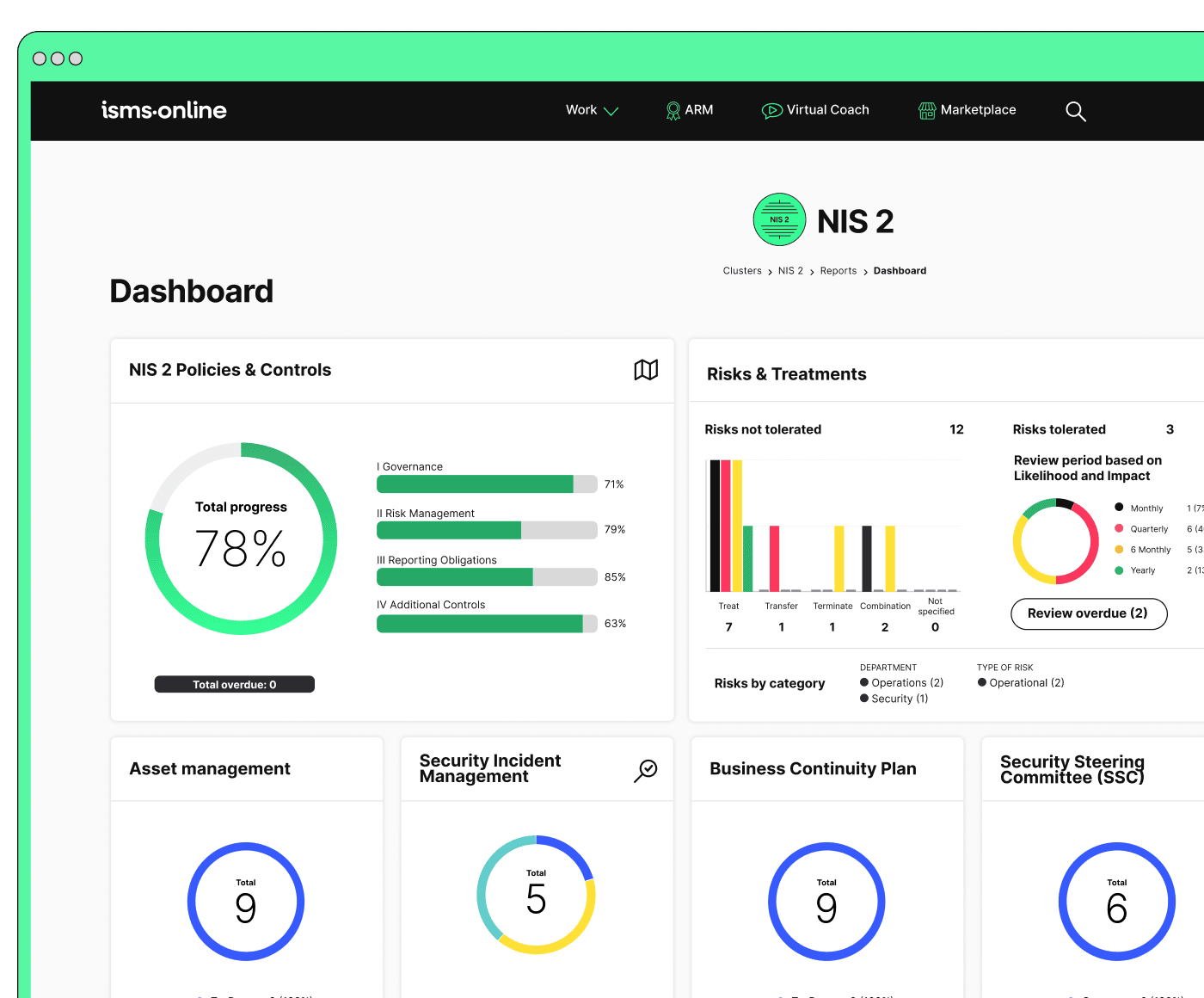
Be NIS 2-ready from day one
Launch with a proven workspace and templates – just tailor, assign, and go.
Traceability Loop: Surviving the Regulator and the Auditor
The survival gap is now measured not only by the existence of evidence, but its traceability and readiness. The “incident-to-evidence loop” is how you answer contract, audit, and regulator-without hesitation.
One broken trace in your loop means regulatory daylight-and lost trust.
What “Traceability” Means Now
SOC 2 wants evidence files and access logs-strong, but often disconnected. NIS 2 and ISO 27001 demand timestamped updates, chain-of-custody for notifications, board-level sign-offs, and-critically-the ability to connect every event from cause to notification to remediation (ENISA, 2024).
| Trigger | Risk Update | Control / SoA Link | Evidence Logged (SOC 2) | Evidence Logged (NIS 2) |
|---|---|---|---|---|
| NIS 2/Regulator Notice | Incident risk escalated | A.5.24 / A.5.21 | Audit log | Timestamps, regulator file, board |
| Annual/Ad Hoc Audit | Control set reviewed | A.5.1 / A.5.36 | Management docs | Signed board minutes, SoA update |
| Vendor Incident | Supplier risk, notification | A.5.19 / A.5.21 | Vendor risk worksheet | Vendor notification, contracts |
Traceability is not about paperwork. It’s about live, operational defence.
Practical Guidance: Platform Automation
Choose compliance platforms that automatically:
- Tag every update and incident for dual regime outputs
- Maintain versioned policies and staff acknowledgment
- Log notification chains across both procurement and regulatory expectations
This is not optional for board trust-it’s now the bar for regulatory survival.
Supply Chain Incidents: Beyond Your Four Walls
When a vendor fails-whether in downtown Austin or rural Romania-the chain of consequence runs straight through your own evidence logs and board meetings. NIS 2’s expanded scope ensures that if your software supports the EU supply chain, you are part of the breach reporting and risk update apparatus.
When the supply chain stumbles, your only defence is proof of action; inaction is a liability you can’t bury.
Contracts need to go beyond passive lists; they must include proactive scenario drills, real-time notification, and evidence-sharing capabilities.
In practise: A US IT manager at a FinTech SaaS sees a notification of a malware outbreak at a vendor. Their platform, dual-tagged for NIS 2 and SOC 2, prompts immediate evidence export: notification to the EU client and local board, audit log for US auditor. Trust is maintained, sales continue, and potential regulatory friction is minimised.
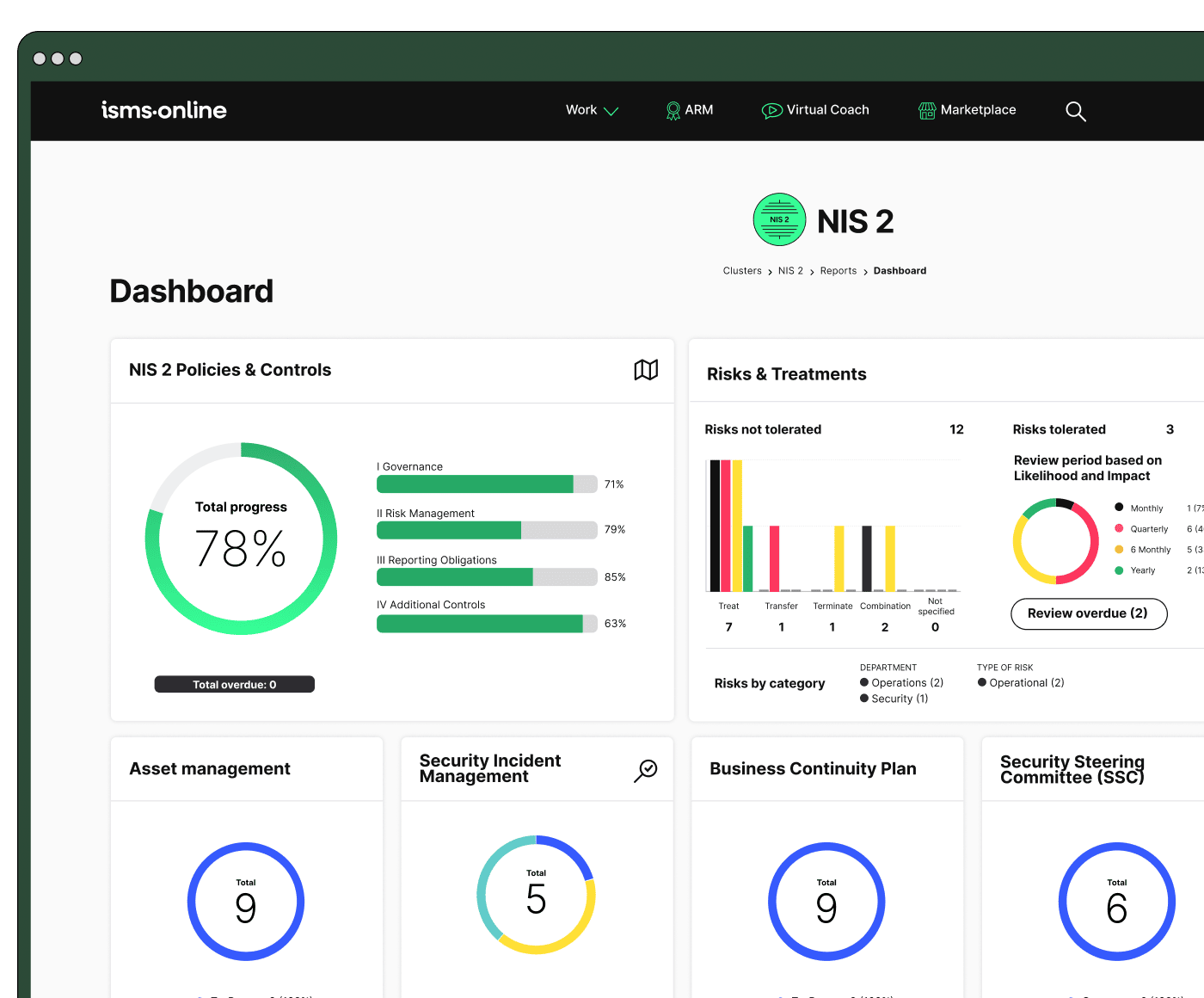
All your NIS 2, all in one place
From Articles 20–23 to audit plans – run and prove compliance, end-to-end.
Dual Alignment In Action: Making Audit-Ready the Default State
Being “ready for audit” isn’t just an annual anxiety anymore-it has become part of week-to-week, even day-to-day business health. Choosing platforms and workflows that enable instant evidence export, dual regime tag-mapping, and real-time dashboards is now the competitive advantage.
Compliance is no longer a once-a-year sport. It’s a team game played every week-in front of boards, auditors, and regulators.
Platform Criticals
- Tag controls/policies for NIS 2 and SOC 2 during setup, not at export
- Automate reminders for reviews, approvals, and evidence collection
- Embed dashboards for both operations and board oversight
- Use live traceability to make assurance part of your daily reporting rhythm (ISMS.online; Drata)
This is how companies demonstrate trusted, living compliance-not just certificates on the procurement portal.
Privacy Officer micro-case: A DPO toggles an EU Subject Access Request (SAR) across US and EU compliance needs. The platform’s mapped SoA, SAR log, and notification records are exported to audit, procurement, and regulator in minutes-not days.
Compliance as a Team Sport
Every department must now understand their handoff points and evidence obligations:
- Security/IT: Maps and updates living controls.
- Procurement & HR: Tracks supplier clauses and staff policy engagement.
- Legal: Validates contracts, ensures cross-jurisdictional responsibility.
- Board: Monitors live dashboards-requires instant answers, not delayed assurance.
When buyers or regulators call, your speed in delivering evidence is a marker of trust-not just compliance.
From Compliance Cost to Boardroom Asset
Your compliance readiness is no longer a technical debt or sunk cost. When managed as a continuous, live-linked process, it becomes brand equity, deal-winning risk capital, and a driver of board trust across every geography you serve.
- Map out exactly which policies and controls shelter which contracts and clients.
- Give real-time board dashboards that show exactly where compliance stands-by regime, risk, and incident.
- Reinvent compliance hours into growth signals; deliver the evidence that not only wins RFPs but survives their toughest legal counterparty.
In our first dual-regime incident, we showed EMEA regulators and US auditors matched dual evidence within 90 minutes-zero panic, zero delay, zero lost trust.
Lead the cross-Atlantic trust game with mapped, audit-ready, and living compliance. When the line between Security and Privacy, between US and EU, blurs-you become the force that keeps business flowing on both sides of the ocean.
Frequently Asked Questions
Who is required to align with both NIS 2 and SOC 2, and why is dual compliance now fundamental for US/EU tech and SaaS providers?
Any technology organisation-whether US-based, EU-based, or global-that delivers digital services, SaaS platforms, or managed infrastructure to the European Union faces a new “dual regime” of NIS 2 and SOC 2 oversight. NIS 2, the EU’s reinforced cyber-security directive effective from October 2024, mandates that if your systems, software, or platforms process, store, or impact EU customer data, you may be classified as an essential or important entity, subject to formal registration, mandatory incident reporting, supply chain controls, and sector obligations-even without a European office. Simultaneously, SOC 2 isn’t just best practise: it’s a virtual prerequisite for US procurement, cross-border SaaS deals, and cloud vendor acceptance, underpinning trust for buyers on both sides of the Atlantic. Today, RFPs and due diligence checklists routinely demand proof of alignment with both regimes-miss one and you risk being excluded from critical enterprise deals, losing revenue to competitors, or failing statutory obligations as authorities harmonise supplier requirements (see;.
Winning deals depends on holding up your end of compliance not only when you land the contract, but every time regulators or enterprise buyers require proof you’re audit-ready.
Which US/EU companies are in-scope?
- SaaS firms exporting software, data, or core processing to EU clients-even if all infrastructure is US-based.
- Digital platform, cloud, or managed service providers supporting essential EU sectors.
- Subcontractors and supply-chain partners whose resilience or privacy controls impact EU organisations.
- Regulated infrastructure, healthcare, finance, and utilities vendors, as well as cloud-native startups.
- Any firm where the buyer, contract, or procurement checklist names both NIS 2 and SOC 2.
Global market access and trust continuity now depend on demonstrating dual compliance as a baseline: the old divide between “big players” and smaller SaaS is gone whenever cross-border procurement rules or regulatory reporting windows apply.
Where do NIS 2 and SOC 2 fundamentally diverge, and how does “double jeopardy” emerge for audits and incidents?
NIS 2 and SOC 2 part company most dramatically during incident response and supply chain events. NIS 2 makes statutory reporting non-negotiable: critical incidents (data breach, ransomware, system disruption) must be reported to EU authorities within 24 hours for an initial alert and fully documented within 72 hours-regardless of your main jurisdiction. SOC 2, while highly respected in US markets, focuses mainly on internal logging, controls, and timely disclosure governed by business agreement, not law. You may satisfy one regime’s auditor, yet fail the other’s non-negotiable deadline-or vice versa.
The supply chain raises the stakes. Under NIS 2, your organisation is legally answerable for third-party vendors and MSPs, often obliged to contractually force incident notification, audit rights, and evidence handoff. In contrast, SOC 2 looks for documented due diligence but cannot substitute for statutory supply chain duties. Any breach involving a US supplier who’s only SOC 2 certified can trigger mandatory NIS 2 escalation and fines, or leave you unable to provide required EU regulator evidence, even as US-based auditors look for a continuous internal evidence loop;.
Incident Escalation Comparison Table
| Trigger Event | NIS 2 Duty | SOC 2 Duty | Overlap Risk |
|---|---|---|---|
| EU customer data breach | 24h notify regulator, 72h full file | Internal log, client notice | Timeline conflict + proof gap |
| Vendor platform outage | Enforce supplier reporting & evidence | Vendor diligence, self-report | Contractual + legal liability |
A single supply-chain event can now require two different teams, evidence packet tools, and reporting lines-with zero tolerance for missed handoffs. Regulatory fines, audit citations, and lost client trust all stack up if you miscoordinate.
How does ISO 27001 allow organisations to “bridge” the gap between NIS 2 and SOC 2, operationally?
ISO 27001 acts as the connective tissue and “policy operating system” for both NIS 2 and SOC 2. NIS 2 cites ISO frameworks for defining what “adequate control” looks like, while SOC 2 auditors frequently accept ISO-aligned policies, controls, and even Statements of Applicability (SoA) as backbone evidence. Building your compliance on a centrally managed, versioned ISO 27001 SoA lets you tag every control, incident, and policy to both frameworks-so that when your policies or evidence update, those changes flow into NIS 2 and SOC 2 files without duplicate work; (https://isms.online/solutions/nis2-compliance-software/)).
Platforms like ISMS.online automate these relationships: a risk event, vendor assessment, or privacy incident auto-populates all relevant SoA, audit, and regulatory packets. Auditors on both sides can now demand (and expect) versioned, role-tagged, continuously updated SoA and evidence logs as minimum proof-and call out disconnected evidence or supply chain blind spots as findings.
ISO 27001 Bridge Mini-Table
| Expectation | Operationalisation | ISO Ref. | NIS 2/SOC 2 Proof |
|---|---|---|---|
| Incident Handling | 24h alert + workflow | Annex A.5.24 | Regulator file, auditor log, board sign-off |
| Supplier Oversight | Registry, licence review | Annex A.5.19, 5.21 | Contract docs, due diligence chain, handoff log |
| Privacy Escalation | SAR / GDPR logging | Annex A.5.34 | Reg. inspection, SoA trace, internal report |
ISO alignment provides common language for policies and evidence-unlocking smooth, cross-regime reporting. Non-integrated “sheet” tracking, by contrast, fails when large audits or urgent regulatory requests hit.
What defines “traceability” under dual NIS 2 and SOC 2 regimes, and why is “living evidence” non-negotiable?
Traceability today means every audit or compliance action-policy approval, incident escalation, vendor update, or board sign-off-is mapped, actor-tagged, timestamped, and exportable the moment any authority or auditor requests it. Regulators under NIS 2 routinely ask for specific logs or approvals months after the event, demanding proof of every decision. SOC 2 auditors require an unbroken chain of evidence mapped from control to boardroom, but in internal and client-facing form. “Living evidence” goes beyond annual audit files: it requires real-time versioning, role-validated updates, and proven sign-off at every step.
Failure to automate traceability leaves organisations exposed to dual penalties-audit citations for broken evidence chains, and regulatory fines (or contract clawbacks) for incomplete or inconsistent records. Modern ISMS solutions overlay dashboards, approval flows, and evidence libraries directly onto your operational policies and supply chain, closing these gaps as a daily discipline, not a desperate scramble at audit time (ENISA, 2024;.
Traceability Table
| Event | Update Tracked | SoA / Annex Link | Evidence Trail Example |
|---|---|---|---|
| Vendor breach | Marked “high risk,” notified | A.5.19 / A.5.21 | Incident log, contract, audit, alert |
| Ransomware | Board escalation, workflow | A.5.24 / A.8.8 | Incident file, board minutes, export |
| Policy update | Approval stamped, versioned | Clause 7.5.1, A.5.1 | SoA, timestamp, e-signature, log |
A “living audit log” is your licence to operate in both markets.
How do supply chain and sector-specific gaps expose organisations to compounded legal and audit risk?
NIS 2’s expanded coverage (energy, health, transport, finance, digital infra, cloud) means more organisations-and their suppliers-fall in scope, with strict liability for upstream security events and delayed notifications. If your supplier fails SOC 2 diligence but misses a mandatory EU incident handoff (e.g., a breach in Chicago affecting Danish clients), you’re on the hook for NIS 2 reporting, legal penalties, and possible contract loss-even if your only failure is not updating contracts or SLAs to enforce real-time evidence handoff. Pure SOC 2 platforms or audits can give a false sense of cover: only a unified platform enforcing both statutory and audit requirements closes these dual blind spots; Intimus, 2024).
Blaming the vendor is obsolete when both law and audit expect continuous, mapped supply chain oversight and evidence handoff-from contract to crisis.
Failure to update contracts, workflows, and platforms for dual regime requirements is now listed as a critical board-level risk on both sides of the Atlantic.
Which platforms fully enable NIS 2/SOC 2 operational alignment, and what core features “close the loop”?
The leading ISMS/GRC platforms-ISMS.online, Drata, OneTrust, Vanta-now provide dual-regime mapping by:
- Auto-mapping policies and controls for both NIS 2 and SOC 2 compliance.
- Tagging incidents, approvals, contracts, and evidence packets for two regimes at once.
- Automating NIS 2 notification deadlines (24/72h), recurring evidence and contract reviews, and expiry alerts.
- Exporting audit packets to both EU regulators and US auditors, instantly.
- Registering suppliers, contracts, and incident handoff in a “contract library” with tracking for notification and audit duties ((https://isms.online/solutions/nis2-compliance-software/);;.
For example, a SaaS breach can trigger not only workflow assignments, SoA updates, and board alerts, but also automatic evidence exports tailored to both regulatory and audit requirements-minimising double handling and error.
What does a mature, audit-ready dual compliance workflow consist of-from breach to board report?
A robust workflow, underpinned by an integrated ISMS/GRC, unfolds as follows:
- Trigger: An issue is detected-a breach, ransomware, supplier failure, or privacy request.
- Dual Response Routing: Automated workflows notify EU authorities under NIS 2 and prepare audit/client updates under SOC 2. Reminders and documentation flow on both legal and audit clocks.
- Live Policy & Evidence Tagging: All updates are version-stamped, role-approved, and SoA-linked in real time, proofed for both compliance universes.
- Supplier & Contract Handoff: Contracts, SLAs, and evidence are linked and exported as audit-ready packets-with tracking for handoff compliance.
- Report Out: Board dashboards and exportable files allow for live oversight, from incident room to regulatory or procurement review, with no manual rework.
The annual audit becomes continuous operational readiness; compliance is visible to leaders and buyers every day.
When should organisations move to ISMS.online (or similar), and what’s the strategic ROI for dual NIS 2/SOC 2 alignment?
Organisations should deploy a dual-capable ISMS/GRC before contracting with EU clients, launching new SaaS offerings in Europe, or responding to new legislative deadlines (NIS 2 goes live October 2024). Early adoption synchronises policy, evidence, and contract handling for both regimes-avoiding later double mapping, dead admin time, and market delays. The strategic ROI for dual compliance includes:
- Shorter, surer procurement cycles: Evidence libraries and mapped controls close deals 2–5× faster for both US/EU buyers.
- Admin and legal risk reduction: One workflow ⇒ lower error, faster gap response, reduced double fines or deal loss.
- Continuous revenue assurance: Compliance becomes a growth lever, not a blocker, for every new deal or audit window.
- Executive and board trust: Dashboards and living logs display compliance health in real time, pre-empting nasty surprises at audit or board review.
Next action: See where your dual compliance stands-request a guided mapping walkthrough in ISMS.online and discover how your current controls measure up against both NIS 2 and SOC 2. The sooner your policies, evidence, and supply chain are harmonised, the stronger your position with buyers and regulators.






