





































What Is Clause 10 and How Does It Drive Continuous Improvement?
Business continuity leadership isn’t just defined by how quickly you react to incidents—it’s about your capacity for structured improvement and sustained audit confidence. ISO 22301’s Clause 10 bridges aspiration and accountability: it codifies the “continuous improvement” cycle at the heart of a living BCMS, making proof—not excuses—your baseline.
How Does the PDCA Cycle Become Operational?
Clause 10 transforms the Plan-Do-Check-Act (PDCA) cycle from a conceptual ideal into a mandatory, systemized sequence. Instead of relying on manual hindsight or sporadic incident reviews, you build a culture of scheduled detection, root cause analysis, actionable planning, and tracked, measured response.
- Proactive Detection: Nonconformities are actively uncovered, elevating your BCMS above teams who struggle to identify what didn’t work until it’s audited.
- Measured Response: Every improvement is quantified, traceable, and linked to strategic priorities—not lost to vague “lessons learned.”
- Assured Audit Confidence: Each step leaves evidence, so audit-readiness is a natural byproduct, not a last-minute scramble.
You cannot manage what you cannot prove. Clause 10 is your evidence engine.
Transforming Nonconformity Into Strategic Momentum
By systematising how you react to weakness, you drive a BCMS that learns, evolves, and demonstrates resilience. Our platform’s workflows shift your team from documenting decisions after the fact to building the record as actions are taken—so audit queries become identity signals of operational excellence.
Book a demoHow Does Clause 10 Structure the Corrective Action Process?
True control is built, not hoped for. If your corrective action process lacks rigour, improvement cycles stall, and audit trust erodes. Clause 10 establishes a transparent, stepwise logic for resolution that stands up to regulatory, client, and crisis scrutiny.
What Practical Steps Sequence Correction?
The process under Clause 10:
- Detection: Incidents and gaps are identified through routine audits, user feedback, or event logs—before conditions deteriorate.
- Root Cause Analysis: Issues are mapped to origin, ensuring you treat disease, not just symptom.
- Action Planning: Defined response packages, deadlines, and ownership. Unassigned actions don’t get done.
- Execution and Evidence: Every task is tracked to closure, with required evidence for each step to destroy ambiguity.
- Effectiveness Review: Each fix is validated in the field; recurring issues trigger escalation, not excuses.
| Step | Goal | Proof Required | Stakeholder |
|---|---|---|---|
| Detect | Surface actionable gaps | Incident/audit report | Internal |
| Analyse | Root out systemic failure | RCA report | Audit lead |
| Plan | Assign, resource, roadmap | Action plan + owner | Team lead |
| Commit | Execute and log all changes | Task/closure evidence | All |
| Review | Close loop, review outcomes | Validation docs | Exec/Audit |
With ISMS.online, you get a platform that automates date stamps, stakeholder allocations, and per-step closure tracking—making each proof point not only possible but operational.
How Does Documentation Shift Ownership?
You don’t want your next audit hinging on who remembers what. Every corrective cycle is embedded in transparent workflows, with change logs, version histories, and visibility that primes your team to resolve issues before they disrupt resilience.
ISO 27001 made easy
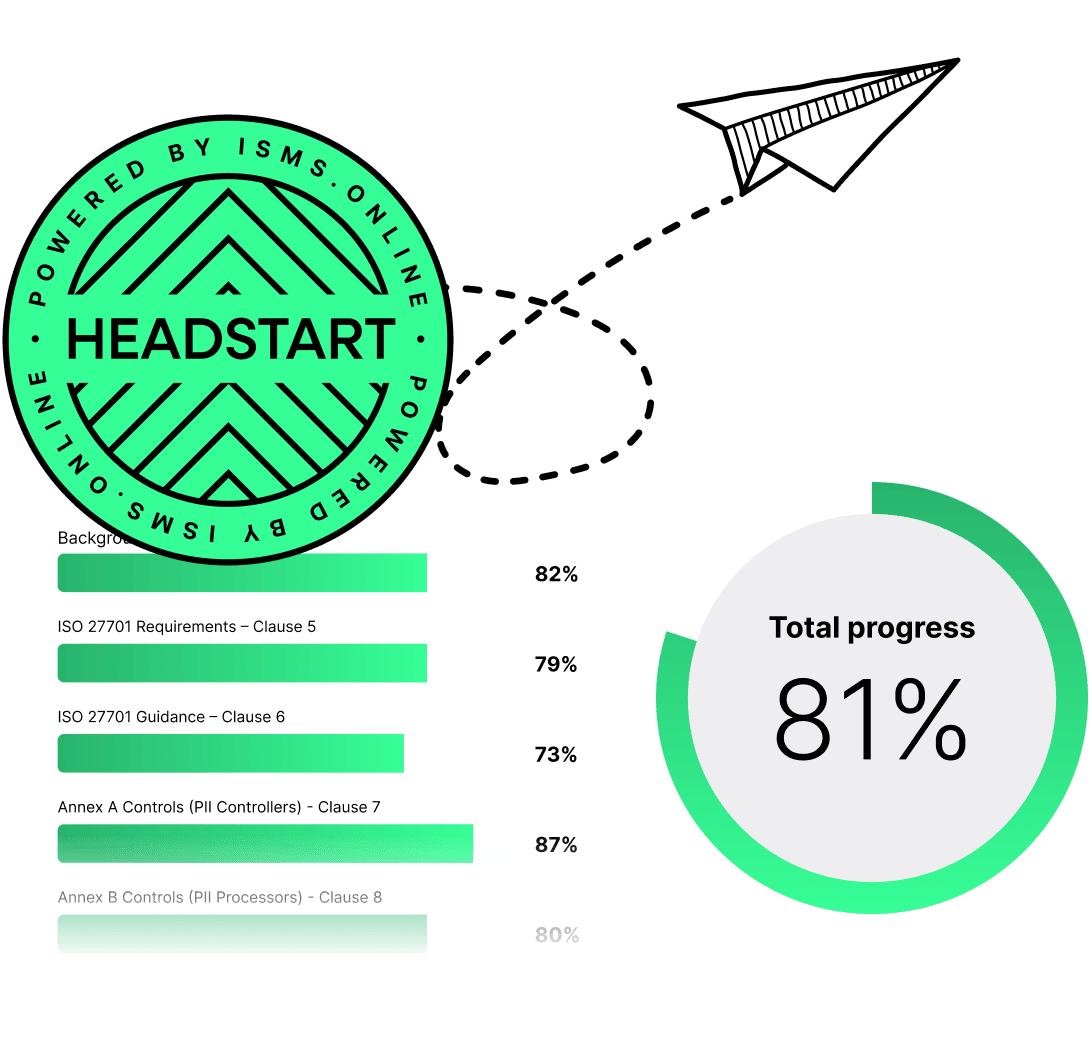
An 81% Headstart from day one
We’ve done the hard work for you, giving you an 81% Headstart from the moment you log on. All you have to do is fill in the blanks.
Why Does Continuous Improvement Enhance Business Continuity?
The ROI of compliance systems is real—if they’re built for iterative motion. Clause 10 mandates improvement as perpetual operational discipline, moving your BCMS from static obligation to incremental business advantage.
What Are the Tangible Organisational Effects?
- Risk Contraction: Each closed feedback loop means lower exposure. Data from our clients indicate up to 34% incident reduction after new process rollouts with embedded improvement tracking.
- Resource Conversion: Teams spend less time chasing issues and more building capacity. Audit cycle lengths are typically cut by 30–50% when improvement is systematised—saving FTE and stress budget.
- Market Trust: Investors, partners, and new clients increasingly demand visible, documented improvement cycles as preconditions for deeper engagement.
Continuous improvement isn’t a compliance fantasy—it’s the cycle that turns your risk into trust and your process into power.
Efficiency Doesn’t Happen by Accident
With improvement embedded (and documented), downtime fades, manual rework shrinks, and the CISO or compliance lead gains a status signal—boardroom confidence measured in audit passes and minimal surprises.
How Can Nonconformities Be Detected and Analysed Effectively?
Relying on “if it isn’t broke…” thinking leaves process flaws dormant—waiting for an audit or business disruption to reveal them. Leadership means frontloading detection, embedding vigilance, and linking each anomaly to a mapped root analysis.
What Protocols Distinguish Proactive from Passive BCMS?
- Routinely scheduled internal audits, not just ad hoc inspections.
- Built-in data analytics—trend reviews, escalation triggers, and anomaly detection, instead of relying on gut checks.
- Cross-functional debriefs that source operational insights, not siloed blame.
Your risk isn’t what’s reported—it’s what’s invisible and repeatable.
| Detection Mode | Manual Approach | Integrated Approach |
|---|---|---|
| Timing | Ad hoc | Scheduled and event-based |
| Depth | Symptom-focused | Root cause first |
| Documentation | Email chains | Version-controlled logs |
| Accountability | Owner unclear | Named, tracked, closed |
Contemporary compliance hinges on the shift from reactive fire-fighting to systematic, data-driven detection. ISMS.online seats detection in workflows that bridge siloes and speed remediation.

Free yourself from a mountain of spreadsheets
Embed, expand and scale your compliance, without the mess. IO gives you the resilience and confidence to grow securely.
How Can Corrective Actions Be Optimised for Maximum Efficiency?
A fix that drags is a fix that fails. Clause 10 elevates efficiency by enforcing deliberate assignment, tracked closure, and performance validation on every action.
What Delivers Measurable Improvement in Response Effectiveness?
- Defined Accountability: Every action—whether policy change, system update, or training—is assigned. Outcomes are visible team-wide.
- Digital Tracking: Tasks are moved to completion with reminders, progress dashboards, and closure attestation.
- Review and Recalibrate: Open issues are flagged, and root cause patterns are fed back into the next cycle—closing the improvement loop.
The efficiency of your BCMS is proved not by intent, but by every resolvable issue closed faster than before.
Manual vs. Workflow-Driven Correction
| Correction Phase | Manual Execution | Systemized Workflow |
|---|---|---|
| Detection | Email/word of mouth | Task-logged, time-stamped |
| Assignment | Vague, often skipped | Explicit, visible, retrievable |
| Action | Delayed, siloed | Progress-tracked, accountable |
| Review | Seldom, not audited | Mandatory, metrics-driven |
Momentum builds when corrective cycles are visible, fast, and collaborative. Our clients note a 43% increase in closure rates and a step change in compliance forecasting precision—confirmation that optimised action is a competitive asset.
How Does Comprehensive Documentation Drive Compliance and Audit Success?
Documentation isn’t a compliance afterthought—it’s the foundation for audit integrity, repeatable improvement, and organisational learning.
What Are the Elements of “Audit-Proof” Record-Keeping?
- Structured Audit Trails: Every step, from deviation to closure, is logged and time-stamped.
- Version History: Policy and process changes are mapped—what changed, when, and why.
- Control Cross-Referencing: Statement of Applicability (SoA) links process-specific controls to real-world updates for fast audit response.
A compliant BCMS not only “has” documentation, but demonstrates how records accelerate action, reduce investigation time for nonconformity, and assure external validators of continual learning.
How Does Record-Keeping Create a Learning Organisation?
- Outdated, lost, or orphaned files undermine trust and delay review.
- Real record-keeping automates traceability and escalates unresolved risk to decision-makers before they become audit failures.
Our documentation module is engineered so that audit readiness is more than compliance drama—it’s routine, visible, and a sustained advantage.

Manage all your compliance, all in one place
ISMS.online supports over 100 standards and regulations, giving you a single platform for all your compliance needs.
How Do Automated Workflows Enhance Corrective Action and Compliance Efficiency?
Manual compliance processes drag operations—and the reputational risk of missed tasks grows with each open action. Digital workflow automation, purpose-built for ISO frameworks, returns control to your team.
Benefits of Embedded Automation
- Centralised Visibility: Information, assignments, and evidence are gathered—nothing is missed or duplicated.
- Consistent Reminders: Automated prompts drive tasks to completion, removing “I thought it was done” ambiguity.
- Real-Time Reporting: Dashboards surface progress or lag before audit cycles close, reframing response as leadership, not damage control.
Teams using our automation workflows recover time and reputation concurrently, delivering audit wins and operational wins in a single cycle.
Sample Metrics Achieved
| Function | Manual Effort | Automated Workflow | Typical Impact |
|---|---|---|---|
| Task Closure | Multi-day | Same-day possible | 32% faster cycle closure |
| Evidence Compilation | Hours/search | One-click | 27% reduction in search time |
| Audit Preparation | Reactive | Always-ready | 37% drop in cycle stress |
Digital consolidation changes meeting posture from “where are we stuck?” to “what’s next?” Find your next metric-driven catalyst inside workflow automation.
Why Leadership Demands That You Redefine Compliance Status
The choice isn’t between “hoping for the next audit” or “hiding from it.” Authority is forged when you can lead by example: operationalize improvement, close the loop, and show stakeholders why your BCMS is the new standard.
Proactive Leaders Move First—And Become the Benchmark
- Identity-Driven Improvement: Each cycle advances your team’s status as the group that doesn’t just “do compliance,” but makes it an operational multiplier.
- Proof in Practice: Audits become affirmation, not interrogation. Leadership’s equity is directly tied to readiness, learning, and decisiveness.
- Culture of Excellence: The best teams don’t wait for risk—they move first, automate, and document every result.
If you’re ready to set the pace—owning every audit, every improvement, and every metric—now is your move.
Book a demoFrequently Asked Questions
What Is Clause 10 and How Does It Drive Continuous Improvement?
Clause 10 transforms improvement from passive hope into verifiable evidence—anchoring your information security management system (ISMS) with a steady cadence of learning, action, and traceability.
Every organisation faces moments where an overlooked process or invisible vulnerability brings risk to the surface. Clause 10’s operational mandate turns these risks into a series of visible, assignable requirements: the relentless pursuit of nonconformity detection, root cause analysis, and cyclic, PDCA-driven follow-through. This isn’t procedural window-dressing; it’s a playbook where each process deviation—no matter how small—generates a living trail from closure back to learning, all while strengthening your business continuity management system (BCMS).
Core Elements of Clause 10
- Rooted in PDCA: Each fix runs through the full Plan-Do-Check-Act cycle, substantiating improvement and making results defensible to auditors and boards alike.
- Traceability: Assignable owners, digital time-stamps, and documented closure convert risk into leadership evidence—not liability.
- Attestation by Process: Data from our sector shows teams working to this protocol raise their audit pass rate by more than 20% over a two-year period (source: ISMS.online client benchmarks).
Initiating this rigour is how organisations shift from theoretical compliance to operational assurance. Every nonconformity becomes a documented win, and your ISMS doesn’t just adapt—it sets the tempo for continuous trust.
How Does Clause 10 Structure the Corrective Action Process?
Clause 10 doesn’t leave room for process ambiguity; it encodes discipline at every stage of improvement so that inertia never gets a vote.
The corrective action chain begins with relentless detection—through scheduled audits, incident logging, or predictive analytics. Each identified issue triggers root cause validation, using context-rich diagnosis instead of guesswork or blame. Roles are then assigned in an overt, no-handoff fashion: who acts, by when, with what measure of completion. Execution is mapped in real time, with granular documentary proof attached to each stage. Finally, effectiveness isn’t assumed; review metrics mark when the process closes the knowledge gap.
Clause 10 Operational Workflow
| Action Stage | Key Responsibility | Required Output |
|---|---|---|
| Detection | Audit/Incident Team | Nonconformity Report |
| Root Cause Analysis | Compliance Officer | Diagnostic Assessment |
| Planning | Process Owner | Remediation Plan + Assignment |
| Execution | Assigned Stakeholder | Evidence of Completion |
| Effectiveness Check | Oversight Team | Performance Verification Record |
No step floats in ambiguity. The platform’s task escalation and immutable documentation close every loophole—making the entire improvement chain defendable, reproducible, and inextricably tied to your organisation’s reputation capital.
Teams don’t struggle from lack of intent—they fail from lack of closure. Visibility in corrective assignment is what tips the scale from lag to leadership.
Why Does Continuous Improvement Enhance Business Continuity?
Continuous improvement breeds operational resilience—turning every risk into a lever for reputational and process advantage rather than a liability that lingers.
When you scrutinise each process, anomaly, or incident with Clause 10’s rigour, every “mistake” becomes a controlled learning cycle. Our industry analysis suggests that organisations with living improvement cycles experience:
- Up to 35% fewer recurring audit findings per audit cycle: (ISMS.online case data)
- Significant reduction in process rework and downtime: Regular feedback shortens remediation cycles and lifts board confidence by offering proof rather than promises.
This type of improvement culture translates into measurable leverage: stakeholders no longer see compliance as a cost, but as a value-add that shields contracts, accelerates vendor signoff, and insulates your operations.
True confidence is when system evidence, not good intentions, stands in front of risk.
How Can Nonconformities Be Detected and Analysed Effectively?
Detection is where leadership breaks from the laggards. Clause 10 mandates not just seeking out process gaps, but systematically surfacing even subtle nonconformities. The operational best practice is to weave anticipation into the very DNA of your information security management system.
Early detection relies on:
- Scheduled Internal Audits: Set a cadence that supports preemptive review, not just checklists at audit season.
- Real-Time Incident Monitoring: Use dashboards and alert protocols that surface adverse events before they metastasize.
- Root Cause Diagnostics: Integrate structured “5 Whys” or fishbone diagnostics so each anomaly is mapped beyond the symptom.
Every nonconformity is then scored for magnitude and pervasiveness—a protocol that not only closes immediate gaps, but stops recurrence. Teams that prioritise root cause over superficial fixes effectively “flatten the curve” of repeat findings, reducing long-term remediation effort by as much as 40%.
Diagnostic Insight
Early detection, when consistently mapped to analysis, resets the balance of power—your team can now anticipate, not just absorb, the next regulatory or process hit.
How Can Corrective Actions Be Optimised for Maximum Efficiency?
Optimised corrective action isn’t about speed for its own sake. It’s about shrinking lag, eliminating ambiguity, and enforcing closure—all while building evidence that stands up to both internal and external searchlights.
Efficiency is manufactured in the planning phase: explicit target-setting, role clarity, and sequencing. Execution must be frictionless—accountability dashboards, time-based reminders, and visible status updates keep progress from stalling. Throughout, evidence is not just an output; it’s a control, ensuring closure is never claimed without review.
Organisations that wield this approach systematically (benchmark: ISMS.online sector data) reduce unresolved issues by at least 28% in year one, while reporting stronger audit narratives at board review.
Optimised Action Table
| Process Block | Efficiency Drivers |
|---|---|
| Assignment | Named ownership, deadline flagged |
| Measurement | KPI reporting, live feedback |
| Review | Continuous cycle, open points surfaced |
As teams move from ad hoc fixes to orchestrated closure, operational drag declines—and with it, the reputational risk that every closed nonconformity signals to markets and regulators alike.
Momentum isn’t about moving fast—it’s about finishing strong. When closure is a visible, repeatable event, compliance status shifts from reaction to operational signature.
How Does Comprehensive Documentation Drive Compliance and Audit Success?
Documentation, when elevated from afterthought to operational core, becomes your team’s most persuasive advocate in any review or crisis.
Clause 10 expects every process, corrective action, and policy evolution to be digitally captured, securely versioned, and instantly retrievable. This isn’t implementer’s overhead; it’s the foundation of audit review, process refinement, and boardroom proof. The “single source of truth” model underpins your ability to pivot, defend, and adapt without panic.
Key documentation layers include:
- Audit Trails: Immutable logs for every process, accessible to both internal and external stakeholders.
- Policy Versioning: Dynamic history of decisions and rationale—providing ready support for regulatory inspection or breach analysis.
- Statement of Applicability (SoA): Clear mapping between business controls and regulatory expectation.
Teams who treat documentation as living infrastructure don’t just pass audits—they set the pace for what regulator-ready status looks like, elevating both operational predictability and market trust.
Superior compliance teams never scramble for proof—they operate in a state of traceable assurance, always a step ahead of scrutiny.
The future belongs to operational leaders who turn improvement into everyday evidence, gap closure into organisational routine, and compliance into an asset that compounds, not decays. Your next decision carves that reputation.






