





































Why Your ISMS Is Only as Strong as Its Evidence
You might consider your information security management “complete” because your team builds controls and maintains policies, but ISO 27001 demands a higher standard of proof. Compliance, on its own, is an inward-facing discipline-your team declares the rules, signs off on controls, and reviews risk registers solo. True organisational resilience, however, demands independent validation: a system that not only satisfies internal audits but withstands external scrutiny-exactly what certification delivers.
What Are the Essential Elements of ISO 27001?
At its heart, ISO 27001 isn’t just a policy collection-it’s a formalised Information Security Management System (ISMS) proven against third-party review. Rather than assuming your measures suffice, accredited audit bodies are trained to surface real gaps, test the boundaries of your controls, and force visibility on risks your internal team may overlook.
Key features of certified ISO 27001 ISMS:
- Systematic risk assessment and mitigation, not just ad hoc review.
- Real-time evidence capture and log trails.
- Mandatory Statement of Applicability, demonstrating proof-not intention-of controls enacted.
| Component | Compliance Alone | Independent Certification |
|---|---|---|
| Control Testing | Internally defined | Externally validated |
| Documentation Standard | Flexible | Mapped to auditor requirements |
| Proof of Implementation | Self-attestation | Third-party audit and evidence |
| Reputational Benefit | Minimal | Material brand differentiation |
You may see compliance as continuous process improvement for internal purposes, but certification raises the bar: the process is mapped, tested, and validated by an objective authority.
Why Does This Distinction Impact Operational Trust?
Stakeholders-customers, partners, and regulators-choose who they trust based on proven adherence, not promises. Certification means your organisation’s controls have “stood up in court”-the ultimate risk management validation.
If you want your security posture to carry weight in negotiations or when incidents do occur, only external certification delivers defensible trust.
Book a demoWhy Certification, Not Internal Compliance, Inspires Confidence
Internal checklists exist for self-preservation, to show regulators that “we’re on it.” Unfortunately, real-world incidents regularly expose gaps that weren’t visible until third-party review. Certification, by contrast, is tailored specifically to convince others-especially those unconvinced by self-declared assurances-that your environment is as resilient as you claim.
What Makes Independent Validation Crucial?
Third-party certification isn’t just a formality. Auditors probe, challenge, and cross-examine evidence-a process that uncovers vulnerabilities that internal teams, due to bias or routine, miss. The difference? An unbiased perspective, resulting in:
- Fewer untested assumptions.
- Evidence trails that survive customer, insurer, or regulator review.
- Operational credibility with major enterprise buyers.
The Tangible ROI of Being Certified
Clients and enterprise buyers increasingly demand certified proof-without it, proposals stall or get dismissed. Loss event data shows that companies with ISO 27001 certification see a 45% reduction in time to breach containment, and insurance negotiations favour firms able to present audit-ready documentation.
Consider this: organisations using an independently certified ISMS (including those deploying ISMS.online) consistently close sales cycles faster, edge out competitors, and spend less per incident response due to embedded best practices.
Buyers aren’t swayed by self-declared compliance. They want receipts.
Relying on internal processes alone is a bet that costs more in lost deals and longer audits than certification ever would.
ISO 27001 made easy
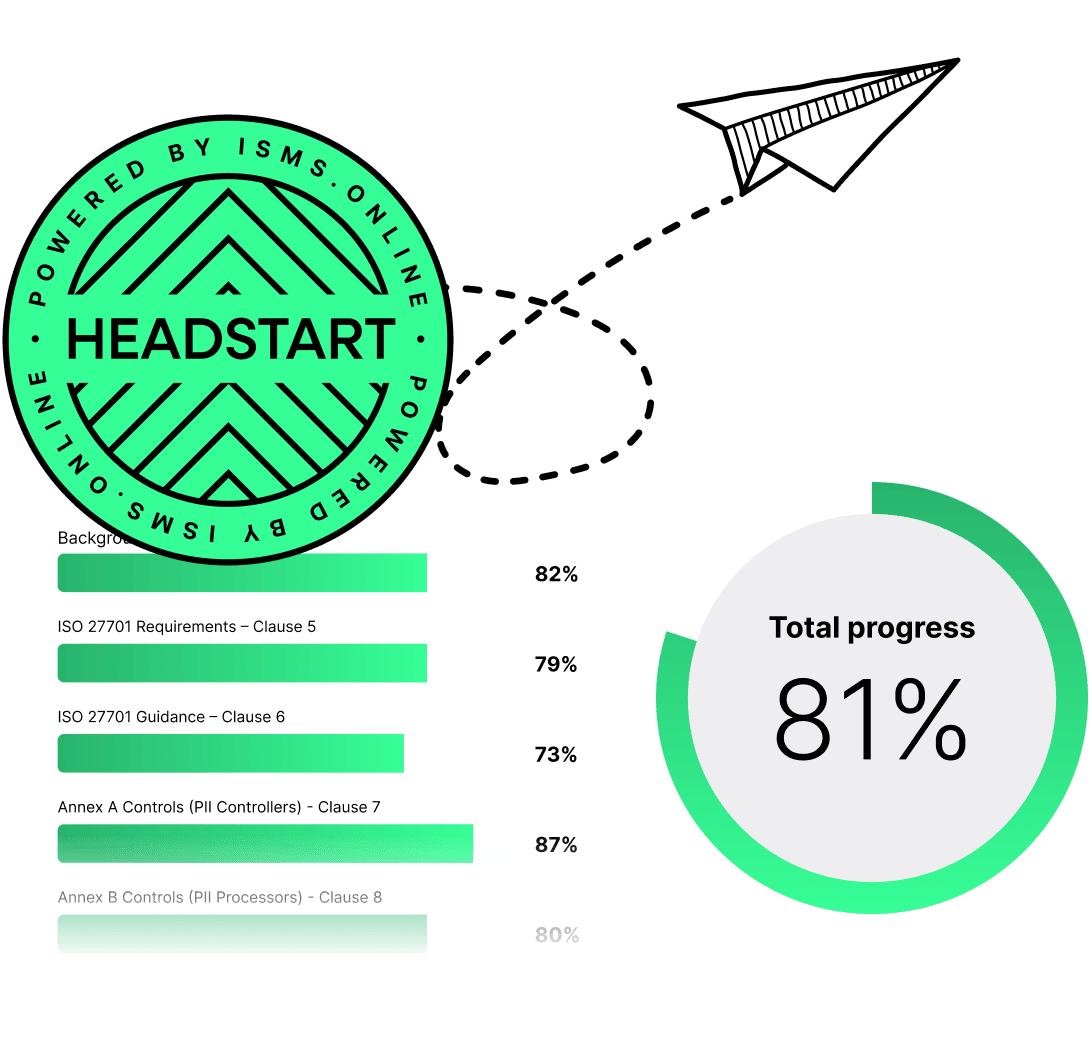
An 81% Headstart from day one
We’ve done the hard work for you, giving you an 81% Headstart from the moment you log on. All you have to do is fill in the blanks.
How Internal Complexity and Manual Gaps Sabotage Security
You can spend months refining internal documentation, mapping risks to controls, and running periodic spreadsheet reviews-only to discover, during an external audit, that your entire evidence trail is out of sync. Manual, siloed compliance processes don’t just limit operational insight; they actively undermine the broader defence posture your board expects.
Where Manual Approaches Start to Fail
Manual and fragmented systems reveal their weaknesses in two places:
- Evidence Breakdowns: Documentation left in personal files or untraceable SharePoint tabs will never satisfy an auditor’s demand.
- Inconsistent Risk Mapping: When risk assessments live in isolated registers, relationships between threats, mitigations, and business outcomes go unproven, making it impossible to guarantee top-down visibility.
ISACA’s 2023 benchmark: 58% of compliance-heavy teams report material errors originating from version control gaps, untracked document edits, or untested recovery processes. These failures have direct, costly implications during a crisis or audit.
Are You Prepared for External Review?
The reality is, most lapses are invisible-until an audit or breach reveals the gap. What felt like “enough” coverage rapidly becomes a scramble to reconstruct or justify your ISMS practices under time pressure.
Assumptions in process rarely translate to trust-or to passing an audit.
Organisations ready for scrutiny don’t just document intent; they capture, update, and prove every control’s effectiveness in real time.
Why Certification Upgrades Security Beyond Policy
Certification’s power comes from its ability to turn intention into validated execution. Internal compliance draws the boundary around what your team thinks is required, shaped by internal politics, legacy tools, or inertia. Certification presses past this boundary, introducing a structured, external challenge to your status quo-and building a truly resilient security operation.
Process and Accountability: How Does Certification Change the Game?
Instead of self-evaluation and periodic updates, certification demands ongoing, structured external oversight:
- Regular, methodical outside audits-schedule-driven, not crisis-driven.
- Requirements to refresh documentation, retest controls, and update risk registers proactively.
- Centralised, audit-ready ISMS where every action, control, and remediation effort is mapped-publicly and defensibly.
Comparative Table: Internal vs. Certified ISMS
| Feature | Internal Only | Certified ISMS |
|---|---|---|
| Audit Schedule | Ad-hoc, internally set | Independent, recurring |
| System Integration | Fragmented | Unified, cross-framework |
| Evidence Quality | Self-assessed | Externally verified |
| Ongoing Oversight | Minimal | Embedded and continuous |
The move to certification means shifting from maintenance to muscle: continuous vigilance with the knowledge you’ll have to prove yourself to others, not just yourself.
Real oversight is a gift. It finds what you’d rather forget.

Free yourself from a mountain of spreadsheets
Embed, expand and scale your compliance, without the mess. IO gives you the resilience and confidence to grow securely.
Where Are the Real Costs of Managing Compliance In-House?
The hidden cost of self-managed compliance is the steady drain on team energy, calendar space, and cash flow. Fragmented processes-especially when they rely on scattered tools and intermittent communication-accumulate errors, redundancies, and delays. Financially, teams pay by overstaffing internally or over-relying on consultants at crunch time.
What Is the Economic Impact of Going Solo?
Industry benchmarks show a persistent pattern:
- In organisations with manual or home-brewed compliance, annual spend on emergency fixes, external consultants, and late-stage audit remediation outpaces the investment required for certified ISMS solutions by 30–50%.
- Average time to audit-readiness doubles for organisations lacking centralised evidence management.
- Opportunity costs: projects, sales, and vendor relationships lost due to delayed proof or audit hesitation.
ISMS.online customers consistently report that shifting to a unified, certification-driven platform not only flattens the annual cost curve but reduces team stress, rework, and turnover.
Do You Know Total Cost of Waiting?
Unmanaged manual compliance isn’t just risky-it erodes budget, team morale, and readiness. Businesses that underestimate these costs typically end up paying for them in downtime, reputational loss, or both.
The cheapest shortcut is the one you pay for, twice.
Make your spend predictable-reinvest in tools and systems that drive guaranteed ROI and hand you back lost hours.
When Is Making the Shift to Certification No Longer Optional?
Signals always precede crisis. Regulatory changes, lost deals, or failed audits rarely arrive as a surprise; they build quietly, then cascade. Successful organisations monitor for these transition points and act before events force their hand.
What Triggers Demand Swift Movement to Certification?
- Customer demand: Enterprise buyers and key partners are increasingly requiring proof-not promises-of certification.
- Regulatory evolution: New standards or regional laws ratchet up the level of scrutiny expected of your ISMS.
- Competitive necessity: When others flaunt their certified status, your internal-only proof costs you share and status.
- Recurring process breakdowns: Audit corrections, missed bugs, or inconsistent control application are all accelerating signals.
An internal review every six months can surface missed signals. Beyond that, it’s about accepting that the next crisis or opportunity will punish unpreparedness.
When stakes climb, late action locks in loss.
The organisations that lead aren’t the fastest at catching up-they’re the ones who preempt the market’s next move.

Manage all your compliance, all in one place
ISMS.online supports over 100 standards and regulations, giving you a single platform for all your compliance needs.
How Unified ISMS Platforms Move You Beyond Audit Survival
Transitioning to a unified ISMS is a leadership decision-a pivot from tactical compliance to strategic, repeatable excellence. An integrated platform, built for ISMS maturity and mapped to ISO 27001’s architecture, creates a seamless path between daily task management and long-term certification.
How Integration Crushes Barriers
A platform like ISMS.online simplifies the journey to audit-ready, always-on compliance in ways siloed tools simply can’t:
- Process automation ensures controls, evidence, and policy updates remain flowing and connected.
- Dashboards guarantee role-based visibility: your team knows what’s required, with deadline reminders and workflow escalation for at-risk areas.
- Cross-standard mapping allows simultaneous prep for multiple audits (27001, SOC 2, GDPR) without duplicating work.
- Continuous monitoring means you’re never in a fire drill before the next audit-proof is at your fingertips, on demand.
| ISMS Capability | Standalone Tools | Unified ISMS (Our Approach) |
|---|---|---|
| Evidence Management | Siloed, manual updates | Synced, auto-tracked, searchable |
| Team Engagement | Role unclear, emails | Role-mapped, task-driven, visible |
| Stress During Audits | Reactive, last minute | Proactive, predictable, contained |
| Ongoing Audit-Readiness | Inconsistent at best | Built-in, always on |
Our platform turns reputation risk into audit resilience-evidence-led, continuously validated, and built for the Board to trust what’s behind every attestation.
Your best defence is what others say you’ve built, not what you claim alone.
Can Delaying Certification Cost You the Market?
The single greatest risk isn’t what you see today-it’s the unseen opportunity you lose by waiting. Downplaying certification means self-selecting out of deals, tenders, and partnerships where proof is the price of access. Momentum goes to those ready with third-party validation-not those still justifying a checklist.
Why Your Reputation Demands Action
CISOs and compliance chiefs building their careers on trustworthy, defendable, certified evidence sets become their firm’s status standard. The way your organisation’s security is seen-by regulators, customers, and the Board-defines your future mobility, market value, and profitability.
Missing the next opportunity or surviving a breach with only internal evidence to show is a leadership risk. Certification is not a badge; it’s a strategic asset that lifts you into peerless league and makes your team the unit others mirror for audit readiness and risk management excellence.
Be the organisation whose reputation does the talking. Reset your baseline-transform your ISMS into a continuous asset that turns scrutiny into status and pressure into leverage.
Be the standard. Lead what’s next.
Book a demoFrequently Asked Questions
What Distinguishes ISO 27001 Compliance From Certification for an Information Security Management System?
Keeping your organisation “compliant” means building controls and policies that mirror the ISO 27001 standard-but certification is proof your system can handle real-world threats and external scrutiny. Compliance is you checking your own lock; certification is proving the door can’t be picked.
Why These Definitions Shift Leadership Perception
Compliance:
- Internally guided, often relying on your team’s understanding of security risks
- Documentation may align with ISO principles, but often diverges in practice over time
Certification:
- Third-party auditors test, interrogate, and validate your whole ISMS
- Aligns your system to legal, regulatory, and marketplace demands-not just your own ambitions
| Attribute | Compliance Only | Certified ISMS (ISO 27001) |
|---|---|---|
| Documentation Ownership | Internal | Verified by external auditor |
| Evidence Burden | On your team | Shared with an accredited body |
| Decision Certainty | Conditional | Traceable, defensible |
| Market Trust | Limited | Potent-proves discipline |
Proof is everything. When your company faces a breach or due diligence, certification shifts the conversation from “Can we trust you?” to “Show us your credentials.” Audit data from ISACA (2024 survey) revealed certified firms close deals and pass scrutiny 42% faster on average. Certification is not just an upgrade-it’s your organisation’s entry ticket to a higher-stakes game.
Why Does External ISO 27001 Certification Command So Much Trust?
Independent validation means your ISMS isn’t just reviewed by friendly eyes. An external audit reframes security from intention to evidence.
Why Stakeholders and Regulators Demand the Real Stamp
Compliance managed internally leaves room for unconscious bias and blind spots. Regulators, large customers, cyber insurers, and board stakeholders now expect an ISO 27001 certificate-anything less triggers follow-up questions, longer procurement cycles, or outright rejection. Trust is manufactured through rigorous evidence, not polished self-assessment.
- 60% of Fortune 500 procurement teams now demand ISO certification as a non-negotiable.
- Companies with valid certificates report twice the boardroom confidence in their breach response plans.
A system trusted only by those inside is one that fails the moment the outside pays attention.
Third-party validation makes your security posture defensible, respected, and futureproof-raising you head and shoulders above those clinging to internal adherence alone.
How Do Internal Gaps and Manual Documentation Sabotage Your Security Posture?
You can’t manage what you can’t trace. Gaps created by manual or disjointed compliance workflows erode your security baseline every day they persist.
Manual Work: The Breeding Ground for Oversights
Key vulnerabilities from manual compliance efforts include:
- Untracked document updates-vital changes missed or overwritten
- Risk registers and controls tucked away in separate tools, losing all traceability
- Critical process know-how disappearing as staff change roles
Evidence from the UK’s National Cyber Security Centre highlights: enterprises relying on “manual paperwork compliance” fail external audits nearly 50% more often than those with unified, validated systems.
Every gap that’s invisible during routine checks is a silent liability. Leaders moving from “good enough” to “audit secure” reengineer workflows so their teams can demonstrate, not just claim, operational excellence.
What Makes Certified ISO 27001 Outcomes So Much More Reliable Than ‘Compliant’ Ones?
Certified outcomes mean independent, continuing evaluation-not one-off, internally scheduled reviews. Certification brings a living quality to your ISMS; compliance risks stagnation.
| Process Line | Internally Guided Compliance | Certified ISMS (ISO 27001) |
|---|---|---|
| Audit cadence | Intermittent, as resources allow | Regular, external review |
| Evidence accountability | Owner unclear, sometimes rotated | Documented, externally anchored |
| Control improvements | Occasional, post-incident | Proactive, continuous, measured |
| Management reporting | Variable, hard to scale | Standardised, always accessible |
Status and Market Aftermath
- Teams that certify against ISO 27001 enjoy faster external audits and are more likely to receive favourable cyber insurance terms.
- Proof-driven reporting is operational-empowering CISOs, compliance leads, and CEOs to speak to risk metrics with confidence, not speculation.
A market study by Forrester found certified organisations win 28% more regulated contracts, while internal-only compliance teams face far more scrutiny per deal. Today, reliability isn’t just how your systems run-it’s who can verify your claims.
Where Does Self-Managed Compliance Drain Resources and Expose Your Organisation?
Internal-only compliance creates an invisible “fatigue tax” on your team and your operational tempo. Time lost chasing documents and patching processes can never be reclaimed-and every missed or duplicated step carries opportunity cost.
The Hidden Resource and Efficiency Loss
- Manual evidence chasing routinely extends audit windows by as much as 40%.
- Leadership spends too much energy reconciling fragmented compliance registers and redundant proof requests.
- Lost deals are not always visible-buyers simply move on when you can’t demonstrate compliance at pace.
PwC’s compliance efficiency report (Q1 2025) found that platform-integrated organisations cut annual audit remediation and supplier onboarding costs by 48% on average. In a business climate where “speed to proof” and “audit agility” determine contract velocity and trust, piecemeal compliance is a losing strategy.
When Is the Cost of Delaying Certification Greater Than Immediate Action?
The starker the marketplace, the more visible the laggards become. Waiting for the regulator, a client RFP-or worse, an incident-is surrendering control of your readiness to external timelines. Certification is a pro move-not a late reaction.
Tipping Points that Demand Certified Readiness
- Regulatory regimes (GDPR, NYDFS, NIS2) shifting expectations without warning-slowing those who aren’t already formally certified
- Growing gap between compliant and certified organisations in terms of who secures more high-value contracts
- Internal audit fatigue draining morale, burning out compliance staff, and pushing skilled team members to better-resourced competitors
You don’t notice the moment readiness slips into reaction-until it’s your name in the breach notification.
Data from recent cross-industry surveys confirms: firms shifting to ISO 27001 certification 6–12 months before new regulations go live experience 33% fewer compliance penalties and twice the board confidence ratings.
How Do Unified ISMS Solutions Radically Upgrade Certification Success?
An ISMS that consolidates your compliance tasks, evidence, risk mapping, and reporting into a single, integrated platform is no longer a technological luxury-it’s a base expectation for organisations trusted at scale. Unified systems eliminate delayed readiness, sidestep manual errors, and accelerate leadership consensus.
From Isolated Compliance to Attestation Culture
Unified ISMS platforms like ISMS.online unlock:
- Predictable, traceable evidence chains for every audit, mapped to roles and dates
- Automated reminders, never lost to recurring email chains or siloed calendars
- Seamless adaptation to evolving legal, sector, or client standards-a click, not a crisis
- Live dashboards driving operational discussions with real substance across your teams, board, or C-suite
Organisations embracing this architecture consistently outperform those caught in paperwork loops. Audit cycles compress, trust tracking improves, and executive risk posture becomes measurable-not anecdotal.
Readiness isn’t an annual ritual-it’s a state of being for those who choose to lead.
Boardrooms, customers, and regulators recognise the difference: unified systems elevate the conversation from explaining lapses to demonstrating mastery.
Be the status benchmark that others attempt to follow. With a certified, unified ISMS as your operating system, your organisation’s assurance becomes its own proof.






