





































Why Spain’s NIS 2 Delay is Your Early Compliance Advantage
Spain’s NIS 2 timeline is a live demonstration of how regulatory uncertainty favours the prepared. While lawmakers continue to debate clauses and enforcement dates, proactive teams are quietly recasting the compliance game. The market perceives regulatory limbo as breathing room, but for compliance leaders and risk owners, this “pause” is an invitation to leap ahead-while competitors hold their breath. Paradoxically, your strongest competitive advantage arrives not with the letter of the law, but in how you use the unfilled gap.
When time feels frozen, resilience begins to move.
Business as usual is no longer a safe bet. High-profile cyberattacks, shifting board demands, and European pressure amplify the need for trustworthy digital governance. NIS 2 will not just raise the bar for incident response; it will force organisations to prove that security is both cultural and operational. The organisations using this interlude to overhaul-rather than patch-will emerge as the new benchmarks. Seen from the boardroom or the security operations floor, this is a unique moment for converting delay into sustainable market advantage.
Most damaging is complacency masquerading as prudence. A surge in late compliance initiatives after the final law will lead to shortages in expert consultants, auditor attention, and internal resources. Early adopters-those now building documentation, agency-mapping, and continuous evidence disciplines-will not only clear certification hurdles first but will also face less scrutiny, fewer breaches in confidence, and stronger procurement positioning. In a word: moving first lets you set the rules others will soon have to play by.
What’s Actually Changing for Spanish Organisations Under NIS 2-and What Should You Do Now?
The NIS 2 Directive, even half-transposed, has already changed the marketplace. For Spanish businesses spanning energy, SaaS, healthcare, infrastructure, and digital services, waiting for the ink to dry is now an operational risk in itself. Regulators, auditors, and procurement chiefs are quietly updating due diligence processes to align with NIS 2 obligations, even before the text becomes law. This means your business will be judged by tomorrow’s standards, not yesterday’s deadlines.
Every undefined week is a unit of competitive preparation-even if few teams realise it.
Board Engagement Takes Centre Stage
NIS 2 unequivocally pulls cyber risk out of the server room and into the boardroom. Board directors will be formally accountable for cyber controls, risk treatments, and the regular review of incident and supply chain policies (see Article 20, NIS 2). Expectation has moved from periodic sign-off to continuous oversight and active demonstration of management involvement; executive signatures on SLAs, risk registers, and incident rehearsals will shift from “nice-to-have” to regulatory requirement-mirroring the cultural leap of GDPR’s early days.
Where to Focus Right Now
- Consolidate your risk registers and documentation.: Don’t wait for the final text; review named asset lists, responsible parties, and incident categories to make sure nothing is legacy or ambiguous.
- Pre-empt vendor and supply chain clauses.: The majority of NIS 2 incidents have involved supplier lapses. Map your contracts and ensure you can trace risk ownership and notification routes for every critical supplier-even if you are not yet “essential” by size.
- Pivot from static evidence to continuous compliance.: Shift from annual fire-drills to live dashboards, audit logs, and evidence repositories available for instant review. Regulators are already testing for continuous improvement, not year-end bursts.
- Position your market advantage.: In RFPs, tender documents, and client communications, reference not only “in progress” compliance, but also evidence-based processes, named control owners, and management training artefacts ready for audit. Your early action will unlock both deals and long-term trust.
Early actors are turning wait and see into move and win-proving that regulatory time is best spent mobilising, not freezing.

Master NIS 2 without spreadsheet chaos
Centralise risk, incidents, suppliers, and evidence in one clean platform.
Who’s in Charge? Mapping INCIBE, CNPIC and the National Cyber Framework
Spain’s cyber governance structure is progressing from coordinated but siloed agencies toward a multi-tiered, integrated response system matched to NIS 2 escalation and reporting requirements. For compliance teams, knowing how and when to engage each body is central to surviving both real incidents and real audits.
In compliance, clarity about escalation is currency: agency confusion is now a risk in itself.
Mapping the Agencies: Spain’s Incident Escalation Framework
[Sector CSIRT]

 |

 v

[INCIBE] <--------------> [CNPIC]

 \ /

 v v

 [National Cyber-Security Centre]

 |

 v

 [ENISA, EU CSIRT, EU-CyCLONe]
Agency Roles
- INCIBE (Instituto Nacional de Ciberseguridad): Primary for SME support, sector-specific drills, advice on technical controls, evidence templates, and cyber awareness.
- Offers real-time incident templates and coordinates technical response for digital and non-critical sectors.
- CNPIC (Centro Nacional para la Protección de Infraestructuras Críticas): Specialises in critical infrastructure-from energy to water. Leads on supplier chain risk, tests continuity, handles incident escalation, and aligns executive accountability.
- National Cyber-Security Centre (New Central Hub): Aggregates data feeds and incidents from sectors, orchestrates Spain’s engagement with ENISA, EU CSIRT, and pan-European crisis liaisons.
How ISMS.online Helps
Simplifying these layers, ISMS.online delivers escalation playbooks embedded directly into the compliance workflow-automatically routing incidents to the right agency, logging both local and EU-facing reports at every step. This addresses not only best practise, but also makes audit time less stressful by removing uncertainty from response protocols.
The Essentials Gap: How to Nail Your Classification (and Avoid NIS 2 Surprises)
Correctly classifying your organisation is the single highest-leverage compliance step you can take-and the one most likely to be neglected. Whether deemed an “essential” or “important” entity affects everything: obligation scope, documentation standards, executive liability, who audits you, and the scale of penalties for failure. The 250-employee and €10M turnover lines are critical, but not the whole story; contracts with critical providers, cross-border digital services, and sector-specific rules can quickly upgrade your status.
Classification errors aren’t just audit failures-they block sales, escalate supply chain risk, and open doors to surprise investigations.
Essentials Trigger & Evidence Mapping Table
| Trigger | Risk Update Needed | Control / SoA Link | Example Evidence |
|---|---|---|---|
| Cross €10M or 250 staff | Essential reclassification | SoA 5.2 / 5.3 | Board minutes, KPI logs |
| New critical supplier contract | Supplier controls update | A.5.20 / A.5.21 | Due diligence, risk reviews |
| Major public infrastructure client | Board accountability drill | A.5.4, 9.3 | Incident notification proof |
| Vendor onboarding (third country) | Supply chain review | A.5.21 | Contract, supplier assessment |
Actively logging each status-relevant change, and mapping contract decisions, is now as important as maintaining a clean asset register or risk map.
How ISMS.online solves it:
Our platform’s NIS 2 assessment wizard rapidly flags changes that could reclassify your status, alerts responsible managers, and populates the necessary documentation-preventing surprise escalations and audit bottlenecks.
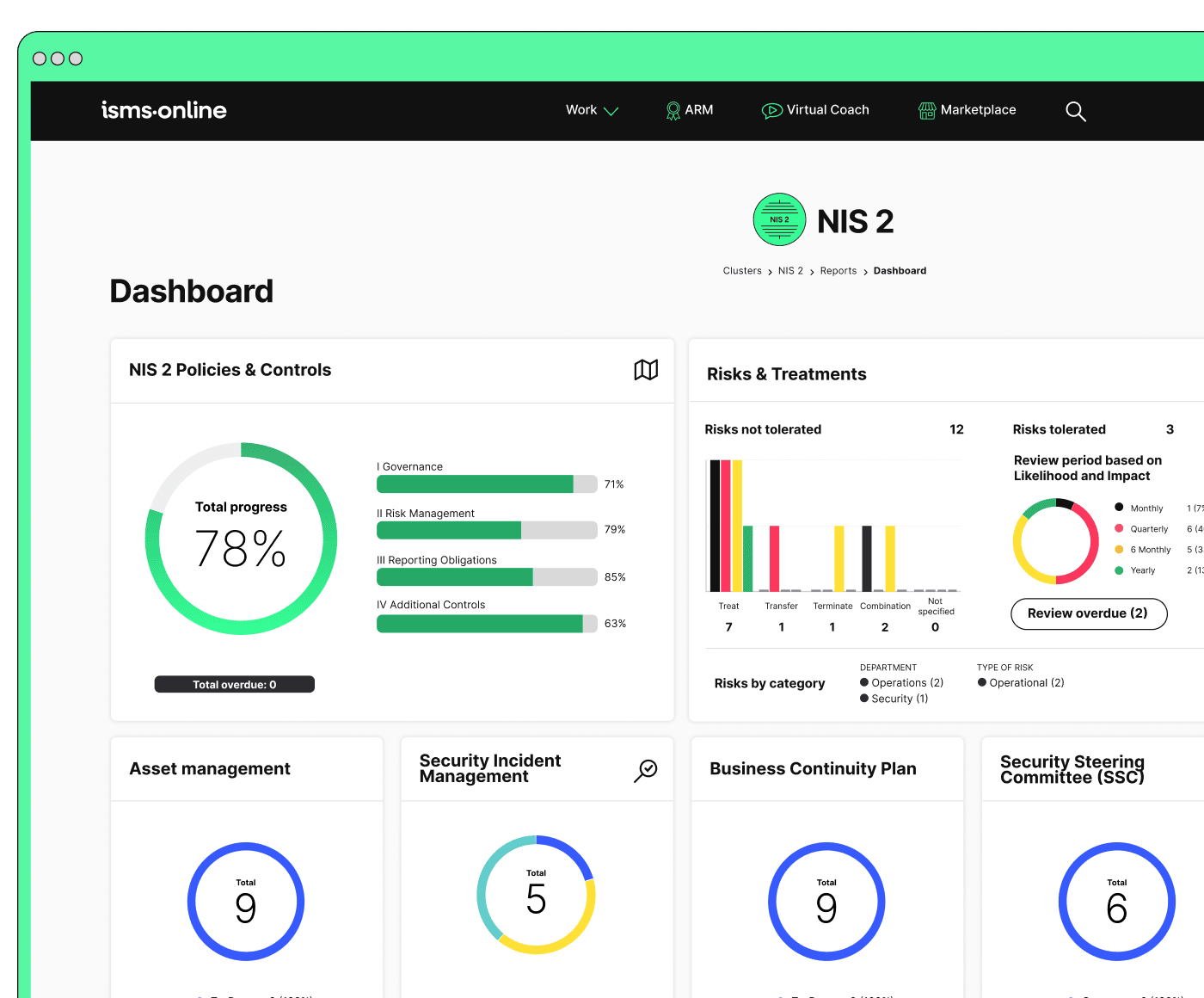
Be NIS 2-ready from day one
Launch with a proven workspace and templates – just tailor, assign, and go.
Blackouts, Supply Chain Crises, and Compliance in the Real World
The 2025 Iberian blackout was more than a crisis story-it was an unscheduled stress test that exposed the delta between “audit pass” and “operational resilience.” The companies that emerged unscathed were those whose paperwork was matched by live procedures: real vendor logs, rapid notification flows, and incident rehearsals involving not just IT, but board and supply chain leads. Compliance, we have learned, is only as good as its capacity to respond under pressure.
Documents prove nothing in a blackout if your team can’t find or trust the process.
SME Challenge: Incident Reporting and Audit Fatigue
Small and mid-sized organisations, especially, suffered when forced to manually compile evidence for overlapping GDPR, NIS 2, and supply chain reviews. Recovery depended less on the size of the compliance department and more on automation: live vendor mapping, policy automation, and digital playbooks reduced downtime, boosted procurement speed, and directly minimised regulatory fines.
- Automating vendor logs and playbooks: Shortened both recovery and deal cycles by weeks.
- Centralised notifications: Maintained staff stamina, reduced turnover, and prevented resource bottlenecks.
ISMS.online brings these capabilities together in a platform built for operational resilience-so incident logs, supervisor checklists, and evidence updates are live, not latent.
The Cross-Border Challenge: EU Networks and Spanish Compliance in Sync
Spanish compliance is now an EU network game. Every delay in escalating incidents or misalignment with ENISA and EU-CSIRT protocols raises the chance of penalties, downgrades reputation, and risks procurement losses-especially for export-facing or multi-country entities.
Spain–EU NIS 2 Notification Pathway
[Spain Enterprise]

 |

 v

[Sector CSIRT]

 |

 v

[INCIBE/CNPIC]

 |

 v

[National Cyber-Security Centre]

 |

 v

[ENISA, EU-CSIRT, EU-CyCLONe]

 ^ |

 | v

 <------ Feedback Loops
By the time the regulator calls, the ability to generate and route evidence-complete notifications-upstream and cross-border-will be an audit baseline, not a stretch goal.
Competitive Lift for Early Movers
Early adopters using integrated platforms for evidence and notification have already started to win cross-border contracts faster, due to:
- Quicker, cleaner incident reporting with EU-compliant templates.
- Pre-configured escalation routes validated by sector CSIRTs.
- Fewer audit “findings” on record management and notification speed.
ISMS.online’s sector-packaged escalation flows and EU-template notifications take the pain out of integration, closing the gap in compliance maturity between Spanish operations and multinational peers.
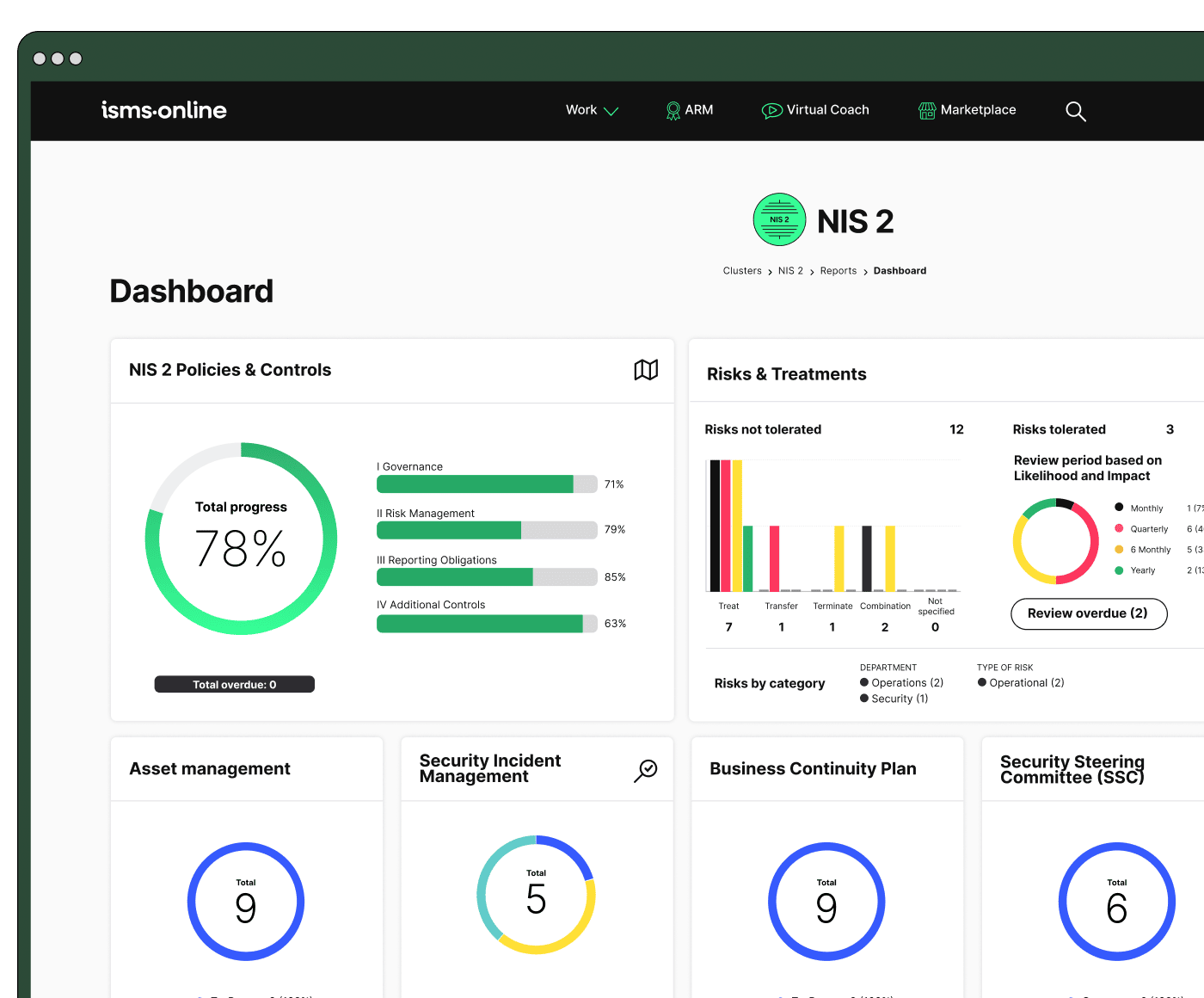
All your NIS 2, all in one place
From Articles 20–23 to audit plans – run and prove compliance, end-to-end.
Your Compliance OS: Why ISO 27001 is the Backbone of NIS 2 Value
ISO 27001 is the thread that ties Spanish practise to European standard-and is now moving from “nice to have” to “non-negotiable” for procurement, partnerships, and board assurance. Rather than a simple checklist, it enables organisations to move from episodic, paperwork-driven sprints to always-on compliance.
Audit fatigue fades as real-time compliance takes over.
ISO 27001 to NIS 2 Table: Expectation → Operation → Clause
| Expectation | Operation | Annex A / Clause Ref |
|---|---|---|
| Real-time dashboarding | Evidence logging, KPI reporting | A.8.15-17, A.5.29 |
| Supplier transparency | Contracts, mapped controls | A.5.20-21, SoA 5–6 |
| Board engagement | Review cycles, management drills | A.5.4, 9.3, SoA |
| Audit readiness | Incident logs, evidence export | A.5.24, A.8.13-14 |
From “Audit Sprint” to “Continuous Compliance”
Organisations integrating ISO 27001 into daily operations experience:
- 35% faster audit cycles: (cycle time reduction by regularised workflows and automated evidence capture.
- Less staff burnout and “last minute” document scrambles.
- Steadier, less disruptive progression up compliance maturity curves.
ISMS.online’s platform institutionalises these lessons, with modules for continuous logging, audit prep, policy distribution, and management review routines all traceable to NIS 2 expectations.
Audit Trails, Continuous Compliance, and How to Survive the Next Regulator Visit
No Spanish team can afford to rely on annual document hunts-regulators expect live dashboards, digitally signed policies, and instant evidence trails when (not if) a problem surfaces. Modern compliance survival is predicated on proving controls not with thick folders, but with always-on logs and demonstrable staff engagement.
Compliance Traceability Table
| Trigger | Risk Update | Control / SoA Link | Evidence Logged |
|---|---|---|---|
| Security incident | Rapid notification | A.5.24, 5.25 | Incident log, CSIRT form |
| Policy update | Staff notified | Policy Pack, SoA | Acknowledgements, emails |
| Vendor onboarding | Contract review | A.5.21, 5.20 | Supplier list, risk docs |
| Supply chain review | Controls check | A.5.20, 5.21 | Vendor assessment file |
Dashboards, logs, and automated workflows transform audit visits from existential threats into normal business routines (adquisitio.es; consultingciberseguridad.es).
The organisations transforming audit into day-to-day discipline are viewed by regulators and clients as the new market leaders.
With ISMS.online, teams map every control to its operational trigger and evidence log, compressing cycle times and eliminating reactivity from their compliance foundations.
Start Sustainable NIS 2 Compliance with ISMS.online Today
The future of compliance in Spain won’t be won by latecomers. Every week of delay narrows the window for smooth audits, strong incident responses, and client trust. ISMS.online customers are already reaping measurable benefits-faster audits, increased staff engagement, more reliable board reporting-because they started before the rush (isms.online; actualidadeconomica.com; elreferente.es).
The biggest risk in compliance is wait and see. Your window is now.
Our Spain-tuned compliance platform blends sector-specific workflows, automated incident escalation, and EU-ready reporting, providing a scalable umbrella for organisations of any size or complexity. By blending agency mapping, dashboarding, and central evidence trails, ISMS.online turns compliance from a “mad sprint” into a sustainable fact of business life-winning both deals and reputational capital.
Lead the Pack-Make Compliance Your Advantage
Bottom line: Compliance is no longer just about passing an audit or responding to the next directive. In the NIS 2 era, the real gain belongs to organisations that operationalise trust-demonstrating resilience, clarity, and control, long before regulatory deadlines force it.
By starting now-while your competitors study the horizon-you turn compliance into a living asset, a force multiplier for contracts, partnerships, and board assurance. ISMS.online is already helping teams become those market leaders, fusing rapid audit cycles, visible improvement, and future-proof controls into a single, actionable system.
Book a demoFrequently Asked Questions
Who enforces NIS 2 in Spain, and how do INCIBE and CNPIC split responsibilities for your business?
Spain’s NIS 2 enforcement operates with two clear national pillars: INCIBE and CNPIC, both orchestrated under the umbrella of the Centro Nacional de Ciberseguridad (CNCS). For most Spanish private sector organisations-especially SaaS, fintech, citizen-facing digital platforms, and SMEs-INCIBE is your direct touchpoint. INCIBE acts as the national CSIRT, providing reporting portals, response templates, and incident triage. Any major incident or compliance event in this space is handled through INCIBE’s CERT, with support designed to make the process accessible, fast, and regulator-aligned.
For operators classified as “essential services”-energy, transport, finance, health, water, or core infrastructure-CNPIC is your nerve centre. CNPIC manages legal oversight, issues sector-specific guidance, runs audits, sets security drill requirements, and handles escalated sectoral events, working closely with critical providers to satisfy national and EU-wide dependency mapping and reporting obligations.
Both agencies synchronise through the CNCS to guarantee that sector differences don’t create reporting shadows. They coordinate their playbooks across borders-via ENISA and EU-CyCLONe-to ensure Spanish organisations feed seamlessly into EU-wide cyber-security campaigns. Your organisation’s sector, regulatory status, and entity classification will determine which agency takes the lead, but the underlying compliance chain ensures every report, drill, and audit ultimately reinforces the same integrated national response.
NIS 2 Enforcement Bodies: Sector Division Table
| Agency | Sectors Served | Core Roles | EU Links |
|---|---|---|---|
| INCIBE | SaaS, fintech, SME, citizen-facing, private sector | National CSIRT, support | ENISA, CyCLONe |
| CNPIC | Essential/critical: energy, transport, health, finance | Sector auditor, regulator | ENISA, CNCS |
For SMEs and digital firms, INCIBE is the front line for incident response and templates; for critical operators, CNPIC directs risk management and audit. Both ensure Spain’s compliance flows leverage the same national backbone and EU integration. |
How do new NIS 2 deadlines and classifications create compliance pressure in Spain for 2025–2026?
Spain’s NIS 2 timeline has created a dual-speed environment: legacy NIS obligations persist but are eclipsed by tougher NIS 2 rules arriving in 2025–2026. The greatest inflexion point is classification: are you an “Essential” or “Important” entity? “Essential” (critical sector, 250+ staff, or €50M turnover) means annual regulatory audits, board-level reporting, and the highest penalty ceiling. “Important” captures exposed or high-impact SMEs with a lighter touch but the same tight reporting deadlines and major penalty risk.
Failing to self-classify accurately, or misunderstanding your supply chain’s scope, leaves organisations exposed to both regimes-sometimes at once. In the new model, regulators expect incident notifications within 24 hours, with 72-hour and close-out windows that are rigorously enforced. The penalties climb to €10 million or 2% of global revenue for Essential entities, and €7 million or 1.4% for Important organisations, with enforcement focused on board accountability and supply chain traceability.
NIS 2 Compliance Classification Table (2025–2026)
| Entity Type | Oversight & Audits | Reporting Deadline | Maximum Penalty |
|---|---|---|---|
| Essential | Full audits, annual | 24h / 72h / close-out | €10M or 2% of global turnover |
| Important | Targeted, risk/event | 24h / 72h / close-out | €7M or 1.4% of turnover |
Firms that preemptively classify, map evidence, and automate deadlines consistently side-step panic audits and avoid the escalated risk of last-minute compliance lapses. |
What actionable procedures must a Spanish company follow to comply with NIS 2?
NIS 2 compliance in Spain is much more than an annual checklist-it’s a switch to continuous, auditable practise. Organisations must:
- Report Incidents Fast: Any significant cyber event must be reported within 24 hours to the relevant CERT (typically INCIBE for private, CNPIC for critical), followed by a 72-hour status and a final mitigation report.
- Keep Risks Under Regular Review: Risk registers have to be updated, board-reviewed, and mapped to assets and supply chain changes-not just signed off once a year.
- Designate a Security Owner: Assign a named manager as the NIS 2 point of contact-accountable before regulators, the board, and auditors.
- Demonstrate Business Continuity in Action: Auditors expect logged evidence of business continuity and disaster recovery *in practise*-including evidence of drills, supply chain checks, and third-party engagement.
Compliance Action Table
| Trigger Event | Must-Do Next Steps | Evidence Artefact |
|---|---|---|
| Cyber incident | Notify within 24h | CERT ticket, dashboard log |
| Vendor data breach | Review/update risk register | Supplier risk, SoA update |
| BCP/DR activation | Drill/test & log evidence | Recovery plan, test summary |
Automating these steps through compliance dashboards turns frantic audits into routine, board-ready evidence reviews-saving costs and avoiding audit shocks.
Evidence-based routines, not checklists, are what distinguish compliant firms from those repeatedly caught off-guard by regulators or procurement hurdles. |
Where do Spanish organisations most often falter with NIS 2: infrastructure, resources, or supply chain?
Compliance struggles rarely stem from headline cyberattacks-instead, they almost always trace back to inconsistent process discipline:
- Infrastructure: Critical sectors-energy, health, manufacturing-often suffer resource and reporting fatigue, especially under annual audit pressure, with board engagement sometimes lagging.
- Resources: High-growth companies and SMEs, stretched thin, bolt compliance onto projects late, missing the advantages of real-time evidence and stakeholder readiness.
- Supply Chain: The fastest-growing risk: poorly-traced supplier controls, gaps in third-party due diligence, and unclear lines of notification mean indirect vulnerabilities can undermine compliance-especially when vendors cross national or sector lines.
Organisations relying on last-minute, patchwork documentation often lose out on contracts or face escalation because their evidence doesn’t withstand routine audits or sector drills. Those that track staff training, vendor roles, and live controls in integrated dashboards are audit-ready without drama.
Procurement teams and boards reward companies whose compliance data is always current-patchwork evidence slows sales and creates ongoing renewal friction. | | El País
How do cross-border incidents and EU-level reporting shape Spain’s NIS 2 obligations and market trust?
Spanish companies embedded in the European supply chain are on the hook for pan-EU reporting discipline. Incident reporting timelines now have to satisfy not only national agencies (INCIBE/CNPIC) but also ENISA, CyCLONe, and CSIRT networks. A single missed or delayed report can trigger both Spanish and EU-level scrutiny-from investigations to penalties to lost business opportunities, especially where government or critical industries are involved.
“Good enough for Spain” is no longer the base standard: cross-border evidence, live notification logs, and clear supply chain mapping are now buyers’ and boards’ minimum expectation for renewals and regulatory tolerance. C-suite risk, contract exclusion, and diminished market trust are real consequences of failing to demonstrate pan-European readiness and timely escalation.
A single incident missed or delayed can quickly erode board trust, trigger EU-level investigation, and put supply chain placements at risk for Spanish and European business alike. |
Why is ISO 27001 considered the “operating system” for NIS 2, and what compliance burden does it lift for Spanish companies?
ISO 27001 has become the “default operating system” for Spanish NIS 2 compliance because it turns every regulatory request-board review, supplier audit, incident report, staff training-into a mapped, trackable artefact in a live dashboard, complete with SoA (Statement of Applicability) mapping. That means less last-minute evidence chasing, shorter renewal cycles, and audits that shift from once-a-year chaos to continuous, low-stress routines.
With ISO 27001 as foundation:
- Board dashboards and logs are always current for renewal and review.
- Evidence trails are immediately available, not reconstructed after the fact.
- Supply chain, incident, and training controls are automatically linked to NIS 2 obligations-removing any ambiguity when audits or procurement checks arrive.
ISO 27001–NIS 2 Bridge Table
| NIS 2 Requirement | ISO 27001 Operation | Clause Ref |
|---|---|---|
| Board oversight/review | Dashboards, audit logs | 9.3 |
| Supply chain supervision | SoA, vendor controls | A.5.20–21 |
| Incident response | CERT log, audit trail | A.5.24 |
| Staff training | Training log, SoA | A.6.3 |
Audit readiness time falls by at least 35% with live ISO 27001 dashboards, and board confidence rises visibly with compliance reviews mapped in real-time. |
What does “evidence ready” really mean for NIS 2 compliance in Spain after 2025?
“Evidence ready” means every relevant party-board, auditor, regulator, key clients-can see at a glance that your controls, training, incidents, and procurement data are mapped to the right risk and regulatory entry, with time-stamped logs and active dashboards. Every new supplier, onboarding, audit, and incident must feed their proof into a living system. This is the heart of both modern compliance and competitive procurement.
Firms retaining static documents, siloed spreadsheets, or outdated evidence snapshots face repeat last-minute anxiety during contract renewals and procurement wins. Companies that automate these flows move faster, earn board and market trust, and are insulated from the risk of frantic evidence gap-filling under regulator pressure.
Evidence Traceability Table
| Event | Action | Evidence Artefact |
|---|---|---|
| Supplier contract | Vendor risk review | Supply chain risk log, SoA |
| Staff onboarding | Training, log update | Training log, policy link |
| Security incident | CERT notification logged | Incident log, audit file |
| Scheduled audit | Dashboard review | Scheduled log, SoA update |
Always-on dashboards and log automation transform compliance from a source of friction to a competitive edge in procurement, renewals, and board oversight. |
How does ISMS.online accelerate and future-proof NIS 2 evidence creation and board assurance for Spanish firms?
ISMS.online is tuned for Spain’s compliance speed and complexity: it integrates dashboards for real-time compliance, automates incident and audit records, embeds templates for sector/entity regulation, and centralises board and procurement reporting in an always-on backbone. Instead of facing the fatigue of last-minute sprints, organisations using ISMS.online can respond instantly to audits, procurement, or board queries-renewing contracts, evidencing supplier diligence, and maintaining staff readiness across any change in Spanish and EU rules.
These firms consistently close renewals and major client contracts ahead of regulatory deadlines, maintain lower resource drain, and report increased board confidence, even as NIS 2 requirements get stricter. ISMS.online adapts to Spain’s and the EU’s evolving frameworks, meaning Spanish businesses secure resilience and regulatory trust through every compliance cycle.
ISMS.online’s continuous compliance model lets organisations outpace regulatory change-winning renewals and board trust while competitors scramble for last-minute records. (https://www.isms.online/solutions/nis2-compliance/) |






