





































How Have New Physical and Environmental Threats Changed the Compliance Landscape?
You’re no longer defending against yesterday’s headline risks; today’s threatscape means every “outlier” incident-be it environmental, human, or hybrid-has become an auditable point of failure. NIS 2 forces security and compliance teams to move beyond legacy threat lists, integrating edge-case weather, unpredictable human threat vectors, and utility instability into your living risk register. This redefinition of risk makes every desk, every site, every dependency fair game for scrutiny.
Audit anxiety rises when yesterday’s rare event becomes tomorrow’s compliance test.
Reframing Risk in a Rapidly Shifting Environment
Organisations once insulated from extreme weather or infrastructure failure now experience record-shattering floods, relentless heatwaves, and power events with multi-day impact. Simultaneously, attackers have evolved from the lone opportunist to well-organised threat actors and supply chain exploiters, targeting both physical assets and digital infrastructure. Recent ENISA and Uptime Institute analyses document a dramatic surge in multi-factor outages-often compounded by under-tested redundancy or neglected environmental controls.
Key threat expansion areas include:
- Severe weather and disaster (flood, fire, wind) is not “one in a hundred” but very often a rolling cycle (see climate-adapt.eea.europa.eu).
- Utility instability: generators, water, HVAC, and data centre redundancy are as likely to be the single point of failure as any firewall.
- Human-driven risk: break-ins, sabotage, and targeted arson leverage lapses in layered access or third-party controls.
- Supply chain convolution: every digital edge and shared physical tenancy multiplies the routes of exposure-a sub-processor’s failure can be your compliance incident.
A risk not named in your register becomes a likely finding if a real-world event puts it on the map.
Evolving Audit Focus Beyond Paper Risk
NIS 2 Article 13.2 does not accept a boilerplate register or annual update. It demands operational evidence that your threat model is alive-reflecting local realities, supplier dependencies, and recent events. Anything else reads as oversight.
To comply, you must prove awareness and proactive management of all plausible physical and environmental threats-including those never before tested in your region, supply chain, or sector. Audit focus has moved to when, where, and how was this last reviewed and tested?
Book a demoWhat Does NIS 2 Article 13.2 Legally Require for Physical and Environmental Security?
Article 13.2 is as much about living evidence as it is about specific controls. Its scope penetrates beyond owned sites into all critical operations, including those managed by vendors or partners. The standard expands on ISO 27001, pulling not just from your internal playbook but requiring up-to-date, site-specific logs, test records, and supplier documentation, all available on demand.
Proof required: Show me which threats you modelled, which failures you rehearsed, and when you last tested them.
The New Minimums for Physical and Environmental Assurance
- You must track and regularly review all facilities, including leased sites, secondary offices, and vendor colocation.
- Evidence must show live monitoring of environmental, human, and operational threats-backed by real-time or routine test logs (e.g., generator tests, HVAC, access drills).
- Operational resilience documentation is now a supply chain compliance obligation-affecting delivery partners, cloud, and managed service contracts.
- Evidence of proactive review (post-incident logs, after-action reviews, drill participation rates, remediation actions) must be accessible for all relevant sites at all times.
- “Audit-ready” means every policy claim can be backed by empirical logs, not just umbrella policies or static assessments.
Immediate Audit Triggers and Red Flags
Insufficient logs, outdated documentation, generic control claims, or lack of supplier drill evidence are audit triggers-escalating findings quickly. The Directive’s enforcement teeth include fines, public disclosure, and even operational suspension if timely, credible compliance can’t be shown.
Article 13.2 requires every organisation in scope to maintain dynamic, site-specific, and supply chain-inclusive evidence of physical and environmental control. Evidence must be current, role-attributed, and produced instantly at any audit or regulatory request.

Master NIS 2 without spreadsheet chaos
Centralise risk, incidents, suppliers, and evidence in one clean platform.
How Do ISO 27001:2022 Controls Map Directly to Article 13.2?
ISO 27001:2022, particularly Annex A controls, offers the structural backbone for translating NIS 2’s broad mandates into specific, audit-bulletproof practise. To pass, you need a live mapping between every Article 13.2 requirement, the operationalisation of controls, and continuous evidence via logs and reviews.
It’s not about having the control; it’s whether you can show auditors exactly when, where, and how it works today.
ISO 27001 Crosswalk for Article 13.2: The Auditable Bridge
| Compliance Expectation | Operationalisation Example | ISO 27001 / Annex A Reference |
|---|---|---|
| Perimeter security | Physical diagrams, regular inspection logs | A.7.1 Physical security perimeters |
| Site entry control | Visitor badge registry, role mapping | A.7.2 Physical entry controls |
| Environmental protection & alarm | HVAC logs, temperature/humidity alarms | A.7.3, A.7.5 Facilities/Env threats |
| Utility redundancy (UPS, genset) | Test logs, outage drills, repair records | A.7.11, A.8.14 Utilities/Redundancy |
| Backup & recovery ops | Backup test logs, BCP exercise records | A.8.13, A.5.29 Information backup |
| Incident/disruption documentation | Post-mortems, after-action reviews | A.5.24–A.5.29, A.8.15 Logging |
Trigger-to-Evidence Traceability Mini-Table
| Trigger | Risk Update | Control / SoA Reference | Evidence Logged |
|---|---|---|---|
| Power outage | Utility resilience gap | A.7.11, A.8.14 | Generator test, outage log |
| Major new tenant | Entry/admin review | A.7.2, A.7.1 | Badge logs, risk update |
| Sudden flood risk | Disaster recovery check | A.7.3, A.8.13, A.5.29 | Drill records, BCP logs |
ISMS.online Controls Automation Benefit
With ISMS.online, every update-risk register entry, test log, access record-writes itself into auditable evidence packets, with direct cross-mapping from every clause to control, owner, and attached log.
The gap between trigger event and evidence log is where most audit findings start.
To demonstrate compliance, you must show operationalised ISO 27001 controls paired with immediately retrievable evidence logs-mapped directly, not via translation or guesswork-to every Article 13.2 requirement.
How Do You Build Defensible Evidence: Logs, Maintenance, Testing, and Reviews?
Defensible evidence under NIS 2 is dynamic: every log, review, and test must be current, attributed, and mapped in context. Most failures originate from evidence debt-fragmented, unattributed, or outdated logs that can’t be easily reconciled with the event that triggered them. The only true protection is rigour: structure, continuity, and role clarity.
The strength of a compliance programme isn’t how many records you keep-but how quickly and confidently you can produce them in context.
Five Audit-Ready Evidence Archetypes
- Access logs (badge, digital): Systematic entries by person, role, and time, easily exportable and role-filtered.
- Site and asset inspection logs: With timestamped entries for physical checks, repairs, and environmental readings.
- Control and backup test records: Evidence for every “what-if” scenario (generator, UPS, HVAC, fire monitoring, offsite backup), mapped to frequency and responsible owner.
- Incident post-mortem records: Actionable documentation for every alarm, failure, or disruption-including root cause analysis and approval of remediation.
- Drill participation and review logs: Tracked by facility and team, including lessons learned and policy updates.
Each log must include the trigger, responsible party, and timestamp, with anomalies highlighted and exceptions escalated. ISMS.online centralises this into a living artefact dashboard-live, exception-aware, and always ready to support both internal and regulatory audits.
Audit power comes from evidence that stays ahead of the regulator’s questions.
Maintain up-to-date, traceable, and role-attributed evidence for every physical and environmental security control-turning each event, test, and review into defensible compliance you can prove instantly.
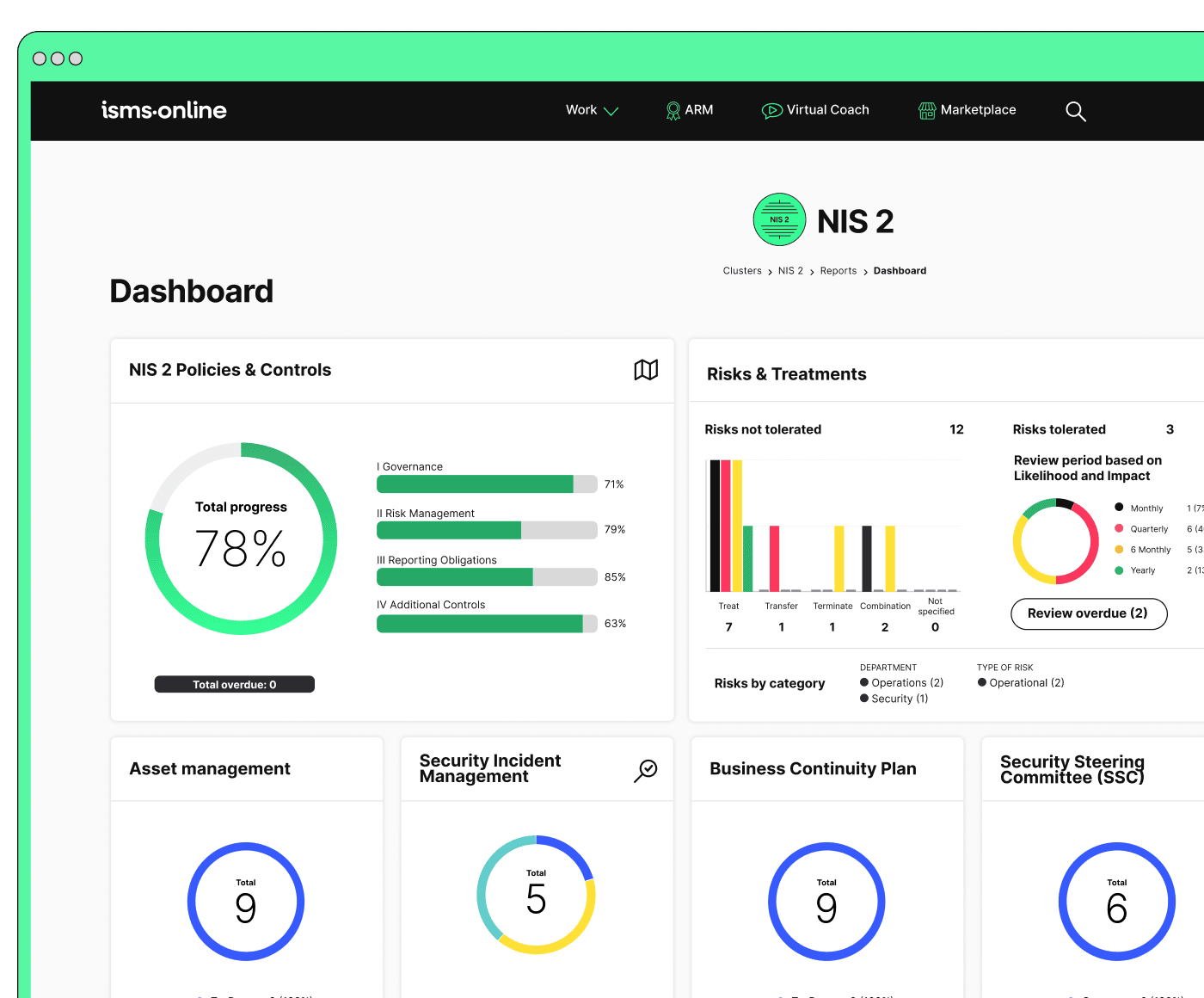
Be NIS 2-ready from day one
Launch with a proven workspace and templates – just tailor, assign, and go.
Why Do Drills and Team Awareness Determine Long-Term Resilience?
Paper controls and perfect logs can unravel in a crisis if teams and suppliers are untrained, disengaged, or unaware. NIS 2 positions resilience as a lived process-where participation rates, feedback loops, and supplier engagement are as important as the controls themselves. Lost institutional memory or supplier turnover is now a leading audit risk.
A well-drilled, engaged team outperforms any checklist in a real event.
Building a Resilient, Audit-Proof Team
- Scenario-driven minimums: At least two drills per year per site, covering both expected and “edge-case” threats, with all relevant parties.
- Log who participates: Every name, role, and third-party involved; gaps or absences addressed via follow-up.
- Feedback to improvement: Lessons learned from each drill must transparently drive updates in policy, process, or controls-logs stamped with date and responsible owner.
- Supplier inclusion: Outsourced and supply chain partners must participate actively-proof now required in the same evidence flow as internal teams.
Visual tracker
ISMS.online dashboards allow visualisation by drill type, participation rates, and open corrective actions, surfacing latent gaps before they attract regulatory scrutiny.
Resilience grows in the space between drills, not in static policy documents.
Long-term compliance and resilience depend on regular, scenario-based drills-tracked for participation and improvement, covering staff and suppliers alike. “Living compliance” is a feedback system, not a file drawer.
How Do You Prove Supply Chain, Outsourcing, and Utility Controls for NIS 2?
Supply chain and utility dependencies now invite as much audit attention as internal controls. Article 13.2’s expanded scope mandates logs and test evidence from all critical suppliers, utilities, and third parties. A missing generator failover log or absent supplier incident report is now your compliance risk, regardless of contractual clauses.
Your audit is only as strong as your weakest supplier’s last test log.
Ensuring End-to-End Supply Chain Evidence
- BC/DR logs: Suppliers must document their participation in your disaster recovery drills and supply test logs upon request.
- Utility redundancy checks: Request and keep evidence for generator tests, unplanned failover scenarios, and restoration times, not just for owned assets but for utility vendors.
- Contractual compliance: Ensure supplier contracts mandate routine evidence sharing, participation in drills, and post-incident reviews-both upstream and downstream.
- Translation and local recognition: For global supply chains, ensure logs are notarised and legally recognised in both your home and supplier jurisdictions.
ISMS.online automates supplier task assignment, evidence collection, and compliance mapping, linking all third-party involvement directly to your risk and control dashboard.
Your compliance under Article 13.2 is inseparable from your supply chain’s evidence-putting as much emphasis on utility and supplier logs as on your own. Make supplier participation and evidence an explicit, living part of your ISMS.
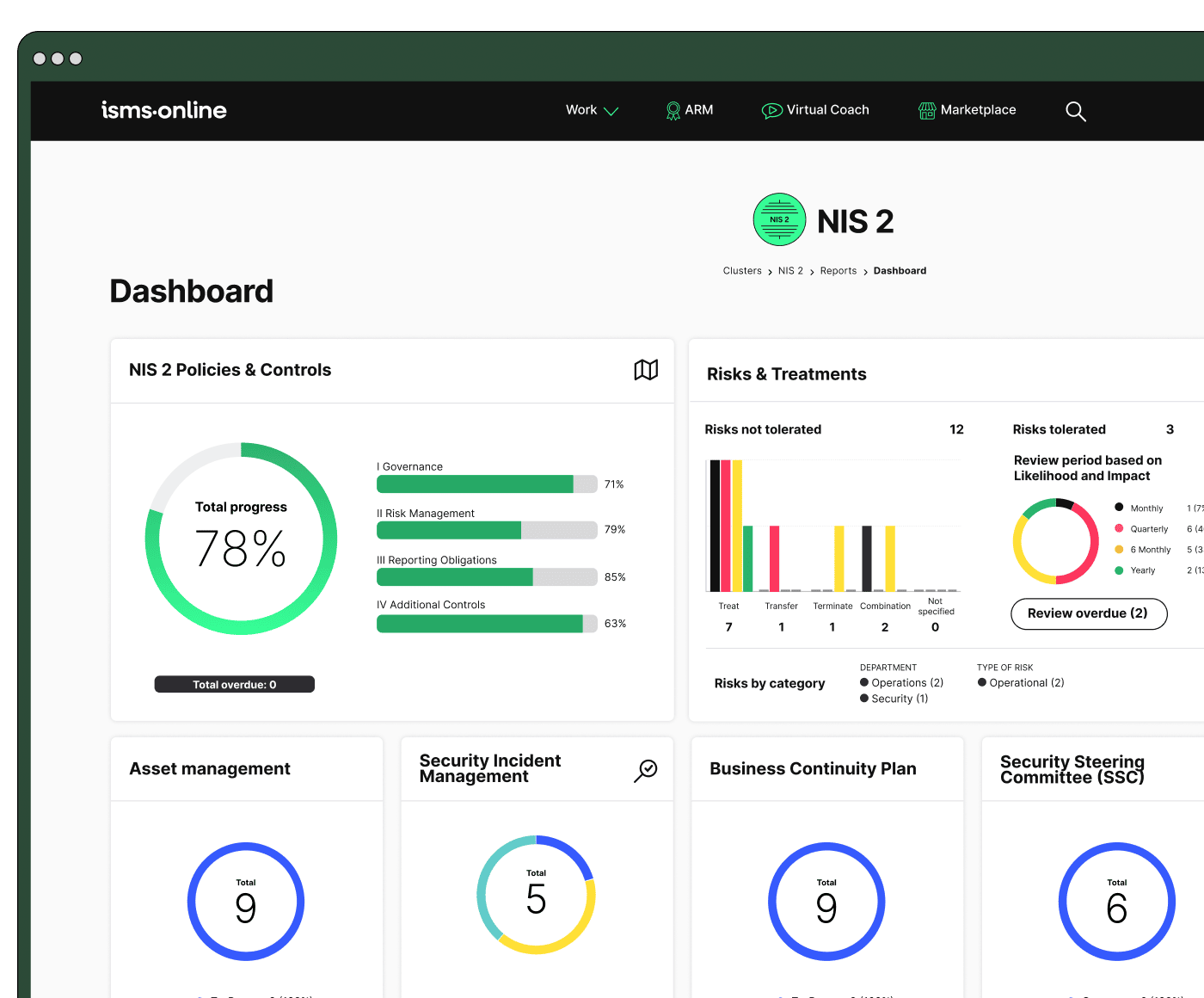
All your NIS 2, all in one place
From Articles 20–23 to audit plans – run and prove compliance, end-to-end.
How Should You Tailor Controls for Local Law, Geography, and Sector?
“Generic compliance” is no longer sufficient; auditors now expect context-aware controls and evidence. Your flood zone, local utility norms, legal jurisdiction, and sector-specific requirements must drive custom reviews and drill schedules. Ignoring local nuances creates an outsized risk of audit failure.
Resilient compliance speaks the language of local risk, not just standardisation.
Systematic Local Adaptation
- Local risk mapping: Tie each facility, asset, and process to its regional hazards (extreme weather, utility type, local law).
- Drill frequency: Adjust the schedule for sites in high-risk zones (quarterly for urban flood areas, semiannual for standard settings).
- Sector/industry requirements: Some sectors (healthcare, energy, public sector) have unique BC/DR and access standards; map controls and evidence accordingly.
- Ownership and accountability: Assign review and evidence responsibilities locally; don’t centralise to “group compliance” unless every nuance is still tracked.
Localised audit mini-table
| Local Factor | Required Adaptation | Evidence Example |
|---|---|---|
| Urban flood risk | Quarterly flood drills | Recent drill logs, local feedback |
| Data sovereignty law | Local-site audit trail | Locally stored, region-attested |
| Shared tenancy site | Updated tenant registers | Occupant and access diagrams |
ISMS.online helps map local variances and assign responsibilities, tracking sector, legal, and regulatory overlays.
Customise your controls, audits, and evidence management for every jurisdiction, sector, and regional risk, ensuring every local expectation is anticipated and documented.
How Can ISMS.online Guide Your NIS 2 Article 13.2 Compliance-Start a Board-Ready Risk Review
Achieving-and demonstrating-Article 13.2 compliance at scale comes down to your platform’s ability to automate, map, and visualise evidence flow. ISMS.online provides this backbone-turning every log, drill, and exception into a board- and audit-ready artefact, all harmonised to ISO 27001 and easily exported per site, supplier, or incident.
A compliance platform should predict your next exception-not wait for auditors to find it.
Stepwise Board-Ready Review and Resilience Cycle
- Import mapping: Rapidly onboard facilities, link to local threats, automate evidence gathering, and cross-map to ISO 27001 and NIS 2 controls.
- Role mapping: Assign owners, reviewers, and suppliers across region, sector, and supply chain; automate notifications and review cycles.
- Evidence pack automation: Build real-time audit bundles-segmented by site, supplier, incident, or control-always up to date, never ad hoc.
- Exception and audit readiness dashboards: Monitor overdue items, role engagement, open gaps-surfacing problems long before they appear in audit findings.
Own Your Next Review
Using ISMS.online, you can close the loop: every risk, event, and control writes instantly to both management and regulatory evidence, ensuring nothing is left unreviewed or unauditable. Spark a living resilience cycle on your next board agenda-ensure your organisation not only passes the next audit, but withstands the next real-world test with confidence.
ISMS.online turns regulatory, supplier, and local complexity into a unified, automated evidence flow-empowering you to lead on both audit and actual resilience under NIS 2.
Book a demoFrequently Asked Questions
Who is truly responsible for updating the scope of physical and environmental threats under NIS 2 Article 13.2-and how have emerging risks redefined compliance expectations?
Your organisation carries ultimate responsibility for identifying and continually updating the scope of physical and environmental threats under NIS 2 Article 13.2, but this duty now plays out under active scrutiny from national authorities and ENISA. Gone are the days of static threat lists focused solely on fire, flood, or theft. Regulators expect organisations to maintain a living, highly contextual risk register-accounting for rapidly evolving threats like heatwaves, droughts, infrastructure failures, and climate-driven incidents (ENISA, Threat Landscape for Climate Change). Modern compliance means your threat universe must flex in real time as incidents, utilities, supply chain interdependencies, and even rare events become routine.
National authorities set the bar: audits increasingly flag static or generic risk registers for being out of step with changing realities. ENISA’s sector threat landscapes serve as reference, but your controls must show an ongoing, localised review responsive to recent events and regional factors. In practise, ISMS platforms like ISMS.online make these updates visible and auditable, linking incidents and risk changes directly to responsible owners and time-stamped evidence.
Today's compliance gap is defined not by what you missed last year-but by what regulators expect you to know right now.
Oversight, rhythms, and escalation
- Real-time review and incident-driven updates are required; mere annual reviews can now trigger regulatory findings.
- Omission of new-outlier threats (like cyber-physical convergence, extended utility failures, or climate extremes) is a cited audit fault.
- Audits demand regionally-aware, facility-specific records-backed by evidence you’re learning from new incidents and adjusting controls accordingly.
- ISMS.online enables dynamic updates, ensuring your risk register always reflects your present-not just your history.
What are the most effective physical and environmental controls for NIS 2 Article 13.2, and how do they really map to ISO 27001:2022?
NIS 2 Article 13.2 compels organisations to demonstrate not just theoretical controls, but a living, layered system: real perimeter defences, environmental monitoring, tested backup utilities, active incident response, and maintained logs. ISO 27001:2022’s Annex A creates a one-to-one mapping for all essential and important entities-but successful organisations go further by establishing operational, reviewable evidence for every control. With ISMS.online, each threat maps directly to a control owner, test cycle, real-world outcome, and audit-ready proof.
Table: Bridging Article 13.2 to ISO 27001:2022 Operational Controls
| Threat / Control Area | ISO 27001:2022 Reference | Real-World Evidence Examples |
|---|---|---|
| Perimeter & Access | A.7.1, A.7.2 | CCTV logs, visitor badge trace, access logs |
| Environmental Hazard | A.7.3, A.7.5 | Drill/test reports, sensor event logs |
| Utilities/Continuity | A.7.11, A.8.14 | Generator/UPS maintenance, failover tests |
| Incident Detection/Response | A.5.24–A.5.28 | Incident logs, after-action reviews, reports |
| Maintenance/Decommission | A.7.13, A.7.14 | Maintenance logs, disposal certificates |
Controls must be proven with fresh, timestamped records-not just written policies. Platform-enabled mapping between ISO clauses and live logs is now an audit differentiator: ISMS.online captures the loop from test cycle or drill to audit-ready evidence, ensuring rapid recall under review.
Controls stated in policy but never evidenced are the first red flag for a modern auditor.
How do you ensure controls, risks, and evidence are always audit-ready in real time?
Real-time audit readiness now means bridging every asset and threat to a control, each with a live status, a named owner, and current operational evidence. For every incident or test (e.g., HVAC alert, flood drill, unauthorised entry), workflows must immediately attribute actions, log the result, update the risk register, and store photographic or digital proof. ISMS.online’s structure ensures that every trigger-alarm, drill, review-automatically chains the asset, control, log, and lesson learned, ready for instant audit export.
Table: End-to-End Traceability in Action
| Trigger/Event | Risk or Control Updated | ISO/SoA Reference | Live Evidence Logged |
|---|---|---|---|
| HVAC alarm triggers | Update: Cooling Risk | A.7.5 | Alert log, repair invoice, photos |
| Minor flood at remote site | Update: Flood Risk | A.7.3 | Incident log, mitigation steps, photos |
| Generator maintenance/drill done | Prove: Power Resilience | A.7.11, A.8.14 | Test records, signatures, analytics |
If an auditor asks, “What happened on, who acted, what was learned?”-you must have the chain from trigger to action, including photographic, sensor, or incident proof. ISMS.online streamlines this, linking every update to responsible roles and enabling clause-focused snapshots for even unscheduled reviews.
If your system can’t answer every ‘what if’ with a fresh log and a name, your compliance won’t survive the audit.
Why do drills and ongoing awareness campaigns change your compliance outcome-and how do you measure their maturity?
Drills and awareness campaigns transform compliance from static paperwork to operational resilience. Organisations that schedule at least two drills per year, plus regular staff awareness campaigns, reduce audit nonconformities and close incident response gaps significantly (Security Magazine, 2022). Each drill or campaign should result in a log: participants by role, failure points, follow-up actions. High-performing teams log time from alert to remediation, trendlines of open actions, and participation rates-all within ISMS.online dashboards.
Metrics that move auditors (and boards):
- Real participation by staff, contractors, suppliers
- Time-to-remediate from alert to closed action
- Up-to-date trendlines: open vs. resolved actions
- Recency: last drill/campaign date per site
- Evidence of improvement cycles (lessons promptly actioned)
Proactively tracking these metrics demonstrates resilience and maturity, making policy a living process rather than static compliance. ISMS.online shows readiness to auditors and stakeholders alike, allowing drill/campaign evidence to flow directly into audit exports.
Your drill logs, not your policy docs, tell the real story of organisational resilience.
How do you secure full auditability when suppliers, contractors, and external providers are in the risk chain?
Resilience now demands that third-party evidence is as tight as your own. NIS 2 and ISO 27001 enforce “flowdown” of controls into supplier contracts: critical suppliers-utilities, building managers, cloud-must be assigned roles in drills, share incident evidence, and document mitigation. ISMS.online automates reminders, escalates overdue evidence, and links every artefact to your audit trail, so you are never blindsided by a supply chain gap. Contracts should spell out explicit evidence return timelines and joint-drill requirements; missed logs must be flagged and chased before auditors step in (Uptime Institute, 2024).
In today’s compliance reality, every missing supplier log is your audit risk-not someone else’s.
What full auditability demands:
- Joint-drill participation (utilities, landlords) and log submission deadlines
- Mapping of all critical third parties into your risk/control register
- Automated tracking and escalation of overdue supplier evidence
- Clause-specific linking of supplier logs to the audit programme
ISMS.online makes these flows visible, ensuring third-party resilience is tracked, not assumed.
How do you adapt controls and evidence for local, legal, and sector specifics-and avoid “boilerplate” compliance failures?
NIS 2 and ISO 27001 require explicit adaptations: controls, review cadence, and evidence must fit local hazards, building codes, sector mandates, and language requirements. ENISA’s country-specific risk profiles offer a guide (ENISA, National Cyber Risk Profiles). In practise, each site’s controls, logs, and drill cadence must be tailored: city-centre HQs may need enhanced entry controls and frequent safety drills; floodplain operations must log sensor readings and utility responses. In Germany, policies and logs may need to be in German, with locally trained staff.
Table: Adapting Controls for Context
| Location/Context | Must Adapt Controls | Evidence Needed |
|---|---|---|
| City HQ | More frequent drills, tighter access | Logs, drill reports, visitor badges |
| Floodplain plant | Quarterly utility/flood tests | Sensor/test logs, flood response records |
| High-rise in Berlin | Fire/safety signage, German logs | Photos, language-specific signoff |
| Colocation site | Shared-responsibility mapping, signoffs | Shared incident/entry logs |
ISMS.online’s configuration allows by-site/country tailoring for review cadence, responsible roles, language, and log type-blocking “one-size-fits-all” compliance errors before regulators or auditors can cite them.
What operational cadence and next steps keep physical/environmental compliance rhythmically up to date-and defensible in an audit?
The organisations that pass audits painlessly are those where compliance is a rhythmic process, not a year-end scramble. To achieve this:
- Update site, asset, and supplier risk registers regularly-ideally at least quarterly.
- Assign review/response owners at site and control level, ready for legal/staff change.
- Log every drill, incident, supplier/test return, and maintenance promptly against controls and clause.
- Schedule ≥ two drills and ≥ one campaign per year for each major facility, tracking via dashboards.
- Monitor dashboards for overdue/missing actions so audits become routine, not crises.
ISMS.online automates review cycles and evidence flows, surfacing lapses before they trigger enforcement or reputational risk.
Resilience beats routine only through rhythm: orchestrate evidence, update risks, and your next audit becomes a demonstration-not a defence.
Ready to close the audit gap? Invite your team or supply chain to an evidence walkthrough in ISMS.online and make audit success a recurring motif, not a lucky break.






