





































Why are cyber and supply chain threats redefining what “compliance” means for the waste water sector?
In today’s waste water sector, the line between regulatory compliance and active defence grows thinner with every breach headline. Ransomware actors now routinely probe water utilities not for zero-day exploits, but for the everyday gaps left by legacy infrastructure, vendor VPNs, and flat internal networks. Compliance focus has shifted: regulators and insurers no longer care for shelfware policies-they demand living, timestamped, operational evidence that demonstrates you can withstand and document a cyber disruption, not just recite a standard.
Every vendor login, unsegmented network, or outdated asset list hands attackers-and auditors-the keys that policy alone will never hide.
How remote access and supplier connections drive risk in the sector
The waste water sector’s hybrid of old SCADA systems and new cloud-connected tools amplifies the risk landscape. Remote access-so vital for efficiency-remains the sector’s Achilles heel. Audit failures and breaches now stem as much from shared or orphaned supplier accounts as from technical exploits. NIS 2 and ENISA guidance require all remote and supplier access points to have enforced multi-factor authentication (MFA), regular rotation, and demonstrably revoked privileges when contracts end (ENISA Threat Landscape for Water). Networks must now be mapped into clear, exportable “zones”-showing exactly how IT, OT, and third-party entry points are separated and monitored.
Why supply chain mapping is the new minimum standard
It’s no longer acceptable to glance at supplier lists once a year; the NIS 2 Directive reclassifies suppliers as “continuously scrutinised” critical assets. Compliance now means dynamic registers that document who has access, when it’s reviewed, and how suppliers are decommissioned. Operators need live supply chain risk dashboards and workflows that record every credential or incident notification-a requirement backed by both ENISA’s sector guidelines and standard overlays like Royal Decree 311/2022. If deprovisioning happens late or isn’t logged, both attackers and regulators have all the evidence they need to hold your organisation accountable.
Scale, scope, and the cross-border challenge
Where once compliance scope was defined by paperwork and square footage, today’s regulator cares about every digital and physical link to essential water services. Cross-border operators are pressed to harmonise asset and supplier registers across multiple regimes-each with distinct definitions, reporting windows, and enforcement preferences (ENISA Strategy Guide). Dashboards and workflows must now map not just assets, but every legal boundary and partner connection-proving no link is neglected.
Why living logs, not policies, separate safe from sorry
Regulators and auditors distinguish the serious from the surface-level by asking for live logs: not a policy folder, but timestamped segmentation diagrams, supplier deprovision records, test schedules, and drill participation logs-including suppliers. When these are not available, a policy-no matter how elegant-is treated as a red flag for both operational and compliance risk. ISMS.online and similar compliance engines are designed around concurrent, actionable evidence, not annual snapshot documents; they keep registers, logs, and corrective loops audit-ready and exportable on demand.
Book a demoWhy do audits and cyber incidents expose the same root failures in waste water operations?
Cyber attackers and compliance auditors are, in one way, allies: both will inevitably surface the cracks left by everyday shortcuts and obsolete procedures. This is no longer a matter of if, but when-risk is now revealed equally by the adversary and the audit.
Your cyber resilience is not what’s on paper-it’s what you can defend, fix, and prove in a crisis.
Real-world breaches and audit failures: Looking for the same weakness
The Oldsmar water plant incident in Florida demonstrated how attackers, using basic (and widely available) remote desktop applications, navigated an undivided, poorly monitored network to reach critical systems. Auditors would have flagged the same misconfigurations: shared credentials, outdated asset registers, lack of segmentation, and an absence of supplier access controls (CSOonline – Oldsmar Cyberattack Analysis). Gaps are common: expired certificates, out-of-date registers, and orphaned supplier accounts.
The self-attestation trap: Why paperwork isn’t proof
Too many operators rely on annual self-certification cycles-submitting “read and understood” checklists, yet operating with unmonitored, untested controls in the real environment. EU regulators and most insurance providers no longer accept self-attestation at face value (ISMS.online – Supply Chain Risk Management); today, only logged actions, automated register extractions, and drill audit trails count as proof.
Multi-jurisdiction risk drift: The hidden compliance trap
Operators with assets or contracts spanning borders face a unique challenge: NIS 2 transposition is fragmented, with deadlines, asset types, and incident notification SLAs varying by country (ECS-org NIS 2 Transposition Tracker). This means that a control considered compliant in one location may leave you exposed somewhere else-unless you keep a harmonised, up-to-date compliance registry explicitly mapped to each local legal nuance.

Master NIS 2 without spreadsheet chaos
Centralise risk, incidents, suppliers, and evidence in one clean platform.
Which NIS 2 and sector security controls are no longer optional, and how must they be evidenced?
Audit resilience now means moving from “documented intent” to “proven operation.” The new floor is set not by policies but by evidence-backed, actively managed controls.
Core controls the regulator now expects-no exceptions
- MFA everywhere: No unprotected remote or supplier logins.
- Network segmentation: Physical and logical separation between OT, IT, and supplier zones; live topology diagrams are a must.
- Active asset inventories: Quarterly-reviewed, cross-linked to both network maps and procurement records.
- Supplier compliance contracts: Explicit clauses mandating incident reporting, regular review, and participation in DR/BC testing.
- Automated test/drill logs: Auditor extractable, not manually maintained.
Compliance gap-to-control bridge table
A rapid snapshot to convert audit gaps into actionable controls (each supported by evidence):
| Audit Failure/Incident | Control Fix | Evidence Required |
|---|---|---|
| Orphaned supplier access | Annual credential review and live log | Supplier access register, revocation logs |
| Outdated asset lists | Quarterly cross-zone asset validation | Timestamped asset inventory, update logs |
| Missing drill logs | Automated test log platform | Drill schedule/attendance records |
| Inadequate incident notification | Contract clause and supplier scenario test | Export of supplier notification logs |
Every missing test log or supplier ledger becomes the attacker’s gift and the auditor’s trump card.
Registers as the operational backbone
Your disaster recovery, supplier, and asset registers should act as living systems-updated during drills, not just reviewed before audits. Modern compliance tools (e.g., ISMS.online) automate the cross-linking of events, registers, and actions, so regulators can see not only that you have controls, but that you use, test, and revise them in real time (ECS-org NIS 2 Transposition Tracker).
What business continuity and disaster recovery (BC/DR) measures withstand NIS 2 scrutiny-and how must they be evidenced?
Resilience is only real when you can demonstrate it. NIS 2 now requires BC/DR plans to go far beyond policy PDF files; operational evidence must show the involvement of key suppliers, annual or scenario-driven testing, and traceable post-test lessons-learned.
Frequency and scope: How often and who must you test with?
Annual testing is now the minimum-NIS 2 expects you to run full-scale and scenario-based drills, clearly involving not just internal teams but all “essential” and “important” suppliers (Bechtle Talk NIS2). Suppliers who do not participate leave a verifiable audit gap. Every drill should log participants, results, follow-up actions, and the corrective actions mapped and closed. Logs must be retrievable well beyond the test-regulators may request proof long after reporting windows have passed.
Common shortfalls-how audits catch insufficient BC/DR
Failure points include drills that exclude third parties, fragmented evidence logs, and missing signoff chains post-exercise (ENISA – Supply Chain Security). ISMS.online’s register integration is designed to eliminate these: each drill, supplier notification, and improvement loop is linked for easy export under review.
Operational bridge mini-table: Law → Execution → Evidence
| Legal Expectation | Operational Approach | ISO 27001 Reference | Audit Evidence |
|---|---|---|---|
| Annual BC/DR test w/ suppliers | Run scenario w/ supplier | A.8.13, A.5.29, A.5.19 | Drill logs, signoff register, lessons-learned |
| OT/IT segmentation | Regular auto-log review | A.8.20, A.8.22 | Network segmentation diagrams, access logs |
| Supplier incident reporting | Contractual/test workflow | A.5.21, A.5.24 | Exported contract, supplier notification log |
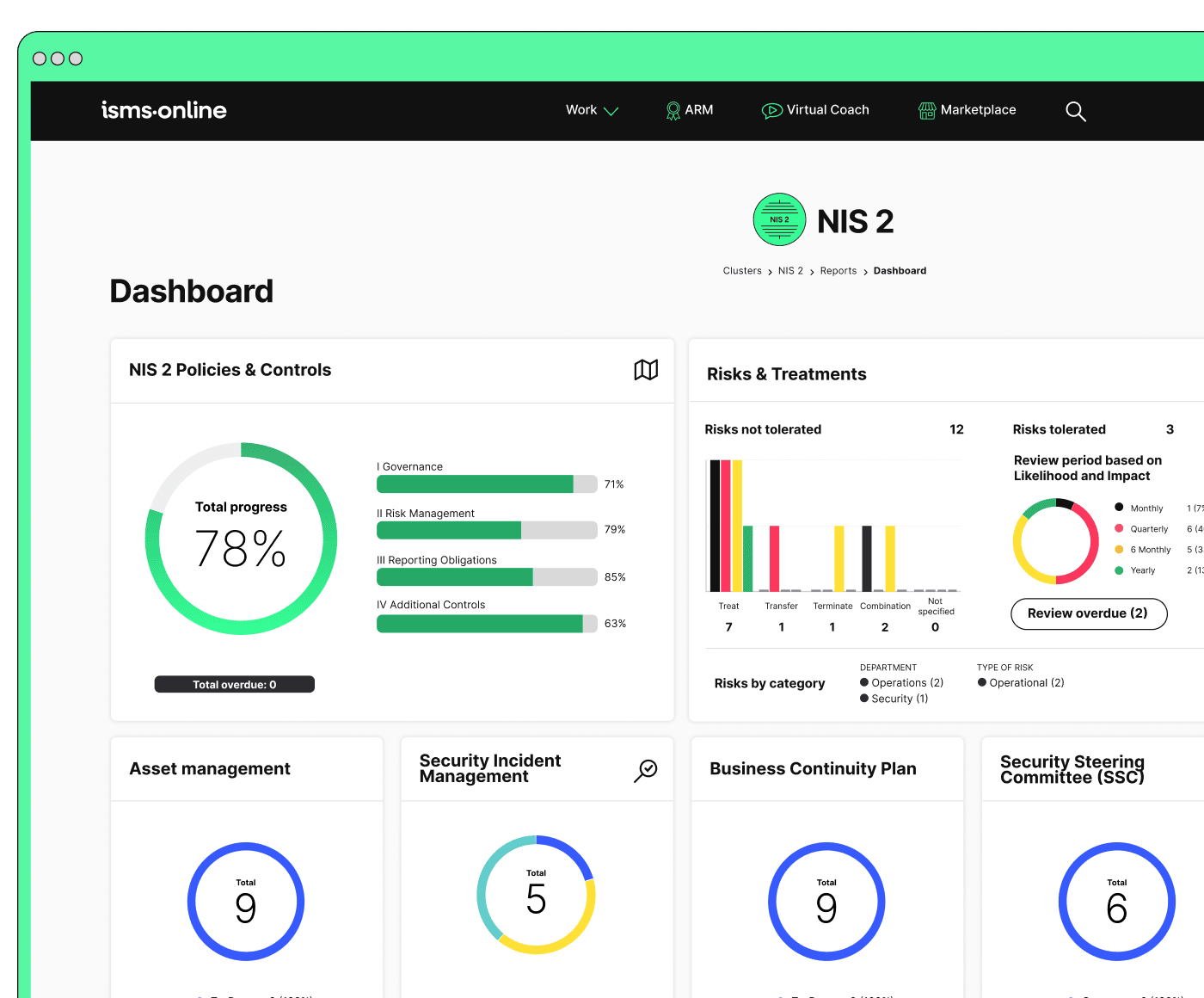
Be NIS 2-ready from day one
Launch with a proven workspace and templates – just tailor, assign, and go.
How should waste water operators manage entity scope, complex jurisdiction, and governance realities?
NIS 2’s expansion means almost every operator is “in scope”-the burden is on you to document exclusions or boundaries, not assume you’re out of remit. Governance is now a test of evidence, not intention.
Mastering multi-jurisdiction compliance (or: the “split-brain” risk)
From Belgium to Spain, NIS 2 is rolled out with local differences. What keeps your operation audit-proof is a central register for scope boundaries, mapped national rulebooks, and ongoing dialogue with authorities (ENISA – Entity Classification). Outreach isn’t just reputational-auditors view preemptive compliance communication as a marker of maturity.
Regulators remember those who reach out before audits, not only after an incident.
Governance isn’t a slide deck-it’s the living record
Boards and regulators want heatmaps of compliance: Which controls are tested? Where are registers up to date? Are corrective actions tracked and closed? Audit comfort now comes from dashboards showcasing continuous governance routines, not static annual reports.
Why ISO 27001 is the backbone and sector overlays complete your NIS 2 defence
ISO 27001:2022 provides the universal structure for risk management, access control, and evidence mapping in the water sector-a trunk that every competent auditor recognises. Sector overlays like CEN/TS 18026 and Spain’s Royal Decree plug the specifics: frequency of drills, OT/IT separation substance, and unique register duties (ISO 27001:2022). The pattern is clear: general framework for security hygiene, sector overlay for operational specificity, and platform to automate the necessary logs and exports.
Fast-visual: Compliance lineage chart
Trunk = ISO 27001:2022
Branches = sector overlays (CEN/TS 18026, Royal Decree 311/2022, ENISA)
Roots = real-time operational logs, supplier registry, asset inventory.
Your resilience story is incomplete without both: a solid compliance backbone and living operational evidence.
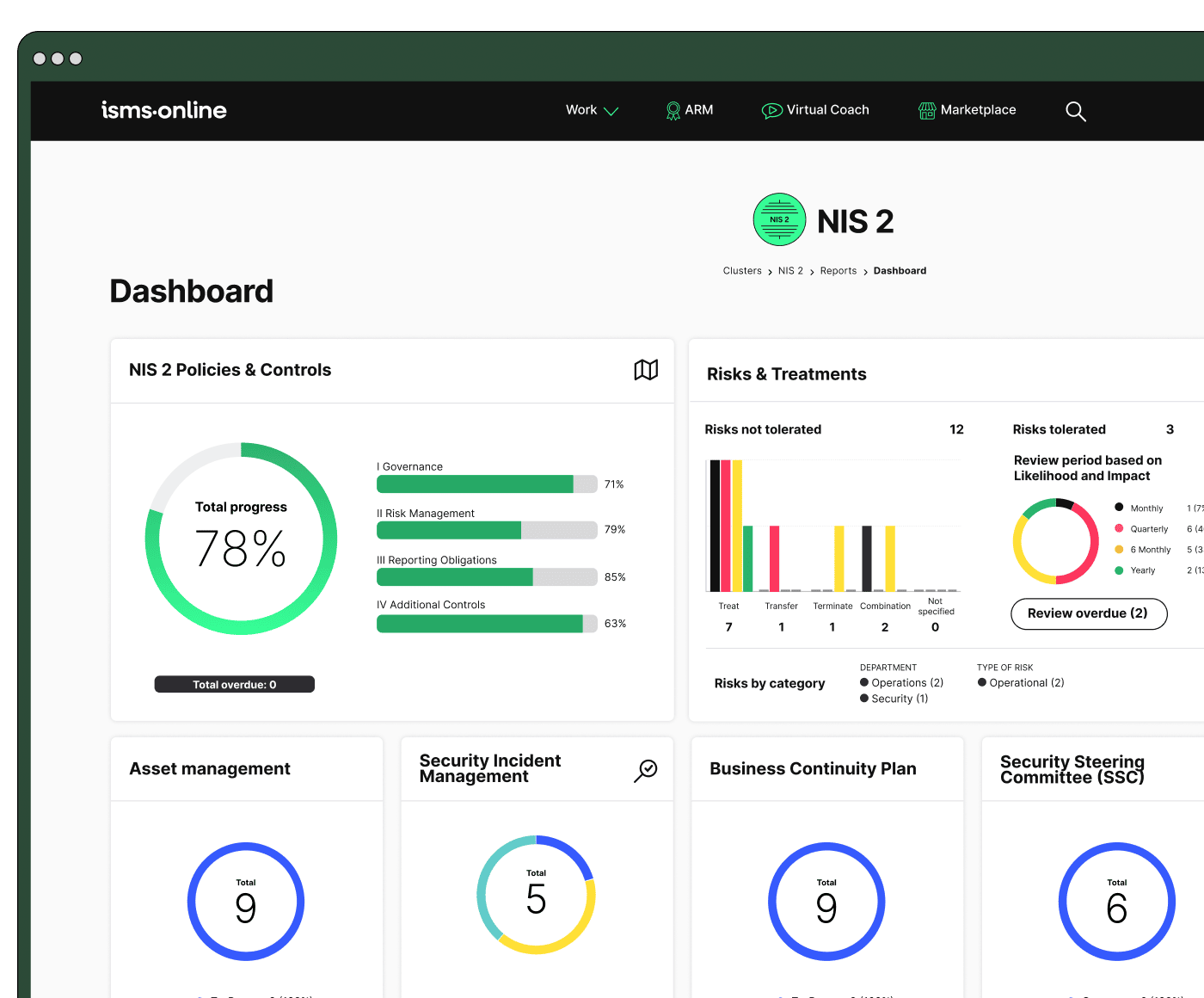
All your NIS 2, all in one place
From Articles 20–23 to audit plans – run and prove compliance, end-to-end.
What is “audit-ready evidence” and how do you build an end-to-end chain for NIS 2?
To move beyond compliance as reputation risk, every operator needs a “proof chain”: every policy, control, register, and corrective action logged so the path from trigger to remediation can be traced start to finish.
Building your evidence chain: What to log, link, and monitor
- Digitally signed polices: -timestamped and accurately versioned.
- Statement of Applicability (SoA): -shows mapped controls, updated as legal overlays change.
- Supplier and asset registers: -live, updated, exported before every audit.
- Drill/test logs: -full participant list, test outcomes, follow-up actions.
- Training and near-miss events: -proving engagement and learning loops.
Traceability mini-table: Connecting events to controls and evidence
| Trigger | Risk Register Update | Control/SoA Link | Evidence Logged |
|---|---|---|---|
| Vendor incident | Update supplier risk | A.5.21, A.5.19 | Incident log, supplier export |
| Disaster drill | Update/test BC/DR plan | A.5.29, A.8.13, A.8.14 | Drill logs, improvement action plan |
| New asset onboard | Update inventory + SoA | A.5.9, A.8.1 | Asset log, device documentation |
A mid-size operator logs a new supplier’s drill scenario, exports the registry record-timestamp, outcomes, supplier signoff, improvement actions-all mapped to audit demands.
Evidence wins: closing the intent–action gap
Whether under attack or audit, resilience is proven by how quickly you surface logs of what happened, when, and how you improved. Digitise gap checks-run quarterly reviews to flag missing test evidence, stale registers, or lagging corrective actions before your next regulator request.
ISMS.online: Aligning sector controls and evidence for defensible NIS 2 waste water compliance
ISMS.online accelerates and automates waste water sector compliance-from template control structures for ISO 27001 and sector overlays, to live asset and supplier registers, audit trails, and disaster recovery evidence. Compliance leadership is about readiness and visibility, not heroics. The best operators log drills proactively and involve supply chain partners as “first responders”-using digital registers and workflows to benchmark and export proof on request (ISMS.online NIS-2 Compliance).
Closing gaps before incidents or audits-operationalised, not theoretical
Replace static documents and spreadsheet sprawl with real-time, linked evidence. Every drill, new asset, supplier contract, or corrective action is export-ready and mapped to an auditor’s needs-a seamless bridge between operational resilience and regulator demands.
Why top operators benchmark against evidence completeness, not intentions
Compliance leadership today demands more than passing marks or policy libraries. It’s measured in the completeness and currency of your evidence, the engagement of your entire supplier ecosystem, and the capacity to export what happened, when, and how you improved-at any audit, any time.
Now is the time to make compliance your operational discipline-not an annual scramble
Don’t wait for the next attack or regulatory deadline to surface gaps in your logs. When you move to active registers, living drills, and supplier-involved scenarios, you convert compliance from cost to capital-making your operation resilient, auditable, and reputation-forward.
ISMS.online places asset maps, supplier management, and operational logs at your fingertips-ensuring that every test, notification, or incident can be evidenced in real time. Move your compliance posture from reactive to leading edge-where your sector expects, your board demands, and your team deserves.
Frequently Asked Questions
Who defines NIS 2 controls for waste water operators, and what proves compliance at audit?
In the EU, national competent authorities turn NIS 2’s legal text into binding controls for waste water operators by writing sector-specific requirements into national law-often referencing overlays like CEN/TS 18026 or Spain’s Royal Decree 311/2022. If your organisation is a public, regional, or major infrastructure provider, you’ll almost certainly be designated an “essential entity” and required to fulfil both the base NIS 2 obligations and national sector overlays. Yet, audit success now hinges on operational discipline-not static policy folders. Auditors will only accept “living evidence” that your registers, controls, and processes are active and real.
- Is your risk register updated in real time, with active tracking of asset and supplier status?
- Can you surface current logs enforcing multifactor authentication for remote/supplier access?
- Do you possess and regularly review OT/IT segmentation diagrams with proof of annual updates?
- Can you deliver incident logs with timestamps proving you meet 24h/72h notification rules?
- Are BC/DR drill records, vendor sign-offs, and improvement actions instantly accessible, connected, and current?
What separates a pass from a fail is your team’s ability to export proof-on demand-that every control is not just described, but operationalised. If you can’t produce supplier involvement logs, drill evidence, or live risk registers, policy detail is irrelevant.
Auditors now gauge compliance by your ability to produce, in minutes, hard evidence of operational controls, not just aspirations.
Rapid-check audit flow
Do you have a single system where every required register, drill, and supplier log is up-to-date and instantly exportable? If so, you’re ready. If not, even the best-written policies will leave you exposed.
References:
- ENISA’s water sector guidelines
- NIS 2 Directive: Article 21, Recital 89
How can waste water operators structure and test BC/DR plans for credible NIS 2 audit evidence?
Passing NIS 2 audit demands BC/DR plans that are not just written, but actively tested and supplier-connected. Each year, your organisation must run risk-based scenario drills involving internal and supplier stakeholders; logs must explicitly capture date, scope (including which suppliers participated), test outcomes, and remediation actions assigned. Auditors want traceability-drills linked to your incident log, risk register, management review minutes, and, wherever possible, supporting supplier/contract records.
- Scenario details: Document which scenario was run, who participated, and test objectives.
- Supplier sign-off: Require signed confirmation of involvement; document any non-participation for remediation.
- Remediation loop: Assign, track, and close improvement actions; link them to future tests or reviews.
- Board/export visibility: Aggregate logs for management, board, or regulator export on short notice.
Leading ISMS platforms, such as ISMS.online, automate the cross-linking between test logs, supplier records, action plans, and evidence exports-a critical edge in audit readiness.
| BC/DR Control | Test Action | Sample Audit Evidence |
|---|---|---|
| Annual drill | Run w/ supplier, log results | Drill log, supplier signed register |
| Remediation | Assign & close | Action plan, closure confirmation |
| Incident linkage | Tie test to incidents | Board minutes, export trace log |
A BC/DR plan without supplier-proof and improvement closure is the quickest path to audit failure.
References:
- ENISA: Securing the Supply Chain
- Bechtle: NIS2 Emergency Recovery
What are the practical supply chain and third-party security duties for NIS 2 in water utilities?
NIS 2 makes supplier discipline your business-not just a legal box-tick. Every critical vendor must be tracked in a live supplier register, including remote/privileged access, incident notification obligations, participation in scenario drills, and enforcement of timely credential revocation. You must gather:
- Supplier contract and due diligence logs: Proof of breach history, certifications, and access reviews.
- Live records of supplier participation in drills/tests, notifications served, and improvement actions closed.
- Audit trails showing that supplier non-performance (missed drill, skipped deprovisioning) triggered action-since audit and regulatory penalties will land on the operator, not just the vendor.
| Control target | Acceptable Audit Evidence |
|---|---|
| Access privileges | Supplier register, access logs |
| Incident notification | Notification and response timeline |
| Drill/test involvement | Signed supplier logs, drill records |
| Remediation follow-up | Improvement action closure register |
Regulatory compliance is brittle where supplier records are missing; every test, notification, and deprovisioning must be provable on demand.
References:
- KPMG: NIS2 and Supply Chain
How do “essential entity” status and national overlays change NIS 2 compliance for water sector operators?
By default, most medium-to-large waste water operators are designated “essential entities” under NIS 2, binding them to its full compliance regime. National overlays-like Spain’s RD 311/2022 or Germany’s BSI requirements-can increase incident notification speed, detail for supplier/asset registers, or mandate extra reporting. If your operations span multiple Member States, the compliance landscape sharpens: you must reconcile differing jurisdictional overlays, unique local controls, and cross-reference every asset, supplier, and process to both NIS 2’s baseline and local additions. Quarterly reconciliation and proactive engagement with competent authorities is now the norm; missed mapping of suppliers, assets, or contracts (“scope gaps”) are penalised at audit with the same severity as missing controls.
| Overlay | Added Requirements | Audit-Proof Examples |
|---|---|---|
| Spain RD 311/2022 | 24h/72h incident, detailed supplier reg | Log exports, registry crosschecks |
| Germany BSI | Enhanced reporting, more controls | Authority correspondence, registers |
| Multi-country ops | Cross-overlay proof, quarterly updates | Unified registers, email logs |
Audit penalties now land as hard on undisclosed suppliers or contracts as on control lapses-always reconcile and map jurisdictions.
References:
- ENISA: Entity classification
Why is ISO 27001 necessary but insufficient for NIS 2 audits in waste water?
ISO 27001:2022 sets the backbone for information risk management, control mapping, evidence registers, and continuous improvement. However, NIS 2 demands sector/national overlays, supply chain controls, and field-ready evidence across IT and OT. For waste water:
- Asset/supplier controls must reference supplier management (Annex A:5.19, A:5.21), BC/DR testing and improvement logs (A:8.13, A:5.29), and OT segmentation (A:8.1).
- Each drill, vendor test, or incident must live-link registers, segmentation diagrams, contracts, and improvement actions.
- Sector overlays (e.g., CEN/TS 18026) and national overlays (Spain, Germany) have to be mapped and referenced in your SoA and registers for the audit to hold in every jurisdiction.
| Audit Expectation | Operationalisation | ISO 27001/Annex A / Overlay |
|---|---|---|
| Supplier drill involvement | Registered, logs, sign-off | A.5.19, A.5.21 |
| Annual BC/DR scenario test | Documented, improved, cross-referenced | A.8.13, A.5.29, A.5.19, CEN/TS 18026 |
| Segmentation diagram upkeep | Quarterly review, mapped registers | A.8.1, A.5.9, CEN/TS 18026 |
| Overlay control proof | Local register, SoA mapped policies | A.5.1, Spain RD 311/2022 |
ISO 27001 is the trunk, overlays are branches, live operational logs are the roots-only all three together pass today’s audit.
References:
What audit evidence and traceability must waste water utilities log to be NIS 2-ready?
Passing NIS 2 audit depends on your ability to present a complete, live-linked chain from policy intent to real-world action. Every control, event, asset, supplier action, and incident must generate versioned documentation accessible from a single system. Requirements include:
- Digitally signed and versioned policies and controls
- Statement of Applicability (SoA) directly referencing NIS 2 and all overlays
- Asset/supplier registers live-linked to every relevant control, drill, and incident
- Drill logs: participation, scope, outcomes, remediation assigned and closed, supplier sign-off
- Incident and near-miss logs, with timestamped workflow
- Management-ready and regulator-ready exports
| Trigger | Register Update | Control / SoA Link | Audit Evidence Example |
|---|---|---|---|
| Supplier breach | Supplier risk register | A.5.21, A.5.19 | Incident record, notification logs |
| BC/DR drill | Drill log, action closure | A.8.13, A.5.29 | Drill report, supplier sign-off |
| Asset onboarding | Update inventory, SoA | A.5.9, A.8.1 | Asset log, onboarding record |
Success now means surfacing, in a click, the unbroken pathway from any event trigger through to closure in registers and signed evidence.
How does ISMS.online accelerate and de-risk NIS 2 and sector overlay compliance for waste water utilities?
ISMS.online is engineered to help teams operationalise NIS 2 compliance as a daily discipline, not just a documentation event. Our platform brings:
- Pre-mapped control templates covering ISO 27001, CEN/TS 18026, and major national overlays
- Automated, up-to-date registers for assets, suppliers, incidents, and policies
- Integrated linkages between every incident, drill, BC/DR exercise, supplier action, and contract clause
- Reminders, workflow tracking, and instant evidence export tools for management, boards, auditors, and regulators
- Role-based access and multi-entity/site capability for cross-border compliance
- Continuous intelligence to connect policy, registers, and proof for every audit cross-check and overlay
- Practitioners, compliance managers, and senior leaders-whether public or regional-scale-can monitor readiness, act on improvement, and deliver audit evidence in hours, not weeks.
Experience ISMS.online’s compliance engine and transform your water sector readiness into resilience others can trust.
Learn more: (https://www.isms.online/cyber-security-solutions/nis-2-compliance/)
What single operational habit will define successful NIS 2 compliance for waste water operators in 2025?
The defining line in 2025 will be this: Waste water operators who treat compliance as an always-on, operational discipline-logging evidence, testing, closing supplier and incident actions, and reconciling overlays-will achieve not only audit pass but sector resilience, regulatory trust, and board confidence. Operators relying on annual paperwork or after-the-fact evidence will face growing risks, rising audit failure rates, and erosion of community and regulator trust.
- Evidence reviews and exports should be quarterly, not annual.
- Drills, supplier tests, and incident logs must directly connect to live registers and improvement cycles.
- Overlay mapping and cross-jurisdiction reconciliation must be systematic, not ad hoc.
- Management and boards will expect real-time assurance, not end-of-cycle updates.
Operational compliance transforms water sector security from insurance cost to resilience capital-trusted by regulators, boards, and the communities you serve.
Experience ISMS.online to make resilience your new normal-and your compliance always provable.






