





































Why NIS 2 Transforms Supplier Review: What Boards and Regulators Now Demand
As supply chains sprawl and third parties multiply, the risk within a single missing contract, an unvetted supplier, or poorly timed review can overwhelm the most robust security plans. NIS 2 redefines the stakes-what was once periodic, checkbox-driven oversight is now a real-time board-level priority. Directors, regulators, and auditors expect evidence that supplier risk management is not a static document, but a dynamic, continuous workflow that bends to every change, escalation, or incident.
87% of NIS 2 noncompliance cases cite missing, incomplete, or outdated supplier records as a root cause (ENISA, 2024).
Gone are the days when compliance could hide inside folders, inboxes, or unlinked spreadsheets. The measure of your programme is how quickly you surface a risk, escalate a contract breach, trace remediation, or show a live supplier record to a regulator-on demand, not upon vague request.
Boardroom scrutiny: Real-time oversight, not shelfware policies
Audit committees and leadership are now expected to demonstrate controls in action, not just wave policy documents. The regulatory challenge: “Show us controls, time-stamped logs, and live workflow history for each high-risk supplier” is becoming routine.
It’s a fundamental shift: Digital evidence-active control logs, system histories, and audit-ready documentation-carries more weight than theoretical intentions. You are responsible for the living proof.
Compliance is no longer what’s stated-it’s what can be surfaced, matched to contracts, and evidenced at the click of a button.
From static risk lists to active threat linkage
Would your team know today if a supplier’s risk status changed or a breach occurred-or would it be another quarter before you heard? NIS 2 now requires ongoing supplier assessment, with every incident, change, or breach logged, tied to contract, and promptly acted upon. Compliance is measured not by static lists, but by the ability to react in real time.
Regulatory expectation: Risk-tuned, sector-specific controls
Blanket, generic policy is now non-compliant. If youre serving a critical sector like health, finance, or energy, sector-specific overlays and exceptions are expected-such as alignment with a 72-hour breach notification in finance, or real-time incident escalation in health. Audit teams will probe your ability to both tailor and execute-not just write.
Key operational question:
If a regulator or board member asked you to show the up-to-the-minute risk status, open incidents, and overdue actions for each critical supplier, could you surface a live dashboard-within minutes, not days? (isms.online)
How to Map Supply Chain Security: Creating an Operational Bridge Between NIS 2, ISO 27001, and Evidence
A genuine state of compliance only emerges when legal obligations flow directly to live policy, mapped controls, contracts, and click-to-audit evidence. Static lists, point-in-time files, or general dashboards will fail to impress a regulator.
NIS 2–ISO 27001 Policy Operations Bridge Table
Before you can operate at pace, expectations must be mapped to process and evidence. This bridge is how you walk auditors through every control, not just policy headlines:
| Expectation | Operationalisation | ISO 27001 / Annex A Reference |
|---|---|---|
| Supplier risk mapped to live contracts | Central contract library, clause tags, owners | A.5.19–A.5.22, A.5.20.1, A.5.21 |
| Timely incident notification | Automated reminders, compliance SLA | A.5.24, A.5.25 |
| Sector/law overlays implemented | Built-in sector overlays, exception workflows | A.5.36 (Compliance) |
| Audit evidence fully linked | Versioned docs, approval histories | A.5.35, A.8.32 |
| Onboarding & renewals auto-triggered | Digital registry with workflow reminders | A.5.22, A.5.12, A.7.10 |
These aren’t hypothetical. When systems connect obligations to live data, every regulatory inspection becomes a navigation-contract to control to proof-instead of a scavenger hunt.
Sector and national overlay adaptability
Generic, sector-blind policy is now a failure point. Health, finance, public sector, and energy firms are expected to manage overlays-additional legal or contract terms-built into workflows and approvals. An annual generic review won’t pass muster.
Digital and non-traditional supplier coverage
Cloud, SaaS, open-source-all are now in scope. Auditors expect digital supplier records, contracts, and evidence to be retrievable without days of email tag. If your ISMS can’t trace a digital provider’s incidents, controls, and contracts, you’re exposed.
Your next audit prompt:
Can your team instantly generate-with a single search-a supplier’s latest risk status, mapped controls, linked contracts, and approved sign-offs for every in-scope entity? (isms.online)

Master NIS 2 without spreadsheet chaos
Centralise risk, incidents, suppliers, and evidence in one clean platform.
Contract Clauses that Act: Incident, Audit, and Automated Remediation
Contract content under NIS 2 has moved from “recommended” to essential and audit-inspectable. Boards and compliance leaders are now accountable for what is (and is not) inside their contracts, as much as for their policies.
Incident reporting: SLA, escalation, and workflow triggers
Contracts must transform from vague (“report promptly”) to enforceable terms-24-hour early warning, 72-hour full report, defined escalation contacts and actions. These clauses must tie directly to incident workflow in your ISMS-not as afterthought, but as automated triggers.
Dynamic contract review and lifecycle
Contract staleness is increasingly cited as a root cause in regulatory findings. Routine, scheduled review of contract terms, linked to digital reminders and evidenced with review logs, is now standard. Automation in your ISMS should flag renewal cycles and enforce review intervals.
Remediation: Evidence, not intent
Stating remediation is not enough; you must show version-controlled logs, digital closure documents, and approvals. Each closure must be date/time-stamped, tied to the contract and control, and accessible to regulators (isms.online).
Contract renewals and automation
Missed renewals or lapsed evidence loops are a frequent cause of financial and reputational loss. Smart automation triggers reminders, flags overdue actions, and escalates persistent gaps (isms.online). “Automation” is not templates; it is system-driven flags and workflow nudges.
Clause Upkeep: Living libraries
Actively managed, versioned, and legal-reviewed clause libraries are the new normal. A clause left unchanged for a year-or not adapted for new risks-is an emerging audit red flag.
Supplier Onboarding and Vigilance: Approval to Live Risk Monitor
Almost all supply chain failures trace back to missed onboarding steps, delayed reviews, or postponed risk assessments-not just major incidents. NIS 2 expects ongoing evidence at every stage.
Mini Traceability Table: Trigger-to-Evidence Chain
| Trigger | Risk Update | Control / SoA Link | Evidence Logged |
|---|---|---|---|
| Supplier incident | Update risk register | A.5.20 / Supplier Risk | Incident report, review |
| Contract expiry | Reassess supplier | A.5.21 / ICT Supply | New contract, due diligence |
| Missed review | Escalate to owner | A.5.22 / Monitoring | Reminder log, escalation |
| Audit finding | Policy update | A.5.36 / Compliance | Policy edit, approval |
Each event should be digitally logged and export-ready. Auditors now test not just process, but real-time evidence connections.
Automated Due Diligence: From Event to Evidence
Onboarding, supplier reviews, and risk tiers should be workflow-driven; missed deadlines or open reviews are escalated, not left to human memory. This diffuses risk, ensures continuity, and gives audit teams a living log of compliance.
Living digital registry over static lists
Static spreadsheets are obsolete. A digital supplier register, with contract and tiering integration, gives daily clarity on exposure, outstanding tasks, and exceptions-especially under incident pressure.
Incidents: No gaps, workflow closure
Every risk event must generate reminders, reviews, and evidence-none falling through cracks. Workflow automation ensures repeated gaps are flagged for management visibility (isms.online).
Exception-first alerts-solve before you explain
Regulators expect you to identify, log, and action exceptions ahead of audit. Real-time alerting means most incidents are remediated before escalations, turning exceptions into proof-points.
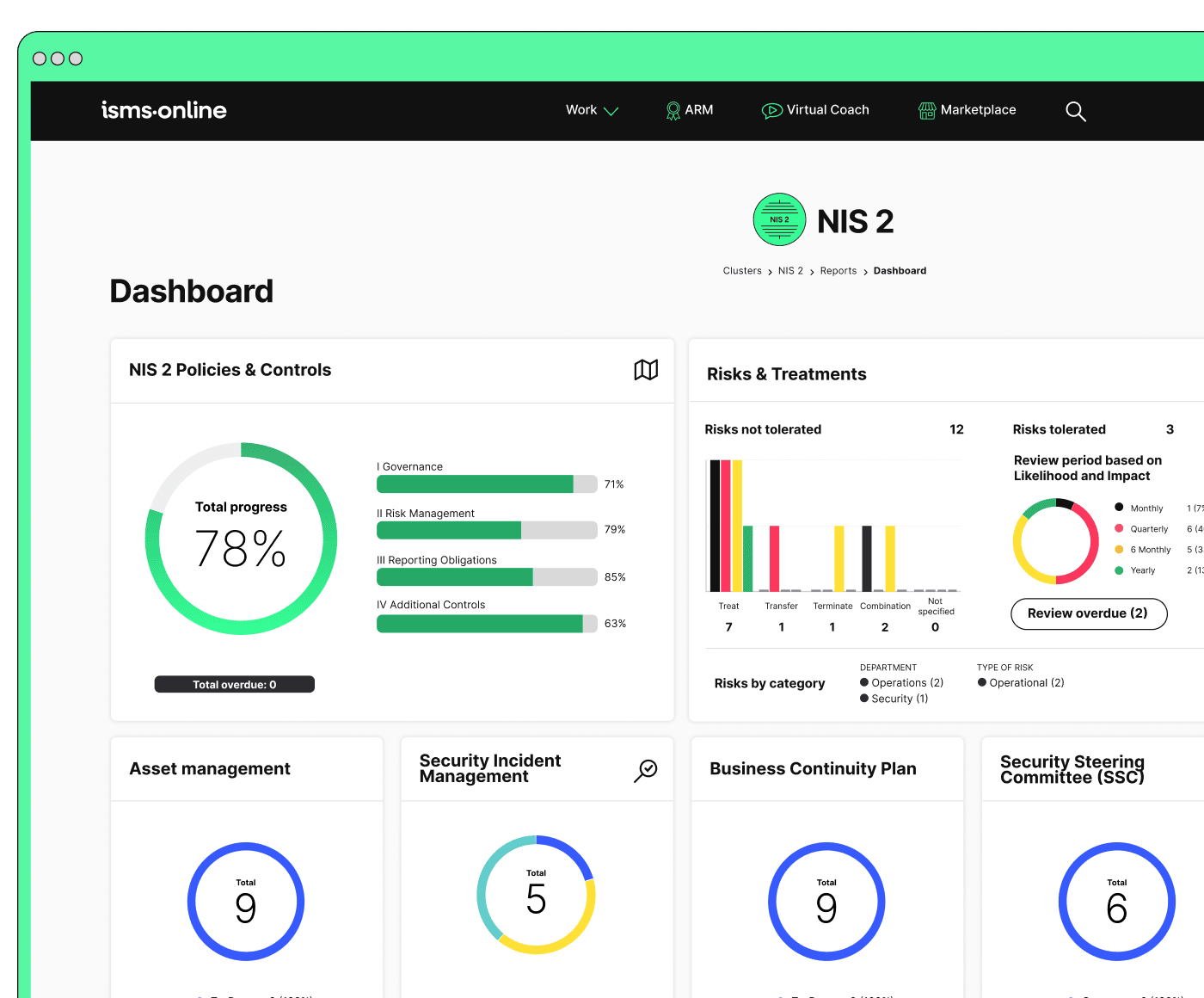
Be NIS 2-ready from day one
Launch with a proven workspace and templates – just tailor, assign, and go.
Building Audit-Ready Evidence: Never Miss a Test
Passing an NIS 2 audit once isn’t enough-your entire evidence lifecycle must be always-on, live, and retrievable whenever the board or auditor demands it.
Defensibility is proven not by declared intent, but by time-stamped, automatically logged actions, visible to any auditor on demand.
End-to-end, digital, time-stamped records
Every element-supplier onboarding, risk rating, incident management, contract renewal, policy change-needs a versioned, time-stamped digital record (isms.online). Auditors are demanding years of history, not weeks.
Audit-export ability on demand
Integrated ISMS systems provide clause-to-evidence mapping, exportable within minutes, covering all controls and actions required by NIS 2 (isms.online). Panic file searching is a relic.
Closing the improvement circle
Nonconformities and their corrective actions must flow directly-via managed workflow-to board-level management review. This turns compliance from annual, ceremonial exercise to routine, proactive management.
Board time-stamping and signed logs
Evidence for KRIs, KPIs, and board reviews must be time-stamped and easily exportable. This transparency is rapidly moving from “best practise” to baseline expectation (isms.online).
Always audit-ready, never surprised
Continuous event-logging, coupled with exception-driven evidence gathering, ensures you are never caught scrambling when an audit or regulator interrogation drops in.
The Assurance Table: Mapping Policy, Contract, Controls, and Evidence
The heart of modern supply chain compliance is a robust, live mapping between policy, contracts, operational controls, and audit-ready evidence.
| Policy Requirement | Contract Clause / Term | ISMS.online Control | Evidence / Audit Log | Annex A Reference |
|---|---|---|---|---|
| Supplier onboarding | Due diligence clause | Supplier registry, tiering | Onboarding record | A.5.19, A.5.20 |
| Incident notification | 24/72hr notification | Incident workflow trigger | Notification timestamp, log | A.5.24, A.5.25 |
| Contract review cycle | Renewal/review term | Automated reminders | Contract change log | A.5.22, A.8.32 |
| Remediation evidence | Proof-of-remediation req | Remediation closure log | Evidence attached to item | A.5.26, A.5.27 |
| Audit readiness | Audit export clause | Audit console/dashboard | Exported file, access logs | A.5.35, A.5.36 |
Every row is action-tested: Any link between policy, contract, and control must lead to an evidence chain-digitally logged, time-stamped, and context-rich. This “proof-loop” is how boards and regulators now qualify programmes.
Bidirectional, versioned traceability
Effortless retrieval of change logs, archived approvals, and versioned artefacts is no longer optional, but demanded (isms.online). Gaps, delays, or ambiguities are now risk findings.
Managed evidence flows
It’s expected to trace what triggered each event, what control operated, who acted, and which evidence logs were created-all mapped across the ISMS stack.
Exception-captured resilience
Workflow-driven capture of exceptions, updates, or escalations allows your controls to respond at human speed or faster. This design builds resilience into your compliance architecture.
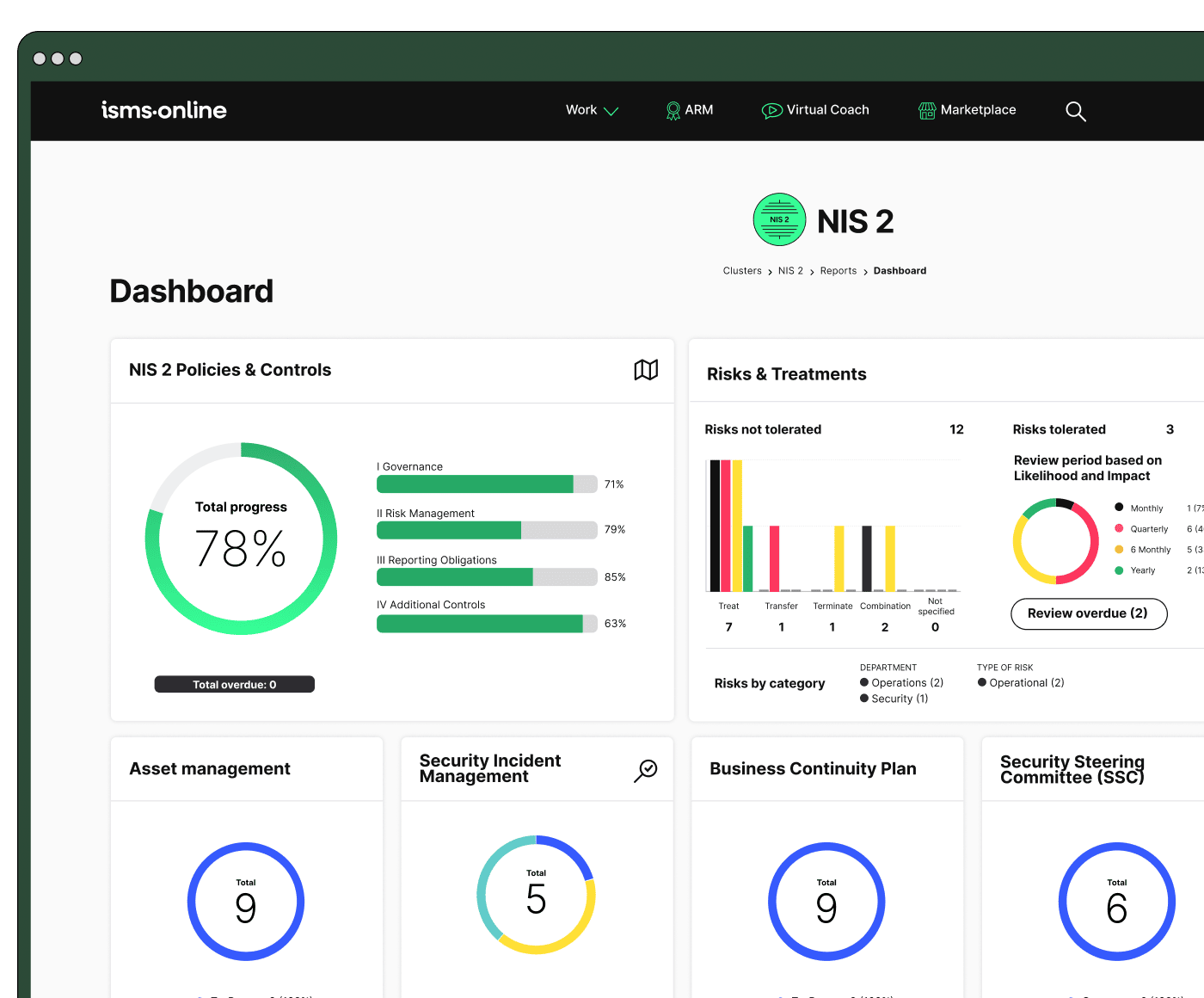
All your NIS 2, all in one place
From Articles 20–23 to audit plans – run and prove compliance, end-to-end.
Avoiding the Compliance Gaps: Embedding Evidence-First Guardrails
Long-term NIS 2 compliance is built upon process-embedded, digital workflows where each action is evidenced, each change is logged, and every finding is closed with proof.
Living evidence, not batch uploads
Compliance only happens when each event-onboarding, incident, audit, contract renewal-generates a workflow, log, approval, and artefact (isms.online). Retroactive or batch-file “evidence” is a signal of systemic weakness.
Routine, automated legal and policy validation cycles
Overlays for national, sectoral, or legal changes are now flagged by system-based deadlines and required controls. If a review is missed, automated escalations and reminders surface that event for management and regulatory response.
If every policy review, contract update, and control escalation is time-stamped, logged and evidenced, compliance gaps turn into rare process breaks-not regular risk.
Workflow resilience-without single points of failure
A robust ISMS means no single staff absence or turnover creates evidence or approval gaps. Change logs and distributed ownership mean supply chain resilience is built by design.
Sector and jurisdiction overlays
Every regulatory jurisdiction, sector, or customer may require different contract terms or approval cycles. The right ISMS flags these and automates compliance escalations.
Event-driven change logging
Every “why” behind an audit finding, incident, or contract review is logged, creating a sealed chain for board or regulatory review (isms.online).
Real-Time, Evidence-First Compliance with ISMS.online
Compliant supplier risk management isn’t just a recordkeeping exercise: it’s a living, operational muscle that must be exercised across procurement, IT, legal, and compliance functions-daily.
Step into evidence-first readiness
- Map all critical suppliers in a live digital registry: , integrating contracts, tier, and risk levels (isms.online).
- Use policy and clause packs to automate onboarding and updates.: Version, review, and approval logs are exportable for every contract and risk event (isms.online).
- Establish performance KPIs: for contract reviews, incident response, and evidence logging-demonstrate improvement over time (isms.online).
- Unify all compliance stakeholders: -legal, procurement, IT-on a single, workflow-powered ISMS.
- Perform board-level readiness reviews, using live dashboards and audit exports: , and prove all controls are operational and evidenced (isms.online).
Frequently Asked Questions
Who sets the benchmark for “acceptable” supplier evidence in NIS 2 and ISO 27001-and how has this shifted from paperwork to digital proof?
Regulators and auditors now define “acceptable” supplier evidence by demanding immediate, digitally linked proof-no longer satisfied with static contract files or disjointed paper trails. Under NIS 2 Article 21 and ISO 27001 Annex A (notably A.5.19–A.5.22), you are responsible for surfacing audit-ready, version-controlled records across onboarding, risk assessments, contracts, reviews, and incident response. It’s not enough to maintain an archive; you need systems that prove, on demand, which person owned a decision, how evidence moved from supplier screening through contract negotiation to incident and remediation, all visible in audit exports. When boards and regulators ask, “Show me your controls today,” time delays and disconnected documentation are seen as red flags.
Compliance is no longer a dusty file-it’s a live, traceable chain ready to answer the regulator’s call.
The new anatomy of supplier evidence
- Supplier onboarding with risk and jurisdiction mapping-logged in real time
- Contracts versioned, e-signed, and linked to each supplier record
- Every material incident or contract update tied to a workflow and control owner
- Change events (e.g. critical incidents, regulatory shifts) trigger instant review, not annual panic
- Exportable audit bundles reveal every step, supporting evidence, and accountable person in minutes
What makes a supplier contract compliant under NIS 2 and ISO 27001, and why do auditors now reject “off-the-shelf” templates?
A compliant supplier contract is laser-focused on live enforceability: explicit incident notification windows (24/72 hours), responsive SLA clauses, audit and escalation rights, legal change triggers, and tracked review logs-baked directly into operational workflows. Auditors now flag generic templates, legacy PDFs, or contracts that lack clear notification timelines and living review evidence, regardless of signatures. ISO 27001 (A.5.19–A.5.22) expects contracts to be mapped to digital processes, not left “set-and-forget.” Stale clauses, missing review cycles, and unlinked exception management often lead to minor nonconformity findings that can balloon into expensive, hard-to-remediate issues.
Clause staleness is no longer academic-it’s a direct audit liability that exposes your board and business.
Table: Contract requirements, operationalisation, and ISO 27001 mapping
| Clause/Expectation | How it’s Operationalised | ISO 27001 Reference |
|---|---|---|
| 24/72 hr Incident Notify | Auto-workflow triggers & timestamps | A.5.24, A.5.25 |
| Audit & review rights | Scheduled digital reviews/logs | A.5.20, A.5.22 |
| Legal change monitoring | Integrated alerts & review cycles | A.5.19, A.5.20 |
| Remediation evidence | Upload + e-sign for closure | A.5.26, A.5.27 |
How does automating supplier risk assessment and contract workflows in ISMS.online prevent supply chain surprises?
Platforms like ISMS.online bring supplier risk, contract lifecycles, and incident reviews into a single, enforceable registry-eliminating “spreadsheet silence” and missed commitments. Each supplier is risk-tiered, assigned accountability, and linked to their contract, KPIs, and critical event history. Incidents or regulatory updates trigger digital workflows: responsible owners are notified instantly, action logs are created, and SoA/Annex controls are mapped live. Every overdue review, incomplete remediation, or unsigned contract is surfaced on dashboards, not buried until the next audit. When an incident, like a data breach, strikes, ISMS.online automatically intertwines contract review, risk update, evidence logging, and closure-so you no longer scramble to assemble proof.
With digital workflows, compliance lapses surface when they happen-not when an auditor unpacks the mess months later.
Core workflow features that seal supply chain gaps
- Always-current supplier registry with risk scoring and owner assignment
- Review cycles and contract events auto-logged and time-stamped
- Incidents auto-trigger: file linkage, SoA control mapping, and owner sign-off
- Exportable audit packs consolidate every required proof in one click
What types of digital evidence actually persuade auditors and boards your supplier controls will stand up to regulatory scrutiny?
What moves auditors-and increasingly, your own board-are these three evidence forms:
1. Time-stamped, version-controlled digital records (contracts, reviews, incidents, remediations)
2. Trigger-action chains showing how every event leads to review, remediation, and closure, mapped to specific SoA controls or annex clauses
3. Exportable audit bundles where every entity (supplier, incident, exception) is one-click traceable from event to logged action and ultimately to policy/contract link
If a serious supplier incident occurs, the ideal chain is: incident detection → risk and contract flagged → SoA/contract clause updated → board and audit log exported, all with timestamped sign-off.
A continuous digital chain, not just point-in-time compliance, is what now separates audit-ready teams from risky ones.
Table: Traceability from real-world event to logged closure
| Supplier Trigger | Workflow Event | Linked Clause/Control | Evidence Output |
|---|---|---|---|
| Breach, missed SLA | Workflow auto-initiated | A.5.24, A.5.26 | Incident log, sign-off file |
| Scheduled review | Owner allocation + checklist | A.5.22 | Review log, digital signoff |
| Remediation needed | Evidence upload required | A.5.27 | Closure file, time stamp |
Where do supply chain compliance failures typically emerge-and how does ISMS.online make these risks visible (and fixable) before audits?
Most failures emerge from static contract archives, manual evidence batch uploads, orphaned exceptions, or “forgotten” reviews when risk events or legal changes occur. These silent gaps drive audit headaches, gaps in board reporting, and regulatory findings. ISMS.online’s always-on workflows assign owners, enforce review schedules, log every event, and flag open exceptions or overdue actions directly to dashboards. Instead of scrambling ahead of an auditor visit, teams track completion in real time-turning unexpected reviews into survivable non-events.
Audit anxiety fades when every policy, contract, and incident leaves a visible, live trail-eliminating the black holes where compliance used to break down.
Smart alerts and corrective workflow triggers
- Overdue contract/review notifications before they escalate
- Exception queues visible across compliance, legal, and audit teams
- Remediation completion locked until proof is uploaded and signed off
What step-by-step actions ensure your supply chain compliance is audit-ready-from requirements to evidence you can trust?
To make your supply chain policy bulletproof, start by mapping each requirement to a digital record and installing a workflow-based control:
• Catalogue every supplier, asset, and contract in a central platform
• Risk-tier and assign owners to all suppliers and contracts
• Enforce automated contract review cycles and incident-driven action plans
• Attach evidence (signed files, logs) at each closure, with digital sign-off
• Export audit-ready bundles that show expectations → controls → live evidence in minutes
When using ISMS.online, each policy expectation, like a 24-hour notification clause or quarterly contract review, has a directly linked workflow, automated tracker, and evidence log. Every exception-missed review, incomplete contract-becomes an immediate, visible alert, never lost until the next regulator request.
When every link in your compliance chain is visible and lived daily, audit confidence follows automatically.
Table: Policy-to-evidence traceability for ISMS boards and auditors
| Policy Requirement | ISMS.online Control | Annex A Ref. | Evidence Type |
|---|---|---|---|
| Incident notification | Auto-notify workflow, alert | A.5.24, A.5.25 | Dated notification log |
| Contract review cycle | Automated review workflow | A.5.20, A.5.22 | Review sign-off, audit tag |
| Remediation closure | Proof upload enforced | A.5.26, A.5.27 | Closure file, log |
Ready to make every supplier, contract, and incident audit-ready-before the next request? ISMS.online ensures your supply chain trail is live, accountable, and trusted by boards, auditors, and regulators alike.






