





































Why Do Social Platforms Struggle With Article 13? Facing Anxiety, Ambiguity, and the Audit Clock
Social platforms navigating the maelstrom of EU digital regulation know that NIS 2’s Article 13 is not just about cyber-security technology-it’s about relentless evidentiary discipline when the stakes are highest. Article 13 upends yesterday’s comfortable distinction between technical “glitch” and regulatory incident, especially when the meaning of “reportable event” is sharply contested and every misstep is under the microscope. For Platform Operations Leads, Founders, Compliance Kickstarters, and technical owners, the hidden adversary is no longer just DDOS attacks or viral backlash. It’s ambiguity: exactly what triggers an Article 13 report? How fast must the team respond-and can you assemble a proof chain even months later, when a regulator or board auditor comes knocking?
Compliance unease isn’t paranoia-it’s the healthy fear that a missed escalation or unlogged hand-off can come back to haunt you.
This anxiety is not an individual failing. It’s the byproduct of a regulatory landscape where ambiguity is weaponized: what counts as an “in-scope event,” whether a response window started at 3:00 or 3:12 am, and which logs really cover cross-border evidence requirements. The more socially viral a platform is, the likelier it is to confront surges of near-incidents or ambiguous “grey zone” issues-each a potential compliance landmine.
For leaders, it means the audit pressure starts well before an incident-and lingers for months in the nervous shadow of regulatory memory. As Deloitte notes: “Audit deadlines start from the first missed log or incomplete incident trail: regulators judge the evidence chain, not leadership’s intent”. In practise, one small omission can ripple out, leading to weeks of audit exposure, loss of trust, and regulatory escalation.
Templates aren’t a safeguard if they’re uninformed by the real and varied operational complexity facing social platforms. “Common PDF exports miss escalation handoffs or jurisdiction-specific nuances, exposing firms to after-action regulatory investigations”. Context-driven, step-by-step evidence-anchored in the real sequence of events, every escalation and role handoff traceable-is no longer optional.
Article 13 doesn’t vilify uncertainty; it spotlights it as evidence of underlying risk. Platforms that reduce anxiety and close audit gaps build not just compliance, but operational trust that survives any incident or regulator review. In the following sections, we’ll surface the systemic tripwires that most often sabotage even mature social platforms and highlight how a context-led evidence strategy transforms incident response from a source of hidden dread into a lever for resilience and leadership confidence.
Where Social Platforms Fail: Anatomy of a Compliance Breakdown
The moment incident reporting moves from daily technical operations into mandatory NIS 2 compliance territory, social platforms encounter a cascade of vulnerabilities hiding in plain sight. Best-in-class tech teams and mature ITIL processes still misfire on Article 13 deadlines-not due to lack of skill but because fatigue, poor role clarity, and piecemeal evidence collection create friction that late nights and heroics can’t remedy. As ENISA points out: “Failure to log near-miss events and role-based handoffs, not just major breaches, leaves audit gaps regulators won’t ignore”.
Even routine slip-ups in evidence-an overlooked export, a missed escalation-can disrupt the compliance narrative, echoing up to the boardroom with real consequences.
Siloed evidence is one of the most damaging-and least acknowledged-forms of compliance vulnerability. “Dispersed evidence, with risks managed in separate silos, leads to missing or conflicting records at the very moments audits hinge on”. Manual checklists, disparate email threads, and unsynchronized logs invariably break down in the face of high-volume or cross-border incidents.
Moreover, platform-neutral templates often fall short. “Sector-agnostic templates ignore user-generated content risks, viral spike detection, or regulator-specific reporting quirks”. When asked why a viral content event went unreported for 36 hours, having an “all-industry” template is no defence; context, trigger, and traceability are king.
A crucial point: missed or late notices are rarely excused, regardless of intentions. “Regulators treat late or incomplete reports as systemic process failures, not isolated lapses; even unrelated incidents are re-examined”. Without a complete, time-synced trail, every error is assumed evidence of wider problems-at best, an opening for further review, at worst, for penalties.
Technical rigour is useless if a single evidence link breaks. “If even one transfer or comms chain isn’t time-stamped and linked, the entire process may be declared broken”. Every incident’s audit trail is only as strong as its weakest handoff.
Let’s spotlight the most common failure patterns:
| Workflow Weakness | Article 13 Trigger Ignored | Impact |
|---|---|---|
| Unlogged near-miss | ‘Suspicion’ not escalated | Regulator flags the gap, triggers broader scrutiny |
| Missed cross-team hand-off | Lack of documented role transfer | Incomplete proof chain, failed audit, blurred ownership |
| Outdated template | Local triggers not accounted for | Notification delays, jurisdictional liability |
| Conflicting timestamps | Timestamps not synced across teams | Fines, audit confusion, blame shifting |
| No lessons/improvements | Failure to document “lessons learned” | Repeated incidents, trust erosion, remediation penalty |
Winning at Article 13 means turning every small event into a precise logfinding, making every actor visible, every handoff verifiable, and every improvement registered as proof that your organisation doesn’t just react, but learns and strengthens over time.

Master NIS 2 without spreadsheet chaos
Centralise risk, incidents, suppliers, and evidence in one clean platform.
What Do Auditors and Regulators Actually Want? Proving Article 13 Compliance
When scrutiny arises-whether from a regulator, auditor, or board review-good intentions are invisible; only the evidence chain matters. Article 13 mandates a full journey: from incident detection, through escalation and notification, all the way to logged improvements and lessons learned. The real question at audit isn’t if you responded, but whether you can map, in order, who did what, when, and with what supporting evidence-every step of the way.
Each entry in the evidence trail should stand ready to be interrogated; audit resilience means every action has a receipt.
Best practise dictates: “Each step-detection, escalation, notification-must be logged, time-stamped, and role-mapped, with documentary evidence for each action”. Informal channels like Slack DMs or missed SMS handovers are not sufficient. “When even a single workflow lacks documented ownership, authorities question the efficacy of the entire mental model and staff training” (isms.online). Scrappy notes don’t survive cross-examination.
Auditors rely on “receipts”: signed PDFs, detailed emails, logs from hand-off or export confirmations. “Only receipts (email, export tracking, hand-off confirmations) stand up during audits to prove completion and timely notification”. No matter how “good” the tech stack, undocumented decisions or missed approvals count as audit gaps.
Further, boards and regulators now expect not just remediation, but demonstrable improvement. “Logs showing real improvement cycles, not just plans, weigh heavily in the regulator’s final assessment”. Learnings from post-incident review become not just organisational capital, but regulatory trust currency.
Live dashboarding underpins day-to-day audit readiness. “Dashboards with instant drill-down clear boardroom anxiety and prioritise pre-audit action” (isms.online). Surfacing uncertainty lets you anticipate audit risks and close them before they become fatal mistakes.
A traceability matrix-showing each event’s “trigger” through to SoA/certification control and associated logged evidence-strengthens defensibility:
| Trigger | Risk Update | Control / SoA Link | Evidence Logged |
|---|---|---|---|
| Outage Detected | Major incident record | A.5.24 Inc. Mgmt | Alert, log, export receipt |
| SOC Escalation | Near-miss notification | A.5.25 Event Assess | Export, hand-off log |
| Cross-border Issue | Multi-jurisdiction alert | A.5.26 Incident Resp | File, mapped notification |
| Board Improvement | Lessons learned record | A.5.27 Learn Incidents | Board summary, improvement |
Platforms that make this mapping operational-every step pre-linked, every file export-tracked, every improvement documented-move from hope to certainty when auditors arrive.
What Workflows Actually Pass Article 13 Deadlines? ISMS.online’s Automated 24/72hr Engine
Platform teams know that “hoping for the best” is not a plan. Article 13’s 24/72-hour escalation workflow creates immense pressure-and exposes weaknesses-in evidence chains. ISMS.online’s workflow engine is engineered to make these regulatory demands achievable, not just aspirational.
The measure of audit resilience is how you prevent missed steps-even when incidents are unpredictable and roles shift mid-process.
“Automated, stepwise workflows guarantee hand-offs and emails are never lost; every action is logged, time-stamped, and visible to all stakeholders” (isms.online). Early detection isn’t enough-regulatory notifications and full incident details must move through every escalation, with proof at every stage.
Platform-specific nuance matters: automation locks in universals (what’s always required) but adapts to context-country, incident category, scale-ensuring the evidence trail is never fragmented. Real-time dashboards reveal open loops before they become audit risks.
Every person in the process-from SOC analyst to legal to executive sign-off-sees their tasks, open approvals, and notifications. “All stakeholders, at all levels, are engaged, activated, and able to deliver incident evidence within the mandated timeframes”.
Visualising the compliance flow:
| Deadline | Responsible | Workflow Step | Evidence Captured |
|---|---|---|---|
| Immediate (Detect) | SOC Lead | Incident detected, auto-log created | Alert/log |
| 24h (Notify) | CISO/DPO | Notify regulator, export PDF/email | Timestamp + delivery log |
| 72h (Details) | Legal/Audit | Full details to regulator | Audit file, hand-off log |
| Aftermath | Board/SOC | Lessons and improvements tracked | Board pack, improvements |
By automating each deadline-bound step, ISMS.online transforms anxiety into an operational advantage-where deadlines are a driver for coordination and confidence, not a source of dread.
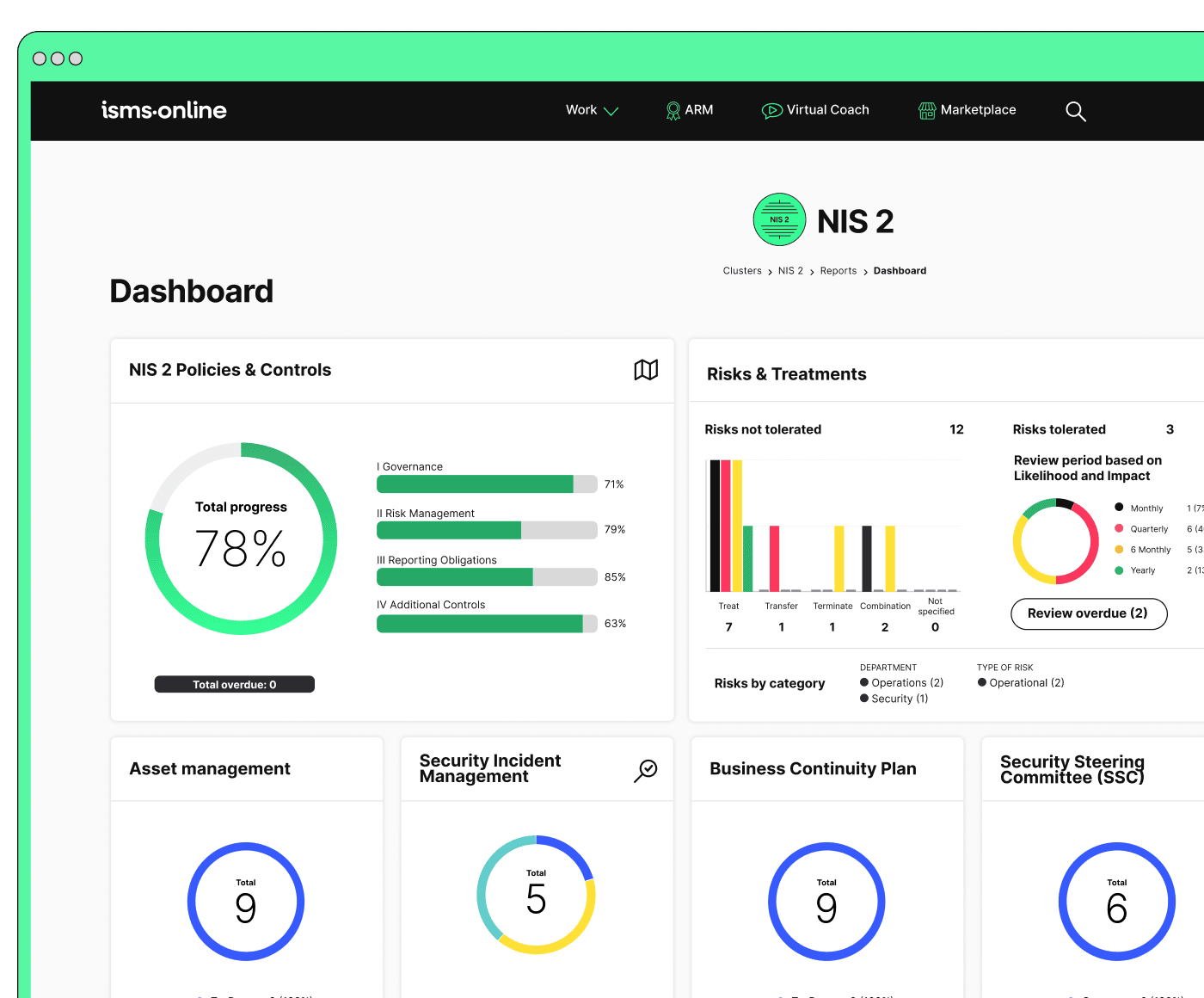
Be NIS 2-ready from day one
Launch with a proven workspace and templates – just tailor, assign, and go.
From Detection to Regulator Receipt: How ISMS.online Orchestrates Article 13 Reporting
A social platform’s true test comes not in the drama of the attack, but in the choreography of the follow-up. ISMS.online orchestrates the Article 13 journey so that even the fastest-moving incident becomes a clean, reviewable story with evidence at each key step. One click means every incident is not only actioned but mapped for both internal and external review-forever.
Operational confidence means being able to reconstruct every notification, approval, and improvement, even years after the fact.
Exports (PDF/XML/email) are not just produced; they’re tracked until acknowledged by the relevant authority. “PDFs, XML, and email notifications are mapped, receipted, and surfaced on audit dashboards with timeline precision”. Each recipient gets exactly what’s mandated, with proof of delivery and timestamped confirmation.
Real-time dashboards highlight every unclaimed approval, overdue step, or missing evidence-making resolution proactive, not corrective (isms.online). At the cross-border level, mapping ensures the right CSIRT is notified, minimising redundant or missed disclosures.
Delayed actions aren’t buried-they’re captured as evidence, with every gap explained. “Even a preventable delay must have a logged reason, and every gap becomes proof, not just exposure”. Long after the crisis, a regulator can ask: which actions were on time, which were lagged, and was continuous improvement documented?
Workflows become self-repairing. “Every audit becomes a test we’re ready for-because our evidence was orchestrated, not bolted on as an afterthought.”
Automated Multi-Jurisdiction Safeguards: Crossing Borders Without Doubling Risk
For global and cross-EU social platforms, Article 13 isn’t one hurdle, but a series of moving targets, each jurisdiction with its own CSIRT, deadlines, and documentation quirks. ISMS.online’s automations ensure that every incident finds the right regulatory home-no missed notifications, no duplicated effort, no local nuance overlooked.
The complexity is real, but a mapped, automated export log makes coverage defensible in every territory.
“Jurisdiction mapping ensures the correct authority/CSIRT per location and incident type-removing the risk of missed or redundant notifications”. Every incident, whether it spans three countries or just triggers in one, is handled with a localised export and centralised log. When rules evolve, updates propagate instantly to templates, dashboards, and evidence logs, keeping IT and compliance teams in sync.
| Incident | Authorities/CSIRT(s) | Evidence Exported | Audit Record |
|---|---|---|---|
| Outage, 3 markets | DE, NL, FR | Country-tailored PDFs | Notification log |
| Content moderation | Member State A, B | Email / XML receipts | CSIRT hand-off |
| Data breach | EU + 1 non-EU | Custom documentation | Compliance file |
When one country upgrades a rule or a CSIRT changes its form, ISMS.online ensures your evidence chain is revised live-no waiting for manual patchwork, no risk of being caught by last quarter’s templates.
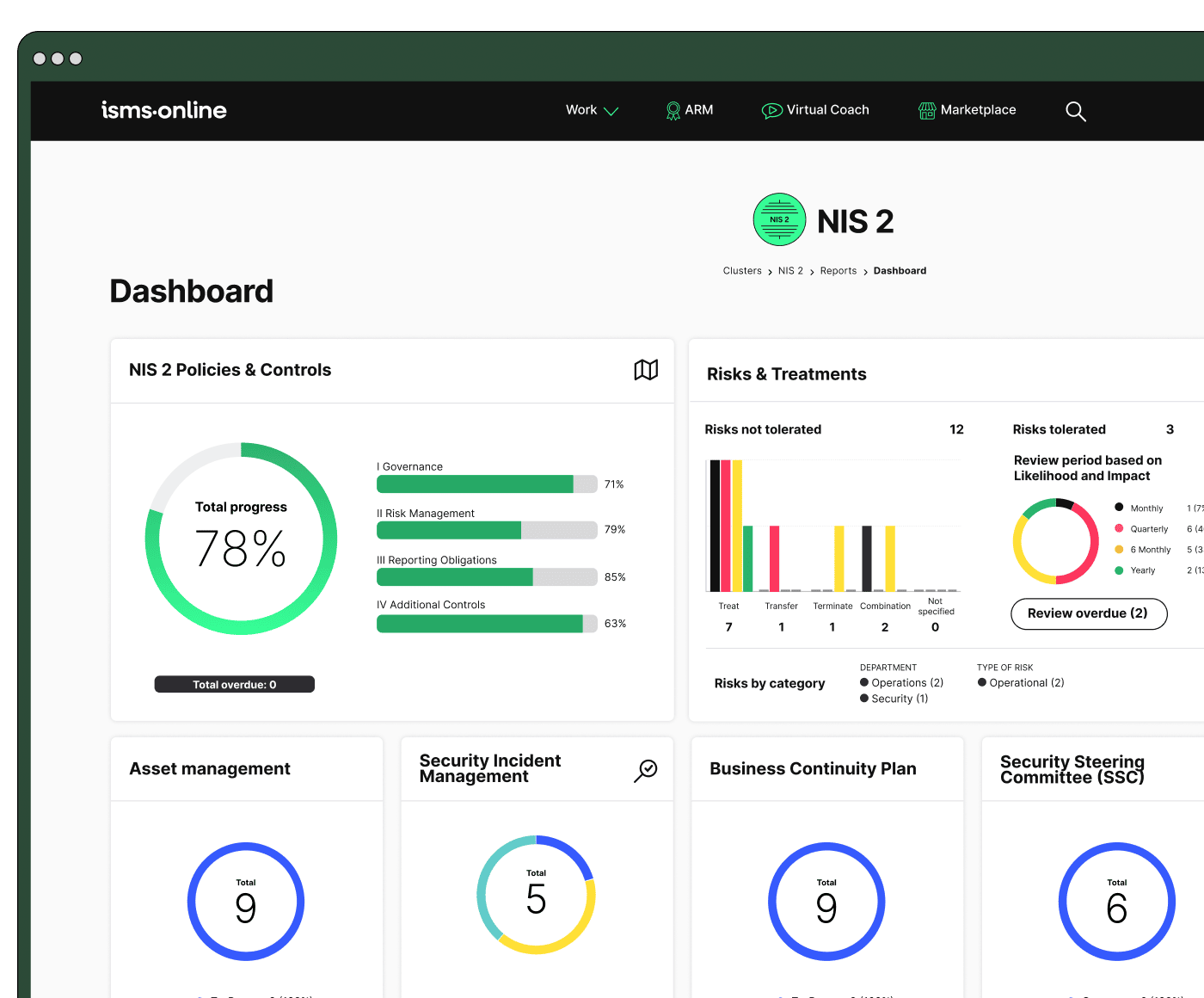
All your NIS 2, all in one place
From Articles 20–23 to audit plans – run and prove compliance, end-to-end.
Building Continuous Audit-Readiness and Board Trust With Live Dashboards
The boardroom and execs don’t just want post-incident assurances; they want proof that audit readiness exists every day. With ISMS.online’s live dashboards, every incident, hand-off, and logged improvement feeds a daily picture of compliance status-for operations, the board, and the regulator (isms.online).
A compliance story that is visible, actionable, and current builds board confidence and fends off surprises before audits.
Dashboards work as both motivator and sentry. “Widgets flag overdue tasks, incomplete documentation, and missing evidence-providing early warning to operations and compliance teams alike”. Compliance is now measured line by line, not in last-minute sprints or post-mortem panic.
With one click, leaders can export jurisdiction-ready, improvement-tagged, and fully timestamped evidence packs for instant review. This transparency isn’t just peace of mind; it becomes a brand and governance asset when a major incident or PR challenge brings regulator and public scrutiny.
Core ISO 27001 bridge table for Article 13 traceability:
| Expectation | Operationalisation With ISMS.online | ISO 27001 / Annex A Reference |
|---|---|---|
| Timely incident detection | Automated detection/triggers | A.5.24, A.5.25 |
| Role-based escalation & logging | Dynamic approvals, role mapping | A.5.26, A.5.18, A.8.2 |
| Regulatory notification | Export templates (PDF, XML), receipt tracking | A.5.24, A.5.26, A.7.10 |
| Lessons learned, improvement | Board-pack, post-incident tracking, reminders | A.5.27, A.10.2 |
| Cross-jurisdiction coverage | Workflow templates, jurisdiction mapping logs | A.5.24, A.5.21 |
Operationalising this link means compliance is not an abstract aim, but an everyday outcome.
How ISMS.online Future-Proofs Your Article 13 Compliance-ENISA, AI, and Beyond
Article 13 is only a waypoint. New ENISA guidelines, upcoming AI regulation, and the next jurisdictional standard all guarantee that Article 13 compliance is a moving target. ISMS.online builds adaptability and improvement tracking into its DNA, so each regulation is an iteration, not a disruption.
In adaptive compliance, mistakes are admitted, logged, and improved on-creating a trajectory of rising trust.
“Updates align instantly with the latest ENISA, CSIRT, or local authority guidance, and trend mapping keeps everything rigorous and current”. One system logs every incident, every lessons-learned improvement, and every workflow tweak, making audit trails not just comprehensive but self-improving.
Every platform change-new incident categories, AI risk checks, shifting notification rules-is tracked and versioned. When boards and auditors review, they see a continuous, living improvement arc-a sign of robust governance (theanalogiesproject.org; forbes.com).
| Change Driver | ISMS.online Response | Audit/Board Impact |
|---|---|---|
| ENISA guideline change | Update templates/notifications platform | Board sees evidence of adaptation |
| New incident type (AI) | Add log event, map workflow/countries | Regulator gets mapped evidence |
| Cross-border rule shift | Live jurisdiction mapping update | Less risk of missed notification |
Continuous improvement, version control, and visible learning form the next frontier of Article 13 mastery-not just compliance.
Take Command of Article 13 With ISMS.online Today
If you’re moving from patchwork evidence and post-incident anxiety toward true proactive assurance, ISMS.online provides the operational, audit-ready backbone for Article 13 dominance. Every notification, escalation, and lessons-learned entry is secured by evidence that withstands audit clocks, board challenge, and regulatory curiosity.
Each log, escalation, and improvement captured in ISMS.online isn’t just compliance-it’s durable proof for both audit and trust.
Download our Article 13 workflow checklist or dive into a walk-through scenario to see the entire proof chain-from detection to export to board improvement-in action (isms.online). ENISA-aligned workflows and audit dashboards aren’t just claims; they’re verifiable outcomes.
Command your Article 13 journey-future-ready, audit-secure, and recognised for resilience by your board and every regulator who enters the picture.
Frequently Asked Questions
Who triggers Article 13 notifications for social platforms, and how does ISMS.online ensure consistent, defensible calls?
Article 13 notifications are triggered by a coordinated group-usually Security Operations (SOC), Legal, Data Privacy, and Compliance leaders-who collectively assess whether an incident crosses the threshold for regulatory reporting. Unlike generic breaches, social platforms must weigh the ripple effects of misinformation, technical outages, and moderation anomalies in real time. ISMS.online clears up the notorious grey area by mapping every incident type into live, rule-driven workflows: it pre-screens scenarios, presents “Does this event reach Article 13 significance?” prompts on the fly, and anchors each escalation to documented roles and justifications. This means your teams move from second-guessing to traceable, auditable decisions-minimising finger-pointing and late submissions.
Sometimes the risk is making the wrong call-or making it too late. Automated prompts can be the difference between a fine and full confidence.
From event to Article 13 trigger: Templates in action
- Playbooks cover technical incidents, viral content, and mass policy errors, pre-classifying severity for reporting.
- Article 13 checkpoints light up within the workflow as new evidence or external signals emerge-not after opportunity has passed.
- All approvals are mapped to the right cross-function, locking sign-offs, timestamps, and rationale.
What Article 13 evidence does a social platform need, and where do organisations most often fail at audit?
Proving Article 13 compliance takes an unbroken, time-stamped audit chain: every alert, handover, regulatory notice, action, and remediation-documented and exportable. ISMS.online automates this from the first event: every activity, approval, and notification is logged, with evidence anchored to the relevant policy and person. Audit failures often trace back to missing steps (handover gaps during staff leave, unclear responsibility), lost “near-miss” events, or evidence scattered in silos. By ensuring all actions and exports are mapped and traceable, ISMS.online moves your proof from reactive discovery to instant recall, covering up to 12 months or more per regulatory window.
The five pillars of defensible compliance evidence
- Incident timeline: From alert to resolution, anchored by actor and timestamp.
- Approval and escalation log: Every internal and external handoff, sealed with receipts and rationales.
- Regulatory notification receipt: Complete export logs, including delivery proofs for each jurisdiction.
What roles must participate in Article 13 compliance, and how does ISMS.online orchestrate them?
Article 13 cannot be solved by a single function; it demands orchestration among SOC, IT, Product, Legal, Compliance, Data Privacy, and often Communications or Board delegates. ISMS.online operationalizes this via a live stakeholder matrix: for each incident, roles are assigned, tasks dispatched, and regulatory clocks started the moment a trigger event is logged. Board-level reviews, country-specific escalations, and multi-department approvals are routed in sequence and traced. As each responsibility is completed, accountability is logged and visible-so confusion and blame are replaced by timeline clarity and audit certainty.
Orchestrating cross-functional compliance
- Templates for each regulator assign responsibilities to the right staff by country or risk vector.
- Workflow dynamically adapts as incidents cross borders or shift in criticality.
- All escalations, board sign-offs, and notifications are accessible in a live, exportable dashboard.
How does ISMS.online automate Article 13’s 24- and 72-hour reporting deadlines, and cover cross-border requirements?
ISMS.online automatically launches regulatory timers when an event is classified for Article 13 reporting. The 24-hour initial notice and 72-hour detailed follow-up are tracked visibly, and jurisdiction-specific tasks route to the right team members with dynamic reminders. The system accounts for multiple country responses, ensuring each export (PDF, XML, or email) targets the proper regulator or CSIRT, and delivery receipts are logged. If a deadline approaches without completion or a jurisdiction is missed, ISMS.online escalates instantly to ensure no reporting slips through. This approach prevents both late filing and partial coverage-critical in the face of pan-EU enforcement.
Never let a missed deadline turn a regulator into an adversary. Live dashboards and automated triggers do the heavy lifting for you.
Reporting clock mechanics and escalation
- Regulatory notification and export routes update instantly as incident scope expands.
- Overdue alerts rise if documentation or notifications lag-even before audit day arrives.
- Proof of notification and receipts are indexed per incident, per country, for rapid audit retrieval.
What ISMS.online features support year-round, real-time Article 13 audit readiness?
ISMS.online provides a continuous compliance cockpit: live dashboards track every alert, incident, task, and sign-off, filterable by country, team, or timeline, so nothing is left to manual checks or memory. “Incomplete” and “overdue” status widgets ensure teams close evidence gaps on the fly. Improvement logs demonstrate resilience and learning, surfacing both successes and fixes to regulators and boards. The full evidence chain-from root cause to regulatory reporting, to post-incident review-is always exportable as a pack, so audit requests become routine instead of a crisis.
Shifting from episodic checks to continuous confidence
- Full lifecycle traceability for each incident, from detection through board-level resolution.
- Role-based checklists flag missing actions today, not just at your next audit or inspection.
- Audit logs, improvement records, and notification receipts are always at your fingertips.
How does ISMS.online adapt to regulatory changes-like ENISA, AI event categories, or NIS 2 updates-without missing a beat?
As ENISA, NIS 2, AI regulators, or CSIRTs introduce new obligations or event categories, ISMS.online instantly updates its playbooks, templates, workflow triggers, and authority contacts. Versioning ensures every change-whether a new AI incident type or shifted deadline-is logged with rationale, approver, and effective date. Jurisdictional assignments and board/export logic update in real time, so all incidents align to the latest rules. Boards, auditors, and legal teams can see historical logic, so even mid-year adjustments never undermine evidence chain or procedural trust.
Living compliance during regulatory turbulence
- Versioned change logs show who adjusted workflows and why, so you’re ready for any procedural audit.
- National and sectoral remapping flows through to assignments and deadlines without downtime.
- Board reports and audit packs always reflect the latest compliance logic, never outdated templates.
ISO 27001 Incident Notification Bridge
| Expectation | ISMS.online System Step | ISO 27001 / Annex A Reference |
|---|---|---|
| Timely, accurate incident recognition | Real-time monitoring, rules-based triggers | A.5.24, A.5.25 |
| Multi-role notification, coordinated handoffs | Dynamic role/stakeholder workflow assignment | A.5.26–A.5.28 |
| Timely, multi-jurisdictional notification | Dual timers (24/72hr), export workflow | A.5.29, A.5.30, A.5.36 |
| End-to-end audit proof | Unified timeline, philtre/export/version logs | A.5.35, A.5.36, A.8.15, A.8.34 |
Notification Traceability Example
| Trigger | Risk Affected | Control Reference | Evidence Logged |
|---|---|---|---|
| Service outage | User trust, uptime | A.5.24/A.5.25 | System alert, investigation note |
| Viral hoax | Public trust, safety | A.5.28/A.5.30 | SOC handoff, regulatory notice |
| Data leak | Personal data risk | A.5.34/A.5.36 | DPO sign-off, notification log |
Regulator expectations escalate, but so can your organisation’s confidence-when compliance, evidence, and actions evolve at the speed of risk.






