





































Do Temporary Joint Ventures or Consortiums Trigger NIS 2-and When Should You Care?
Forming a joint venture, consortium, or temporary partnership brings your organisation squarely into the scope of the NIS 2 Directive the moment you deliver regulated services or infrastructure. The European regulator’s stance leaves no room for misinterpretation: it does not matter if your collaboration is “temporary,” informal, or lacking a separate legal entity-if the group’s services or activities match NIS 2 thresholds, the obligations commence immediately (osborneclarke.com; cyberwatching.eu; lathamwatkins.com).
Temporary in name, permanent in compliance: JV obligations arise at formation, not exit.
Compliance is about the operational reality-not the length of your project plan or what label you attach to the structure. If your joint venture or consortium manages regulated infrastructure or digital services listed in the NIS 2 sectoral annex (such as energy, health, transport, finance, or digital infrastructure), your duty to comply emerges from the day operations commence. Regulators will follow control, not just contracts. If your collaboration governs or influences a covered system, front-load your compliance planning: gaps add risk from day one.
Every client forming a temporary partnership-whether for a critical infrastructure build, a health-tech project, or a digital transformation contract-should pause and clarify their operational exposure before assuming “short-term” status provides immunity.
| Contract Label | Operational Reality | NIS 2 Trigger? |
|---|---|---|
| Temporary JV | Controls critical infrastructure | Yes |
| Consortium | Delivers digital health service | Yes |
| Ad-hoc Project | No regulated activity | No* |
*Sectoral or national provisions may still apply-always verify activities, not assumptions.
Belief reset:
Relying on “project-end” as an escape route for NIS 2 exposure is a common and costly mistake. Whether your joint effort dissolves at quarter-end or lasts years, you may silently accrue full regulatory duties from kickoff.
Which JV or Consortium Entities Become “NIS 2 Entities”-And Why?
NIS 2 status flows directly from activity and operational control-not from formal structure or participant label. Any joint arrangement-incorporated or otherwise-that manages, operates, or meaningfully influences systems listed under NIS 2 can qualify as either an “essential” or “important” entity. This holds even for loosely structured partnerships where a minority partner has material control, or when the lead entity’s regulated status “cascades” into the JV (thinkbrg.com; eurofound.europa.eu).
When Does Regulation Bite?
- If a single partner’s regulated function (such as an IT, SCADA platform, or network role) is embedded in the JV or consortium, the NIS 2 regime can apply to the entire group-regardless of voting rights, profit shares, or project timeline.
- Management or lead roles under Article 26 mean the dominant operational party (not necessarily the biggest shareholder or financier) will be answerable as the “main establishment” or EU-based legal representative.
- Factual control: is decisive: operational leadership (named directors, project managers) can establish NIS 2 entity status, bringing personal accountability for compliance.
| Condition | Outcome | Regulatory Designation |
|---|---|---|
| JV runs in-scope asset/service | All participants in scope | Essential/Important |
| Minority partner controls key risk area | JV in scope | Shared responsibility |
| No digital critical or regulated activity | May be exempt* | Sectoral/Contract only |
*Sectoral compliance or contractual obligations may still cause indirect exposure.
A JV is only as exempt as its least-regulated partner allows.
Key insight:
Don’t let governance diagrams lull you into a false sense of security; actual operational influence triggers NIS 2, not the board’s letterhead or a minority position’s label.

Master NIS 2 without spreadsheet chaos
Centralise risk, incidents, suppliers, and evidence in one clean platform.
How Does NIS 2 Allocate Accountability and Liability in JVs or Consortiums?
Under NIS 2, accountability is both collective and individual-directors, officers, and member organisations all carry liability for compliance gaps. Contractual language, “best efforts” commitments, or attempts to ring-fence responsibility rarely hold up if the operational substance reveals shared control or inaction (cyberwiser.eu; twobirds.com).
When one member slips, the whole group feels the regulatory heat.
Liability Triggers
- Individual Partner Lapses: Missed incident reporting, delayed supplier checks, or an unaddressed vulnerability in one partner exposes all JV signatories. Failure to enforce group-wide oversight triggers collective liability.
- Director/Officer Risk: Article 20 grants regulators power to pursue named directors and officers-imposing personal sanctions or fines for poor due diligence.
- Supply Chain or Vendor Gaps: Failures by contractors or sub-vendors roll back up to the JV, especially where contracts lack enforceable “flow-down” clauses. In the event of a breach or oversight, primary responsibility sits with the main JV body and its controllers.
| Trigger | Risk Update | SoA / Contract Link | Evidence Logged |
|---|---|---|---|
| Partner non-reporting | Group-wide escalation | Breach notification clause | Dated incident logs, cross-party email |
| Supply chain fail | JV-wide risk update | Supply/indemnity clause | Contract file, mapped risk |
| New director/officer | Director liability flag | Governance records, roles | Approved board minutes, signed forms |
Practical perspective:
No JV or consortium should overlook the risk posed by a single unmonitored member or external service provider-regulatory scrutiny is a group affair, and so is the pain of enforcement.
What Minimum Due Diligence Steps Must JVs or Consortiums Take Under NIS 2?
For JVs and consortiums under NIS 2, documented, cross-party due diligence is non-negotiable from project inception (dlapiper.com; iclg.com).
What Due Diligence Means in Practise
- Reliable Onboarding: Every member must submit their baseline ISMS maturity and cyber risk profile before forming the operational group. Evidence includes security controls, policies, and explicit criteria for risk tolerance or acceptance.
- Unified Control Register: Collate all controls from each party into a single, up-to-date risk register-surfacing gaps, overlaps, or blind spots.
- Dynamic Record Keeping: Log changes-whether new suppliers, staff, or member organisations-immediately within incident/risk registers, not just at annual review.
- Audit-Ready Evidence: Keep sign-off logs, board approval minutes, supplier risk ratings, and risk registers updated and accessible. Each process should form a documented, defensible trail for every JV party.
| Expectation | JV/Consortium Practise | ISO 27001 / Annex Reference |
|---|---|---|
| Establish ISMS maturity | Uniform onboarding, baseline reviews | Clause 6.1, Annex A.5.1, A.5.7 |
| Control/risk registers | Unified asset/risk mapping | Clause 8.2, Annex A.5.12, A.5.19 |
| Evidence logging | Signed minutes, review logs, registers | Clause 9.2, 9.3, A.9.2, A.5.35 |
| Supply chain assessment | Supplier onboarding risk review | Annex A.5.20, A.5.21, A.8.8 |
Due diligence is only as strong as the weakest signature in your evidence chain.
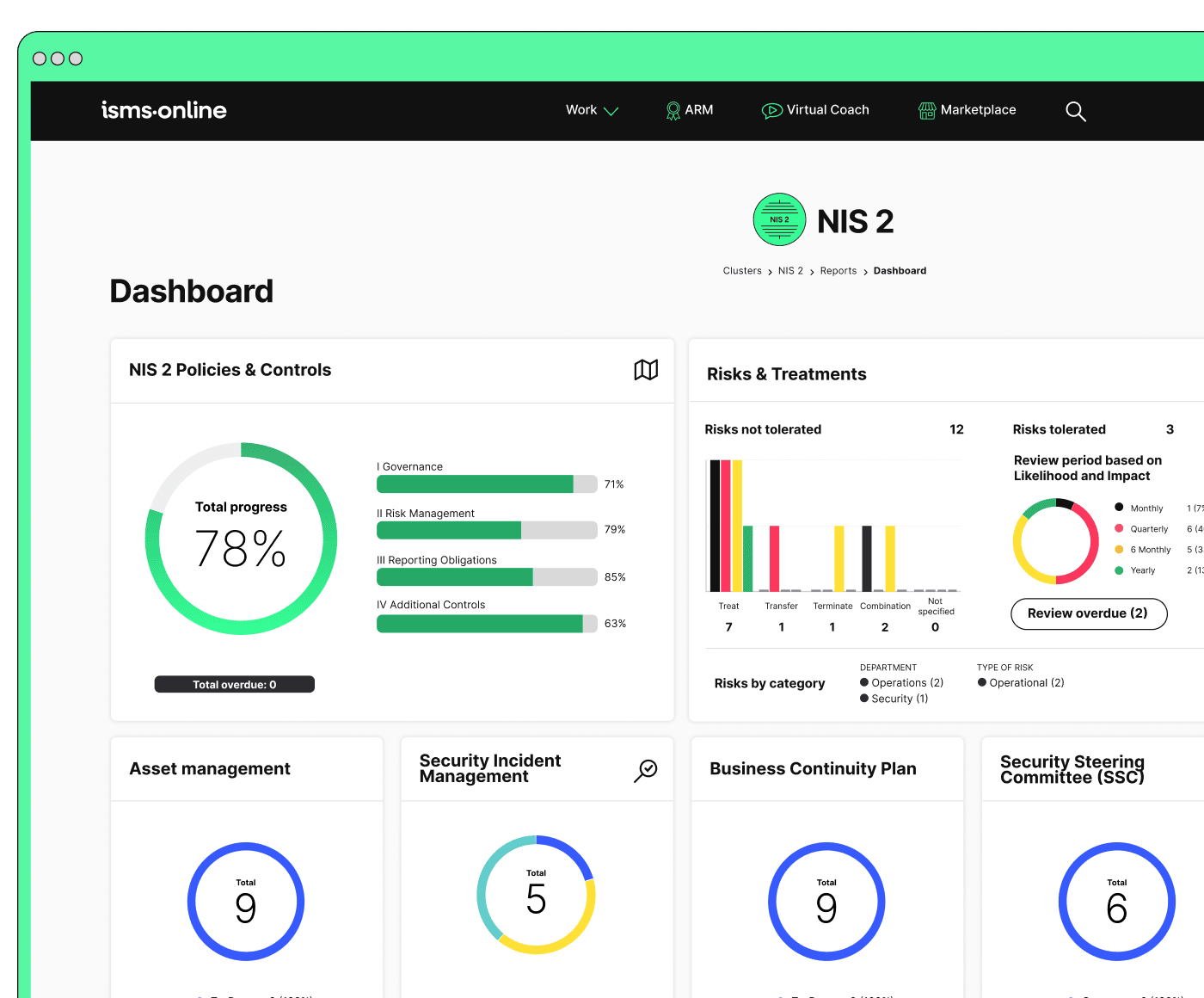
Be NIS 2-ready from day one
Launch with a proven workspace and templates – just tailor, assign, and go.
Where Do Most JV/Consortiums Get Caught-Supply Chain & Subcontractor Snags Explained
For many temporary or ad-hoc collaborations, the final hurdle is end-to-end supply chain compliance. Problems surface where contracts do not contain enforceable incident notification or compliance “flow down,” or where EU-focused regulatory obligations are neglected by non-EU suppliers (cyberpulse.info; rsm.global).
Gaps in third-party compliance travel further and faster in temporary partnerships.
Typical Weak Points
- Lack of “flow-down” clauses: Contracts need explicit requirements for NIS 2 adherence (including audit and notification) for all suppliers, not just good faith or best efforts *(Eversheds Sutherland eversheds-sutherland.com)*.
- Non-EU supplier blind spots: Regulatory duties apply to suppliers impacting EU-regulated services, even if based elsewhere. Gaps often go unnoticed until an incident exposes EU-wide liability.
- Reporting lag: Incidents at a supplier can only be managed if contracts mandate immediate notice-otherwise, the entire JV carries exposure.
| Supply Event | JV/Consortium Risk Update | Control/SoA Link | Evidence Logged |
|---|---|---|---|
| New supplier onboard | Supplier due diligence, contract review | Annex A.5.20 | Supplier assessment file |
| Vendor incident | Incident notification to all members | Annex A.5.25 | Incident report, log |
| Regulatory request | Lead reports, audits supplier trail | Clause 4.4, A.5.35 | Correspondence, audit log |
Regulators are now explicit: 'End-to-end supply chain compliance is a core audit focus for regulated JVs and consortia.' (RSM Global 2023 rsm.global)
Visualise:
Could you track a cyber incident back through a third-tier supplier, flag the risk on your JV’s register, notify every partner, reference the controlling contract, and present a full audit trail at board level-instantly?
What Must a JV or Consortium Write Into Contracts-Essential Clauses and Audit Leverage
NIS 2 compliance must be operationalised from the contract up (rsm.global; simmons-simmons.com; eversheds-sutherland.com). The days of “boilerplate” wording are over-specific, role-mapped requirements are key for audit and defensibility.
Core NIS 2 Contract Requirements
- Incident notification: Define short, mandatory reporting intervals (e.g., 24–72 hours) and standardised processes for group-wide communication (see Articles 23–26).
- Audit rights: Grant both JV partners and regulators the right to demand, access, and test compliance evidence-scheduled and on-demand.
- Supply chain enforcement: Every supplier-direct and indirect-must be contractually bound to NIS 2 duties and periodic checks; this includes audit/notification rights.
- Indemnity/remediation: Set out clearly the sanctions and liability for non-compliance, including requirements for mitigation, escrow, and contractual exit.
- Evidence platform usage: Confirm central, digital evidence logging and tracking-ideally with a platform (such as ISMS.online) that ensures evidence cannot fragment.
| Clause | Impact | Audit/Evidence |
|---|---|---|
| Notification | Ensures timely group response | Notification logs, call notes |
| Audit rights | Enables validation, correction | Audit calendar, findings log |
| Supply extension | All suppliers are “on the hook” | Supplier attestations, checks |
| Remediation | Assigns liability, mandates action | Signed plans, exit docs |
An auditable compliance trail begins in the contract; every clause must map to logged, defensible evidence. (Simmons & Simmons 2024 simmons-simmons.com)
Boardroom lens:
Test whether your platform can link each contract clause, in real time, to an actual evidence artefact-across the entire JV or consortium.
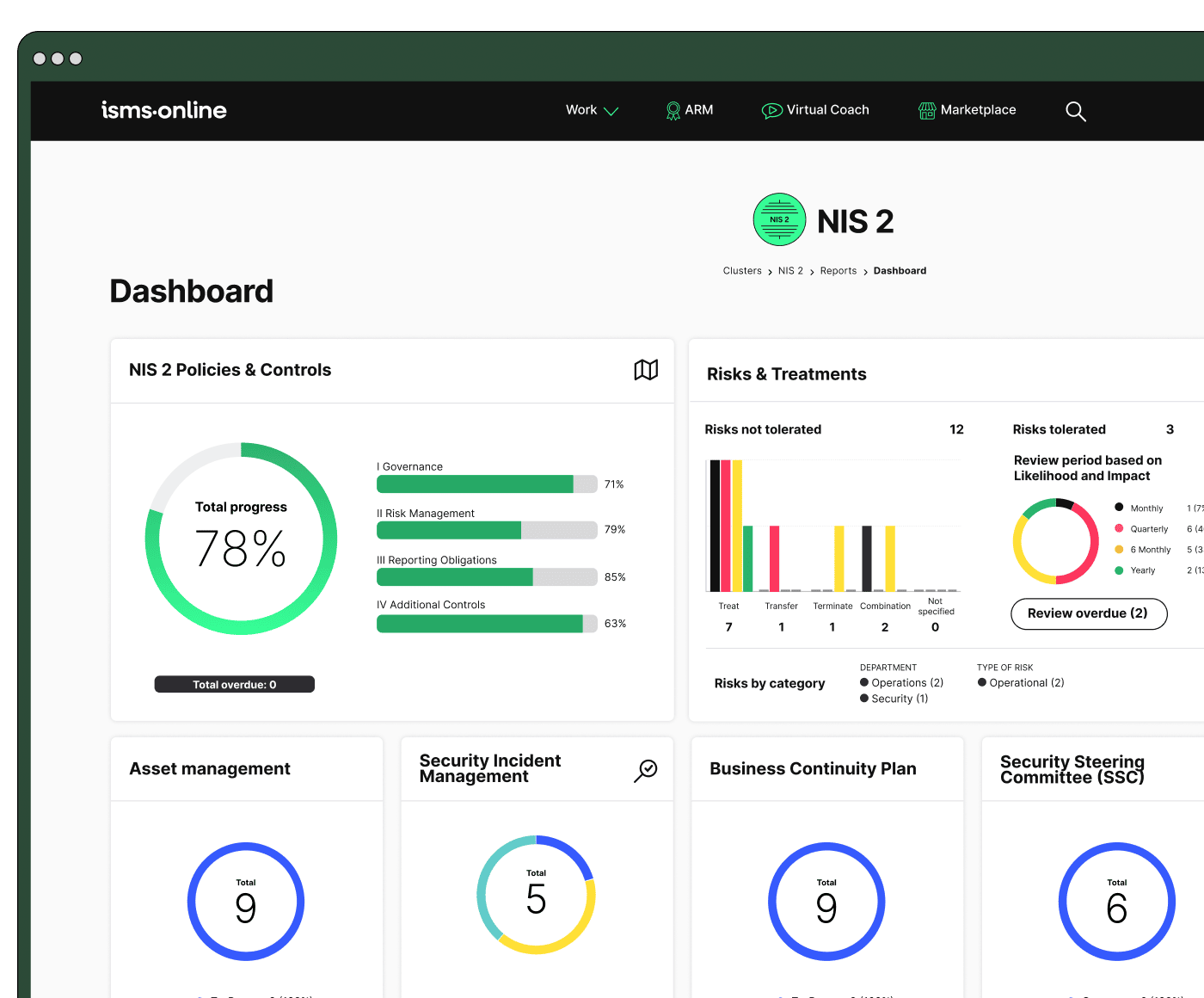
All your NIS 2, all in one place
From Articles 20–23 to audit plans – run and prove compliance, end-to-end.
What Sector or Country-specific Exceptions Should My JV/Consortium Expect?
NIS 2 is minimum standard-sectoral regulations and national laws frequently impose extra duties, typically around board-level oversight, director sign-off, or incident reporting (energyfacts.eu; lawpilots.com). In real-world multi-country joint ventures, expect variability that can raise the bar further.
Key Regional and Sector Variations
- Sector overlay: In segments like energy, health, or banking, incident response may require real-time or near-instant notification, additional technical measures, or continuous logging-above the NIS 2 default.
- Board/director liability: Certain jurisdictions (e.g., France, Germany) now require *personal* log acceptance-board members must sign documented minutes affirming compliance awareness, and audits regularly check for these records.
- Jurisdiction ambiguity: Where JV or consortiums do not clearly designate a “main establishment,” they risk exposure to conflicting or duplicative cross-border enforcement.
- Standard harmonisation: Boards are expected to prove mapping across NIS 2, GDPR, DORA, and sector standards-not treat them as silos.
| Trigger | Board/Director Action | Additional Evidence |
|---|---|---|
| Sector: real-time alerts | Monitoring, test escalation | Incident logs, board review |
| France: personal liability | Accept/record compliance role | Signed minutes, legal opinion |
| Multiple-standards event | Document mapping, notify lead auth | Cross-standard report/log |
A board’s greatest risk is believing liability stops at the border. Regulators care who signed, who logged, and who can prove it-across all applicable regimes.
Real-World Audit Lessons: How Do JVs and Consortiums Pass or Fail NIS 2?
Audit success always flows from live compliance, shared evidence, and seamless responsibility tracing from endpoint to boardroom. Failure most often stems from passive documentation or unclear handoffs. ### What Audits and Board Reviews Show
- Evidence platform edge: High-performing JV audits rely on a live, structured compliance system (such as ISMS.online). This allows both partners and auditors to test notification, response, and board engagement in real time.
- Onboarding and offboarding hazards: Auditors scrutinise the evidence chain for partner entry and exit-most findings stem from missed, out-of-date, or incomplete onboarding/exit documentation.
- Multijurisdictional clarity: JVs that document which authority to notify (where, when, and by whom) receive better audit outcomes-unclear lines of reporting often lead to repeat findings.
- Continual engagement: Tools supporting live To-do lists, reminders, and real-time evidence updates yield superior performance over once-a-year policy reviews.
Picture an event at a supplier funnelling instantly to a JV register update, cascading notifications to every group member, active board review, timestamped evidence in audit logs, and final incident closure acknowledgment. If you cannot draw this line without ambiguity, your compliance trail is at risk.
Belief inversion prompt:
Many assume that once policy documents are filed, audits are won. Actual pass/fail status depends on a living chain-system, contract, incident, board. If any link is missing, the JV’s exposure is amplified.
Start Your JV or Consortium Risk Review-Build NIS 2 Confidence with ISMS.online
Temporary partnerships and joint ventures must now meet regulator-grade standards: compliance starts at project inception and must remain accessible, shareable, and auditable across every member, supplier, and director until dissolution. Static plans, ad hoc registers, and untracked responsibilities increase risk-not control. ISMS.online empowers JV and consortium teams to operationalise NIS 2 duties: unified onboarding, real-time register and evidence management, supplier control, multi-country and board-level traceability-all mapped from project plan to closure, audit and beyond.
The difference between compliance and compliance leadership? The latter owns the evidence chain-ready to prove, not just to promise, whenever a question is asked.
Ready to move beyond guesswork? Begin your JV or consortium NIS 2 risk review with ISMS.online. Discover how an operational, dynamic compliance backbone-mapped to every contract, supplier, and board decision-can transform your team from temporary collaborators into trusted, audit-ready partners on par with the largest permanent operators.
Frequently Asked Questions
Who makes the call on NIS 2 scope for joint ventures and consortia-and why can’t you just say “we’re temporary”?
National cyber regulators and sectoral authorities decide whether your JV or consortium is in scope for NIS 2, but the real test is substance over form: any project, however fleeting or informal, that includes an “essential” or “important” entity (per sector/size thresholds) is likely considered in scope. The group’s legal wrapper, duration, and branding are secondary-the presence of regulated risk, not just the company type, triggers obligations. France, Germany, and Italy make this especially clear: if a covered energy, finance, healthcare, or major digital entity participates, the JV or consortium must proactively identify a lead entity for notifications, but every partner carries direct responsibility. Assume your arrangement is covered unless you gain written confirmation from a regulator to the contrary, as real-world enforcement increasingly ignores “project-based” or “temporary” status in favour of operational risk.
Temporary alliances are measured by risk, not by form-assume in scope until your regulator agrees otherwise.
Table: NIS 2 scope triggers for JVs/consortia
| Criteria | Example | NIS 2 Applies? |
|---|---|---|
| Essential/important partner present | Energy firm joins rail digitalisation group | Yes – all partners |
| JV/consortium hits size/sector threshold | Three national banks form fintech startup | Yes – full duties |
| No regulated entities, purely local | Two SMEs build a single office infrastructure | Unlikely, verify |
How is liability shared, managed, or “stuck” among JV or consortium partners under NIS 2?
Liability under NIS 2 clings to each participant who holds operational or security responsibility-regardless of “lead partner” or contractual claims. Delegation or a lead reporting role does not protect you: Articles 20, 21, and 26 of NIS 2 specifically enforce joint and several liability for all partners under their respective scopes. While a designated lead may coordinate incident notifications or manage the ISMS, every partner remains personally answerable for their actions, their sub-processors, and board-level governance-and recent German and French enforcement makes this plain. Directors may be personally liable for governance gaps. Contractual indemnities or shifting blame between partners often fail if logs, controls, or oversight are missing or fragmented.
NIS 2 liability is sticky-blame moves up and sideways until everyone’s controls pass scrutiny.
Quick view: Partner liability in JVs/consortia
- Each partner is responsible for compliance on what they “control” (operational, security, supplier, or risk).
- A “lead” entity aids with coordination, but doesn’t insulate others.
- Board-level engagement and directorship sign-off are increasingly expected.
What must a JV or consortium contract do to actually deliver NIS 2 assurance (not just box-tick)?
Contracts must operationalise NIS 2: turn legal obligations into specific, traceable actions and logs. The best agreements embed:
- Notification requirements: 24-hour initial, 72-hour follow-up mapped to incident registers.
- Mutual audit and cooperation: every partner can trigger or participate in audits, demand evidence, and review registers.
- Supply chain “flow-down”: all direct and indirect suppliers (even outside the EU) must be contractually held to the same reporting and technical standards, with onboarding proof.
- Remediation, indemnification, and exit clauses: specific logs for any breach, failure, or separation event, with clear evidence chains.
- Policy and risk governance: board approval, sign-off, and tracked exceptions for risk tolerance, major policy changes, or supplier onboarding/offboarding.
Auditors and national authorities now examine not just what the contract says, but whether those terms are evidenced-via policy logs, registers, and board minutes-at every meaningful change.
Contracts are only as good as their lived evidence-show your register, or the clause won’t stand.
Contract-to-compliance mapping examples
| Clause | NIS 2 Article | Evidence Required |
|---|---|---|
| “Notify incidents within 24h” | Art. 23 | Incident dashboard, notification logs |
| “All partners may audit at any time” | Art. 29 | Audit participation records, logs |
| “All suppliers flow-down NIS 2” | Art. 21, 25, 27 | Supplier register, onboarding proof |
| “Remedy/exit on non-compliance” | Arts. 32–36 | Indemnity/exit log, board minutes |
| “Board must sign off critical changes” | Art. 20 | Signed approvals, management reviews |
What does live, day-to-day evidence and due diligence look like for NIS 2 JVs?
Living evidence is now standard: each partner must maintain real-time registers and logs across the full JV/consortium lifecycle. This means:
- Upfront onboarding: explicit role definitions, risk profiles, supplier status, ISMS maturity, signed entries.
- Continuous logging: every partner swap, supplier change, incident, or major policy update triggers an update and is mapped directly to controls and risk (with attributable evidence).
- Board oversight at intervals: ongoing reviews of management, risk, and policy-evidenced by minutes and action logs, not just annual reports.
- Automated compliance: ISMS.online and similar platforms log every event, from partner changes to supplier incidents, with evidence available instantly for audit or regulator inspection.
Failures at onboarding, supply chain changes, or policy update handoff remain the most common sources of audit findings and enforcement triggers. ENISA, SANS, and national regulators explicitly demand traceability linking event, risk, control, and evidence (“Don’t just show your contract-show your last 3 onboarding artefacts and live risk log”).
Real audit strength comes from registers that match every change-paper trails won’t be enough when you need to prove it live.
Traceability mapping table
| Trigger/Event | Risk Register Update | Control/SoA Link | Evidence Logged |
|---|---|---|---|
| New partner onboard | Role/risk registered | Access/segregation | Signed register, onboarding doc |
| Supplier replaced | Supply chain risk review | Flow-down verified | Updated contract, audit entry |
| Major policy update | High risk, board review | Management approval | Minutes, signed record |
How are supply chain and vendor risks handled in consortia and JVs under NIS 2?
Your weakest supplier is your live attack surface-and now a direct compliance risk for everyone in the chain. NIS 2 makes supply chain risk a shared, continual duty:
- All suppliers (direct and indirect) are contractually bound by NIS 2 reporting and audit standards, with robust flow-down clauses and real onboarding evidence.
- Ongoing compliance checks: dashboards and registers reveal live status, incident alerts, and control gaps for all suppliers and partners-not just at onboarding, but throughout.
- Incident escalation: any supplier incident triggers instant JV-wide notification, auto-log update, and evidence chain-no waiting for “email handoff.”
- Explicit role audits: always log which partner manages which supplier at any time.
ENISA and national authorities penalise “set and forget” supply onboarding; dynamic updates and rapid response win audits and reduce fines.
Supply chain workflow
- Supplier incident triggered → dashboard notifies all in-scope partners.
- Incident and response logged with time/data stamps; evidence updated.
- Board/management oversight immediately evidenced for regulator or auditor.
- Registers synchronised for instant inspection.
Can sectoral and national rules override or intensify NIS 2 for JVs and consortia?
Yes-sectoral overlays (like energy, health, digital infrastructure) and national rules often set stricter standards, faster escalation, or extra governance burdens.
- Sector overlays: Real-time incident escalation, mandatory technical controls, frequent drills, and board-level sign-off (e.g., healthcare, energy).
- National overlays (France, Germany, Italy): Board members or directors may be personally accountable (board minutes required), with broader entity scope.
- Cross-regime harmony: Where DORA, GDPR, or other frameworks overlap, policy evidence and board reviews must withstand the highest bar in effect.
Auditors expect JV/consortium registers to evidence the strictest requirement across all applicable overlays, and board minutes or legal registers should be ready for inspection.
Regulatory overlay table
| Layer | Example | Extra Requirement | Evidence Expected |
|---|---|---|---|
| NIS 2 EU Baseline | Pan-EU JV notification | 24/72-hour alerts | Central incident log, notification |
| Health/Energy sector | France/Italy JV | Real-time escalation, drills | Drill log, board approval records |
| National overlay | France/Germany/Italy | Board minutes, sign-offs | Legal register, signed board docs |
| GDPR, DORA overlay | Tech JV | Cross-regime mapping | Policy Pack, SoA log, joint dashboard |
What defines JV/consortium audit success-and where do most fail under NIS 2?
Successful audits: Registers, controls, policies, and contracts are up to date, all changes are logged, and evidence is instantly available, not buried in annual paperwork. Board and management reviews are minuted, signed, and mapped to live dashboards. Supplier breaches or partner changes are recorded and evidenced in real time, with immediate notification cycles.
Failures: Outdated or missing registers post-onboarding, unclear responsibility mapping, missing evidence of policy change or supplier transition, and supply chain clauses that say compliance but lack proof of delivery. Even the best worded contract or policy falls short without live evidence to match.
Modern audits reward living, shared registers and decision logs-annual paperwork alone leaves your JV exposed.
How can a JV or consortium be always audit-ready under NIS 2?
Move your compliance environment to a platform like ISMS.online: manage onboarding, partner/supplier roles, major contract and risk events, and all incident/notification cycles in one live register. Automated evidence logging, dashboard-driven oversight, and joint partner/supplier management ensure “show me now” readiness at all times. This approach keeps every participant, supplier, and director aligned, adaptive, and provable to regulators, investors, or boards-day to day, not just once a year.
Audit-readiness isn’t about more paperwork-it’s about giving leadership and regulators real confidence in your JV or consortium every day.






