





































Are NIS 2 Auditors Demanding Evidence You’re Not Ready to Provide?
Nowhere does compliance get more real than audit day. For organisations in scope under NIS 2-finance, digital, health, cloud, critical supply chain-auditors want more than policies and intent statements. They want live, immutable proof that your entire security and risk management system really works. That evidence has become the currency of trust. If your board can’t surface documented, system-generated trails for risk reviews, incident reporting, supplier due diligence, and board engagement-on demand-you face two existential risks: enforcement penalties and a reputational crisis.
The time to look for evidence is before the regulator asks-not after.
Moving Beyond Written Intention-The Compliance Era of “Immutable Evidence”
What’s changed? Proof is now operational. Modern auditors scrutinise the system’s heartbeat, not just a set of static documents. A passing set of PDFs, editable registers, or self-signed checklists will be interrogated. Boards can no longer delegate away accountability or hide behind “intent” without consequence; under NIS 2, directors and senior officers are personally exposed to enforcement up to €10 million or 2% of revenue.
To anticipate what will keep your organisation off the regulator’s radar, you must show immutable, system-generated evidence:
- Who approved and reviewed each control, risk, or contract-and when?
- Can you present board minutes, risk registers, and incident logs in a form that can’t be tampered with after the fact?
- Is there a traceable chain-board decision to operational action to audit-ready artefact-backed by digital timestamp and owner?
You can’t pause a regulator’s request. But when evidence is mapped and system-led, you neutralise risk before it starts.
Bridging NIS 2, ISO 27001, and Continuous Operation
The operational crosswalk is clear. Here’s how real proof travels from expectation to evidence:
| Expectation | Operationalisation | ISO 27001 / Annex A Reference |
|---|---|---|
| Board reviews risk register annually | Management review documented, minutes filed | Clause 9.3, Annex A.5.35 |
| All incidents reported within 24h/72h | SIEM/incident platform logs, incident tickets | Annex A.5.26, A.5.25 |
| Controls enforced on assets, supply | Asset inventory linked to controls, contracts | Annex A.5.9, A.5.21 |
When your platform ensures these links are immutable and auditable, compliance shifts from a scramble to a steady, systematic flow.
Immutable Logs: The Auditors Gold Standard
If your system produces records that cannot be edited or deleted after the fact (immutable logs), youre aligned with regulator and auditor preference. Typical ISMS and SIEM platforms (especially those leveraging blockchain or tamper-evident architectures) now form the compliance backbone-every sign-off, incident, and board review is locked at the point of action. By contrast, activity logs or editable reports-no matter how detailed-now pose material risk if challenged in legal or regulatory review. For directors, this is not academic: actual fines and personal liability rest on whether you can document engagement and oversight, not on whether you had the right policy template.
Book a demoWhy Can’t a Template or Tech Stack Guarantee Pan-EU NIS 2 Compliance?
It’s tempting, under pressure, to believe compliance-in-a-box platforms or template collections can solve the Pan-European jigsaw. But that’s a dangerous illusion. NIS 2 is not a single standard-it’s a framework implemented in 27+ national variants and sector overlays, each with their own quirks, documentation needs, and regulator mood.
What wins you an audit in Belgium may cause rejection or penalty in France or Poland.
The National Maze: Navigating Legal Divergence and “One Size Fails All”
Every jurisdiction in the EU and EEA interprets NIS 2 differently. Belgium might demand 24-hour breach alerts via national platforms; France emphasises digital supplier registration; Poland scrutinises authentication and asset logs. Article 26/27 of NIS 2 locks this divergence into law, meaning your obligations attach everywhere your business or suppliers operate.
Templates, even excellent ones, reflect the assumptions of their origin. “Repurposed” ISO 27001 or generic policy sets often leave evidence gaps at the border-and those gaps become audit-fail root causes. Reliance on paper policies or checklists invites a devastating question: “Is your system adapting to your hardest audience, or just hoping for luck?”
Auditors Surface Gaps by Testing for Border-Proof Compliance
External auditors and regulators now actively probe for “jurisdictional specificity.” They look for mapped workflows that reconcile the strictest compliance step needed anywhere in your footprint-not just your HQ. Gaps in supplier contracts, vulnerabilities in incident playbooks, or risk models focused only on your home country are called out and trigger formal remediation-sometimes in multiple nations at once.
It only takes one poorly mapped contract or incident to see compliance break at the thinnest part of your cross-border network.
Are You Border-Proof or “Home-Locked”?
Have you reviewed your stack, line by line, against French, Belgian, or Polish protocols? Is your ISMS exporter-ready, or will your evidence get stuck at the port? These are now existential questions-not edge cases. The solution: system-led, multi-jurisdictional mapping with continuous updates, not just retrofitted paperwork.

Master NIS 2 without spreadsheet chaos
Centralise risk, incidents, suppliers, and evidence in one clean platform.
Has Your Board Fully Grasped Their Personal Risk Under NIS 2-And Are You Protecting Them?
For directors and boards, NIS 2 is now personal. Under Articles 20, 21 and 41, sign-off and accountability are tied to individuals, not committees or abstract teams. No longer does compliance shield senior leaders behind institutional “groupthink”-auditor and regulator focus is on checks and balances between people, with named signatures and personal engagement logs.
Every board signature, approval or training record is now a digital artefact. It’s evidence for (or against) that director or officer.
From Board Minutes to Defensible Engagement
Audit documentation must clearly connect named directors to evidence of engagement. That means you must present:
- Resolved board minutes for annual and triggered reviews, filed and timestamped
- Security policy approvals with digital sign-off trails, mapped to individual roles and responsibilities
- Risk and supplier discussions with clear logs of dissent, escalation, and resolution
- Evidence of board training and “fit and proper” background checks
We reviewed cyber risk is not enough. You’ll need to show how, when, and who approved, flagged, or escalated issues.
Role Assignment and the End of “Diffuse Accountability”
One of the main reasons audits now fail: role drift-where multiple people claim credit (or avoid blame) for the same asset, control, or decision. Under NIS 2, every control, asset, supplier, or process must have one named owner-with scope, training and escalation routes logged. Board and operational sign-off needs to refer to actual people, not just “the security team” or “the committee.”
The regulator’s fundamental test: Can every material risk be walked back, via immutable logs, to a named individual with the relevant authority and training? If not, it’s remediation or penalty time.
Can You Prove the Chain from Threat to Control-And Evidence Every Step of Audit Traceability?
Traceability isn’t just a buzzword-it’s the crux of defence under regulatory interrogation. In today’s regulatory context, being able to walk every incident, control, and board review from trigger to logged evidence is the line between a failed and a smooth audit.
Traceability in Action: End-to-End Live Walkthrough
Consider this mini-table-the living “map” auditors will step through:
| Trigger (Event) | Risk Update | Control / SoA Link | Evidence Logged |
|---|---|---|---|
| Phishing attempt | “High” risk-staff | A.5.10, A.5.24 | Incident ticket, SIEM alert, policy update |
| New supplier | “3rd party” risk updated, sourced / reviewed | A.5.19, A.5.20, A.5.21 | Supplier assessment, contract copy |
| Policy change | Scheduled/ad-hoc review, board scrutiny | A.5.1, A.5.4, A.5.36 | Board minutes, approval logs |
Auditors look for no dead ends. The ability to demonstrate, in minutes, the “walk” from a risk or incident to the control in play, mapped back to approved policy and logged board review, gets you a green score. Anything less risks dreaded remediation, escalation, or regulatory action.
When your system can instantly show evidence for any step in the process, the audit turns from ordeal to routine business practise.
No More Static SoA-Only Living Controls
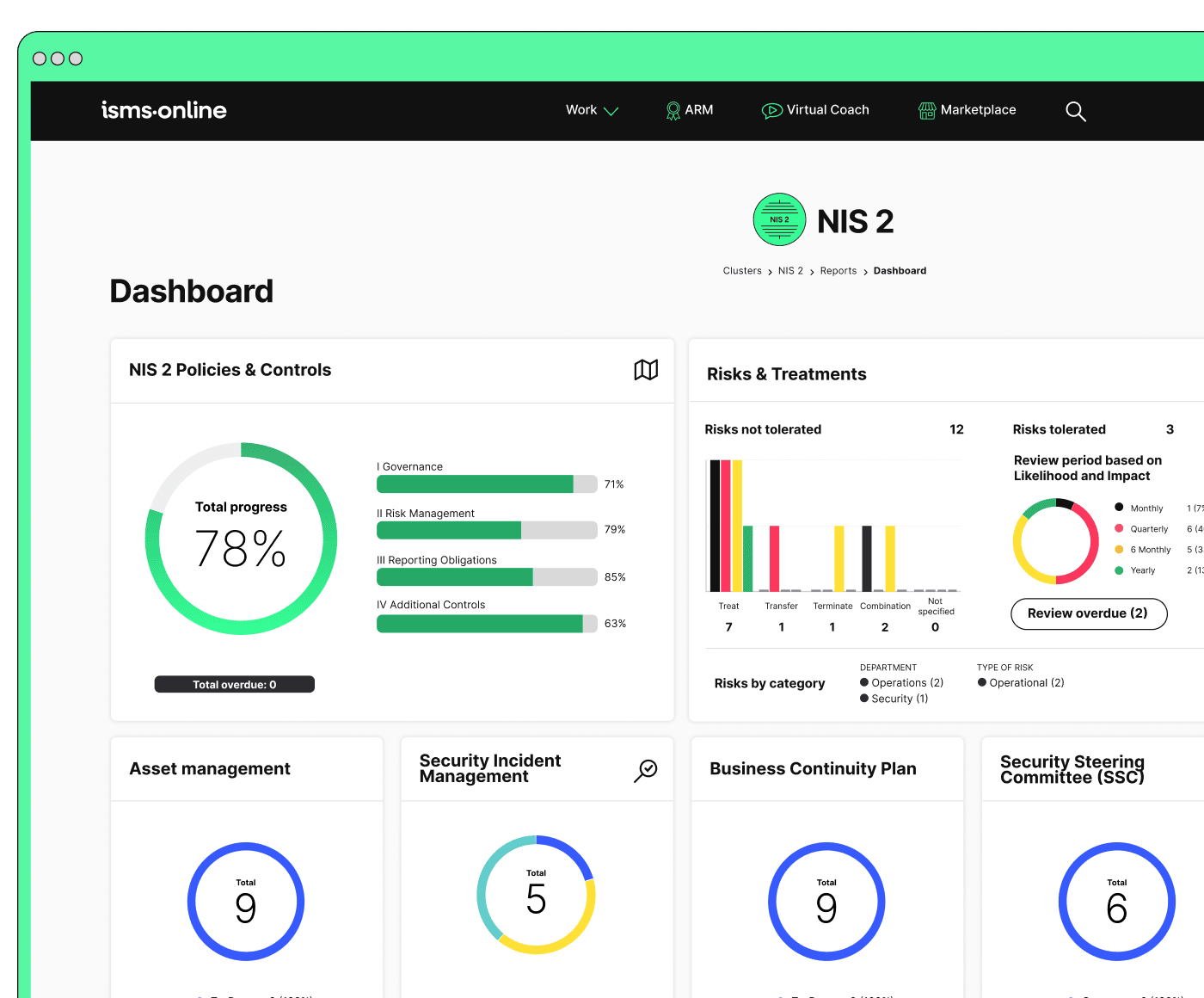
The modern Statement of Applicability (SoA) is not a single annual document; it’s a living, automated linkage that “moves” with every new risk, supplier, incident, or control. With ISMS.online, each action or policy change automatically associates to an evidence record-audit logs update, change registers refresh, and every risk/control mapping is “walkable” at a click. Human-in-the-loop reviews are recorded and time-stamped, not backfilled or post-dated.
Be NIS 2-ready from day one
Launch with a proven workspace and templates – just tailor, assign, and go.
Is Your Supplier Chain the Unseen Risk That Could Break Your Audit?
Supply chains and third-party providers now represent the greatest residual risk across most regulated industries. Major NIS 2 fines and enforcement actions begin when unseen or unevidenced vendor practises result in breaches, late incident reporting, or non-aligned contracts.
Your supplier’s weakest moment is now your regulatory risk-liability flows upwards.
Supplier Audit Table: Finding the Tenuous Links Before the Regulator Does
| Supplier Audit Fail Type | Risk Caused | What Auditors Want to See |
|---|---|---|
| Outdated contract (pre-NIS 2) | Non-aligned incident/reporting | Active contract clauses, NIS 2 addenda |
| No documented risk assessment | “Blind spot” in provider exposure | Risk score, due diligence record, review logs |
| No incident notification clause | Silent breach, missed reporting | Incident response, evidence of supplier notice |
| Unscored inherited SaaS service | Orphan system in compliance scope | Asset inventory, risk mapping, contract review |
The End of Self-Attestation-System-Verified Supply Chains
Auditors and regulators see self-attestation as a minimum, not an endgame. The strongest compliance defences require evidence of system-driven supplier reviews with clear status logs, contract snapshots, and periodic renewal triggers. Supply chain management in ISMS.online means being ready with more than “we asked”-showing when you reviewed, who signed off, and how issues were tracked and closed.
Scrambling to finalise supplier evidence the week of an audit is no longer a badge of ambition; it’s evidence of systematic risk.
Are Manual Audit Scrambles Predictable-or Can You Build Continuous Resilience?
“Audit scramble syndrome” is the fate of any organisation relying on manual evidence gathering, after-the-fact data entry, or leader-memory compliance. Under NIS 2, manual approaches become a rolling operational hazard, inviting missed deadlines and regulatory penalties-with burnout as the silent partner.
The real compliance test isn’t who can rally hardest the week before audit-it’s who can show operational resilience, every day.
System-Based Evidence: Turning Technology into Compliance Leadership
Modern ISMS (Information Security Management Systems) and related security stacks let organisations automate proof:
- Automated reminders: Live “out-of-date” flags for risks, controls, or supplier contracts.
- Immutable logging: Each board meeting, policy review, or incident logged at the point of action-unalterable, retrievable, and mapped to responsibility.
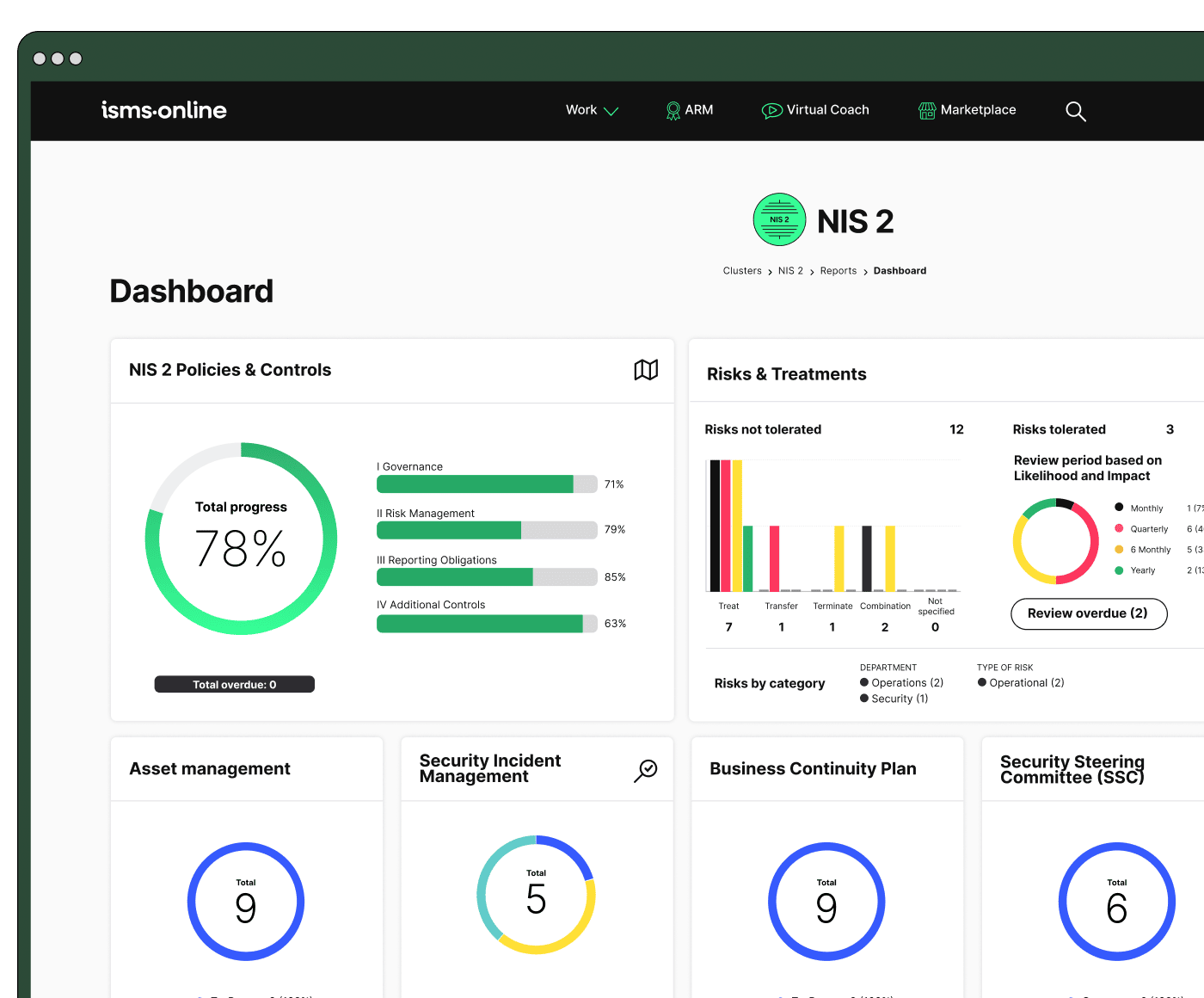
- Live dashboarding: Executive and team views for readiness and assurance, with performance KPIs auto-updating as evidence is gathered or gaps emerge.
If you need to open more than a browser tab to know if your risk register is up to date, your audit readiness is not continuous. Systems like ISMS.online are now “table stakes”-their automations, reminders, and immutable logs create not just compliance, but confidence at every level of your staff and leadership.
All your NIS 2, all in one place
From Articles 20–23 to audit plans – run and prove compliance, end-to-end.
Can Unified Mapping Eliminate the Pain of Compliance Across Multiple Frameworks?
Every CISO, DPO, and compliance lead hears a version of this: “We passed last year’s audit-isn’t that good enough?” The answer under NIS 2, and increasingly for ISO 27001 and ENISA overlays, is no. Long-term compliance now means live, unified mapping across every framework, sector overlay, and jurisdiction.
The pain of compliance multiplies when each framework is managed in its own silo; it dissipates when mapping is unified and dynamic.
The Unified Mapping Table: One Source, Many Standards
Your new compliance “map” isn’t a single diagram but a living table, linking every requirement across NIS 2, ISO 27001, sector overlays (e.g., DORA for finance, NIS 2/ENISA for digital health), and regional rules. This table is the backbone for:
- Evidence reuse: One policy or control cross-linked to five or more standards-minimising rework.
- Jurisdiction overlays: Compliance checks for all locations and suppliers, dynamically updating as rules shift.
- Audit simplicity: At audit time, every mapped requirement points straight to a control, a risk, a sign-off, and an evidence bundle-eliminating scavenger hunts.
Organisations leveraging ISMS.online’s mapping platform are, as ENISA’s 2024 research shows, 86% more likely to finish audits ahead of schedule, freeing time and resources and increasing regulator and board trust.
Quarterly mapping reviews keep your compliance current, agile, and audit-insulated-outpacing regulation itself.
Are You Ready to Step Forward as Your Organisation’s Compliance Leader?
Compliance is not just a checkbox; it’s a leadership challenge. The most effective teams don’t just react-they dictate the audit narrative, control the pace of evidence production, and turn anxiety into assurance.
ISMS.online gives you the power to:
- Map every standard-NIS 2, ISO, ENISA, sector overlays-across controls, risk, supplier, and board requirements.:
- Export live, unified evidence packs: for every audit-no more last-minute chases.
- Automate reminders, board/contract approvals, and role ownership.: Evidence of actions is immutable, timely, and always linked to a named owner.
- Live dashboards: for board, management, audit, and operational leadership keep readiness visible-so you control your compliance reputation before the auditors do.
Demonstrating operational resilience is the hallmark of compliance maturity. - ENISA 2024
The path to becoming the leader your organisation needs is not about being the loudest voice on audit day-it’s about ensuring your story is documented, your evidence is current, and your board can step forward confident and prepared.
Ready to shift from firefighting to assurance?
With ISMS.online, you lead the compliance agenda, prove resilience, and outpace every new wave of regulation.
Frequently Asked Questions
What are the new non-negotiable evidence requirements under NIS 2, and how do regulators define “operational proof” today?
Under NIS 2, accepted evidence has shifted to digital, system-generated records that are time-stamped, linked to specific owners, and resistant to manual manipulation. Regulators now expect every critical event-risk review, incident response, supplier assessment-to produce an audit trail exportable directly from your ISMS, SIEM, or workflow platform, with each entry confirming who acted, what was done, and when. Static documents, editable logs, or self-attestations no longer suffice.
For your board review, this means digitally signed, immutable minutes attached to board decisions and risk cycles. For supplier audits and incident responses, it’s live contract files, system-logged notifications, and incident timelines confirmed by responsible personnel. Training and policy engagement must be evidenced by tracked acknowledgments and real-time completion logs. ISMS.online addresses this mandate by capturing approvals, actions, and commentary as part of daily workflows-leaving a chain that not only satisfies audit demands, but streamlines operational accountability.
Types of Regulator-Ready Evidence
- Digitally signed, time-stamped minutes from ISMS/board meetings
- Immutable incident or risk logs, owner-attributed and exportable
- Supplier agreements linked to control requirements and board decisions
- Staff training and policy acknowledgements logged by system, not spreadsheet
| Evidence Area | Regulators Expect | System Format |
|---|---|---|
| Board decision | Signed minutes, review export | Immutable ISMS export |
| Incident response | Timeline logs, closure evidence | Time-stamped event chain |
| Supplier control | Linked contract, owner and risk mapping | Digitally signed, traceable |
| Staff engagement | Policy read, training completed | System log, role-attributed |
Regulators aren’t interested in your policy PDFs-they want to see a living, digital trail that proves decisions and actions really happened.
Before your next audit, examine every critical control: can you prove it’s operational within minutes using a system log-without reconstructing the past?
Why don’t ISO 27001 templates or static policy packs satisfy pan-EU NIS 2 compliance anymore?
Because NIS 2 evidence expectations are live, evolving, and locally interpreted across the EU-making static templates and generic ISO 27001 artefacts insufficient and risky. Where ISO 27001 lays a strong foundation, NIS 2 raises the bar: compliance in Germany does not guarantee acceptance in France or Belgium, with each state’s regulator testing against specific, regularly refreshed proof.
French authorities may require documentation of engagement with local agencies, while Germany scrutinises identity control records. Belgium expects verified vulnerability disclosures with clear incident timelines. Furthermore, “evidence” is only valid if it’s attached to live controls in your system, regularly updated by action-not just by annual review. Relying on a one-size-fits-all file or checkbox can expose your weakest link and jeopardise deals across borders.
| Country | Regulator’s Extra Demand | Example of Proof |
|---|---|---|
| France | Authority/CSIRT engagement logs | Signed comms, process workflows |
| Germany | Dynamic identity/access controls | Access change logs, ID mapping exports |
| Belgium | Vulnerability handling process | Incident logs, root cause timelines |
Modern compliance means every jurisdiction can ask for unique, local operational records-one outdated artefact can put your EU standing at risk.
Prioritise ISMS or compliance tooling that integrates multi-jurisdictional mapping, so your evidence is current, exportable, and designed for each regulator’s expectations-not just one.
How does NIS 2 transform board and C-level liability, and what digital proof must leadership now verify and approve?
NIS 2 assigns direct, personal responsibility to directors and executives, mandating live, traceable evidence of every significant review, escalation, and supplier approval-no more unsigned minutes or passive acknowledgements. Articles 20, 21, and 41 make clear: oversight is not symbolic-it’s recorded. Every board decision or incident escalation must be attributed by name, with logged dissent, approvals, and follow-up clearly documented.
This means replacing “board discussed and approved” with immutable, digital logs that reveal: who engaged; when they acted; what dissent, challenge, or alternative was raised; how next steps were assigned. Contracts and supplier risk reviews cannot be “rubber-stamped” but must be mapped to control requirements, with approval histories visible in system reports.
| Board Action | Required Owner | Acceptable Evidence |
|---|---|---|
| Annual risk review | CISO, Board Chair | Signed system logs, exportable |
| Incident oversight | Compliance Director | Linked incident event trail |
| Supplier approval | Procurement Exec | Digital contract, log export |
Liability now wears a name tag-regulators want proof of who saw what, who owned decisions, and how challenges were addressed.
If your board packs and action logs aren’t digital, role-attributed and exportable, your leadership risk is climbing-regardless of existing frameworks.
What does “walkable” traceability mean, and how does it build resilience from first risk to final audit proof?
“Walkable traceability” means that, for any trigger-risk, incident notification, or policy change-you can retrace the entire chain through controls, ownership, and action evidence in a matter of clicks, with no dead ends or ambiguity.
The best organisations map out their compliance workflow so a single event can show, in one view: the risk it created, the control(s) it engaged, the person accountable at each point, and the digital proof of each action taken. For NIS 2, this is no longer a hypothetical: it’s a baseline requirement. A phishing attack, for example, must link directly to risk scoring, show which control(s) mitigated it (Annex A reference), who led the response, and the system log or document confirming outcome.
| Trigger | Risk Response | Control Reference | Digital Evidence |
|---|---|---|---|
| Email threat | Flagged in ISMS | A.5.10, A.5.24 | Incident log, board minute |
| Supplier added | Risk assessment filed | A.5.19–A.5.21 | Contract file, risk log |
| Policy update | Accountability review | A.5.1, A.5.36 | Review log, digital sign-off |
True resilience is live-every risk and action leaves a traceable chain, validated by human and system, never by memory.
Conduct internal walk-throughs: can your team click from an incident notification to final audit proof without detours or gaps?
Why has third-party and supplier risk become central, and what new evidence is needed for regulators?
Third-party and supply chain risk is a primary compliance exposure under NIS 2, with regulators expecting real-time evidence that every key supplier is tracked, risked, contracted, and integrated into your operational logs. Merely keeping a spreadsheet of vendors or storing contracts ad hoc leaves critical gaps.
Expectations include: an up-to-date supplier database, mapped to risk scores and jurisdictions; annual (or more frequent) evidence of risk review; digital contracts tagged to specific annex controls and signed within your ISMS; and audit-ready logs of supplier notifications, drills, and expiry reminders. In the event of a supply chain incident, regulators will trace your entire evidence chain-if one link is missing, your compliance case can collapse.
| Supplier Oversight | Required Evidence | Audit Expectation |
|---|---|---|
| Live supplier register | Mapped to risk, annex, expiration date | System-exported list |
| Contract management | Signed file, cyber clause, jurisdiction | Digital doc, review log |
| Drill participation | Notification log, review outcomes | System log |
| Renewal & expiry | Automation-triggered reminders | Evidence of no lapse |
You’re only as strong as your slowest or least-audited supplier-regulators test the entire evidence chain, not just your segment.
Set up automated, ISMS-driven reminders and digital contract workflows to avoid last-minute panic and demonstrate supply chain resilience.
What manual compliance habits now place your organisation at risk, and how does automation raise your audit readiness?
Manual workflows-spreadsheets, email reminders, unsigned contracts-now create direct audit exposure, while system-driven automation is not just preferred but expected under NIS 2. Any point where evidence can be overwritten or lost outside the platform is a future liability. Auditors increasingly look for kinds of failures that only emerge from “human-in-the-loop” evidence, especially where sign-offs or reminders can be skipped or backfilled.
Automated readiness means: triggers and role-approvals are captured natively in your ISMS, with exportable logs at every step; contract or compliance reviews launch system-generated reminders and escalate lapses before they breach; and audit packs are a by-product of operational work, not a last-minute scramble. Manual activities-like “chasing” renewals or collating incident responses after the fact-are now flagged as at-risk.
| Manual Task | Automation Upgrade |
|---|---|
| Email reminders | ISMS notifications |
| Spreadsheet logs | Role-attributed system exports |
| Contract review chases | Automated renewal reminders |
Automation doesn’t replace ownership-it removes friction, creates continuous audit readiness, and hardens your evidence chain before an auditor can find the cracks.
Perform a workflow sweep: each manual touchpoint you eliminate is one less gap that an auditor will seize on.
ISMS.online eliminates every audit vulnerability: live digital evidence, pan-EU mapping, board-linked approvals, and supplier management-all inside your operational flow. Move from audit scramble to permanent audit resilience-so your compliance reputation grows stronger every day.






