





































Is Ground Infrastructure Still “Invisible” Under NIS 2?
Few sectors have witnessed a sharper compliance recalibration than the space industry’s ground infrastructure networks. Ground stations, mission uplinks, telemetry, and command (TT&C) hubs were once the silent backbone of satellite operations-secure in their functional opacity, peripheral to the headlines. NIS 2 changed those dynamics overnight: the European Union’s cross-sector cyber-security regulation has designated ground segments as critical assets, mandating that operational “invisibility” is no longer an excuse for deferred risk or delayed investment (ENISA 2023).
The greatest threat to a ground station’s security is assuming its risks remain unseen.
The regulatory context is unmistakable-ransomware attacks have brought down European ground terminals, supply chain breaches have forced postponed launches, and sophisticated interference has quietly targeted ground network frequencies (ESA). These incidents revealed the interconnected nature of space risk: no segment is immune if its ground link is vulnerable. Procurement cycles that once allowed exemptions for “legacy” platforms or out-of-band patches have run out of road. Article 26 of NIS 2 makes plain that essential ground infrastructure of any type, regardless of its initial design or ISO status, now sits within the compliance spotlight.
Auditors and boards are demanding more than theoretical gap assessments. The expectation is evidence-continuous, recurring, ready for scrutiny at any time. For operators, prime contractors, and service providers alike, the days of considering ground infrastructure compliance optional are over.
The Structural Shift-Why This Matters
This evolution is about more than just new paperwork. As the boards risk literacy increases, reporting pressure flows downward: compliance failures in the ground segment now directly threaten revenue streams, contract renewals, and sector reputation. The granularity of regulatory attention on ground networks has become a competitive differentiator-and a make-or-break factor in the next audit window.
Book a demoWho Holds Real Responsibility-and Is There Anyone Missing in the Risk Map?
Space missions are increasingly collaborative, and NIS 2’s risk accountability web has broadened accordingly. The essential entity is now every organisation touching, supplying, maintaining, or integrating any part of the ground segment-whether in mission control, uplinks, cloud-linked TT&C, or operations managed off-premises. Managed service providers and API-based integrators, once buffered by contractual carve-outs, now face direct liability. There is no gap for “invisible” vendors.
A persistent misconception among many ground ops leaders is that ISO 27001 or sector agency certification forms a protective shield. Nearly half of respondents in recent ENISA surveys listed ISO compliance as their fallback defence. NIS 2, however, adds non-negotiable requirements that cannot be retrofitted:
- Ultra-fast notification windows: -24/72 hour incident reporting is now explicit and enforceable, moving away from “reasonable time” ambiguity.
- Board-level evidence and sign-off: -annual board review and documented policy updates are a direct legal obligation.
- Continuous, live supply chain mapping: -all suppliers, integration partners, and third-party APIs must be referenced in risk registers, not just on contract renewals (ISO/NIS 2 Crossmap).
Notably, dual or triple-audited status (ESA/EUSPA/National) no longer provides a buffer. At audit, regulators expect cross-mapped, current evidence-discretion or interpretation is off the table.
The unlisted supplier on your asset map is the one that could derail your audit.
Practical Implication-Scope Never Stands Still
Every new integration, supplier contract, or cloud service triggers a live scope review. If your ground infra asset and supplier registry is only updated annually, it will be out-of-date by the next procurement milestone. With onboarding and attrition accelerating, the companies most often missing from scope are those inherited mid-cycle or working indirectly through larger system procurements.
The golden rule: any system, vendor, or service that “touches the mission” is within audit scope. This means procedural rigour in registry updates and live accountability mapping is now a practical and legal imperative.

Master NIS 2 without spreadsheet chaos
Centralise risk, incidents, suppliers, and evidence in one clean platform.
How Do Modern Risks and Audit Pressure Points Derail Teams?
Most space-sector cyber incidents stem from overlooked, ageing entry points-not elite zero-day exploits. ENISA’s recent sector analyses identified a quartet of critical vulnerabilities that consistently trip up ground infrastructure compliance (ENISA Good Practises):
- Supplier/Vendor accounts that persist long beyond contract, creating unmonitored access.
- Uncontrolled API, VPN, or cloud integrations that bridge legacy and modern networks without coherent security policy.
- Home-grown scripts or interfaces that lack resilience or business continuity testing.
- Patch cycles outpaced by both vendor advisories and changing attack profiles-often by years.
Audit teams now demand end-to-end documentation, not just from internal security but from all suppliers, MSPs, and integrators. Singular, disconnected log folders or evidence scattered across business units and contractors are no longer tolerated. Incident logs require time-stamped, chain-of-custody clarity-with automated evidence updates (not emailed PDFs). Regulators aggressively penalise delays or gaps in notification when incident documentation lags.
When every team brings their own risk dashboard, compliance falls at the first audit hurdle.
Silos That Fragment Compliance
Pressure mounts when operational maturity falls behind audit requirements. Technical and asset management teams, risk registrars, and procurement managers can unintentionally fragment the audit surface if evidence remains decentralised. With NIS 2, true resilience flows from synchronised, live compliance tools-systems that link risk, evidence, and supplier action trails into a single, always-auditable record.
Are You Moving Beyond “Controls” to Showing Resilience?
A list of controls is no longer the pass grade for regulators. NIS 2 (Article 21) redefines compliance as a living system of resilience: continuous risk assessment, real-time incident detection, and uninterrupted auditability (ENISA NIS 2). It requires not just readiness for audit, but ongoing, demonstrable defence and improvement.
Teams that fail audits most often do so for one of two reasons:
- Quarterly or supplier review cycles are skipped or delayed.
- Asset registries or contract logs drift, becoming inaccurate between annual refreshes.
The cost of these gaps is now board-level liability. Sloppy or generic evidence trails are cited directly in breach reports-no longer is the burden on auditors to chase down explanations (ESA).
NIS 2 Compliance in Practise: The Bridge Table
| Expectation (NIS 2) | Operationalisation | ISO 27001 / Annex A Reference |
|---|---|---|
| Supplier scrutiny | Quarterly TT&C vendor evaluation | A.5.19, A.5.20, A.5.21 |
| 24/72 hr notifications | Live incident reporting (not batch) | A.5.24, A.5.25, A.5.26 |
| Real-time risk feeds | Automated log aggregation from operations | 6.1.2, 8.2, A.8.15, A.8.16 |
| Board sign-off | Digitally-signed audit findings trail | Cl.5.2, 9.3; A.5.4, A.5.35 |
| Live supply chain | Asset + vendor/contract registry | A.5.9, A.8.7, A.8.8, A.5.21 |
Certified teams now automate the population of evidence-registers update with every policy or incident entry, asset set, or induction. Instead of annual “compliance sprints,” they operate a permanent system for resilience, bridging NIS 2 and ISO 27001 at every operational touchpoint.
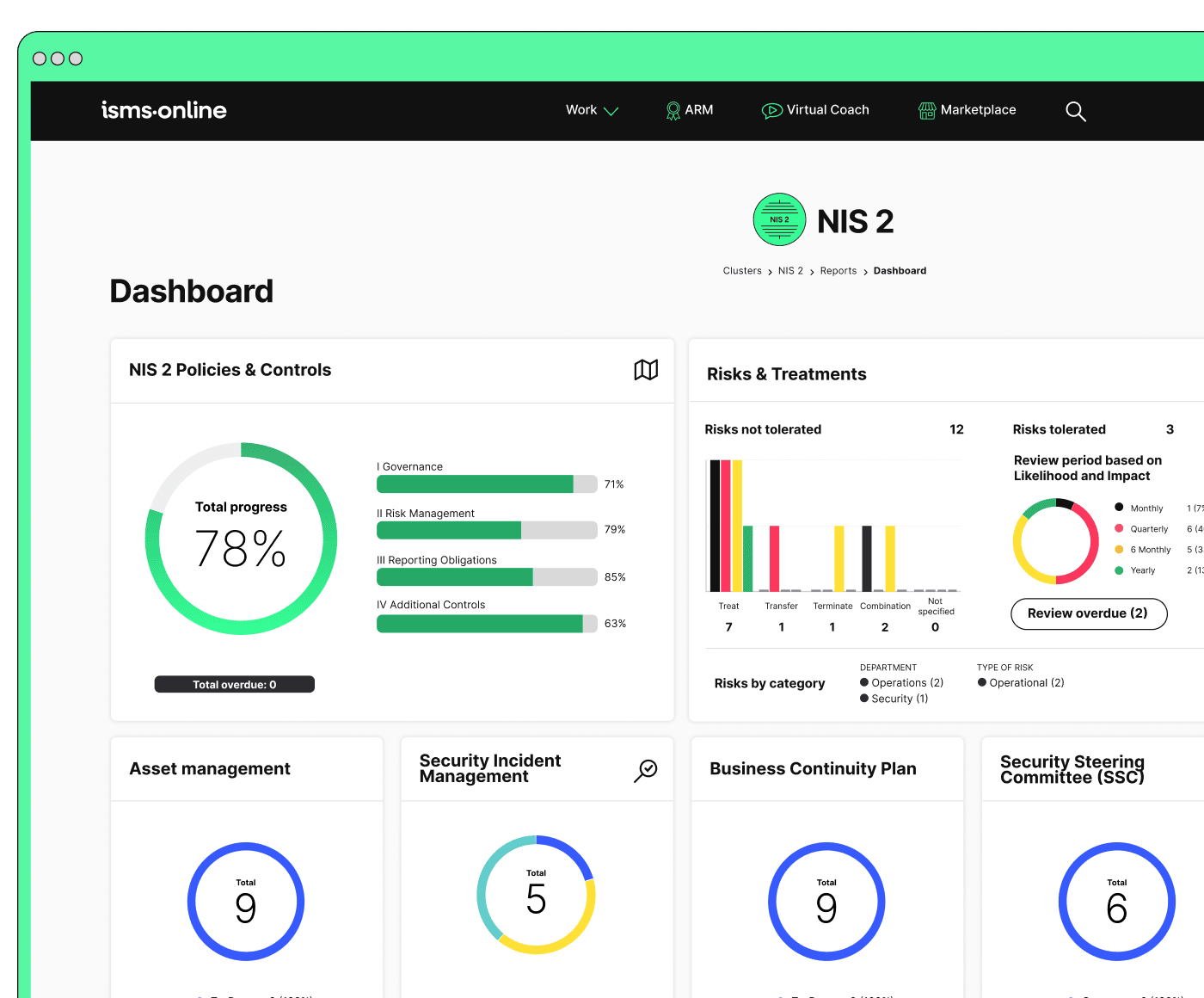
Be NIS 2-ready from day one
Launch with a proven workspace and templates – just tailor, assign, and go.
Does Harmonising for Multi-Layer Audits Simplify or Complicate Practise?
Multi-framework audits are now the rule, not the exception. ESA, ENISA, EUSPA, and national or private-sector auditors run overlapping reviews, often with distinct control checklists but convergent evidence expectations. Core harmonisation lies in “live” (not batch) asset and supplier registers, continuously updated SoA (Statement of Applicability), and routinely signed governance documents (ISO 27001).
Efficient compliance rests on mapping evidence to every standard in real-time, eliminating the audit scramble and “unknown unknowns.” However, the harmonisation surface introduces new risks: unmanaged suppliers, outdated SoA versions, and fragmented contracts can invalidate months of work on the spot.
If your SoA and vendor registry don’t match, compliance is already under question.
Live Traceability-Turning Compliance Into Advantage
Success depends on aligning workflows and systems so that onboarding, risk actions, and board communications are digitally mapped and reviewable at a click. Consider the procedural example for onboarding a new supplier:
| Trigger | Risk Update | Control/SoA Link | Evidence Logged |
|---|---|---|---|
| New TT&C contract | Update supplier risk profile | A.5.21 (Supply Chain) | SoA + vendor review record |
| Incident detected | Escalate risk | A.5.24–A.5.26 (Incidents) | Chain-of-custody log |
| Quarterly review | Asset & control registry check | A.5.9 (Inventory), A.8.7 | Board-approved update |
| Board meeting | Revise compliance KPIs | Cl.9.3, A.5.4 (Governance) | Signed minutes |
This model elevates compliance: regulatory harmonisation becomes a demonstration of operational maturity, not administrative burden.
Are You Audit-Ready-Or Just Audit-Hopeful?
Regulatory “readiness” sets a higher bar than box-ticking: compliance surfaces must be continuously mapped, instantly auditable, and visible to the board (ENISA). Incomplete dashboards, broken audit trails, or missing supplier links are the most common root causes of audit failures. Mature teams build traceability into workflows, not as an afterthought.
True readiness means that when a new supplier is onboarded or a risk flag is raised, the digital trail is live: SoA, log evidence, action records, and KPIs update with every compliance event. The most successful organisations integrate this at the ISMS level-where every trigger, status update, and board sign-off maps directly to external evidence requirements.
Traceability Table-From Event to Evidence
| Trigger | Risk Update | Control/SoA Link | Evidence Logged |
|---|---|---|---|
| TT&C onboarding | Supplier risk profile | A.5.21 | Vendor review in SoA |
| Uplink anomaly | Risk escalation | A.5.24–A.5.26 | Incident + alert logs |
| Quarterly asset review | Update asset registry | A.5.9, A.8.7 | Board sign-off, file log |
| Annual review | KPI refresh | Cl.9.3, A.5.4 | Signed board minutes |
The audit process now validates not just documents, but your organisation’s living compliance spine.
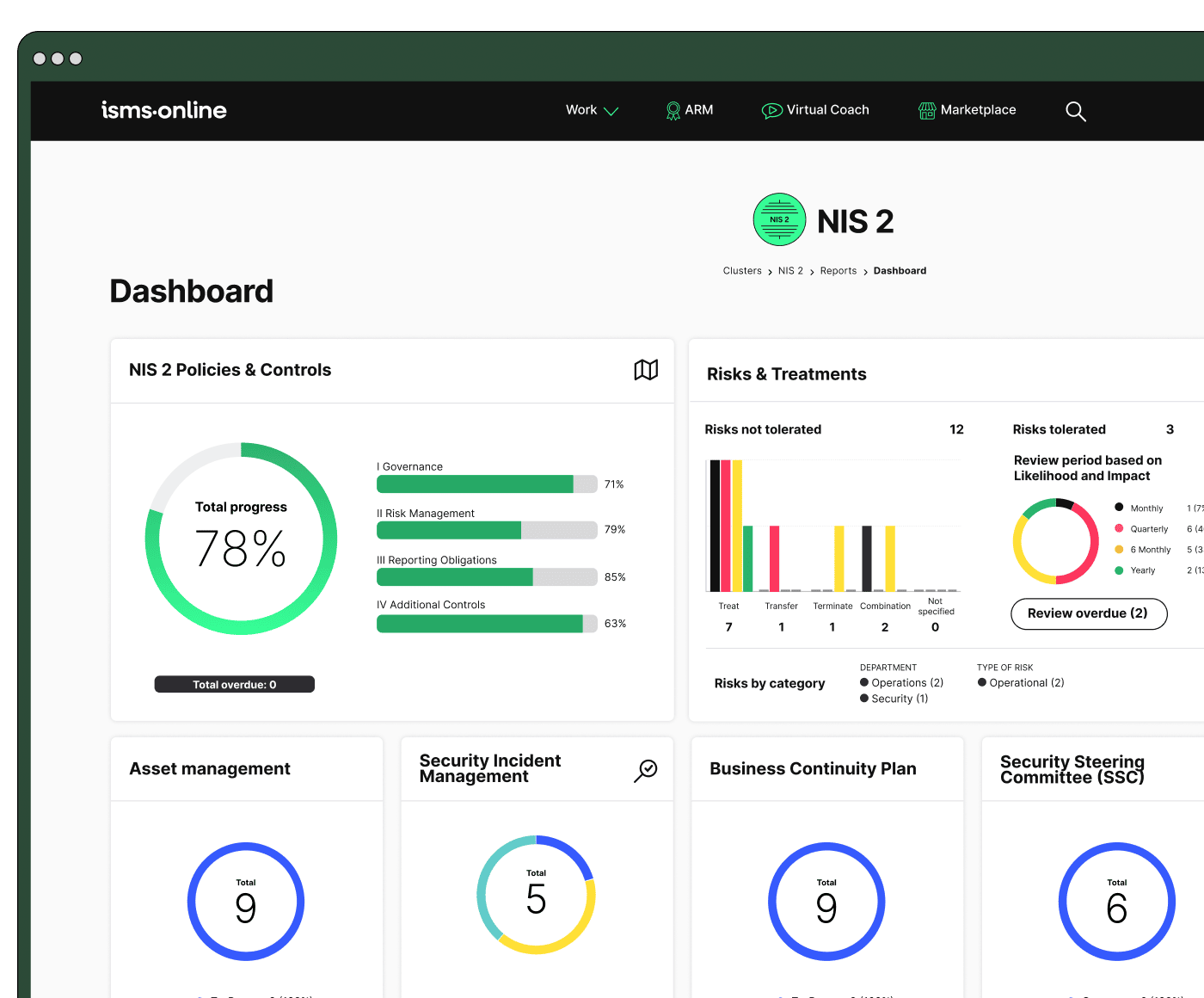
All your NIS 2, all in one place
From Articles 20–23 to audit plans – run and prove compliance, end-to-end.
Can You Survive (and Benefit From) Joint ESA, EUSPA, and ISO 27001 Audits?
It is increasingly common for space and ground segment providers to navigate three or more audit regimes-ESA, ENISA, national agencies, and commercial clients-each demanding overlapping evidence and ever-tighter turnaround times (ESA; EUSPA News).
The most resilient teams don’t just survive; they win by standardising best-practise artefacts: harmonised risk registers, SoA matrices, and board-signed document logs. Automation through purpose-built ISMS platforms like ISMS.online dramatically reduces chase cycles, enables projectable close-outs, and transforms audit defence into a strategic advantage (ENISA Space Sector). Success increasingly depends on advance notice from suppliers and instant evidence mapping-dashboards must reflect all control links, not just surface statistics.
The strongest compliance surface is the one that stays in sync between every audit and every board review.
How Do You Build Board Capital and Continuous Resilience Into Compliance?
Passing audits is just a waypoint on the resilience journey. The true transformation, and the source of sustainable trust and operational value, originates from a living ISMS: one where every compliance action (from tabletop crisis simulation to policy acknowledgement) is tracked, reviewed, and immediately auditable at board or regulator request.
Organisations excelling under NIS 2 adopt:
- Live dashboards for board and management sign-off: , built from real audit statistics and KPIs, not batch-reported numbers.
- Annual crisis drills and incident scenario rehearsals: , with completion, lessons, and board actions recorded.
- Team engagement: via workflow-embedded awareness, To-dos, and built-in training completion snapshots (ENISA).
Wherever enforcement actions or audit failures are traced in the space sector, the root cause lies in missed validation, overdue review cycles, or delegated “tick-box” compliance. Every evidence asset, every review log, and every signed policy is resilience capital on deposit with your board, your regulator, and your market.
The measure of your compliance is not what you file-it’s what your ISMS proves in the moment.
The future belongs to transparent, continuously-auditable compliance. Every board-KPI update and audit linkage is a new deposit in your reputation ledger.
Demonstrate Continuous Resilience with ISMS.online
Space and ground infrastructure teams choose ISMS.online because every step, every link, every evidence record maps directly to NIS 2, ISO 27001, ESA, and sector-specific requirements-automating what others scramble to pull together during audit season. Incident logging, vendor onboarding, policy staff engagement, and real-time dashboards converge in one source of truth, turning resilience into a visible, defensible competitive asset.
Ready to shift from audit anxiety to compliance confidence? Download a sample evidence trace, preview a board-level resilience dashboard, or schedule a tailored walkthrough to see how ISMS.online can streamline every phase of NIS 2 compliance. Let your documentation, not your inbox, carry the load-so you meet regulators, win contracts, and build operational reputation with every review cycle.
What you do next deposits trust into your board’s resilience account. Start building with ISMS.online-your ground infrastructure, continually audit-ready.
Frequently Asked Questions
Who carries legal and operational responsibility for NIS 2 compliance in space sector ground infrastructure-and what does that accountability look like today?
Every organisation that manages, operates, or directly supports mission-critical space ground infrastructure is now front-and-centre for NIS 2 compliance. This extends to mission control centres, satellite ground stations, TT&C operations, cloud-based support actors, and any managed service or SaaS vendor with system or staff access to operational, command, or data pathways. If your tech, process, or partners touch core ground segment functions-or if you supply assets, network, or software to an ESA, EUSPA, or national programme-your organisation’s name is on the compliance line.
Regulators do not accept “compliance by contract.” No matter how many layers of suppliers or indemnity clauses you have, the organisation recorded in ESA/EUSPA or national registries-as the direct ground service provider or mission operator-holds the ultimate duty. This means you must actively maintain up-to-date risk and asset registers, supply chain oversight, and real-time evidence trails, all of which regulators can demand at any time.
If a system or vendor has the ability to access, control, or disrupt mission data, it is in regulatory scope-silent partners or legacy suppliers create real-world liability.
The new standard: Dynamic, Living Supply Chain & Risk Registers
Because the NIS 2 “blast radius” tracks every hand in the mission, registry updates must occur in real time-not quarterly or “as scheduled.” Missed updates or fragmented evidence are now among the leading causes of regulatory action and audit failure.
What unique NIS 2 obligations make ground-segment compliance fundamentally different from legacy ISO 27001 or ESA/EUSPA requirements?
NIS 2 moves ground-based space operators from retrospective, paper-heavy compliance programmes to a continuous, evidence-driven security posture. Key differences include:
- Continuous risk and asset registers: Every operational facility, IT asset, supplier, and process requires live risk scoring and linkage; each new contract, cloud deployment, or staff change triggers an immediate register update-annual or quarterly review is no longer enough.
- Blazingly fast incident notification: First report within 24 hours, full documentation in 72-both to the national authority and sector regulators (ESA, ENISA, EUSPA) if relevant.
- Mandatory quarterly supply chain audits: Evidence of contract and supplier review must be demonstrable at all times. Surprise spot-checks for suppliers or missing audit attachments are now habitual triggers for noncompliance.
- Digitally signed board oversight: Board-level risk and incident reviews (Clause 9.3, ISO 27001; NIS 2 Article 20) are not just recommended-they are binding. Unexecuted or unsigned cycles can result in personal and institutional penalties.
| Compliance Trigger | NIS 2 Operational Practise | ISO 27001/Annex A Reference |
|---|---|---|
| Onboard new supplier | Immediate update to risk/asset/SoA | A.5.19, A.5.21, A.8.9 |
| Incident detected | Notify in <24/72h; update log/KPIs | A.5.25, A.5.26 |
| Board review | Digital signature, evidence chain | Cl. 9.3, A.5.4, A.5.36 |
| Quarterly supplier review | Contract audit, fresh attachments | A.5.20, A.5.22 |
NIS 2’s paradigm is relentless: evidence and risk registers must reflect live conditions, not the state at your last audit.
What practical steps demonstrate ground team NIS 2 compliance-and what are the main audit pitfalls to avoid?
Auditors want a direct, real-time chain between every event, policy, risk review, contract, and a specific NIS 2 control-backed by evidence that clicks through to the live registry. “Tickbox ISMS” or fragmented SharePoint/email trails do not survive modern audits.
Five most common audit failures to avoid:
- Scattered evidence: If critical logs, contracts, or vendor records are locked in a staff drive, inbox, or third-party SaaS and not mapped to the live ISMS, they are considered invisible.
- Policies disconnected from suppliers/assets: Lack of direct linkage between a written rule and its active vendor/asset trail signals “theoretical” compliance.
- Unsigned or missed board reviews: Unapproved risk/incident cycles, or disconnected management sign-offs, nullify even strong technical control performance.
- Ghost vendors or outdated registers: Legacy, ad hoc, or “hidden” third-parties absent from your SoA represent both audit and operational risk.
- Failure to prove continuous supplier monitoring: Audits are lost when organisations cannot show that every third-party underwent quarterly (not just onboarding) evidence review.
| Audit Trigger | Live Record Needed | Annex A/NIS 2 Reference | Strong Evidence Example |
|---|---|---|---|
| Supplier on/offboarding | SoA/risk update & timestamp | A.5.19, A.5.21, A.8.9 | Contract upload, onboarding log |
| Incident alert | Incident log, notification | A.5.25, A.5.26 | Email alert, closure notes |
| Board review | Digital sign-off & action log | Cl. 9.3, A.5.36 | Board minutes, sign-off files |
| Supplier check | Audit log, SoA refresh | A.5.20, A.5.22 | Audit file, review checklist |
An audit trail lives or dies by your ability to trace every compliance event to a current, in-system piece of evidence.
What makes NIS 2 a major leap from ISO 27001 or ESA/EUSPA ground segment compliance?
Speed, oversight, and digital evidence: NIS 2 is not an add-on to ISO 27001-it resets the daily cadence, accountability model, and technical bar across the ground segment.
- Incident response clocks and binding deadlines: 24/72-hour windows are monitored and enforced; ISO 27001 lacks time-bound incident mandates.
- Personal legal accountability: Board approval, digital signatures, and meeting logs shift from best practise to hard requirement; failure moves beyond fines to personal liability.
- Continuous supplier/asset due diligence: Every supplier or process update is a compliance event-real-time integration is now baseline.
- Ongoing, cross-mapped controls: Your SoA, risk, and asset registers must always reflect real operational status, accessible by regulators and clients.
Annual certificates and exported PDFs only count if mapped and joined to your NIS 2 compliance surface in real time.
How does harmonising audits (NIS 2, ISO 27001, ESA/EUSPA) reshape daily ground segment workflows and sector expectations?
Welcome to the era of live, shared, and sector-aligned compliance. “Audit windows” are being replaced by continuous visibility, with regulators, partners, and sector primes all expecting:
- Unified evidence packs: One ISMS controls registry and asset log supports NIS 2, ISO 27001, and sector-specific frameworks-reducing duplication, missed requirements, and finger-pointing during investigations.
- Dynamic supplier and contract engagement: Registry updates, contract reviews, and vendor offboarding all occur in real time, with evidence mapped and archived as proof for auditors.
- ISMS automation at the core: Tools like ISMS.online allow teams to maintain live dashboards, centralised audit trails, and real-time action logs that are accessible by both boards and external reviewers.
- Board and cross-team engagement: Every compliance-critical event (drill, supplier change, review) is tracked, assigned, and digitally signed across risk, IT, legal, and ops teams-building a culture of collective resilience, not isolated compliance.
A living ISMS is the new sector norm. The more real-time, transparent, and audience-visible your registry and evidence, the stronger your audit position and partnership standing.
Is your organisation truly board-ready and audit-proofed for sector-wide NIS 2 challenges?
True NIS 2-readiness means your leadership, operations, and technical teams can provide up-to-the-minute, joined-up compliance trails for every incident, asset, supplier, and management review cycle. If your registry, incident logs, contract reviews, and board sign-offs aren’t surfaced daily and mapped to live controls, you’re at risk of delays, lost tenders, or regulatory penalties.
In 2024–25, the overwhelming majority of NIS 2 audit failures are driven by missed management reviews, out-of-date or invisible supplier lists, and untracked training cycles-not just technical vulnerabilities. Board and sector clients are watching for live, defensible evidence, not static compliance certificates.
Practical next steps:
- Audit your ISMS for live traceability from contract to asset registry to board review; run a live demo for your board.
- Use ISMS.online or a comparable ISMS platform to automate registry updates, incident-to-board evidence trails, and to surface compliance dashboards.
- Establish routines for management reviews, scenario drills, and supplier audits that create digital evidence-ideally with direct sign-off and notification.
- Benchmark your evidence and sector relationships against industry leaders, not just minimum requirements-to move from “check-the-box” to being a compliance role model.
The most resilient ground segment operators aren’t the ones who avoid incidents-they’re the ones who prove traceable compliance, executive oversight, and supplier integrity every single day.
ISO 27001:: NIS2 Operational Bridge Table
| Expectation | How It’s Realised Under NIS 2 | ISO 27001/Annex A Reference |
|---|---|---|
| Supplier onboarded | Registry/risk update, live SoA | A.5.19, A.5.21, A.8.9 |
| Incident | <24/72h alert/log/review loop | A.5.25, A.5.26 |
| Board review | Digital signature, metrics log | Cl. 9.3, A.5.4, A.5.36 |
| Supplier audit | Quarterly, evidence linked | A.5.20, A.5.22 |






