





































Is the Shift from NIS 1 to NIS 2 Really About More Than Just “Compliance as Usual”?
The transition from NIS 1 to NIS 2 is a strategic reset of the EU’s entire digital risk posture. At its heart, this is not the usual regulatory “refresh”-it’s a forceful move away from fragmented box-ticking and towards non-negotiable operational cyber resilience. Under NIS 1, member states could adjust obligations, allowing some to dilute enforcement or stretch deadlines; gaps remained, and adversaries exploited those cracks repeatedly. This lack of uniformity led ENISA to report regular, union-wide vulnerabilities and emerging risks that outdated controls left exposed (ENISA Threat Landscape 2023).
Sometimes a single missed update echoes through your whole network-until a threat walks right in.
NIS 2 is the answer: a hard-edged, harmonised set of rules that ends patchwork self-definition, enshrining uniform requirements for sector coverage, deadlines, board accountability, and evidence handling. The European Data Protection Board calls NIS 2 the “digital glue” Europe’s cyber enforcement requires-a joint standard that holds every link in a chain responsible, not just the “prime movers”. This framework insists compliance is meaningful: a live shield, not just a report filed under duress.
In practise, ISMS.online distils this into action. Instead of scattered tasks and conflicting national checklists, our platform gives your team a single system: workflows prompt the right controls, evidence, and sign-offs, deploying compliance as an enabler for resilience. This means your effort carries the same recognised value whether your supply chain touches Helsinki or Lisbon. And when clients, auditors, or partners scrutinise your records, the same clarity, traceability, and rigour are there-whatever the jurisdiction.
Rather than compliance as an isolated cost, NIS 2 drives a collective surge in standards. You aren’t just protecting your organisation-you’re locking in trust and access with every partner, supplier, and customer in your network.
Which Organisations Are Now at Risk or Opportunity as NIS 2’s Scope Expands?
One of NIS 2’s clearest signals is that few can still claim they’re “out of scope.” While the original NIS focused on essential nodes in sectors like energy, banking, and transport, the updated directive dramatically expands coverage across healthcare, digital infrastructure, postal and courier services, food production, water, cloud, and major digital service providers. If you underpin a critical supply chain in the EU, you are almost certainly in scope (enisa.europa.eu, eur-lex.europa.eu).
Assuming exemption on the basis of size, sector, or back office status is a high-stakes gamble.
Small or micro-businesses previously shielded may stay exempt only until their function becomes truly critical-or, as is increasingly common, if they support a regulated entity’s operations. That moment can arrive with little notice, especially through procurement or contract renewals. For CISOs, DPOs, and compliance leaders, “we’ve always been exempt” is no longer enough. Each business relationship and asset must be regularly checked against scope-the regulatory exposure is no longer static.
Leading analysts now urge a “map and verify” approach, a shift in behaviour that ISMS.online actively supports. Through automated scoping and asset mapping, supplier governance, and workflow-driven risk portals, you can surface previously invisible third-party dependencies and document exactly why (or why not) your organisation, or a specific line of business, is in scope.
Table: Who Should Use This Scope Map?
| Expectation | Operationalisation | ISO 27001/Annex A Ref. |
|---|---|---|
| Clear demonstration of sector inclusion | Asset review, “in or out” mapping, board sign-off | Clause 4.3, A.5.2, A.5.7 |
| Third-party dependency management | Supplier due diligence and contract evidence | A.5.19–A.5.21 |
| Micro/small firm exemption justification | Risk-based evidence, strategic record of criticality | Clause 6.1.2, A.5.7 |
Waiting to be told that you are in scope is the equivalent of waiting for a compliance audit “surprise.” With ISMS.online, routine scoping and supplier mapping ensure you move before the regulator does.

Master NIS 2 without spreadsheet chaos
Centralise risk, incidents, suppliers, and evidence in one clean platform.
What Concrete Actions Now Define Cyber-Security Readiness and Audit in the NIS 2 Era?
Cyber readiness is redefined under NIS 2. No longer does a “tick-the-box” policy file suffice-as ENISA reports make clear, dynamic, live evidence is now the only credible foundation. The end of “annual risk register day” is here; readiness is routine and documented in real time, supporting proactive, continual assurance for CISOs, Privacy leads, and IT asset owners alike.
Regulators, auditors, and even key clients will now expect instant access to:
- Updated incident logs (not just policies, but timestamped records and notifications)
- Asset inventories with live change logs, management approvals, and up-to-date criticality
- Supplier risk registers and ongoing assessments surfaced as evidence of due diligence
- Control effectiveness reviews-linked back to operational events, not just intention
Spreadsheets can’t survive first contact with an auditor demanding traceable change history for every critical asset.
ISMS.online transforms these expectations into daily action: when controls shift, risks materialise, or supplier statuses change, every update, review, and sign-off is logged, legally actionable, and instantly exportable. Privacy teams can document SAR logs with Board/DPO sign-off, IT can record asset assignments with management approval, and CISOs can map incident reviews into real-world business impact-all within a single, systematic workflow.
Traceability In Practise: How a Risk or Incident Update Becomes Audit Evidence
| Trigger | Risk Update | Control / SoA Link | Evidence Logged |
|---|---|---|---|
| Supplier breach | Vendor risk score revised | A.5.20, A.5.21 | Supplier risk register |
| New asset onboarded | Asset inventory updated | A.5.9, A.8.9 | Asset change log, approval |
| Policy review | Control effectiveness | A.5.2, A.5.36, Clause 9 | Policy audit, board signature |
With ISMS.online, routine cyber operations and checklists transform into audit-certified evidence-empowering teams to “show, not tell” when Board, auditor, or regulator arrives.
How Are Board and Management Liabilities Altered by NIS 2-and How Can Executives Protect Themselves?
For the first time, NIS 2 plants clear legal and operational liability on the shoulders of directors, boards, and C-suites. The “signature on an annual policy” era is over-oversight, resource allocation, and responsiveness are board-level duties, every year, every incident;.
Leadership is no longer the last name on a policy-it’s a chain of traceable, effective action.
Boards must now show:
- Regular, competent review of cyber risks (with signatures and timestamps)
- Active allocation of resources to cyber functions (demonstrable via approvals and budget linkage)
- Leadership in incident response (sign-off chains, board guidance recorded with each breach)
- Direct engagement in ongoing compliance monitoring and management review processes
With ISMS.online, every significant asset, incident, and policy or control review can be tied directly to a leadership action, signature, or comment. The platform’s management review dashboards and evidence logs allow you to assign, monitor, and export any and all relevant activity for executive or regulatory scrutiny-mitigating personal and organisational liability and turning rigour into trust.
For directors, stepping up to this board-level scrutiny is now a baseline, not an extra credit. With each review, approval, or incident update captured and traceable, effective oversight is always provable.
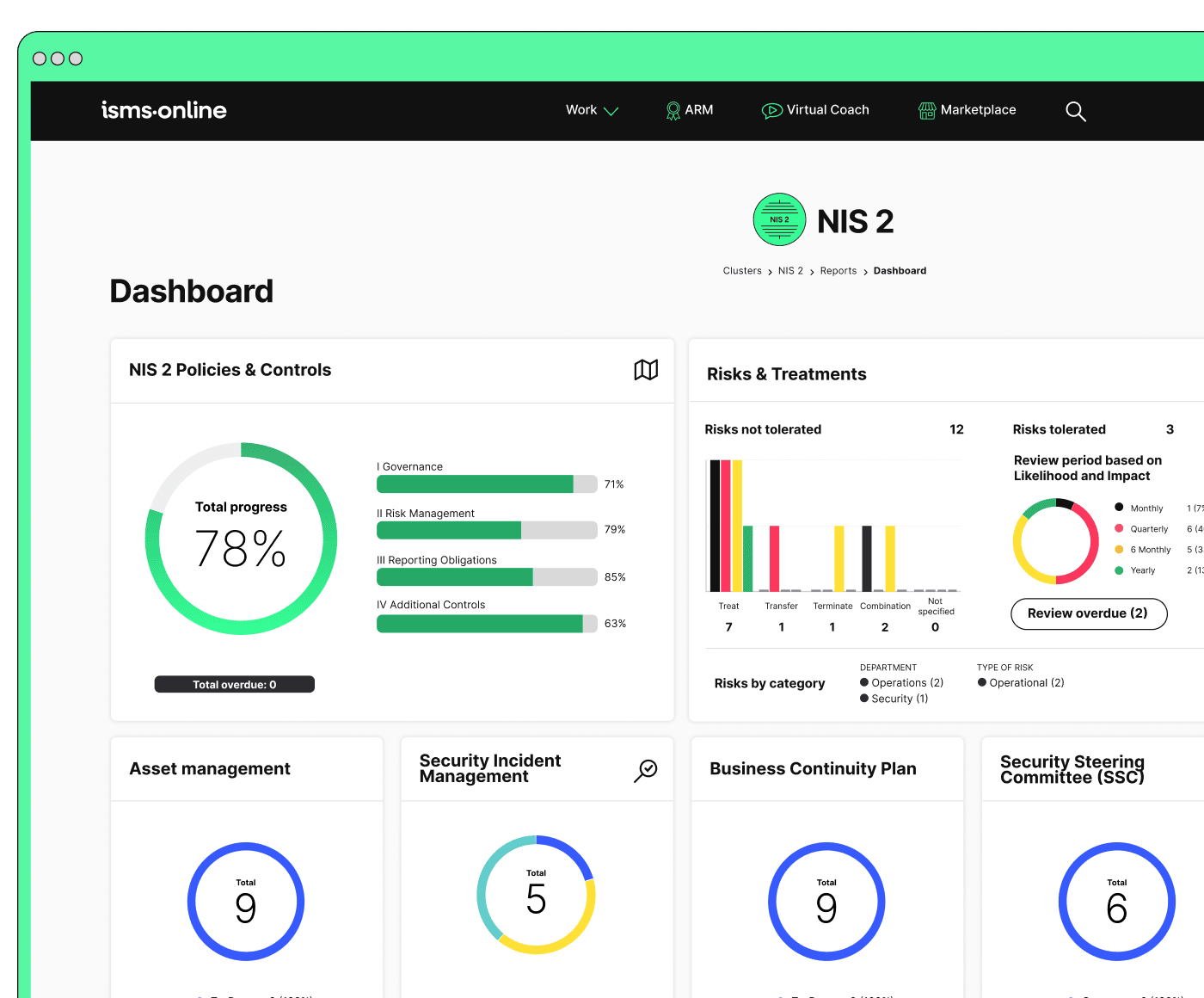
Be NIS 2-ready from day one
Launch with a proven workspace and templates – just tailor, assign, and go.
Can Teams Realistically Keep Pace With NIS 2’s New Incident and Vulnerability Reporting Demands?
NIS 2 accelerates the reporting cadence dramatically: 24 hours for first notification, 72 hours for a detailed report, and a one-month closure window;. This timeline applies to both internal incidents and supplier-led events if their systems underpin your critical operations.
In cyber, slow and perfect reporting gets punished-imperfect but immediate response is now the standard.
Moreover, “significant vulnerability” processes are formalised: each sector gets thresholds, responsible disclosure obligations, and reporting lines to ENISA and sector regulators. Now, failing to track, triage, and evidence a supplier incident can trigger both regulatory penalties and audit findings.
ISMS.online helps teams automate these expectations: incidents can trigger notifications, playbooks drive required evidence capture at each stage, and prompt teams to gather what’s needed for ongoing updates. Incident registers, notification timestamps, escalation logs, and closure evidence are all held in one place, with progress markers and required reporting deadlines mapped and tracked.
For DPOs and privacy leads, the process is even more direct: incident logs and subject access request (SAR) trackers ensure regulatory timelines are met, every data transfer is accounted for, and evidence is instantly exportable for review.
–
What’s Changed in Supply Chain and Third-Party Cyber Risk-And How Do You Evidence Due Diligence?
NIS 2 transforms supply chain cyber due diligence from an afterthought into a core audited requirement;. Now, both onboarding and ongoing management of suppliers are regulated at the same cadence as internal cyber controls. Failing to actively map, risk-assess, and update supplier status during incidents or business change can now unsettle both your compliance standing and actual security.
A blind spot in your vendor’s controls quickly becomes your own operational vulnerability.
ISMS.online automates and streamlines these processes: supplier risk scoring, automated review prompts, centralised contracts and approvals, incident logs linked to third-party actions, and supply chain dashboards showing real-time risk. Not only does this make oversight easier-it creates a continuous audit trail, proving your organisation is vigilant, not just compliant.
Supplier review, onboarding, and status changes-all are documented and time-stamped, with evidence ready for board, auditor, or client review at any time.
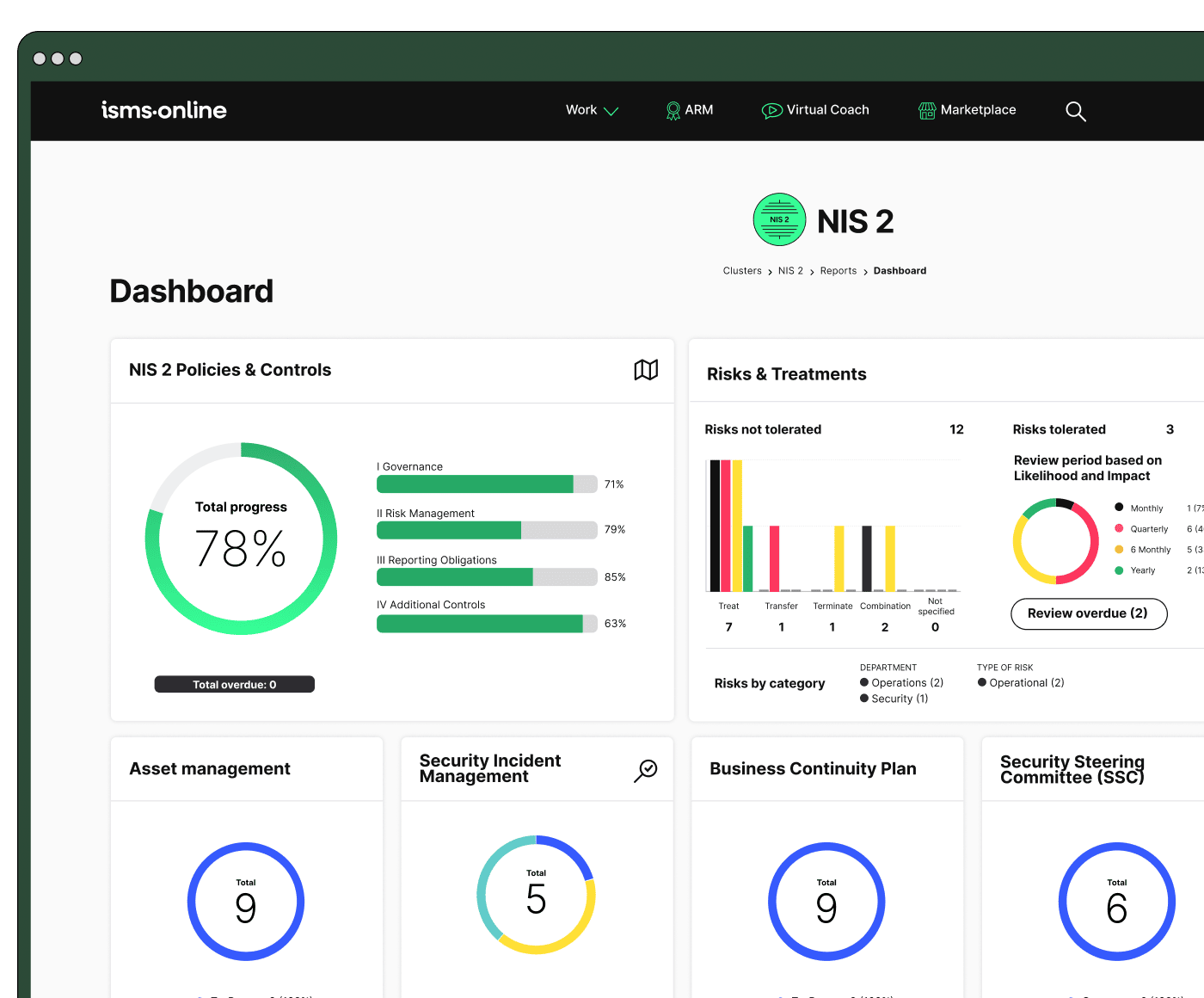
All your NIS 2, all in one place
From Articles 20–23 to audit plans – run and prove compliance, end-to-end.
Is ISO 27001 Still Enough-Or Does NIS 2 Trump Global Standards?
ISO 27001 remains the gold standard for structuring and governing an organisation’s security controls-but in the EU, NIS 2 replaces voluntary controls with compulsory law (thomasmurray.com; linklaters.com). Where NIS 2 obligations are more stringent, they take precedence-timelines, sector overlays, and direct board liability now override ISO’s protocol flexibility.
ISMS.online closes this gap: our platform enables mapping ISO 27001 controls and reporting functions directly to NIS 2 and other sector-specific requirements, reducing friction during audits and simplifying remediation tracking. Compliance evidence is centralised, updated, and instantly exportable: no more risking a failed audit due to a lack of cross-standard clarity.
Privacy officers especially benefit from the combination: ISO 27701’s privacy-by-design framework is strengthened by NIS 2’s reporting pressure and direct links to DPO and data controller obligations. All regulatory, operational, and privacy-ready records are unified, so you are prepared-whether the audit lens lands on security, privacy, or supplier oversight.
For those operating in digital infrastructure, finance, or health, overlays like DORA, eIDAS, or Payment Services effectively stack on top of both standards. ISMS.online ensures every overlay control is tracked, up-to-date, and ready for demonstration.
How ISMS.online Makes Compliance Continuous-and Audit Success Routine
A compliance platform is only as valuable as the evidence it surfaces when you need it. ISMS.online is built for the demands of NIS 2: always-ready incident logs, asset registers, supplier reviews, evidence banks, workflow triggers, approvals, and audit trails-all centralised, visible, and exportable at the click of a button; (isms.online).
When your records move at the speed of the audit request, you’re never unprepared.
For CISOs, the platform turns compliance into an operational loop: controls and incidents update dashboards, audit reminders drive accountability, and evidence is ready for both regulator and client. DPOs and Privacy leaders use evidence logs and embedded controls for defensibility and regulator response. Executives and boards get visible, traceable proof of oversight, decision, and allocation.
Each action is time-stamped, role-attributed, and mapped to both ISO 27001 and NIS 2 obligations. Role-based dashboards are customisable; views and exports are filterable by need-so teams across Security, Privacy, IT, and Operations are always aligned.
Unifying policies, risks, assets, suppliers, controls, and incidents, ISMS.online transforms compliance from passive, last-minute scramble into real-time, integrated resilience.
See for Yourself: Why Evidence-Driven Systems Outpace Policy-Only Platforms
If you’ve ever felt compliance is one step ahead of your readiness-where one slow report, missing approval, or untracked supplier derails the audit-now is the time to act. NIS 2 raises expectations: compliance is now measured in evidence, timeliness, and confidence, not just documents on file.
ISMS.online is engineered for continuous compliance in the real world. Whether your responsibility is for rapid certification, board-proof oversight, cross-standard reporting, or day-to-day incident tracking, you’ll find evidence at your fingertips and friction designed out.
Book an evidence demonstration today to experience how audit preparation, regulatory queries, or board reviews can become just another routine moment in your work-never again a last-minute scramble, always a proof of readiness.
Frequently Asked Questions
Who does NIS 2 regulate now that was previously outside NIS 1’s scope?
NIS 2 expands regulatory reach far beyond the traditional “critical operators” of NIS 1, pulling in thousands more organisations previously considered peripheral. Now, if your company works in public administration, cloud and managed IT, data centres, digital infrastructure, manufacturing, food supply, postal and courier services, waste management, or research-and you exceed 50 employees, €10 million turnover, or hold a key role in supply chains-you are almost certainly inside the compliance perimeter. NIS 2’s definitions cover everything from SaaS scale-ups providing operational technology to logistics firms whose goods are vital to the market, regardless of whether you serve direct consumers or as a strategic B2B provider. Smaller businesses may also come under scrutiny if their disruption could endanger essential services; national authorities can designate you as “critical” based on risk, not only size. Only micro-entities with minimal systemic impact generally remain outside.
The back office has become national infrastructure; compliance is now everyone’s business.
NIS 2 Inclusion Comparison Table
| Sector / Entity | NIS 1 Scope | NIS 2 Changes |
|---|---|---|
| Water, Energy, Transport, Banking | Yes | Still included |
| Public Administration | Rarely | Included at scale |
| Cloud, Managed IT, Data Centres | Rarely | Explicitly included |
| Manufacturing, Food, Research | No | Included if above threshold |
| Postal, Courier, Waste, Logistics | No | Included if critical or large |
| Small non-critical suppliers | No | Still excluded |
What operational and boardroom obligations change most from NIS 1 to NIS 2?
NIS 2 rewrites accountability: it elevates directors and boards from passive sign-off to direct, personal legal responsibility for cyber resilience. Boards must actively direct, resource, and log cyber strategy-failure risks regulatory investigation, suspension, or fines of €10 million or 2% global turnover. Supply chain risk isn’t a policy “goal” but a mandate; contracts and ongoing evidence of oversight are compulsory. The incident reporting regime is now granular and deadline-driven: 24 hours for initial regulatory warning, 72 hours for a first assessment, and full analysis within a month. National authorities receive new powers: surprise audits, real-time stop orders, and suspension of authorisations. Under NIS 2, neglecting or failing to act on supplier disruptions, staff training, or incident escalation is not just risky-it’s explicitly illegal. Living management reviews, sign-off logs, and real-time risk tracking are now minimum viable proof for executives.
Boards can no longer delegate cyber-security-regulators will demand to see the fingerprints of leadership in every decision and review.
NIS 1 vs. NIS 2 Board & Operations Table
| Requirement | NIS 1 Approach | NIS 2 Mandate |
|---|---|---|
| Sector inclusion | 7 classic sectors | 15+, broader and deeper reach |
| Board liability | Soft / indirect | Active, personal, auditable |
| Supply chain oversight | Guidance | Contractual, evidence-driven |
| Incident reporting | 72h+, variable | 24h/72h/1m, enforced |
| Regulator powers/fines | Limited | Fines €10m/2% turnover, suspensions |
How do incident and vulnerability reporting processes operate under NIS 2?
NIS 2 introduces a rigorous, structured reporting lifecycle that teams must internalise as daily practise. Once a significant cyber incident is identified, an early alert must reach authorities within 24 hours-even if full details are not yet available. Within the next 72 hours, a first assessment is required: outlining scope, potential impact, and what is known so far. A final, closure report is due within one month with causal analysis, mitigation actions, recovery strategy, and lessons learned. Vulnerabilities are also in scope: discovering a flaw with potential for major disruption-before any breach-demands registration via national or EU channels (often ENISA). Importantly, the reporting clock starts the moment your critical services are threatened, whether directly or via a supplier, and the timeline is reset for every material incident. Documentation is your shield: every drill, escalation, and board review strengthens the audit trail that regulators will examine.
Every alert, every log, and every assessment becomes your evidence of resilience-prepare to defend each with timestamps and signatures.
NIS 2 Incident & Vulnerability Reporting Table
| Trigger Event | Timing | Required Action |
|---|---|---|
| Major incident identified | Within 24 hours | Early warning to regulator |
| Initial root cause assessment | Within 72 hours | Detailed update/report |
| Final closure & lessons report | Within 1 month | Full remediation/evaluation |
| Critical vulnerability found | ASAP | Register with authority (ENISA/EU/national) |
How is supplier and third-party risk management now evidenced for NIS 2 audits?
Under NIS 2, supplier oversight is transformed into a continuous audit discipline-not a static box-tick exercise. Every critical vendor, IT provider, cloud host, or logistics partner must undergo-and be able to evidence-a risk assessment, robust contract clauses (covering security, audit rights, patching, incident response), real-time validation of certifications, and periodic logged reviews. When a supplier incident disrupts your critical operations, your own reporting deadlines start immediately. Regulators will investigate not only your internal logs, but supplier onboarding checklists, due diligence documentation, audit triggers, and incident traces that prove active, ongoing management. ENISA and national authorities issue and update best-practise templates for these processes, but the expectation is “living evidence”: ready documentation of who checked, when, and how you responded-never “set and forget.”
Regulators now follow cyber risk upstream and downstream; your compliance depends as much on your supplier ecosystem as your own defences.
Supply Chain Assurance Checklist
• Supplier contracts: NIS 2-compliant clauses, audit rights embedded
• Vendor risk assessments: documented at onboarding and regular intervals
• Certification management: review logs, expiry alerts, revalidation
• Incident escalation: authority reports, supplier-triggered response logs
Is ISO 27001 or Cyber-Security Act certification equal to NIS 2 compliance-or what’s missing?
Neither ISO 27001 nor EU Cyber-Security Act certification is a silver bullet for NIS 2. ISO 27001 frameworks-risk registers, incident playbooks, policy governance, and asset management-give invaluable structure, and auditors recognise the discipline. Cyber-Security Act schemes (focused on cloud products and critical services) provide trust signals for customers and partners. Yet, NIS 2 imposes non-negotiable legal duties: fixed deadlines for incident/vulnerability reports, board and executive accountability, continuous living evidence for supply chain management, and the ability to demonstrate active leadership in cyber resilience. Compliance is not about what’s in your certificate, but what’s in your logs and management reviews this quarter. A crosswalk between ISO/CSA and NIS 2 flags strong coverage, but without “living proof”-up-to-date registers, tracked workflows, and board sign-off-your compliance is at risk.
Crosswalk: ISO 27001, CSA, and NIS 2 Requirements
| Area / Control | ISO 27001 Provided | CSA Coverage | NIS 2 Law Demands |
|---|---|---|---|
| Asset & risk register | Yes | Sometimes | Mandatory, living evidence |
| Board accountability | Advised | Not required | Explicit & personal |
| Incident/vuln reporting | Yes (flexible) | No | Strict deadlines, audit logs |
| Supplier control | Yes | Rare | Contractual, ongoing, audited |
| Enforcement/fines | No | No/rare | High fines, market suspension |
What ongoing proof must boards and executives show for NIS 2 resilience and audit readiness?
Regulators are re-framing compliance from “written policy” to ongoing, logged action-boards and executives must now maintain, and be able to export on demand: management review minutes; resource allocation records to cyber/IT; sign-offs on policies and risk registers; incident and escalation logs; staff training and supply chain audit completions. KPIs (response times, completion rates, supplier review cycles) should be visible on request. In practise, the strongest organisations automate this evidence with a platform like ISMS.online: workflows trigger approvals and sign-offs, evidence packs log control reviews, audit events are time-stamped, and management review cycles are tied to recurring tasks and board meetings. When an auditor or regulator asks for proof, your responses move from a scramble for old minutes and emails to instant, exportable dashboards and logs-demonstrating active, not reactive, compliance.
Boards that lead with logged evidence turn regulatory pressure into a trust advantage-your readiness answers every audit before it’s even asked.
Sample Board Compliance Dashboard
| Performance Indicator | Evidence for Board/Regulator |
|---|---|
| Management review frequency | Signed minutes, review logs |
| Register & incident log updates | Snapshots, event chains, board sign-off |
| Policy/control review cycle | Acknowledgments, tracked revisions |
| Training & supplier audits | Completion metrics, audit records |
| Audit-export readiness | Shareable dashboard, evidence log |
How does ISMS.online automate NIS 2 compliance, audit proof, and future-readiness?
ISMS.online converges all live evidence, actions, and policy registers for NIS 2-plus ISO, SOC 2, GDPR, and AI governance-inside a single, secure environment. Board reviews, sign-offs, supplier & risk assessments, incident and asset registers are all actively tracked by role and time, with audit-ready exports available on demand. Automated To-dos, reminders, and Policy Packs tie day-to-day work to ongoing compliance, closing the gap between policy and practise. When regulatory updates or best practise templates (from ENISA or national authorities) change, ISMS.online updates workflows, templates, and compliance checklists to match-so your evidence never falls behind. Role-based dashboards surface emerging risks, overdue reviews, and incomplete supplier audits, allowing your team to close gaps before auditors spot them. Every workflow is versioned, logged, and mapped for authorities. As framework scopes evolve, “linked work” and modular structures mean you can add NIS 2, SOC 2, ISO 27701, or even AI Act workflows-without starting from scratch.
True readiness is living, not static: with ISMS.online, audit confidence, evidence, and board compliance are always a click away.
ISO 27001/NIS 2 Bridge Table: Expectation → Operationalisation → Reference
| Expectation | How Demonstrated | ISO 27001 / NIS 2 Ref |
|---|---|---|
| Timely incident outreach | Incident logs, authority communication | 6.1, 8.16, A5.24 / NIS2 |
| Supply chain control/remediation | Supplier audits, evidence, contracts | A5.19-21, NIS 2 Art. 21 |
| Board managerial engagement | Review/sign-off logs, training | 5.1, 9.3, A5.4 / NIS 2 |
| Asset & risk visibility | Register exports, board visibility | 6.1, 8.2, A5.7 / NIS 2 |
Compliance Traceability Table
| Regulatory Trigger | Risk Register Update | Control Link (SoA/Annex A) | Example Evidence |
|---|---|---|---|
| Onboard new supplier | Supplier risk log | A5.19-21 / NIS 2 | Due diligence, contract review |
| Supply chain disruption | Incident register | A5.24-27 / NIS 2 | Reporting event, action log |
| Annual board review | Risk/control update | 9.3, A5.4 / NIS 2 | Minutes, management review |
| Training completion | Training records | A6.3 / NIS 2 | Training log, proof certificates |
Turn compliance evidence into your organisation’s finest asset-let ISMS.online orchestrate NIS 2 readiness, resilience, and board confidence for every cycle, deadline, and regulator.






