





































What Does the Data Say About ISO 27001 ROI?
The short answer is yes, but you should not take our word for it. Independent survey data from the BSI Group, IBM and ISO itself paints a consistent picture: certified organisations see measurable improvements in security outcomes, operational efficiency and commercial performance.
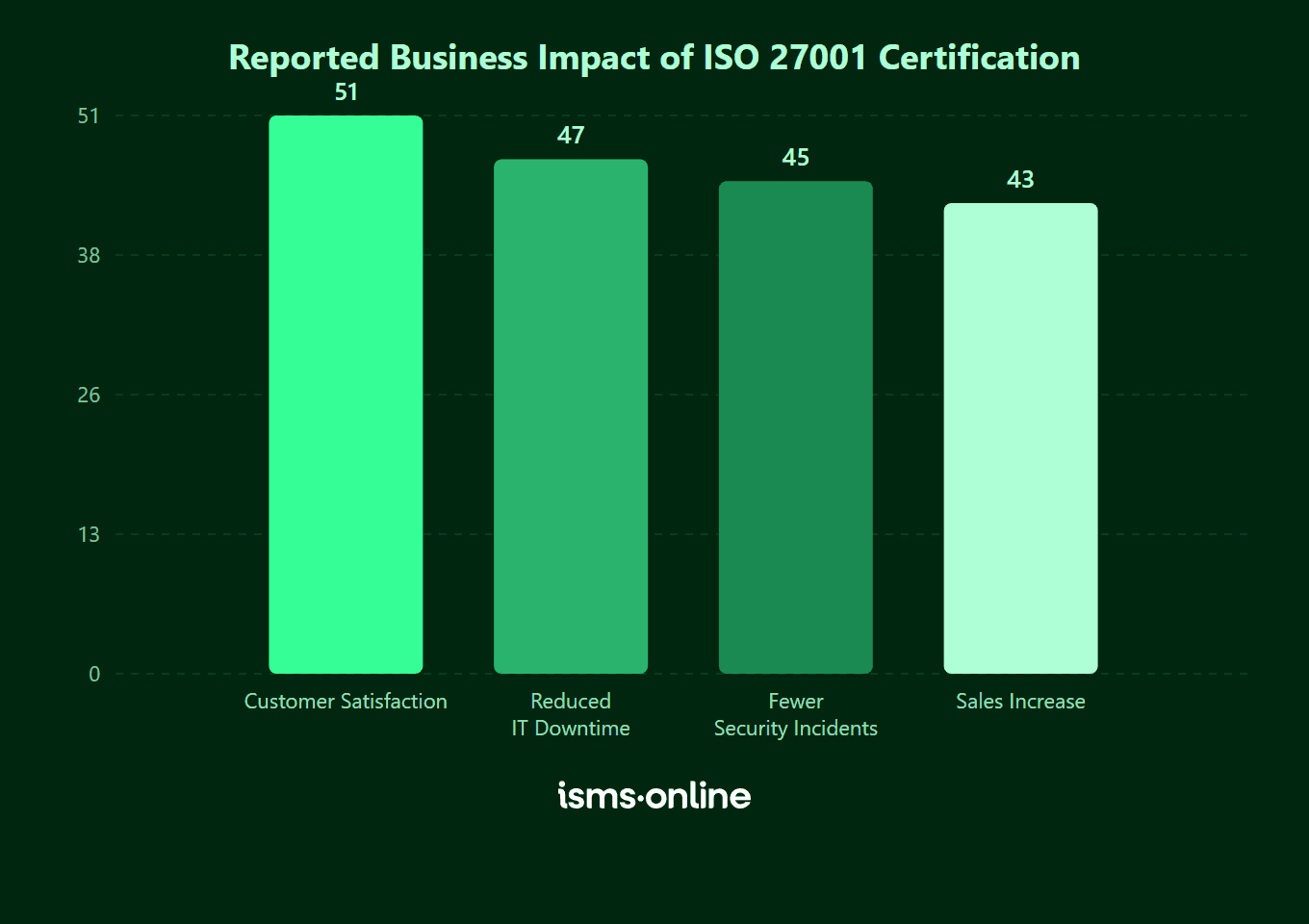
A BSI Group survey of 645 certified organisations found that after achieving ISO 27001 certification:
- 51% reported increased external customer satisfaction
- 47.3% saw reduced IT system downtime
- 45% experienced fewer security incidents within the first year
- 43% reported a direct increase in sales
These are not marginal gains. A 43% sales uplift alone can dwarf the cost of certification many times over, especially for organisations where enterprise customers or regulated industries make up a significant portion of their pipeline.
How Does Certification Reduce Your Financial Risk?
The IBM Cost of a Data Breach Report 2025 puts the global average cost of a data breach at $4.44 million. In the United States, that figure rises to $10.22 million. In healthcare, it reaches $7.42 million.
Certified organisations consistently fare better. IBM’s 2024 data showed that companies with a mature information security management system had $1.2 million lower breach costs than those without one. That single statistic means ISO 27001 certification could pay for itself several times over in a single avoided or contained incident.
Beyond breach costs, certification directly impacts your risk assessment posture in three measurable ways:
| Risk Area | Impact of Certification | Source |
|---|---|---|
| Cyber insurance premiums | 15–25% reduction in annual premiums | Intervalle Technologies, DigitalXRAID |
| Security incidents | 45% decrease within 12 months of certification | ISO 2024 Report |
| Breach containment time | 45% reduction in time to contain a breach | ISMS.online analysis |
For a mid-market organisation paying £50,000 per year in cyber liability insurance, a 20% premium reduction saves £10,000 annually. Over the three-year certification cycle, that is £30,000 in insurance savings alone, before accounting for any avoided incidents or reduced downtime.
What Is the Commercial Case for Certification?
The financial risk argument is compelling, but for many organisations the commercial case is even stronger. ISO 27001 certification is increasingly a prerequisite for doing business, not a nice-to-have.
Faster Sales Cycles
Enterprise procurement teams, particularly in IT, healthcare, finance and government, now routinely require ISO 27001 certification as a knockout criterion in RFPs. Without it, your proposal may never reach the evaluation stage. With it, you skip weeks of security questionnaires and vendor assessments that would otherwise delay the deal.
Research shows certified organisations experience 40% faster vendor onboarding and a 44% reduction in blocked sales or forced re-audits. When a single enterprise deal can be worth hundreds of thousands of pounds, removing friction from the sales process delivers an immediate and measurable return.
Market Access and Trust
ISO 27001 certifications globally grew from 6,000 in 2006 to over 71,500 in 2022, a trend that shows the standard is becoming table stakes rather than a differentiator. The question is shifting from “is certification worth it?” to “can you afford not to be certified?”
This is especially true for organisations selling into regulated sectors. NHS suppliers, financial services firms, and government contractors increasingly expect their supply chain partners to hold certification. Being certified opens doors that are simply closed to uncertified competitors, giving you a genuine competitive advantage.
Reduced Security Questionnaire Burden
If your sales team currently spends hours completing lengthy security questionnaires for every prospect, certification changes that dynamic. An ISO 27001 certificate serves as externally validated proof of your security posture. Instead of answering 200 questions per prospect, you share your certificate and Statement of Applicability. For organisations fielding 20 or more questionnaires per year, this alone can save hundreds of hours of staff time.
ISO 27001 made easy
An 81% Headstart from day one
We’ve done the hard work for you, giving you an 81% Headstart from the moment you log on. All you have to do is fill in the blanks.
How Much Does Certification Actually Cost?
To judge whether something is worth it, you need to know the price. Here is what ISO 27001 certification typically costs by organisation size, broken down into the three main cost categories.
| Organisation Size | Implementation | Certification Audit | Annual Maintenance | Total (Year 1) |
|---|---|---|---|---|
| Startup (10–50 staff) | £3,000–10,000 | £2,000–7,000 | £1,000–3,000 | £6,000–20,000 |
| SME (50–250 staff) | £9,000–25,000 | £4,000–12,000 | £2,000–5,000 | £15,000–42,000 |
| Mid-market (250–1,000 staff) | £15,000–40,000 | £6,000–20,000 | £3,000–7,000 | £24,000–67,000 |
| Enterprise (1,000+ staff) | £30,000–100,000 | £10,000–50,000 | £5,000–15,000 | £45,000–165,000 |
For a full breakdown of what drives these numbers, see our detailed guide to certification costs.
The biggest hidden cost is internal labour. Compliance officers and IT teams can spend hundreds of hours building documentation, collecting evidence and preparing for audits when doing it manually. A compliance platform like ISMS.online reduces that manual effort by 30–50%, which for many organisations is the difference between a project that stays on track and one that stalls.
What Are the Common Objections and Do They Hold Up?
If you are still weighing the decision, you are probably wrestling with one or more of these concerns. Here is what the evidence says.
“It is too expensive for our size”
A startup can achieve certification for as little as £6,000 to £20,000. Compare that against the cost of losing a single enterprise deal because you could not demonstrate your security posture, or the average cost of a data breach for small businesses (over £100,000 according to UK government data). The maths works at every size, but the payback period gets shorter the more you rely on enterprise or regulated customers.
“It takes too long”
It does not have to. With a dedicated project owner and a structured compliance platform, organisations regularly achieve certification in three to six months. The days of 12 to 18 month manual implementations are over for organisations that use the right tools.
“We already have SOC 2”
SOC 2 and ISO 27001 share approximately 90% control overlap, which means you are already most of the way there. But SOC 2 is primarily recognised in North America, while ISO 27001 is the global standard. If you are selling internationally, or to European enterprises, you need both. The incremental effort to add ISO 27001 when you already have SOC 2 is significantly lower than starting from scratch.
“We can just be compliant without certifying”
You can, but compliance without certification carries a credibility gap. When a prospect asks “are you ISO 27001 certified?” the answer is either yes or no. “We follow the framework but are not certified” rarely satisfies enterprise procurement teams. The difference between compliance and certification is the difference between a promise and proof.
“Ongoing maintenance is not worth the effort”
Annual surveillance audits cost a fraction of the initial certification and serve a valuable purpose: they keep your security posture current rather than letting it decay. Organisations that treat their ISMS as a living system rather than a one-off project see compounding returns as processes improve, evidence collection becomes routine and audit preparation takes hours rather than weeks.

Get started easily with a personal product demo
One of our onboarding specialists will walk you through our platform to help you get started with confidence.
Who Benefits Most from ISO 27001 Certification?
While certification delivers value across industries, certain organisations see an outsized return:
- SaaS companies selling to enterprises: Certification removes the biggest friction point in enterprise sales. If your pipeline includes deals above £50,000, the ROI is almost immediate.
- Healthcare technology providers: Patient data protection requirements make certification essential. NHS Digital and many health systems now require it from suppliers.
- Financial services and fintech: Regulators expect robust information security. Certification satisfies FCA expectations and aligns with operational resilience requirements.
- Government contractors and defence suppliers: Public sector procurement increasingly mandates ISO 27001 as a baseline.
- Any organisation handling personal data at scale: Certification demonstrates GDPR alignment and reduces regulatory risk. The 93 Annex A controls map directly to many GDPR requirements.
Why Choose ISMS.online to Maximise Your Certification ROI?
ISMS.online is purpose-built to help organisations get certified faster and maintain compliance with less ongoing effort. Here is how the platform maximises the return on your certification investment.
- 30–50% reduction in manual effort: Pre-built policy templates, automated evidence collection and guided workflows eliminate the labour-intensive documentation work that drives up implementation costs.
- 100% first-time certification success rate: Over 30,000 organisations have used ISMS.online to achieve certification. The structured approach means you arrive at your Stage 2 audit fully prepared, avoiding costly failed audits and rework.
- Faster time to certified: Organisations using ISMS.online typically move from kickoff to audit-ready in weeks rather than months, compressing the timeline and accelerating the point at which certification starts generating commercial returns.
- Lower total cost of ownership: A subscription platform replaces the need for expensive consultants, reduces internal staff hours and provides continuous compliance monitoring that keeps surveillance audits straightforward. Compare the approach with ISMS.online vs traditional consultants.
- Multi-framework efficiency: Already working towards SOC 2, NIS 2, GDPR or ISO 42001? Map overlapping controls once and reuse evidence across frameworks, multiplying the value of your initial investment.
- Continuous compliance, not annual panic: Automated monitoring, task management and audit scheduling keep your ISMS running year-round, so surveillance audits are a formality rather than a scramble.
- Collaboration built in: Assign controls and tasks to owners across departments. HR, Legal, IT and Operations stay aligned without email chains or spreadsheets.
The question is not whether ISO 27001 certification is worth it. The data is clear: it is. The real question is how quickly you can start seeing returns. Book a demo to see how ISMS.online can get you there faster.
FAQs
What is the typical ROI of ISO 27001 certification?
Most organisations see a positive ROI within 12 months. The BSI Group found that 43% of certified organisations reported increased sales, while IBM data shows certified companies save an average of $1.2 million per breach compared to uncertified peers. Add in 15–25% cyber insurance savings and reduced security questionnaire burden, and the payback period is typically well under a year for organisations with enterprise or regulated customers.
Is ISO 27001 worth it for small businesses?
Yes, particularly if you sell to larger organisations or handle sensitive data. A startup can achieve certification for £6,000 to £20,000. If that certification helps you win even one enterprise deal or avoid one security incident, it has paid for itself. The key is to scope your ISMS tightly, focusing on your core product or service rather than trying to certify everything at once.
How does ISO 27001 compare to SOC 2 in terms of value?
Both deliver strong ROI, but they serve different markets. SOC 2 is primarily recognised in North America, while ISO 27001 is the globally accepted standard. For organisations selling internationally or to European enterprises, ISO 27001 typically delivers greater commercial value. The two frameworks share approximately 90% control overlap, so holding both is achievable with manageable incremental effort.
Does ISO 27001 certification reduce cyber insurance costs?
Yes. Multiple insurance industry sources report that ISO 27001 certification leads to 15–25% reductions in cyber liability insurance premiums. Some insurers now require certification as a prerequisite for coverage. Over the three-year certification cycle, the cumulative insurance savings can offset a significant portion of the total certification cost.
What happens if we do not get certified?
The direct risk is commercial. Enterprise RFPs increasingly use ISO 27001 as a mandatory requirement, meaning uncertified organisations are excluded before the evaluation even begins. Beyond lost deals, uncertified organisations face higher insurance premiums, longer security questionnaire processes, greater exposure to breach costs and a weaker negotiating position with partners and customers who demand evidence of robust information security.
How quickly can we see a return on our certification investment?
Many organisations see commercial returns before they are even certified. The process of implementing an ISMS improves your security posture, which you can demonstrate to prospects during the sales process. Once certified, the returns accelerate through faster deal closures, insurance savings and reduced incident costs. With a platform like ISMS.online, you can be audit-ready in weeks and certified within three to six months.






