











ISO/IEC 27005:2022 is the international guidance standard on managing information security risks. It helps organisations set risk criteria, then identify, analyse, evaluate and treat information security risks, and it is written to support the risk requirements of ISO/IEC 27001. It is guidance, so organisations cannot be certified against it.
Where does ISO/IEC 27005 fit in information security risk management?
Risk assessment (commonly referred to as risk analysis) is likely the most difficult component of ISO 27001 implementation; nevertheless, risk assessment is the most critical phase at the start of your information security initiative. It lays the groundwork for information security in your organisation. Risk management is often over complicated. This is where ISO 27005 comes in.
What is ISO 27005?
ISO/IEC 27005 is an international standard that gives guidance on carrying out information security risk management in support of ISO 27001. The current edition is ISO/IEC 27005:2022, Information security, cybersecurity and privacy protection – Guidance on managing information security risks. This fourth edition was published in October 2022 and replaced the third edition, ISO/IEC 27005:2018. Its clauses now follow the layout of ISO/IEC 27001:2022 (see our guide to the ISO 27001:2022 standard update), and it adds risk scenarios and an event-based approach alongside the asset-based approach.
ISO 27001 allows you to show proof of risk assessment for information security risk management, measures taken, and the application of applicable controls from Annex A.
- ISO 27005 guidelines are a subset of a broader range of best practices for preventing data breaches in your organisation.
- The specification provides guidance on the formal identification, assessment, evaluation, and treatment of information security risks – procedures that are central to an ISO27k Information Security Management System (ISMS).
- Its aim is to help organisations rationally plan, execute, administer, monitor, and manage their information security controls and other arrangements in relation to their information security risks.
- As with the other guidance standards in the series, ISO 27005 does not define a clear path to compliance and contains no certifiable requirements. It simply recommends best practices that will fit into any standard ISMS.
What is Information Security Risk Management?
ISRM, or information security risk management, is the practice of identifying and mitigating risks related to the use of information technology. It entails identifying, assessing, and mitigating threats to the confidentiality, integrity and availability of an organisation’s information assets. The end result is to manage risks in line with an organisation’s overall risk tolerance. Businesses do not expect to eradicate all risks; rather, they should strive to define and maintain a risk level that is appropriate to their company.
ISO 27005 and Information Security Risk Management
While risk management best practices have evolved over time to address individual needs in a variety of areas and industries through the use of a variety of different methods, the implementation of consistent processes within an overarching framework can help ensure that risks are handled reliably, accurately, and intelligibly within the organisation. ISO 27005 provides guidance for such a framework. It describes risk management practices tailored to information security, with a special emphasis on supporting the requirements of an Information Security Management System (ISMS), as set out in ISO/IEC 27001.
It recommends that risk management be set up to suit the organisation’s characteristics, taking into account the complexity of the organisation’s information security management system, the risk management scope, and the industry. Although ISO 27005 does not define a particular risk management method, it does support a continuous risk management approach built from the activities set out below:
Context Establishment
The risk assessment context establishes the guidelines for identifying risks, determining who is accountable for risk ownership, determining how risks affect the confidentiality, integrity, and availability of information, and calculating risk effect and probability.

Free yourself from a mountain of spreadsheets
Embed, expand and scale your compliance, without the mess. IO gives you the resilience and confidence to grow securely.
Information Security Risk Assessment (ISRA)
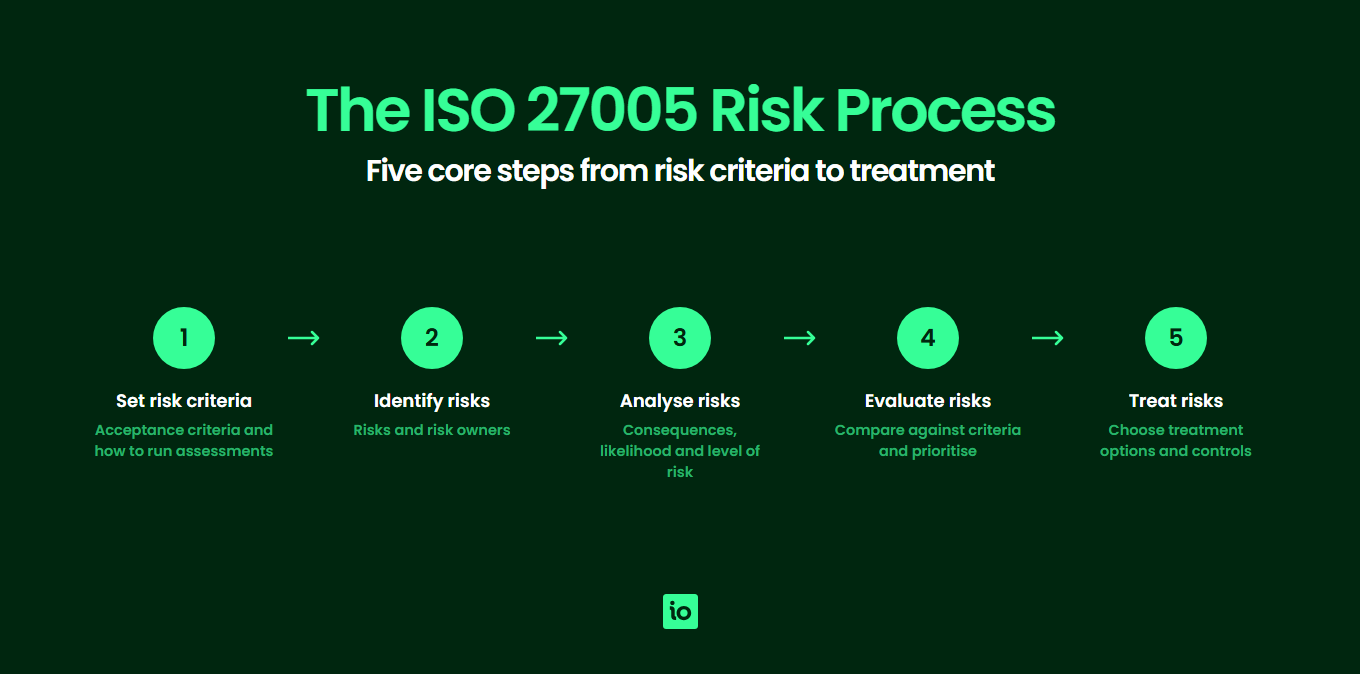
Assessing information security risk can be a difficult process, but once you know what to look out for, you will begin to discover the possible issues that can occur. ISO/IEC 27005:2022 describes two common ways to identify risks: an event-based approach, which looks at risk sources and the events and consequences they could cause, and an asset-based approach, which works through assets, threats and vulnerabilities. To properly assess the risk with an asset-based approach, you must first list all of your assets and then the threats and vulnerabilities relevant to those assets, noting the level of potential risk. Some organisations opt for a five-stage asset-based risk assessment approach.
- Creating a database of information assets
- Determining the threats and vulnerabilities that each asset faces
- Assigning values to the consequence and likelihood in risk assessment in accordance with risk criteria
- Comparing each risk to predefined acceptance thresholds
- Determining which risks should be tackled first and in what order
Information Security Risk Treatment
Everyone knows that risks are not created equal. So, the best way to treat risk is to start with the unacceptable risks – the ones that pose the most problems. ISO/IEC 27005:2022 describes four risk treatment options:
- Avoid: remove the risk by deciding not to start or continue the activity that causes it. Example: stop collecting a type of personal data you do not need, so there is nothing to lose.
- Modify: change the likelihood or the consequence with security controls. Example: turn on multi-factor authentication for administrator accounts.
- Share: pass part of the risk to a third party through insurance, outsourcing or another contract. Example: take out cyber insurance to cover part of the cost of an incident.
- Retain: accept the risk by informed choice. Example: a risk owner signs off a low-rated risk and records it for review.
Information Security Risk Acceptance
Organisations should establish their own risk acceptance criteria, based on their risk appetite and taking into account factors such as their objectives, legal and regulatory aspects and financial constraints. This means documenting everything. Not just for the auditors, but so that you can refer to them in the future if need be.
Information Security Risk Communication
Effective risk communication and consulting are critical components of the information security risk management process. It helps people responsible for risk management grasp the rationale for decisions and the reasons for such actions. Sharing and exchanging ideas about risk also helps policymakers and other stakeholders reach a consensus on how to handle risk. Continuous risk communication should be practised, and organisations should establish risk communication strategies for both routine procedures and emergency situations.
Information Security Risk Monitoring and Review
Risks are dynamic and can change rapidly. As a result, they should be actively monitored in order to detect shifts easily and maintain a complete picture of the risks. Additionally, organisations should keep a close watch on the following:
- any new assets brought into the scope of risk management
- asset values that need to be adjusted to reflect changing business requirements
- new risks, external or internal, that have not yet been evaluated
- incidents involving information security
How does ISO 27005 map to ISO 27001 clauses 6.1.2 and 6.1.3?
ISO 27001 sets the requirements an organisation is certified against; ISO 27005 gives guidance on how to meet the risk parts of them. The table below shows where each step sits in both documents (clause numbers from ISO/IEC 27001:2022 and ISO/IEC 27005:2022).
| Risk step | ISO 27001:2022 requirement | ISO 27005:2022 guidance |
|---|---|---|
| Set risk acceptance criteria and criteria for running assessments | 6.1.2 a) | 6.4 |
| Identify risks and risk owners | 6.1.2 c) | 7.2 |
| Analyse consequences, likelihood and level of risk | 6.1.2 d) | 7.3 |
| Evaluate risks against criteria and prioritise them | 6.1.2 e) | 7.4 |
| Choose risk treatment options | 6.1.3 a) | 8.2 |
| Decide the controls needed and check them against Annex A | 6.1.3 b) and c) | 8.3 and 8.4 |
| Produce the Statement of Applicability | 6.1.3 d) | 8.5 |
| Write the treatment plan, get risk owner approval and accept residual risk | 6.1.3 e) and f) | 8.6 |
| Carry out assessments and treatment in day-to-day operation | 8.2 and 8.3 | 9.1 and 9.2 |
What does an asset-based risk assessment look like in practice?
The short example below is illustrative only. Your own scales, criteria and decisions come from the risk criteria you set during context establishment.
- Asset: a customer database hosted with a cloud provider.
- Threat: an attacker using stolen administrator credentials.
- Vulnerability: administrator accounts protected by a password only.
- Consequence: loss of confidentiality of customer data, rated high on a 1 to 5 scale.
- Likelihood: rated medium, given phishing attempts the organisation already sees.
- Evaluation: the resulting risk level is above the acceptance threshold, so it must be treated.
- Treatment: modify the risk by requiring multi-factor authentication for administrators.
- Residual risk: rated low and accepted by the named risk owner, then reviewed at the next planned assessment.

Manage all your compliance, all in one place
ISMS.online supports over 100 standards and regulations, giving you a single platform for all your compliance needs.
What is the Scope and Purpose of ISO 27005?
ISO/IEC 27005 applies to all types and sizes of organisations, as do the other ISO/IEC 27000 family standards – a very varied group, which is why it would be inappropriate to require uniform approaches, processes, risks, and controls.
Other than that, the principles offer broad guidelines within the context of a management framework. Managers are urged to use formal approaches that are applicable to and suitable for their organisation’s unique circumstances, rationally and methodically addressing risks to information.
Identifying and putting information risks under management supervision enables them to be managed effectively, in a manner that adapts to trends and capitalises on growth opportunities, resulting in the ISMS evolving and becoming more successful over time.
ISO 27005 further supports ISO 27001, since the latter requires that the controls applied as part of an ISMS (Information Security Management System) are determined through risk assessment and risk treatment.
Is ISO 27005 mandatory for ISO 27001?
No. ISO 27001 clause 6.1.2 requires you to define and apply a risk assessment process, with set criteria, that gives consistent, valid and comparable results when repeated. It does not require any particular method. ISO 27001:2022 lists ISO/IEC 27005 in its bibliography as further reading, so you can use it, adapt it or follow another method that meets the clause.
Why is ISO 27005 Important for your Organisation?
It also helps you prioritise risks and take proactive measures to eliminate or minimise them.
The document is extremely beneficial if you wish to gain a better understanding of information security risk assessment and treatment – in other words, if you want to serve as a consultant or even as a permanent information security/risk manager.
There is no organisational ISO 27005 certificate: organisations are certified against ISO 27001 by accredited certification bodies. Some training providers run courses based on ISO 27005 and issue personal certificates to individuals; these are qualifications set by the training provider. Using the ISO 27005 guidance can help you:
- implement an information security risk management process effectively
- run an information security risk assessment process responsibly, taking account of applicable legal and regulatory requirements
- guide staff responsible for network security and risk control
- align the organisation’s ISMS with its risk management goals
Why choose ISMS.online for ISO 27005?
ISMS.online is our cloud-based solution for putting ISO 27005 guidance into practice within your ISO 27001 ISMS. With it you can:
- Document your ISMS processes and checklists.
- Use that documentation to demonstrate compliance with the relevant standards.
- Manage all your checklists in one place.
- Collaborate with your team.
- Use a rich suite of tools to design and implement an ISMS that is in line with global best practices.
- Get advice and help from our in-house team of information technology professionals, all the way through your ISMS design and implementation.
To see how ISMS.online can help you manage information security risk with ISO 27005, book a demo.
FAQs
Does ISO 27005 tell you which security controls to use?
No. It gives guidance on how to choose controls, not a fixed list. ISO 27001 asks you to decide the controls you need through risk assessment and risk treatment, compare them with the controls in Annex A, and record the result in your Statement of Applicability.
Who accepts the risk that is left after treatment?
The risk owner. Under ISO 27001 clause 6.1.3 e) and f), risk owners approve the risk treatment plan and accept the residual risk, and ISO 27005 clause 8.6 gives guidance on this step. Document the decision so it can be checked at the next planned assessment.
Can small organisations use ISO 27005?
Yes. ISO 27005 applies to organisations of all types and sizes and does not set one method. It recommends that risk management suits the organisation’s complexity, scope and industry, so a small business can scale the process to its size, as long as the results stay consistent, valid and comparable.