





































Are You Mapping Resilience-or Drifting into Audit Risk? Why Static NIS 2–ISO 27001 Matrices Are Failing Fast
Every compliance leader who’s spent late nights crosswalking NIS 2 with ISO 27001 has been tempted by the path of least resistance. Tick the spreadsheet boxes, upload a few ageing policies, and you’re done-right? But the nature of scrutiny has evolved: regulators and auditors are no longer satisfied by static matrices lingering in SharePoint or email. Modern compliance expectations hinge on “living” mapping-an ever-adapting, owner-verifiable evidence chain that keeps pace with how your organisation really operates, not how it’s supposed to on paper.
Audit failure is rarely about having too little paperwork-it’s when real operations outpace mapping that risk grows silent and deep.
This is the fundamental operational shift: NIS 2 reframes compliance from documentation-first to operational resilience, spotlighting the moving parts, not just the artefacts. ENISA’s guidance is explicit: “Mapping drift”-the result of static files, legacy matrixes, and control links failing to map to current processes-leads directly to findings, fines, and reputational harm. Article 20’s new paradigm hands not just oversight but personal liability to boardrooms, making “on-demand traceability” a baseline, not a bonus.
If your mapping still relies on a couple of siloed project owners-if control links age by the quarter or orphaned policies sit unaudited-you’re now carrying hidden regulatory risk, not just process drag. In fact, year-old control descriptions, ageing evidence logs, or unclear owner assignments are now explicitly listed as “audit traps” in both ENISA’s and BSI’s latest toolkits.
The new baseline: Auditors no longer ask “Do you have the mapping?”-they want to see operational proof now: timestamps, owner verification, fresh document links, and responsive risk registers. Static paperwork or legacy “mapping matrices” are flagged in minutes; living, role-tied mapping has become the standard of care.
Can Automation Save You, or Does It Multiply Your Exposure? The Dangerous Allure of “One-Click” Mapping
The promise of mapping automation and instant compliance health-checks glows on every SaaS demo. Instant crosswalks, pre-stacked dashboards, “one-click” policy libraries, and on-demand SoA exports-who wouldn’t want the frictionless overlay? But experience reminds us: automation only pays off if it’s rooted in operational reality.
A green dashboard can’t outfox an audit if the evidence chain is broken behind the scenes.
Modern mapping platforms often default to checklist logic: as long as a control is ticked, it’s considered mapped-forgetting that real-world changes (from supplier churn and contract updates to staff turnover and incident response) constantly shift the ground underneath. Most audit teams now ask pointedly: “Show me how your tool ties supply chain risk reviews to live evidence”. Templates or automation that fail to flag contract expiry, risk scoring adjustments, or access privilege lapses may actually exacerbate regulatory liability-the green tick stays, while compliance reality quietly drifts away.
Supply chain controls are a salient example: most mapping failures occur not at onboarding but in-phase, when a supplier changes risk status or is breached, but the mapping fails to fire a new review, update the control, or reassign ownership. Regulatory fines and audit never-ends result not from missing controls-but from controls that went uncoupled from operational events due to passive mapping.
Can your current mapping solution trace every change, owner, and event in real-time? If a supplier, policy, or privileged user changes status today, does your dashboard update, flag a new review cycle, and log the evidence-without manual intervention?
Risk multiplies when people trust dashboards more than the living reality underneath.
The bottom line: automation must trigger process, not lull teams into a false sense of compliance. Only tools that bridge live triggers-changes in contract, policy, incident, or privilege-into remapped, versioned, and owner-verified evidence can withstand modern audit and regulatory review.

Master NIS 2 without spreadsheet chaos
Centralise risk, incidents, suppliers, and evidence in one clean platform.
Which 10 NIS 2–ISO 27001 Control Pairs Are Most Likely to Determine Audit Survival?
Success under scrutiny comes down to putting your audit muscle where it matters: in 10 high-leverage control pairs where operational drift can turn strength into exposure overnight-or, if locked down, buy you unrivalled audit confidence. These pairs aren’t just headings for mapping-they are living fault-lines, and every NIS 2 leader should treat them as daily battlegrounds.
1. Real-Time Asset Inventory
Ownership and risk status must update dynamically. “Anonymous inventories spell disaster in audits”-SANS. Name every asset, tie active risks, and assign owners who update the register each change window.
2. Supply Chain Lifecycle & Evidence
Document the full arc: onboarding, contract updates, scheduled reviews, and responsive action to risks. PwC: “Contract changes and actions must be logged and owner-reviewed-not just policy filed.”
3. Incident Handling & Timed Reporting
Tie every incident to the mapped reporting clock-time to notify, escalation role, and evidence trail. Controllers must assign owners and keep timestamps in sync with regulations.
4. Access Control & Multi-Factor Review
Regular, event-driven privilege reviews-especially for privileged or remote access-must feed back audits, approvals, and log evidence. Missing a single timed review is now a flagged control.
5. Board and Senior Management Evidence
Board sign-off must show not just an annual policy review, but timestamped mapping approvals-direct, evidence-logged, and accessible in every audit window.
6. Living Policy Version Control
Every policy must evidence both version history and cross-reference to mapped controls. Updates that aren’t reflected in mapping are a fast path to nonconformity.
7. SoA–Risk Register Alignment
The Statement of Applicability acts as the live mapping hub: risks, controls, and evidence must align and trigger real-time status changes across the chain.
8. Continuous Monitoring with Alert Loops
Automated monitoring must not just capture events-but link them to mapped controls, flagging new risks, and alerting control owners for review and evidence logging.
9. Staff Training: Versioned, Role-Mapped and Audit-Verified
Training must be mapped to exact control numbers, role assignments, and staff rosters-auditable not just for participation, but for up-to-date status against regulatory windows.
10. Supplier Directory & Risk Mapping
Every supplier and linked control must trace to a risk assessment, review schedule, and owner-ready to evidence at a moment’s notice, on demand.
Audit readiness is proven by the chain: control-to-owner-to-evidence, tracked in time and action.
Can You Prove “Audit Readiness” at Any Moment? The Anatomy of Living Evidence
Audit readiness isn’t about satisfying an annual appointment. It means delivering owner-tied, up-to-date, bi-directional evidence every day. If your team hesitates-can you output a timestamped, owner-verified log for any mapped control in seconds?-then underlying risk has already taken root.
Any hesitation in answering who updated this, when, and for what change is a signal to the audit team.
Consider these operational hallmarks of audit readiness:
- Each control, policy, and risk is owner-assigned, with timestamps at every edit.
- Bi-directional navigation: any reviewer can leap from a piece of evidence → mapped control → SoA, and back, in a click.
- The SoA synchronises live: every risk update flows through mapped controls and evidence logs without lag.
- Each retention period is mapped against current ISO 27001 + NIS 2, with mapped triggers-not blanket rules.
- Dashboards export all mappings, change logs, and approval histories-ready for auditor or board at any cadence.
These expectations are not “nice to have.” They are now minimum requirements for any modern compliance platform, and recognised by both auditors and ENISA as essential (isms.online/features/statement-of-applicability/).
The strongest compliance teams equip themselves with dashboards that bring together mapping, evidence, role ownership, and live triggers-synchronised across security, privacy, and supplier frameworks.
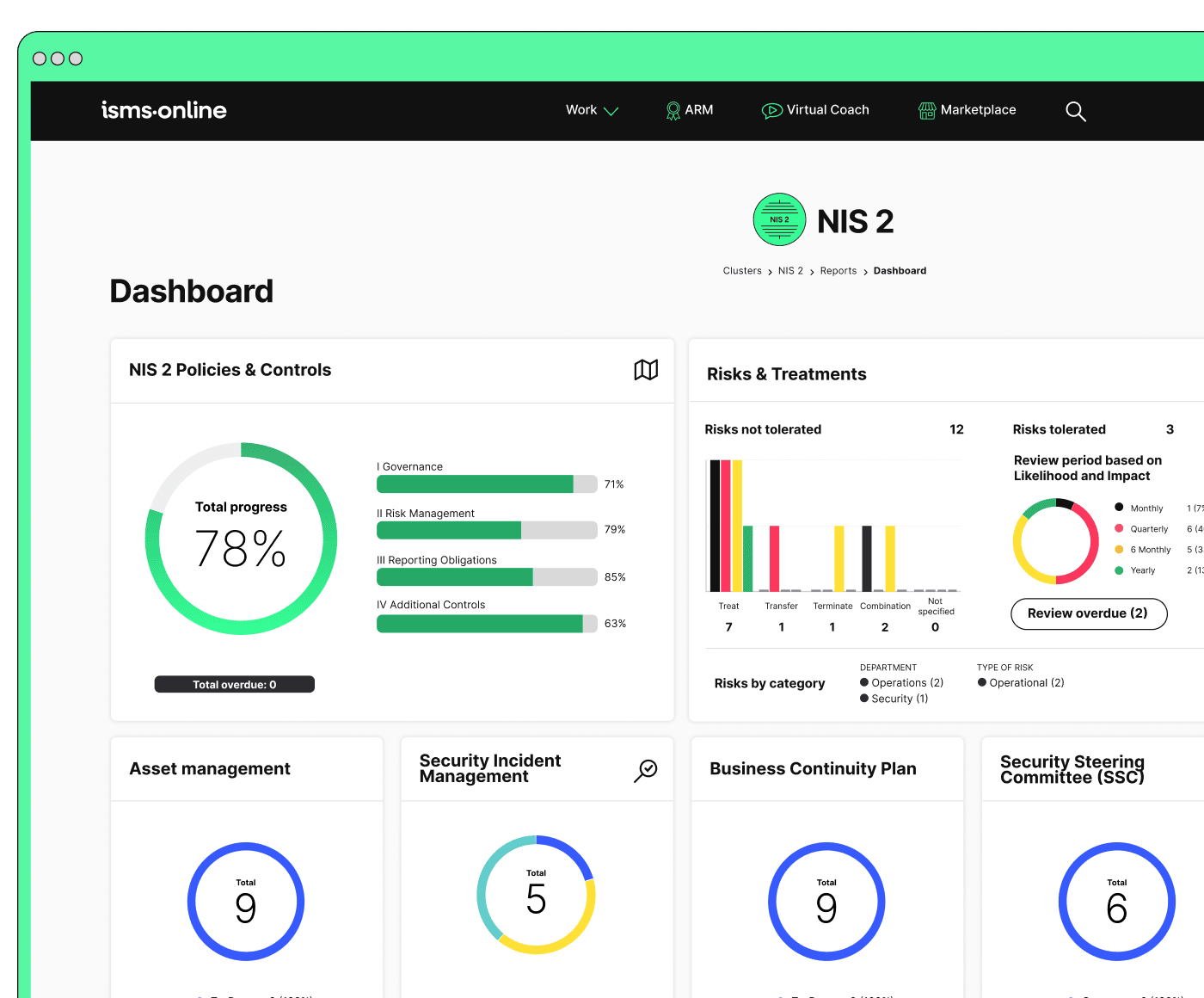
Be NIS 2-ready from day one
Launch with a proven workspace and templates – just tailor, assign, and go.
Is Your Evidence Chain Traceable, Versioned, and Built to Survive Board and Regulator Review?
Every control chain should be versioned-showing not just “what” but “who, when, and why.” If version logs are ad hoc, evidence is scattered, or mapping to events is manual, expect flags on first review.
The highest risk lies in idle evidence: a new risk emerges, the update log stays silent for days, and mapping is left to a batch process. “Manual history trails are regulatory warning signals. You need real-time, automated tracking of every evidence and mapping event,” cautions RSISecurity.
Example Review Chain: Action to Audit-Ready
| **Trigger Event** | **Update Action** | **Control/SoA Link** | **Evidence Captured** |
|---|---|---|---|
| Contract renewed | Supply chain risk re-assessed | A.5.21 (supplier management) | Updated supplier log + board sign-off |
| New account privilege | Access risk re-evaluated | A.8.2 (privilege), A.8.5 (MFA) | Log review + approval, evidence attached |
| Security incident flagged | Incident log updated | A.5.24-27, A.8.15 | Incident report, actioned owner, notification |
| New staffing/training | Roster + evidence update | A.6.3, A.8.8 | Training log synced to mapped control |
Traceability here means every event-not just the annual review-forces an evidence update, mapping reconciliation, and dashboard status change. Modern compliance platforms build this logic into every evidence and mapping interface: you never “lag work in progress.”
The expectation is clear: you should be able to produce-on demand-a linked chain showing who initiated, who reviewed, what was changed, and why. This is traceability-now the core definition of audit resilience.
ISO 27001 Expectation–Action–Reference Bridge (Mini Table)
Here’s how to contextualise “what to prove”:
| **Expectation** | **Operationalisation** | **ISO 27001 / Annex A** |
|---|---|---|
| Asset, owner, risk, proof | Live roles, asset-risk tie | A.5.9, A.5.2, A.8.1 |
| Supplier + evidence workflow | Scheduled logs, reviews | A.5.19–A.5.23, A.8.30 |
| Incident reporting window | Evidence trigger, notification | A.5.24–A.5.27, A.8.15 |
| Privilege reviews + approval | Log & approval timestamps | A.5.16, A.8.2, A.8.5 |
| Board sign-off | Workflow, signature evidence | A.5.4, A.5.35, Cl.9.3 |
| Policy version tracking | Policy linkage, update logs | A.5.10, A.5.12, A.7.5 |
| SoA–risk–evidence chain | Owner-mapped, synchronised | Cl.6.1–6.3, Cl.8.3, A.5.7 |
| Alerts (monitoring) proof | Dashboard, logs, notifications | A.8.6, A.8.16, A.8.22 |
| Training, versioned and mapped | Logs by staff/control | A.6.3, A.8.8 |
| Supplier risk directory | Dashboard + link + schedule | A.5.9, A.5.19–A.5.23, A.8.30 |
Your mapping must surface this evidence instantly-matching role, control and time to an irrefutable baseline.
What Should a Modern Compliance Dashboard Deliver to Your Team-Not Just Auditors?
Resilience is now measured by shared, visible proof-who owns what, what’s overdue, and where the next risk or evidence lag sits. The strongest dashboards surface not just mapping progress, but “operational readiness” in real time, allowing all stakeholders to see, act, and remediate ahead of regulators or boards.
A dashboard isn’t just for audit-it's your early warning and shared trust system.
A robust compliance dashboard ties together control mapping, owner assignments, evidence logs, review cycles, supplier status, incident logs, and staff training-all on a single, exportable screen, with at-a-glance risk and compliance KPIs. Boards and auditors want to see, at any moment:
- Which mapped controls are overdue.
- Who owns each mapped control.
- How current is each evidence log or policy version.
- What’s the next scheduled review, and what triggered it.
- Cross-framework mapping, not just ISO 27001 but supplier, privacy and sectoral overlays.
- One-click export of everything your board or a regulator will ask for.
This isn’t aspirational. It’s the new baseline for audit readiness and operational trust.
If your team feels blind to any of these, or takes more than ten minutes to answer-“who owns this mapped control?” or “when did we last update this risk?”-your compliance is signalling risk before the audit even begins. Modern platforms, like ISMS.online, bring this visibility into the daily workflow, moving compliance from paper shadow to living shield.
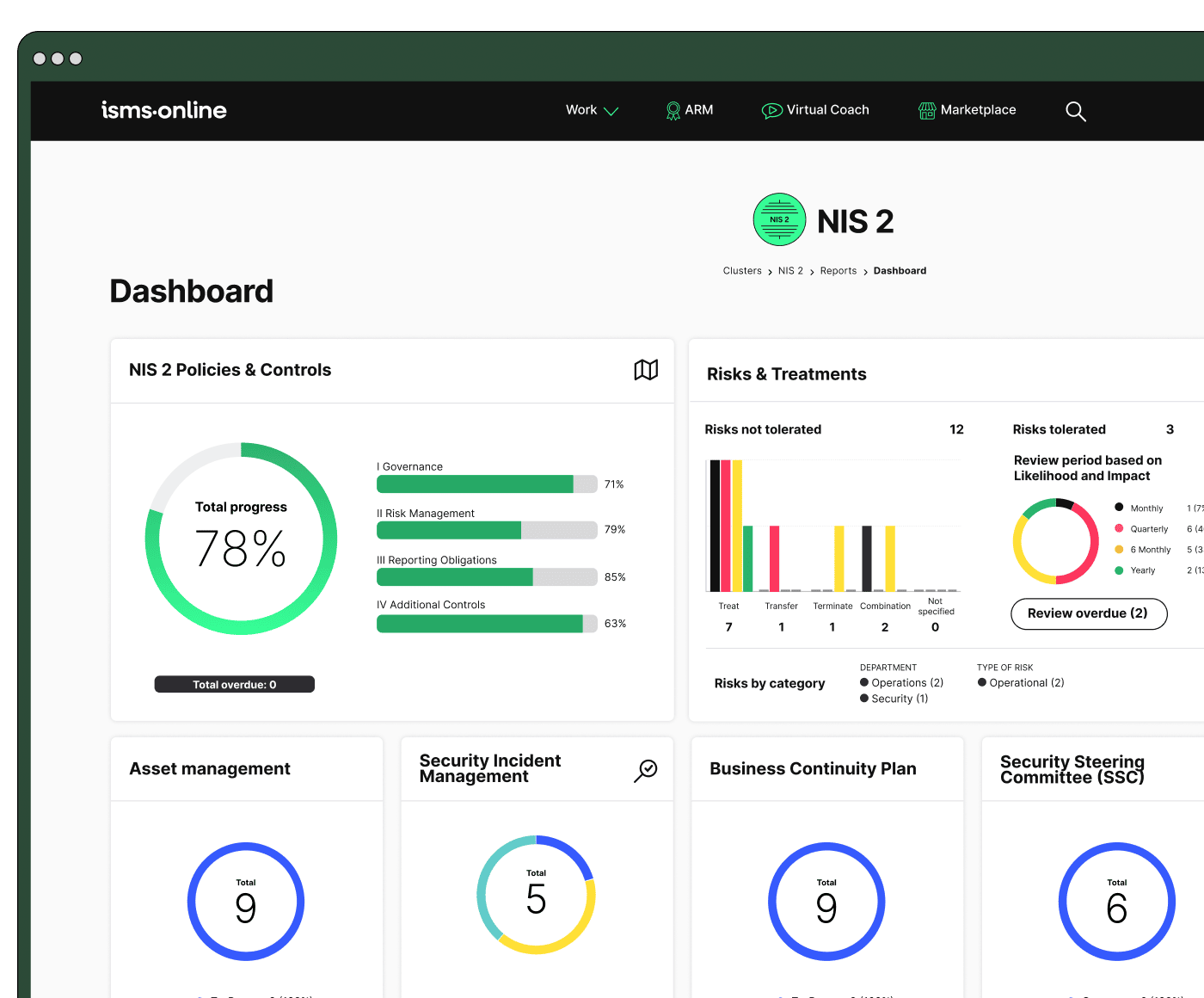
All your NIS 2, all in one place
From Articles 20–23 to audit plans – run and prove compliance, end-to-end.
Does Your Compliance Loop Actually Close? Lessons Learned, Evidence Refreshed, and Continuous Improvement Proven in Practise
Compliance is no longer a static seatbelt-it’s an evolving muscle, growing stronger with every audit, incident, or control review. Mature teams operationalise this by baking “lessons learned” feedback into evidence logs, SoA updates, and risk register change cycles. ENISA’s 2024 report found resilience and reputational trust grew strongest in organisations who mapped audit and incident feedback directly into their control system, not just into PowerPoints or staff briefings.
Mature compliance lives where your next evidence log closes the loop on your last lessons learned.
This loop comes alive as:
- Each finding, incident, or KPI gap triggers a mandated policy or control review, directly versioned to evidence and mapping.
- Lessons learned are surfaced in dashboard review cycles, not buried in inboxes.
- Evidence-logging becomes a process of daily improvement-raising control, proof, and mapping standards continuously.
Organisations with this loop internalised shed audit anxiety and see compliance become a cultural force-visible, owned, and continually improving. Boards, risk committees, and regulators now actively seek this visibility, transforming compliance from box-ticking to reputational and operational trust capital.
Make Compliance Your Next Strategic Advantage-Diagnostic Offer
If you’ve read this and worried your mapping, evidence, or versioning might not stand up to live review-or that board, regulator, or client could request exportable, owner-tied proof without enough warning-pause and act. The risk isn’t only non-conformance; it’s missed opportunity: compliance as a lever for faster deals, happier boards, and audit-ready calm.
Confidence comes when readiness is lived, not just documented.
ISMS.online leads the market by building every mapping, evidence, and workflow feature around the principle of living compliance: versioned, owner-assigned, reviewer-flagged, and export-ready records. Stop chasing static mapping-let compliance become your most strategic, visible asset.
Take the next step: book a strategic compliance diagnostic with ISMS.online. See first-hand how live, traceable mapping not only passes audits, but delivers peace of mind and business momentum. Let compliance become your operational catalyst, not your annual anxiety.
Frequently Asked Questions
What causes most NIS 2–ISO 27001 mapping failures, and how do you convert static compliance into audit-ready evidence?
Most NIS 2–ISO 27001 mapping failures result from treating compliance mapping as a “tick-box project” rather than a living, adaptive system. Static mappings-often captured once in spreadsheets or ad hoc tables-quickly drift out of sync with board priorities, sector requirements, and evolving regulations. Audit trails look tidy until an auditor asks, “Who owns this control now? When was it last reviewed?” or “How did you update your approach when the law or business changed?” Rigid mappings without real ownership, version-tracked changes, or feedback-driven updates collapse under scrutiny.
Audit readiness isn’t about tidy crosswalks-it’s about showing live ownership, reviewer trails, and adaptive responses to new risk.
Failures typically surface as annually “refreshed” mapping tables with no system prompts, C-suite signoff missing from critical controls, or risk incidents triggering no policy review or evidence re-linking. Organisations that succeed go beyond static documentation: every mapped requirement is assigned an accountable owner (including board- or exec-level for key areas, per NIS 2 Art. 20), scheduled review cycles are visible and automatically prompted, and every evidence log is tied to the living Statement of Applicability (SoA). When a new obligation or incident arises, automated workflows drive review, update, and export readiness-anchoring trust with both regulators and boardrooms.
Table: Static Mapping vs. Living Evidence
| Static Approach | Living System (Audit-Ready) |
|---|---|
| Annual spreadsheet update | Scheduled, auto-prompted reviews |
| Single owner, no sign-off | Board/exec co-owner with signature |
| Siloed docs, no SoA link | Evidence mapped SoA → Control → Owner |
| Incidents manually noted | Incidents auto-trigger mapping review |
Where do “automated” mapping tools fall short, and how do you fix live evidence gaps?
Automated mapping tools promise speed, but they introduce new risks when control updates, sector rules, and incidents outpace pre-set mappings. Many organisations trust “green ticks” on dashboards to signal compliance, only to find at audit that automated logs can’t answer: “Who reviewed this control after a major supply chain event?” or “Did your mapping update when NIS 2/ISO published an addendum?” Automation without embedded, scheduled peer/manager reviews or incident-driven mapping checks creates evidence gaps that regulations like NIS 2 explicitly penalise.
A mapping tool should never replace stakeholder reviews, versioned change logs, or drift alerts. The system must auto-prompt review on sector change, legal update, or incident, and export mapping trails (who did what, when) to the auditor or board on demand. Evidence must be bi-directionally mapped: incidents → mapping reviews, not just one-way documentation.
Checklist: Ensuring Mapping Automation Stays Accurate
- Do: Enable peer/exec sign-offs and automated reviews
- Do: Configure alerts for mapping drift and unreviewed controls
- Don’t: Rely on checklists without context triggers for incident or legal update
- Don’t: Accept “green” mapped statuses in place of signed, versioned change evidence
Systems that surface mapping gaps before the audit enable quiet continuous improvement-while blindspots always surface as last-minute chaos.
What are the top 10 NIS 2–ISO 27001 mapped control pairs under audit, and what proof is needed?
Auditors and regulators now expect mapping that is reviewable, signed, time-stamped, and bi-directionally linked to your risk management and policy lifecycle. These 10 pairings nearly always feature in modern audit samples:
| NIS 2 Area | ISO 27001 / Annex A Ref. | Bulletproof Evidence (Must-Have) |
|---|---|---|
| Asset Inventory | A.5.9, A.8.1 | Owner logs, periodic reviews, change history |
| Supply Chain Security | A.5.19–A.5.22 | Supplier registry, risk ratings, review logs |
| Incident Handling | A.5.24–A.5.28 | Timestamped logs, escalation, mapping links |
| Access Control/MFA | A.5.15–A.5.18, A.8.5 | Privileged access logs, signoffs, updates |
| Board Sign-Off/Resp. | Clauses 5.2, 9.3 | Board/CEO signature on controls, versioned |
| Policy Versioning | A.5.1, A.5.36 | Versions, approvals, change logs |
| SoA-Evidence Chain | A.6.1–6.3, SoA | Control/evidence mapping, detailed triggers |
| Continuous Monitoring | A.8.15–A.8.16 | Real-time log export, audit trail, trending |
| Awareness & Training | A.6.3, A.7.15–A.7.16 | Training matrix, mapped to policy reviews |
| Vendor Directory | A.5.22, A.5.21 | Supplier directory/renewal triggers |
Proof requires: Reviewer sign-off, version or timestamp, and SoA-control-evidence linkage for every mapped requirement-exportable in a click.
What evidence will auditors and regulators accept for mapped controls, and where do most orgs fall short?
Auditable evidence must live in a controlled, versioned environment-not as an exported snapshot or a generic table. “Accepted” proof always shares these attributes:
- Live system logs, not spreadsheets:
- Time-stamped reviewer/owner approvals:
- Direct mapping to SoA, control, and policy:
- End-to-end traceability for trigger, owner, change, and outcome:
Evidence that fails: PDFs of last year’s audit, policies with no change log or approval record, incident logs not linked to mapped controls, or mappings without named owners. For example, a training attendance spreadsheet is weak; a versioned log showing every employee’s completion date, mapped to the relevant control, and signed off by HR and exec is audit-strong.
Audit confidence rises when your controls, evidence, and accountabilities are visible from board to front line-in real time.
Markers of Valid, Audit-Ready Evidence
| Accepted | Red-flagged |
|---|---|
| System export with owner | Orphaned logs |
| Reviewer approval + date | No sign-off or timestamp |
| Policy + SoA mapping | “Floating” evidence, no linkage |
How do you maintain live traceability and bulletproof version control for mapped evidence?
Continual traceability now means every mapping change is logged with date, stakeholder, and the reason for update-automatically. Top-performing organisations institute dashboards where every mapped control, incident, policy, or legal change is versioned, peer-reviewed, and instantly exportable. Automated reminders surface overdue items and mapping drift; segregation of duties ensures no single-owner silos. When a regulator or director demands proof, one click exports mapping, reviews, signatures, and evidence bundles as a unified set.
Live Mapping Traceability Table
| Audit-Ready Mapping Practise | Failing Practise |
|---|---|
| Auto-logged changes | Manual or missing logs |
| Peer/manager sign-off | Single-owner silos |
| Drift alerts + reminders | Annual calendar only |
| 1-click export bundles | Manual, fragmented output |
A system like ISMS.online provides this backbone, replacing spreadsheets with living, compliance-grade traceability.
Which dashboard features anchor mapping to board and audit action-before the deadline?
Dashboards that tie mapped controls to real owners, live evidence, overdue reviews, and incidents change every compliance conversation. When legal, Audit, or the board asks “Who owns X? When was it reviewed?”-your dashboard gives a time-stamped answer. Key features to demand:
- Live mapped control views: -role/owner visible
- Overdue/unassigned flags: -no-trust red signals
- 1-click evidence export: -mapping, evidence, and reviewer bundled
- Sign-off tracking: Board, exec, and peer reviewer assignments
- Drift trend visuals: History of mapping changes, bottlenecks, triggers
When mapping is no longer “just a file,” compliance transforms into a living, strategic advantage for audit and executive trust.
Every tough board or director query is answered, live-never with after-the-fact patchwork.
How do you close the compliance loop with feedback and incident-driven resilience instead of static reviews?
Closing the compliance loop means that every audit finding, board feedback, security incident, or national regulation triggers a review and mapping update-ideally in days, not just annually. Leaders map incidents and lessons-learned directly to controls, as ENISA and NIS 2 Recitals increasingly expect. Dashboards show which mappings were updated post-audit or policy trigger, and evidence logs reflect all linked action, reviewer, and timestamp for a truly resilient ISMS.
Real-Time Feedback Loop Table
| Feedback/Trigger | Mapping Response | Evidence Logged |
|---|---|---|
| Audit finding | Review scheduled, mapping revised | Action task, timestamp, signer |
| Security incident | Mapping review + incident logging | Updated SoA + incident record |
| Regulatory obligation | New owner + board sign-off | Policy, mapping, export files |
Resilient compliance isn’t “yearly,” it’s adaptive-linking every learning back to evidence, mapping, and board insight. Live systems power this transformation.
Ready to move from static mapping and audit anxiety to demonstrable boardroom trust? See how living ISMS.online mapping gives you versioned evidence, peer sign-off trails, and one-click audit export-turning compliance into business resilience, every day.






