





































Are You an “Essential” or “Important” Provider? Navigating NIS 2 Scope and Responsibilities
The European Union’s NIS 2 Directive has redefined the landscape for ICT service providers, ending the era where niche sector, headcount, or presumed “low-profile” status offered regulatory shelter. If your company delivers cloud, managed services, SaaS, or underpins digital infrastructure-even on a regional or specialist scale-you are now likely facing compliance responsibilities that eclipse anything seen before. ENISA’s sector lists and the digital strategy arm of the European Commission make this explicit: “middle weight” ICT providers join giants under a wider compliance net (enisa.europa.eu, digital-strategy.ec.europa.eu), and the margin for error is vanishing fast.
Last year’s exceptions are this year’s compliance battlegrounds.
Executives can no longer afford to rely on outdated assumptions or wait for sector-specific carveouts. NIS 2 is about criticality, not just headcount. The Directive shifts responsibilities squarely onto “essential” and “important” providers-no matter their size-if their digital services support other organisations deemed critical or important themselves. Miss the annual sector list update, or fail to map your business lines and customers to the latest ENISA guidance, and you could find yourself non-compliant (and audit-exposed) overnight.
The regulation’s “compliance crosshairs” now align with the practical risk you carry, not hypothetical industry thresholds. Many IT leaders miss this, discovering late that contracts, SLAs, and even supplier status updates can automatically drag new business lines into scope. According to recent ITPro surveys, more than 50% of cloud and MSP vendors underestimated their direct compliance burden, only realising too late when faced with unplanned audits and rushed investments.
Keeping Up with the Moving Target
Every year, ENISA and member state authorities review and adjust their sector inclusion/exclusion lists. Don’t expect a warning mid-cycle: new reporting and control obligations can land as early as January, and companies caught flat-footed have found themselves scrambling not just to document controls, but to identify board-level accountability and cross-jurisdictional coordination in weeks-not months.
If your board debates whether to “wait and see,” consider that most enforcement actions in the past 12 months have penalised inaction, not overcompliance. The difference between seamless audit and frantic reaction is often proactive engagement.
What Do Service Providers Need to Do Now?
- Map your core customer base and all services to the latest ENISA sector lists.
- Review board and executive readiness for new, explicit liability and sign-off standards-dont assume the compliance chain ends in IT.
- Track ongoing sector list and regulatory adjustments, briefing your board frequently with real evidence.
- Measure company size, materiality, and supply chain exposure using both national and EU-wide definitions; these may now be harmonised for NIS 2 purposes.
- Conduct a proactive controls and evidence gap analysis, referencing ISO 27001:2022, ENISA, and NIS 2 implementation guidance, rather than rushing compliance fixes after a warning or incident.
Has Boardroom Liability Gone from Hype to Hard Truth Under NIS 2?
For years, directors viewed cyber risk as a technical problem several steps removed from board-level accountability-a compliance tick-box, not a boardroom priority. This has changed. NIS 2 shifts personal and collective liability directly onto directors and the C-suite for any failure to ensure an effective, documented, and responsive ISMS. As enforcement cases are now proving, fines, sanctions, and disqualification risk for directors are real, not theoretical.
Compliance isn’t a shield; it’s a board-level responsibility-every executive at the table owns the outcome.
What’s Different for Executives and Boards?
- Incident notification and reporting now operate under a 24-hour initial and 72-hour full disclosure standard, with penalties and public reporting tied to how boards respond. There is no grace period for learning on the job.
- SLAs and master service agreements must include detailed, regulator-proof escalation, notification, board sign-off, and reporting timelines. ISACA’s 2023 reviews demonstrate that most recycled, pre-NIS 2 templates fail to meet the bar.
- Documentation that only exists for audit tick-box purposes is now viewed as “compliance theatre.” If the evidence is static, disconnected from operational practise, or boards cannot demonstrate real involvement, the entire ISMS is at risk.
- Manual records, orphaned digital procedures, or projects that leave the board “out of the loop” provide new hooks for fines and enforcement. Turing Law’s legal analysis shows the value of *living* audit logs-every material security or privacy decision, especially those involving incident response, must be logged with evidence of C-suite engagement.
Turning Responsibility into Boardroom Discipline
- Deliver targeted NIS 2 awareness workshops to directors, focusing on practical impacts, real enforcement data, and board-level risk.
- Map escalation paths and notification flows that require C-suite approval-produce and maintain logs that evidence hands-on response at the highest level.
- Update audit committee terms of reference and quarterly metrics to include NIS 2 incident speed, regulatory engagement, and control effectiveness.
- Run scheduled evidence-based board reviews and table-top exercises, not just internal technical ones. Directors should co-own outcomes and incorporate feedback into dashboards and policies.
- Engage cross-functional teams (legal, privacy, finance, procurement) early, so that gaps in procedure or evidence do not emerge in the run-up to deadlines.
The discipline of compliance is now measured in how well your board can demonstrate ownership, not just sign off on paperwork.

Master NIS 2 without spreadsheet chaos
Centralise risk, incidents, suppliers, and evidence in one clean platform.
Which Security Controls Must Be “Operational By Default” Under NIS 2?
For experienced ISO 27001 operators, NIS 2 feels both familiar (in controls) and unforgiving (in scrutiny). “Good practise” is no longer enough: ENISA and the European Commission demand active, continuous evidence. It does not matter how excellent your documented policies are; what counts is whether controls are working at all times.
Yesterday’s pass mark could be today’s finding. Templates don’t keep you safe anymore.
Operationalising Compliance: NIS 2 and ISO 27001 in Concert
A robust ISMS turns standards into living controls. The table below bridges expectation, operationalisation, and audit references-ideal for board and technical review.
| **Expectation** | **Operationalisation** | **ISO 27001 / Annex A Reference** |
|---|---|---|
| Encryption for comms & assets | Enforce and evidence encryption | A.8.24, A.8.5 |
| Vulnerability management (continuous) | Scan, patch, evidence cadence | A.8.8, A.8.31 |
| Supply chain security | Audit + tiered supplier controls | A.5.19, A.5.21, A.5.20 |
| Resilience + backups | BCPs + restore logs, test drills | A.5.29, A.8.13, A.5.30 |
| Multi-factor authentication | Mandate + audit MFA everywhere | A.8.5, A.5.16, A.5.17 |
| Board accountability | Board review, SoA sign-off logs | Clauses 5.2, 9.3, A.5.4, A.5.36 |
(Source: ENISA, European Commission, ISO 27001:2022)
Living documentation is what auditors expect-evidence in active logs, not annual shelfware. (ISACA 2023, isaca.org)
ISO 27001 certification is a springboard-NIS 2 expects continuous attention to supply chain risks, cross-border legal exposure, and direct board oversight. Audit teams at Atos found that even mature certifications don’t impress when evidence is confined to spreadsheets or detached from daily ops.
Relying on automation? Beware: tools that just push emails or output static reports are insufficient. Your platform must continually map controls to evidence across risk, incident, and procurement events-or your dashboard is just theatre. (cloudnuro.ai, controllo.ai)
Are You Underestimating Supply Chain Risk-And the Board’s Duty to Lead?
It’s a risk to assume that supplier assessment is just a procurement flow. Post-NIS 2, boards and CISOs are duty-bound to see, structure, and evidence supplier risk in every direction. The biggest recent audit fines have landed on companies that delegated risk to procurement, lost sight of upstream contracts, or relied on passive, self-attested compliance.
Your supplier’s incident could be your board’s next crisis-unless you trace risk end to end.
After the TSMC breach, regulators didn’t just stop at the vendor-they dug through customer escalation records, contracts, and even board minutes to assign accountability.
ENISA, ISACA, and the NIS 2 working group now expect every significant supplier to have a file: documented, risk-assessed, and evidence-logged not just annually, but throughout the life of the relationship (isaca.org, nis2.news). Annual reviews and one-time onboarding “checks” are no longer enough.
Traceability in Action: Risk → Update → Control → Evidence
| **Trigger** | **Risk Update** | **Control / SoA Link** | **Evidence Logged** |
|---|---|---|---|
| Vendor breach | Update risk register | A.5.21 (Supply chain) | Incident + risk log, SoA update |
| New supplier onboarded | Supplier review, controls test | A.5.19, A.5.20 (Supplier controls) | Supplier assessment, contract review |
| Failed supplier audit | Board escalation, remediation | A.5.29 (Continuity), A.8.13 | Board minutes, corrective plan |
Teams who operationalise traceability directly into the ISMS can provide on-the-spot evidence-a clear competitive advantage in audits and procurement. For managed service providers (MSPs) and SaaS vendors, aligning with ISO 27001’s supply chain controls streamlines procurement, accelerates onboarding, and builds customer trust.
If you only run a supplier review when your morning coffee gets cold, don’t be shocked when the auditor wants ice water for the meeting…
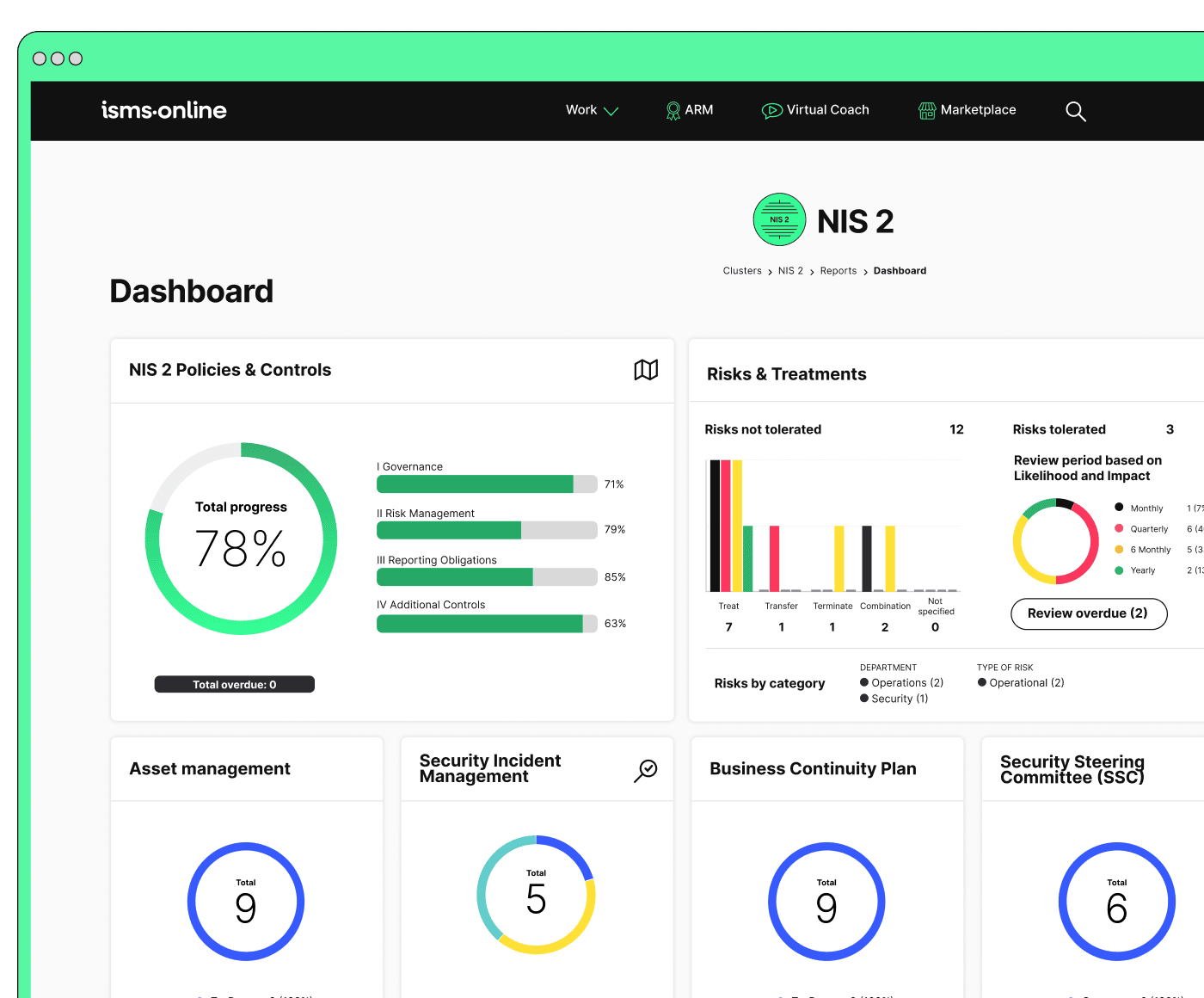
Be NIS 2-ready from day one
Launch with a proven workspace and templates – just tailor, assign, and go.
When Incidents Happen, Will Your Team Beat the 24/72 Clock?
Under NIS 2, incident notification is not just a technical checklist, it’s a regulatory race against time-with new expectations that legal and board-level decision-makers stay attached to the process. Missing the 24-hour (initial) and 72-hour (follow-up) deadlines for significant events can trigger fines, customer loss, and boardroom fallout.
Confidence is knowing every incident is tracked, triaged, and timestamped-even at 3 a.m.
What Are the Steps to Incident Response Mastery?
- Don’t let your incident management plan gather dust-keep it in use, live, and regularly rehearsed with delineated ownership and timestamps.
- Involve legal, privacy, and directors in every major simulation or real drill, not just IT.
- Make sure every incident update is linked to the risk register for audit and review.
- Centralise evidence retention for provenance-chain of custody and forensic readiness are not optional.
- Map and rehearse the full escalation flow before the real event-regulators won’t pause for your “learning curve.”
Responding to major incidents within NIS 2’s deadlines is now board and executive territory.
Fatigue is the enemy of compliance under the clock. Automation buys you time; well-tested playbooks make you look smart.
Privacy teams: remember, GDPR doubles the incident pressure-customers as well as authorities expect quick notification, and audits increasingly require you integrate NIS 2 and GDPR evidence in a single loop.
Why Is Automation the Survival Kit for Compliance at Scale?
Your bench strength isn’t doubling while reporting and evidence demands are. Chasing every record and approval manually puts your team under unsustainable strain-and increases the chance of audit failure.
Leaders in compliance now connect risk logs, evidence, contracts, and reviews with automated, mapped workflows. They cut audit preparation by weeks and spot gaps before an auditor or regulator does. Studies by IP Fabric and Secfix (ipfabric.io, secfix.com) back this up: automated ISMS platforms finish audits faster, respond sooner to risks, and enable easier board reporting.
Trying to track everything in spreadsheets is like using a garden hose to fight a warehouse fire.
Choosing your system means picking for the right scale. Large, multi-national enterprises may require orchestration like IP Fabric or Controllo; growth-stage and mid-market ICT firms often turn to SaaS-first platforms such as ISMS.online or Vanta. The key is mapping evidence and responsibilities live, not just pushing emails or tracking checkboxes.
Automation that doesn’t synchronise mapping between risks, controls, and evidence leaves you with ‘dashboard theatre’ - present on the surface, empty in audit.
Transition Bridge: Automation to Mapping
Don’t stop at automated workflows-without cross-standard mapping, automated compliance can steer you into dead-ends. True resilience and audit win rates come from integrating mapping with workflow so that every change in policy, risk, or supplier triggers an ISMS alignment and notification.
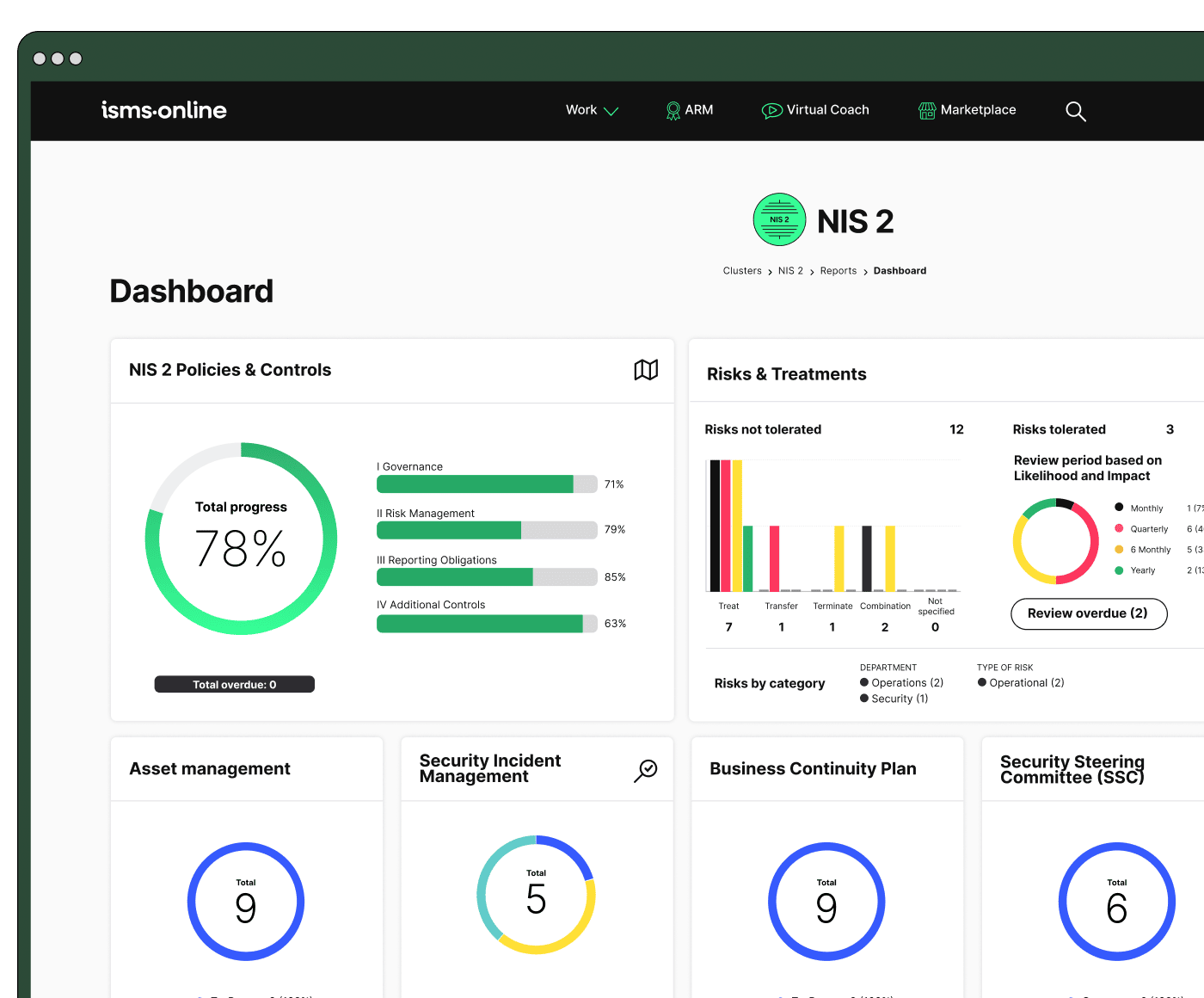
All your NIS 2, all in one place
From Articles 20–23 to audit plans – run and prove compliance, end-to-end.
Is Your Mapping Sharper Than Your Auditor’s Memory? Static vs. Live Mapping in the NIS 2 Era
Many ICT service providers learned the hard way that mapping controls and evidence to standards is not a fire-and-forget project-regulators and auditors now demand evidence that all mappings are current and reactive as your business evolves.
A static mapping table is like a city map with no detours - it only takes one road closure (or policy change) for your navigation to lead into trouble.
What Are the Hidden Risks in Static Mapping?
- *Stale mapping*: Last year’s ISO crosswalk sits untouched as supply chain, policy, or technical changes leave you exposed.
- *Evidence lag*: A SoA or risk register that doesn’t reflect recent incidents or supplier reviews breaks audit trail credibility.
- *Policy drift*: Documents change but mappings stay dated, multiplying manual audit prep and ratcheting up anxiety at go-time.
Advantages of Live, Iterative Mapping
- Automated updates: every material change in risk, policy, asset, or supplier creates a crosswalk refresh.
- Audit dashboards always reflect the latest evidence, bridging risk, incident, and policy-avoiding audit surprises.
- Internal and external reviews accelerate, winning stakeholder and customer trust via “living” documentation.
| **Static Mapping** | **Live, Iterative Mapping** | |
|---|---|---|
| Audit Timing | Annual only | Real-time / on-demand |
| Evidence Sync | Manual, often outdated | Automated, always current |
| Risk Response | Lagging-delayed reaction | Proactive-immediate linkage |
| Auditor Trust | Erodes with each mapping miss | Increases with visible update cadence |
Consider your compliance tooling as a GPS, not a paper street atlas. As the routes change, so should your evidence and mapping.
Ready to Be Recognised as the Reason for Your Team’s Trust?
Everyone who has felt the pressure of last-minute audits, new regulation, or relentless update cycles knows that maintaining resilience is more than a paper chase. The differentiators-at audit, in procurement, or with your board and customers-are mapped, live evidence and integrated workflows that close the gap between law, operation, and trust.
ISMS.online provides the toolset to operationalise, evidence, and automate controls, mapping, and incident response across your ISMS. Integrated workflow means you’re never adrift: your evidence is ready for auditors and procurement, and your team is recognised as the engine of trust and compliance resilience.
Every audit is survivable. Every new requirement is just a system away from becoming your proof of excellence.
Don’t settle for compliance that’s only skin-deep. Let your record of control, evidence, and response become your competitive advantage-delivering trust not just as a side effect, but as a tangible asset.
Book a one-to-one mapping demo or request a tailored checklist to accelerate your next audit-see how ISMS.online can help your team close the compliance gap, reduce stress, and earn recognition as the backbone of cyber trust and operational excellence.
Your business deserves proof that grows with you. Move from annual panic to everyday trust.
Frequently Asked Questions
What determines whether an ICT service provider is “essential” or “important” under NIS 2-and how does this status shape your compliance burden?
Your designation as an “essential” or “important” ICT service provider under the EU’s NIS 2 Directive depends on where your services fit in the digital supply chain, the critical nature of your offerings, and your organisational size or regional reach. Crucially, the difference isn’t just language for regulators-it fundamentally alters the breadth of compliance, audit frequency, director oversight, and incident response you must deliver.
Essential entities are those that underpin society’s critical digital backbone-think major cloud, managed service, or data centre providers, DNS or TLD operators, or any provider on which sectors like energy, healthcare, transport, and financial services rely. If a disruption in your operations risks cascading failures across vital infrastructure, or you meet thresholds such as 250+ staff or €50M+ turnover, you’re likely “essential.” Authorities expect you to undergo proactive (including on-site) audits, maintain a rigorous evidence trail, and expose senior leadership to personal liability for lapses.
By contrast, important entities include a broader swathe of SaaS vendors, IT service providers, and smaller or niche firms supporting resilience in the digital ecosystem. The bar for incident reporting, risk assessment, and response is the same-but you’ll see fewer supervisory audits and lighter penalties.
If your downtime threatens hospitals or pipelines, the compliance bar rises-no matter your headcount or profit margin.
Most importantly, don’t assume your designation based purely on business size. Map where you sit in the flow of critical services using ENISA’s current. Misclassification can halt critical sales, trigger regulatory fines, and lead to board-level accountability during an incident review.
How does NIS 2 change board and executive responsibilities compared to previous frameworks?
NIS 2 moves security outcomes squarely onto the boardroom’s radar. Executives and directors are now expected to demonstrate living, ongoing engagement with cyber risk-no more annual policy sign-offs or blind delegation to IT. Senior leaders must actively oversee risk assessments, sign off on ISMS reviews, take part in incident simulations, and record their engagement via board minutes and documented audit trails.
If a significant incident or audit occurs, you must show:
- Board and C-suite awareness and involvement-who engaged, when, and how.
- Management review cycles that include cyber risk and resilience as standing agenda items.
- Crisis response and escalation rehearsals with senior leaders in real roles.
- Rapid follow-up and learning loops when things go wrong-evidenced in updated risk registers, SoA documents, and management review outputs.
Inaction, superficial review, or ignorance at the executive level is now prosecutable; compliance can no longer be delegated silently down the org chart.
ISMS.online and similar platforms support these demands by surfacing board approval checkpoints and audit-ready management review trails. For essential entities, this is now a permanent expectation-not a best-practise suggestion.
Which technical and organisational controls are now “operational minimums” under NIS 2, and how do they go beyond ISO 27001?
NIS 2 transforms what was once “recommended” under ISO 27001 into default operational requirements. Encryption, vulnerability management, tight network segmentation, multi-factor authentication (MFA), robust supply chain monitoring, rapid incident response, and tested business continuity no longer allow “risk acceptances” with no action plan. They are required unless a justified and documented exception exists.
Here’s how NIS 2 operationalizes these controls-mapped against ISO 27001:
| Expectation | Implementation Proof | ISO 27001 / Annex A |
|---|---|---|
| Encryption | Enforced, auditable, recent logs | A.8.24 |
| Vulnerability mgmt | Scans, patch logs, risk entries | A.8.8 |
| MFA | Deployment/tuning logs, user logs | A.8.5 |
| Supply chain | Supplier onboarding, contracts | A.5.19–A.5.21 |
| Board accountability | Signed review records, minutes | Clauses 5.2, 9.3 |
NIS 2 further expects real-time (not just annual) evidence: recent logs, change histories, board sign-offs, and automated triggers (for supplier changes or incidents) in your ISMS.
How does NIS 2 redefine supply chain and subcontractor security, and what evidence is required for compliance?
NIS 2 eliminates ad hoc supplier reviews in favour of continuous risk and compliance monitoring. Every significant supplier or subcontractor-especially those providing cloud, hosting, MSP, or hardware services-must be risk-assessed at onboarding, contractually bound to incident reporting and audit provisions, and subject to documented, repeatable reviews throughout the relationship.
Auditors now require:
- Onboarding records complete with risk tiering and initial evaluations;
- Contracts/SLA copies with explicit cyber clauses and rapid notification rights;
- Live audit or monitoring trails-change logs, risk assessment updates, and review meeting proofs;
- Incident triggers that automatically link supplier events to your risk register, SoA, and board documentation (no spreadsheet silos).
| Event Trigger | Risk Update | Control/SoA | Evidence |
|---|---|---|---|
| Supplier breach | Escalation/reaudit | A.5.21 | Incident log, SoA change log |
| New onboarding | Initial assessment | A.5.19–21 | Supplier file, risk record |
| Contract renewal | Review and update | A.5.20 | Minutes, updated contract |
Without these “living documents,” you face regulatory penalties and real operational risk-board and leadership are directly exposed. ISMS.online automates these linkages to minimise missed updates.
What are the exact steps for operationalising continuous incident detection and mandatory notification timelines under NIS 2?
NIS 2 demands that incident monitoring runs year-round, with near real-time detection capable of flagging significant events that could impact operations, data, or the broader ecosystem. Once discovered, the notification process is time-bound and non-negotiable:
- Continuous monitoring: Use SIEM, managed service providers, or internal teams to oversee event triggers.
- Incident classification: Rapidly determine significance-if there’s potential regulatory, service, or reputation impact, escalate.
- Within 24 hours: Send early notification to authorities/CSIRT-include all current facts and scope of impact.
- Within 72 hours: File an update with root cause, impact analysis, containment status, and recovery progress.
- Within one month: Submit a detailed report with lessons learned and planned/implemented improvements.
- If customers/end-users are impacted: Notify as early as feasible-no “wait for perfection.”
- Management review update: Each incident’s full lifecycle-detection, notification, action, learning-must be documented in the ISMS, visible to executive and board oversight.
Leading ISMS platforms now automate incident escalation, evidence logging, and reporting workflows, making it easier to avoid regulatory missteps and shorten response cycles.
Which platforms and tools best enable live NIS 2/ISO 27001 mapping, evidence collection, and future audit resilience-and what’s ISMS.online’s role?
Compliance platforms like Controllo, Drata, Vanta, Secfix, and IP Fabric (for larger organisations) have set the benchmark for evidence automation, control mapping, and live compliance monitoring for EU/UK NIS 2. They centralise logs, contracts, assessments, and incident records; create live links between NIS 2, ISO 27001, and DORA/AI Act; and enable automated board dashboards and audit exports.
ISMS.online stands apart by:
- Integrating mapping, evidence, and risk modules with automated incident linkage, supplier re-assessment, and SoA updates in a single environment.
- Exporting audit-ready documentation mapped to all major frameworks (NIS 2, ISO 27001, DORA, GDPR), reducing time-to-audit.
- Enabling live, two-way updates-new supplier or incident changes are instantly visible to boards and compliance teams.
Industry leaders now rely on platforms that ripple every supply or incident event through mapped controls, giving real-time board insight and on-demand audit readiness. ),)
How does “live” compliance mapping between NIS 2, ISO 27001, and DORA/AI Act unlock audit readiness and resilience compared to static reports?
Static mapping-annual, spreadsheet-based, or driven by periodic risk review-exposes organisations to hidden risk. Audits can reveal compliance divergences months after controls or responsibilities change. Live mapping means your risk register, SoA, supplier status, and incident handling stay linked and current: every regulatory shift, supply chain re-tiering, or major incident auto-updates mapped records, evidence, and board reporting.
| Mapping approach | Audit Readiness | Incident Detection | Evidence Age | Regulatory Risk |
|---|---|---|---|---|
| Static | Delayed-reactive | After the fact | Stale | Increased |
| Live/Iterative | Ready-on demand | Real time | Current | Lowered |
ISMS.online enables this by synchronising operational events (supplier, incident, regulatory change) with mapped controls and audit artefacts. Teams can absorb new frameworks or regulations without weeks of overhaul. Board trust, client confidence, and audit outcomes all benefit from real-time, auto-evidenced compliance.
What’s the most effective path to operational NIS 2 and ISO 27001 compliance-future-proofed for DORA and AI governance-using ISMS.online?
Transform your compliance approach from year-end panic to active, board-managed resilience. Begin by benchmarking your current posture using a tailored NIS 2 & ISO 27001 mapping demo or by downloading our certified compliance checklist on ISMS.online.
With ISMS.online, you can:
- Rapidly compare your controls, SoA, and evidence base against both NIS 2 and ISO 27001 using live mapping and gap analysis tools.
- Set up real-time links across your risk register, SoA, supplier onboarding, incident management, and management review activities-ensuring every operational event triggers compliance updates and board awareness, not manual catch-up work.
- Position your ISMS as the launchpad for the next wave of frameworks (DORA, AI Act, ISO 27701), reducing project fatigue and audit risk.
When compliance is “always on” and mapped to every major regulatory and customer demand, you don’t just protect reputation-you create resilience and unlock growth. Make the shift today so every board, client, and regulator sees you as an industry leader-not just an audit survivor.






