





































What Are the Main Benefits of ISO 42001 Certification?
ISO 42001 is the first international standard for AI management systems. Certification is not just a compliance exercise — it is a structured way to turn AI ambition into a programme that customers, regulators, auditors, and your own board can trust. The benefits fall into five distinct categories: commercial, regulatory, operational, risk reduction, and people and culture.
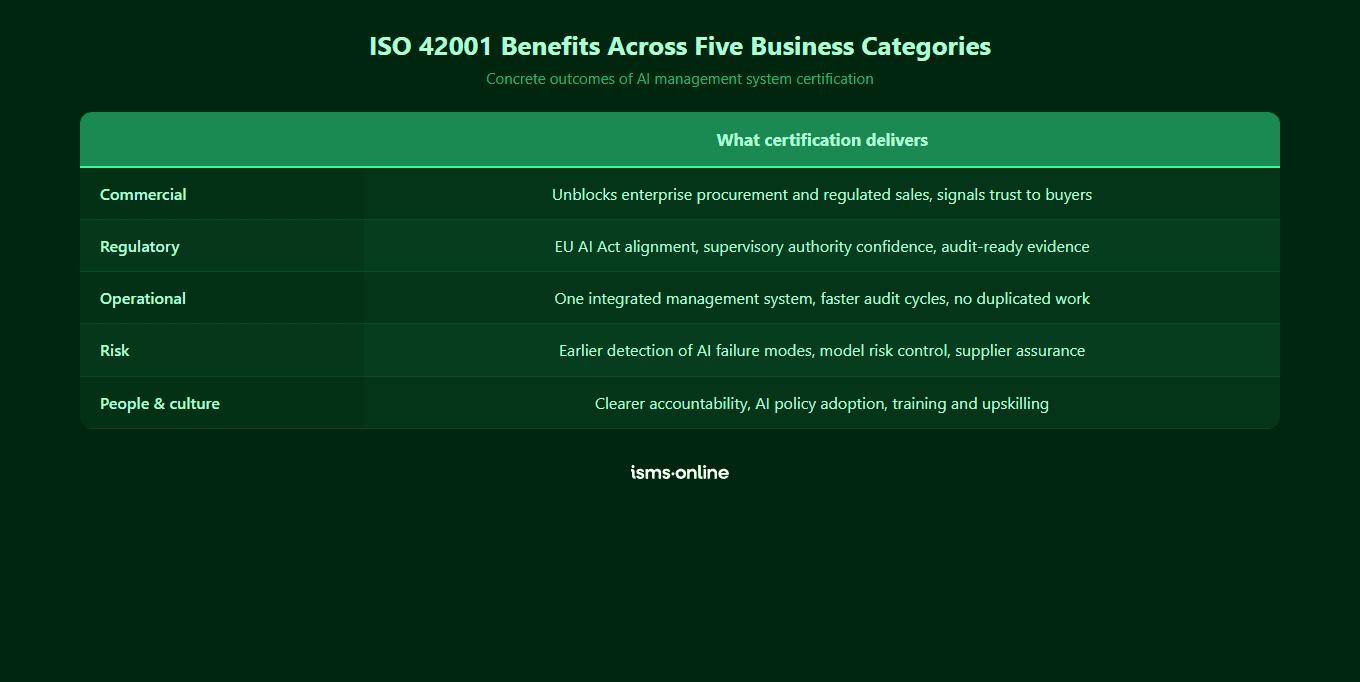
This page is a benefits listicle organised by category, with a concrete mechanism behind each benefit and the ISMS.online capability that helps you realise it. For a dedicated pros and cons decision view, see Is ISO 42001 Worth It.
Benefits Summary at a Glance
| Category | Benefit | Concrete outcome | How ISMS.online enables it |
|---|---|---|---|
| Commercial | Enterprise market access | Clear AI procurement answers that unblock six and seven figure deals | Assurance pack with live Statement of Applicability, policies, and evidence |
| Commercial | Faster sales cycles | Security and AI questionnaires answered from a single source of truth | Reusable evidence library mapped to Annex A controls |
| Regulatory | EU AI Act alignment | Documented risk, impact, and life cycle controls expected by regulators | AI risk and impact assessment registers with Annex B aligned templates |
| Operational | Single integrated management system | One platform for ISO 27001 and ISO 42001, not two parallel programmes | Shared risks, controls, evidence, audits, and management review |
| Risk | Model and AI system risk control | Earlier detection of bias, drift, misuse, and third party AI failure modes | AI risk register (Clause 6.1.2) and AI impact register (Clause 6.1.4) linked to controls |
| People and culture | Clear AI accountability | Named owners for AI policy, risk, models, and suppliers | Role assignment at clause and control level with attestations |
What Are the Commercial Benefits of ISO 42001?
The first benefit most boards care about is the commercial one. ISO 42001 is already appearing in enterprise procurement questionnaires, vendor risk forms, and tender criteria for organisations that build AI features into their products or use AI in customer facing processes. Certification gives you an external, independently verified answer.
- Enterprise market access. Regulated buyers in banking, insurance, healthcare, and the public sector increasingly require an accredited AI governance story. Certification gives procurement a box to tick and legal a reason to proceed.
- Faster procurement cycles. Instead of answering AI specific questions from scratch for every deal, you point to your ISO 42001 certification, Statement of Applicability, and supporting evidence. Weeks of back and forth collapse into a single assurance pack.
- Credible AI positioning. Sales and marketing can make responsible AI claims backed by a recognised standard, not a self written whitepaper. That shifts conversations from sceptical due diligence to commercial negotiation.
- Competitive differentiation. Few competitors are certified yet. For the next 12 to 24 months, ISO 42001 is a credible reason for buyers to choose one AI vendor over another.
- Higher contract values. Demonstrable AI governance supports higher tier pricing and longer term commercial commitments, particularly with enterprise and public sector buyers.
- Reduced customer churn. Existing customers renewing in the post EU AI Act world will expect a clear answer on AI governance. Certification is the fastest way to give it.
For a practical view of the investment behind these returns, see the ISO 42001 certification cost breakdown.
What Are the Regulatory Benefits of ISO 42001?
AI regulation is arriving in waves — the EU AI Act, sector specific guidance from supervisory authorities, and national AI strategies across the UK, US, Singapore, and beyond. ISO 42001 is the most practical way to demonstrate an organised response.
- EU AI Act alignment. The EU AI Act expects documented risk management, transparency, human oversight, data governance, and post market monitoring. ISO 42001 clauses and Annex A controls align directly with these obligations, which is why regulators and standards bodies increasingly treat the standard as a practical route to compliance. See our dedicated page on EU AI Act compliance.
- Audit ready evidence. Certification forces you to maintain documented information under Clause 7.5, with version control, owners, and approvals. That evidence is reusable for regulatory inspections and sector audits.
- Supervisory authority confidence. Data protection authorities, financial regulators, and health regulators are more comfortable engaging with organisations that can point to an accredited management system rather than ad hoc governance.
- Reduced enforcement risk. A documented risk based approach, with owners and review cycles, materially reduces the likelihood and severity of regulatory action when something goes wrong.
- Contractual compliance. Many customer contracts already reference ISO standards. ISO 42001 gives you a named hook for contractual AI governance obligations.
- International recognition. ISO 42001 is an international standard, which means one certification satisfies buyers and regulators across multiple jurisdictions rather than navigating separate national schemes.

Everything you need for ISO 42001
Structured content, mapped risks and built-in workflows to help you govern AI responsibly and with confidence.
What Are the Operational Benefits of ISO 42001?
Certification is often sold as a commercial and regulatory win. The quieter, arguably bigger benefit is operational. ISO 42001 forces the kind of discipline that makes AI work safer, cheaper, and faster to deliver.
- Single integrated management system. Annex D of ISO 42001 maps directly to ISO 27001. Organisations already certified to ISO 27001 can extend their existing management system rather than build a second one. That is the difference between a six figure parallel programme and an incremental uplift. See the comparison at ISO 42001 vs ISO 27001.
- Faster audit cycles. A structured AI Management System (AIMS) with linked evidence turns what used to be weeks of audit preparation into a few hours of walkthrough. Surveillance audits and recertification become routine rather than fire drills.
- Reduced duplication. Shared policies, shared risks, and shared evidence across ISO 27001 and ISO 42001 eliminate the double entry problem that kills GRC productivity.
- Improved AI life cycle hygiene. Annex A.6 mandates controls across objectives, design, development, deployment, operation, and validation. In practice, that means fewer bad models reach production and fewer production models drift undetected.
- Better supplier and tooling decisions. Annex A.10 forces structured assessment of AI suppliers, which means third party AI tools are evaluated against the same criteria you apply to your own systems. Procurement gets cleaner, and operational surprises get rarer.
- Clearer documentation. The documented information requirements of Clause 7.5 leave you with durable reference material for onboarding, handover, and incident response — the kind of knowledge that usually walks out the door when a key engineer leaves.
What Are the Risk Reduction Benefits of ISO 42001?
AI introduces failure modes that traditional risk frameworks were not designed to catch: bias, hallucination, drift, adversarial attack, opaque supplier models, misuse by well meaning users. ISO 42001 gives you a structured way to find and treat these risks before they become incidents.
- Earlier detection of AI failure modes. A formal AI risk assessment (Clause 6.1.2) forces you to enumerate the things that could go wrong: bias, drift, robustness, explainability, misuse, societal impact. That is the opposite of hoping your engineers will remember to think about all of them.
- Model risk control. Annex A.6 covers AI system life cycle controls including verification and validation. Combined with Annex A.7 data controls, this materially reduces the likelihood that a flawed model reaches production.
- AI impact assessment discipline. Clause 6.1.4 requires documented AI system impact assessments covering individuals, groups, and society. That addresses the risks traditional security risk assessments ignore, including discrimination, autonomy, and human oversight.
- Third party AI supplier assurance. Annex A.10 requires documented assessment of suppliers and third party AI components. That turns the opaque model problem from a blind spot into a managed control.
- Incident and issue response. Annex A.8 covers information for interested parties, including incident communication. You end up with an actual playbook for AI incidents rather than a scramble when something visible goes wrong.
- Continuous improvement. Clause 10 requires corrective actions and continual improvement, so lessons from incidents feed back into the management system rather than getting lost in post mortem decks.
For the full list of controls that drive these risk reductions, see our reference page on Annex A controls.

Start your free trial
Want to explore?
Sign up for your free trial today and get hands on with all the compliance features that ISMS.online has to offer
What Are the People and Culture Benefits of ISO 42001?
The most underrated benefits of ISO 42001 are the cultural ones. A management system is only as good as the people running it, and certification turns AI governance from a slide in someone’s deck into a named responsibility owned by specific people across the organisation.
- Clearer accountability. Clause 5 requires named leadership commitment, assigned roles, and documented responsibilities. Annex A.3 covers internal organisation for AI, including reporting of concerns. The result is that AI governance has owners, not volunteers.
- AI policy adoption. Annex A.2 requires AI policies aligned with organisational strategy, communicated and understood across the organisation. That closes the gap between a policy document and actual behaviour change.
- Training and upskilling. Clause 7.2 requires competence, which means a documented approach to training anyone involved in the AI system life cycle. Teams end up better informed about AI risk, not just the central governance function.
- Cross functional collaboration. ISO 42001 cannot be delivered by the compliance function alone. It forces product, engineering, legal, data science, and operations to work from the same management system, which builds durable working relationships.
- Psychological safety around AI concerns. Annex A.3.3 covers reporting of concerns about AI systems. Formalising that channel gives employees a way to flag issues without personal risk, which surfaces problems earlier.
- External credibility for your team. Working inside a certified management system is a selling point when you are hiring senior AI governance, risk, and compliance talent. Candidates prefer organised environments to firefighting ones.
- Board level AI literacy. Clause 9.3 management review requires board engagement with AI performance, risks, and opportunities. That raises AI governance from an engineering concern to a strategic one.
How Does ISMS.online Amplify the Benefits of ISO 42001?
Every benefit above assumes the management system is actually operating. The single biggest reason ISO 42001 programmes fail to deliver their potential is the gap between the certificate on the wall and the day to day reality of running an AIMS. ISMS.online closes that gap by giving the whole programme a working home.
- Commercial benefits land faster because a live Statement of Applicability, policies, and evidence produce procurement answers in minutes, not days.
- Regulatory benefits hold up under scrutiny because documented information is versioned, approved, and traceable to the clause and Annex A control that requires it.
- Operational benefits are real because ISO 27001 and ISO 42001 share risks, controls, audits, and evidence in one platform rather than two parallel tools.
- Risk reduction benefits are measurable because AI risk and AI impact assessments are structured registers with scoring, treatment, owners, and review cycles, not free text documents.
- Cultural benefits stick because Policy Packs, attestations, and role assignment turn responsibility into tracked behaviour rather than an org chart aspiration.
Why Choose ISMS.online for ISO 42001?
ISMS.online is the platform that turns ISO 42001 from a certification project into a system that delivers commercial, regulatory, operational, risk, and cultural benefits on an ongoing basis.
- Pre-built AIMS framework. Ready to use AI Management System aligned to all 10 clauses and 38 Annex A controls, so your team starts tailoring rather than designing from scratch.
- AI specific risk and impact tooling. Dedicated registers for AI risk (Clause 6.1.2) and AI system impact (Clause 6.1.4), with scoring, treatment, owners, and review cycles that directly drive the risk reduction benefits above.
- Integrated with ISO 27001. Annex D mapping baked in, so you get the operational benefit of one management system instead of two. One risk register, one evidence library, one audit programme.
- Live Statement of Applicability. Always current, with every Annex A control justified and linked to evidence, so procurement and regulators see a real management system rather than a snapshot.
- Policy Packs with adoption tracking. Pre-drafted policies, approval workflows, user attestations, and adoption reporting so cultural benefits show up in real behaviour, not just binders.
- Audit and management review built in. Internal audits (Clause 9.2), management review (Clause 9.3), and corrective actions (Clause 10) run as native workflows, which is what keeps the commercial and regulatory benefits compounding year on year.
- Assured Results Method. Proven implementation approach that has helped hundreds of organisations achieve certification first time, backed by onboarding, adoption support, and live human help.
For context on what the standard requires, read our implementation guide or the ISO 42001 compliance checklist.
Ready to see the platform in action? Book a demo to see how ISMS.online can turn the benefits of ISO 42001 into business value for your organisation.
FAQs
What are the top benefits of ISO 42001 certification?
The benefits fall into five categories. Commercially, ISO 42001 unblocks enterprise procurement and shortens sales cycles. From a regulatory angle it aligns with the EU AI Act and gives supervisory authorities confidence. Operationally it gives you a single integrated management system alongside ISO 27001, with faster audit cycles. On risk, it drives earlier detection of AI failure modes and structured supplier assurance. Culturally it creates clear AI accountability and builds AI literacy across the organisation.
How does ISO 42001 help with the EU AI Act?
The EU AI Act expects risk management, transparency, human oversight, data governance, and post market monitoring. ISO 42001 clauses and Annex A controls map directly onto these obligations, so a well implemented AIMS covers the majority of the expectations a regulator will want to see. It does not replace the legal obligation but it gives you the evidence, documentation, and operational discipline that make compliance demonstrable rather than theoretical.
What commercial benefits do organisations see after getting certified?
Most organisations report faster enterprise procurement, fewer blocking questions on security and AI questionnaires, credible AI positioning in sales conversations, and competitive differentiation against non certified peers. For AI vendors selling into regulated sectors, certification is already appearing as a scoring criterion in tenders. The result is shorter sales cycles, higher win rates on enterprise deals, and reduced renewal risk with regulated customers.
Does ISO 42001 really reduce AI risk or is it just paperwork?
Done well, it reduces real risk. Clause 6.1.2 forces structured AI risk assessment covering bias, drift, robustness, explainability, and misuse. Clause 6.1.4 adds impact assessment for individuals, groups, and society. Annex A.6 covers life cycle controls including verification and validation, and Annex A.10 forces assessment of AI suppliers. Together these controls surface failure modes earlier, reduce the chance of flawed models reaching production, and make third party AI risk manageable rather than opaque.
Is ISO 42001 worth it for organisations already certified to ISO 27001?
Yes, and the return on investment is higher because the lift is smaller. Both standards share the Annex SL high-level structure, and Annex D of ISO 42001 maps directly to ISO 27001. You can extend your existing ISMS rather than stand up a separate programme, reusing risk processes, evidence, audit cycles, and management review. Most of the commercial and regulatory benefits land quickly because the underlying governance infrastructure is already in place. For a full decision view, see our page on Is ISO 42001 Worth It.
How long before we see benefits from ISO 42001 certification?
Some benefits appear during implementation, before the certificate is issued. Clearer AI accountability, documented risk and impact assessments, and improved AI life cycle hygiene all show up in the first few months. Commercial benefits land once the certificate is issued and sales teams start referencing it. Regulatory and cultural benefits compound over 12 to 24 months as the management system matures, surveillance audits normalise, and AI governance becomes business as usual rather than a project.
Do the benefits of ISO 42001 apply to AI users as well as AI developers?
Yes. ISO 42001 applies to organisations that develop, provide, or use AI systems. Organisations that deploy third party AI in customer facing or business critical processes often see the largest benefits from Annex A.9 (responsible use) and Annex A.10 (supplier and third party relationships). Those controls turn opaque model supply chains into managed ones, which is increasingly expected by customers, regulators, and insurers regardless of whether you build AI yourself.






