





































Why Are Organisations Pursuing ISO 42001 Certification?
Artificial intelligence is no longer a niche technology confined to research labs. It is embedded in products, services, and internal processes across every sector—from healthcare diagnostics and financial underwriting to recruitment screening and autonomous vehicles. With that adoption comes scrutiny, and the regulatory landscape is shifting fast.
The EU AI Act, which entered into force in August 2024, introduces legally binding requirements for AI systems based on risk classification. High-risk AI systems face mandatory conformity assessments, and Article 40 explicitly references harmonised standards as a route to demonstrating compliance. ISO 42001—published in December 2023 as the first international standard for AI management systems—is positioned to become that harmonised standard.
In the UK, the government’s pro-innovation approach to AI regulation still expects organisations to demonstrate responsible AI governance. The UK AI Safety Institute, sector-specific regulators, and public procurement frameworks are increasingly referencing ISO 42001 as a benchmark for trustworthy AI. Customers, investors, and insurance providers are asking the same question: how do you govern your AI systems?
For organisations that develop, deploy, or use AI, the question is no longer whether AI governance matters. It is whether ISO 42001 certification is the right way to demonstrate it. Here is the evidence.
What Are the Tangible Benefits of ISO 42001?
The benefits of ISO 42001 go well beyond a certificate on the wall. They fall into six categories, each with measurable business impact.
1. Regulatory Readiness
The EU AI Act’s enforcement timeline runs from February 2025 (prohibited practices) through to August 2027 (high-risk systems in Annex I). Organisations that certify to ISO 42001 now are building the governance infrastructure they will need when enforcement bites. Article 40 of the EU AI Act allows providers to use harmonised standards to demonstrate conformity, and ISO 42001 is the leading candidate. In the UK, the ICO, FCA, and other sector regulators are developing AI-specific guidance that aligns with ISO 42001’s risk-based approach. Certification provides documented evidence of ISO 42001 compliance that regulators can assess.
2. Competitive Advantage
Fewer than 500 organisations worldwide hold ISO 42001 certification as of early 2026. That represents a significant early-mover advantage. In procurement processes—particularly in government, defence, financial services, and healthcare—demonstrable AI governance is becoming a differentiator. Organisations that can point to an independently audited AI Management System (AIMS) stand out from competitors relying on self-declared policies.
3. Risk Reduction
ISO 42001 requires a structured approach to AI risk assessment (Clause 6.1.2) and AI system impact assessments (Clause 6.1.4). These are not bureaucratic exercises. They force organisations to systematically identify what could go wrong with their AI systems—bias, safety failures, privacy breaches, security vulnerabilities—and implement documented controls to mitigate those risks. Organisations with formal AI risk frameworks experience fewer costly incidents, faster incident response, and reduced liability exposure.
4. Stakeholder Trust
Public trust in AI is fragile. High-profile failures—biased hiring algorithms, discriminatory credit scoring, autonomous vehicle accidents—have made customers, employees, and the public sceptical of AI claims. ISO 42001 certification provides independent, third-party validation that an organisation governs its AI responsibly. For B2B organisations, it simplifies due diligence. For consumer-facing organisations, it builds the trust needed for AI adoption.
5. Operational Efficiency
Without a formal framework, AI governance tends to be ad hoc—different teams making different decisions with no consistent methodology. ISO 42001 formalises these processes: who approves new AI use cases, how risks are assessed, how systems are monitored, and how decisions are documented. For organisations already running ISO 27001, the integration is straightforward. Both standards follow the Annex SL high-level structure, and Annex D of ISO 42001 provides explicit mapping guidance. Learn more about the overlap in our ISO 42001 vs ISO 27001 comparison.
6. Insurance and Liability
As AI-related claims grow—from algorithmic discrimination lawsuits to product liability for autonomous systems—insurers are paying close attention to AI governance. A certified AI management system provides documented evidence that an organisation took reasonable steps to identify and mitigate AI risks. This strengthens legal defence positions and is increasingly relevant to cyber and professional indemnity insurance underwriting.

Everything you need for ISO 42001
Structured content, mapped risks and built-in workflows to help you govern AI responsibly and with confidence.
What Does ISO 42001 Actually Require?
ISO 42001 follows the same Annex SL high-level structure as ISO 27001, ISO 9001, and other management system standards. If your organisation already operates one of these, the framework will be familiar. The standard has 10 clauses covering context, leadership, planning, support, operation, performance evaluation, and improvement.
The controls sit in Annex A, which contains 38 controls organised across 9 control areas covering AI policies, internal organisation, resources, AI system life cycle, data management, monitoring, and third-party relationships. Annex B provides normative implementation guidance for each control. Annexes C and D offer mapping to other frameworks and standards.
For organisations already certified to ISO 27001, this is not a ground-up rebuild. You already have leadership commitment (Clause 5), documented information management (Clause 7.5), internal audit processes (Clause 9.2), and a culture of continual improvement (Clause 10). The additional effort focuses on AI-specific risk assessments, impact assessments, and the Annex A controls. Our implementation guide walks through the full process.
When Is ISO 42001 Not Worth It?
Honesty matters more than a hard sell. There are scenarios where ISO 42001 certification may not be the right investment right now:
- You have no AI systems: If your organisation does not develop, deploy, provide, or use AI systems in any meaningful capacity, the standard has no scope to apply to. Basic AI awareness and a watching brief on regulations may be sufficient.
- You are a very early-stage startup: If you are pre-revenue with a team of five and your AI product is still in prototype, the overhead of a formal management system may be premature. That said, building governance habits early is easier than retrofitting them later.
- Your AI use is genuinely trivial: If your only interaction with AI is a customer service chatbot provided by a third party with minimal customisation, the risk profile may not justify full certification.
However, it is important to note that ISO 42001’s scope is broader than many organisations assume. Clause 1 and Clause 4.1 make clear that the standard applies not just to organisations that develop AI, but also to those that deploy, provide, or use AI systems. If you are integrating AI tools into business-critical processes—even if you did not build those tools—you are in scope. A gap analysis can help you determine whether certification is proportionate to your AI risk profile.
How Does ISO 42001 Compare to Alternatives?
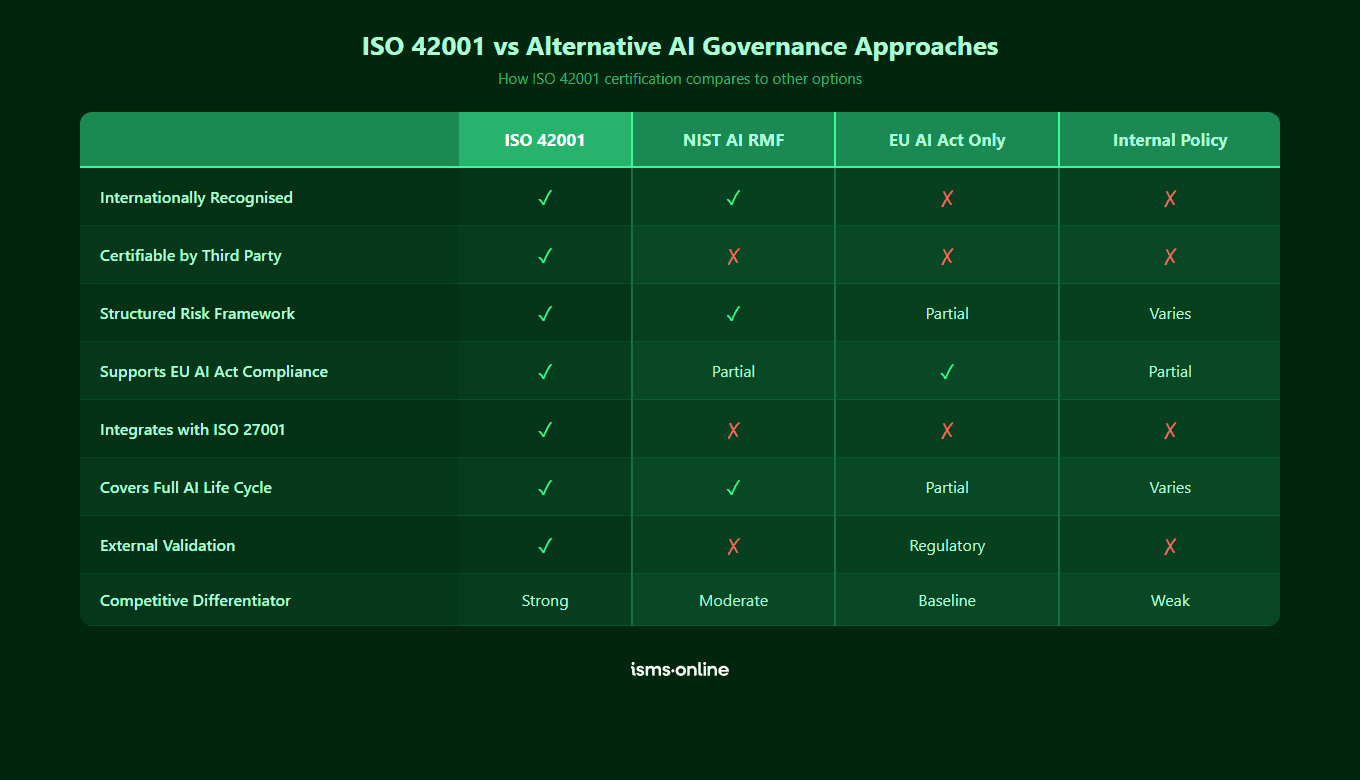
ISO 42001 is not the only AI governance framework available. Here is how it compares to the main alternatives:
| Framework | Certifiable? | International Recognition | Key Limitation |
|---|---|---|---|
| ISO 42001 | Yes—third-party certification | Global (ISO member bodies in 170+ countries) | Requires investment in formal management system |
| NIST AI RMF | No—voluntary framework only | Strong in the US, growing internationally | No certification path; no external validation. See our ISO 42001 vs NIST AI RMF comparison. |
| EU AI Act compliance alone | No—regulatory requirement | EU jurisdictions | Reactive compliance; no proactive governance framework; limited to EU scope |
| Internal AI governance policies | No—self-declared | None | No external validation; inconsistent implementation; limited credibility with stakeholders |
The key differentiator is certifiability. Only ISO 42001 offers an independently audited, internationally recognised certification that provides external assurance to regulators, customers, and partners. The NIST AI RMF is a valuable resource—and ISO 42001 aligns with many of its principles—but it does not provide the same level of third-party validation. Our ISO 42001 vs EU AI Act comparison explores how the two frameworks complement each other.

Get started easily with a personal product demo
One of our onboarding specialists will walk you through our platform to help you get started with confidence.
Why Choose ISMS.online for ISO 42001?
ISMS.online provides a purpose-built platform that makes achieving and maintaining ISO 42001 certification faster, simpler, and more sustainable. Here is what you get:
- Pre-configured AIMS framework: A ready-to-use AI Management System mapped to all 38 Annex A controls, so you start with structure rather than a blank page.
- Integrated risk register: Purpose-built for AI risk assessments (Clause 6.1.2) and AI system impact assessments (Clause 6.1.4), with risk scoring, treatment plans, and automated review reminders.
- Policy templates: Pre-drafted policies aligned to Clause 5.2 and Annex A.2 (AI policy), ready to tailor to your organisation’s context and AI use cases.
- Evidence collection and document management: Centralised storage for all documented information required by Clause 7.5, with version control, access permissions, and audit-ready organisation.
- Statement of Applicability builder: Generate and maintain your SoA for Annex A controls, documenting which controls apply, how they are implemented, and justifications for any exclusions.
- Built-in audit management: Plan, schedule, and execute internal audits (Clause 9.2) within the platform, with findings linked directly to corrective actions and tracked to closure.
- ISO 27001 integration: For organisations already running ISO 27001 on ISMS.online, the ISO 42001 framework integrates seamlessly—shared processes, shared evidence, one platform. Learn more about the overlap in our ISO 42001 vs ISO 27001 guide.
Whether you are starting from scratch or building on an existing management system, ISMS.online gives you everything you need to achieve ISO 42001 certification with confidence. To explore the full picture, read everything you need to know about ISO 42001.
Ready to build your business case? Book a demo to see the platform in action.
FAQs
Is ISO 42001 mandatory?
ISO 42001 is a voluntary international standard—no law currently mandates certification. However, the EU AI Act references harmonised standards as a route to demonstrating compliance, and ISO 42001 is expected to be recognised under this mechanism. In practice, procurement requirements in government, defence, financial services, and healthcare are increasingly making ISO 42001 a de facto requirement for organisations providing AI systems or services.
How long does ISO 42001 certification take?
For most organisations, expect 3 to 9 months from initial gap analysis to certification. Organisations with an existing ISO 27001 management system can typically achieve certification faster because much of the governance infrastructure—leadership commitment, document management, internal audit processes—is already in place. The timeline depends on the complexity of your AI systems, the maturity of your existing governance, and auditor availability.
Can ISO 42001 be integrated with ISO 27001?
Yes, and ISO 42001 is designed for exactly this. Both standards follow the Annex SL high-level structure, which means they share common clauses for context, leadership, planning, support, performance evaluation, and improvement. Annex D of ISO 42001 provides explicit mapping to ISO 27001. Organisations running both can operate an integrated management system with shared policies, risk registers, audit programmes, and management reviews—reducing duplication and overhead significantly.
Do we need ISO 42001 if we only use (not develop) AI?
Potentially, yes. ISO 42001 Clause 1 explicitly states the standard applies to organisations that provide or use AI-based products or services, not just those that develop them. If you are integrating third-party AI tools into business-critical processes—such as AI-powered analytics, automated decision-making, or customer-facing chatbots—you carry governance responsibilities for how those systems are deployed, monitored, and managed within your organisation. A gap analysis can help determine whether full certification is proportionate to your risk profile.
How much does ISO 42001 certification cost?
Costs vary depending on organisation size, complexity of AI systems, and chosen certification body. Typical components include: certification body audit fees (ranging from £5,000 to £25,000+ depending on scope), internal resource time for implementation, any external consultancy support, and platform or tooling costs. For organisations already certified to ISO 27001, marginal costs are significantly lower because the governance foundation is already established. Annual surveillance audits add ongoing costs, but these are typically 30–50% of the initial certification audit fee.






