





































How Long Does ISO 42001 Certification Take on Average?
Most organisations reach ISO 42001 certification in 3 to 9 months from kick off to a passed Stage 2 audit. The wide range reflects real differences between programmes rather than padding. A scaled AI developer with a mature ISO 27001 management system, a defined scope, and executive sponsorship can comfortably land inside 3 to 5 months. A mid-sized organisation starting from zero, with multiple AI use cases and no existing management system to leverage, typically needs 6 to 9 months.
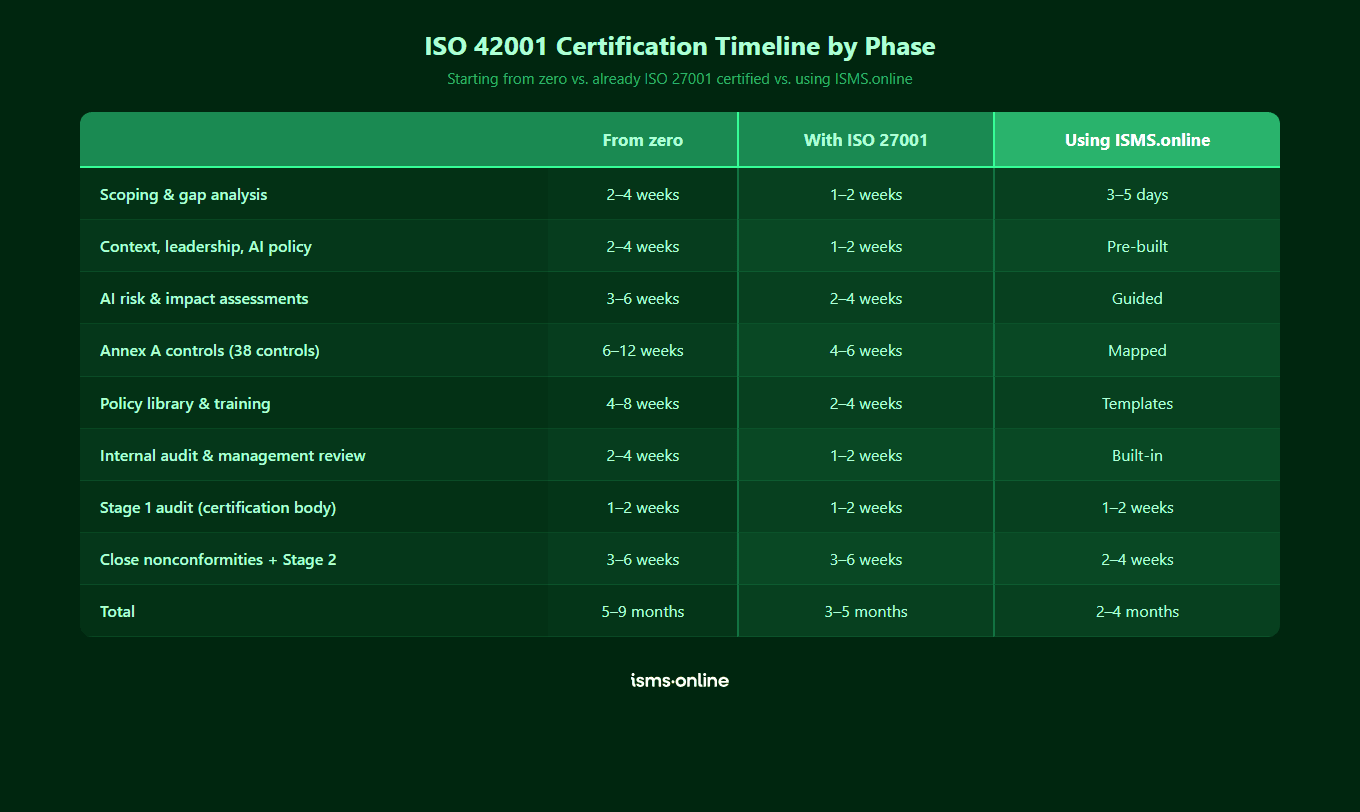
The useful way to plan is not a single headline number. It is a phase-by-phase estimate that reflects your starting point, the scope of your AI Management System, and the resource you can dedicate to the programme. This guide walks through each phase with concrete week and month estimates, compares starting from zero against already holding ISO 42001 vs ISO 27001, and shows where ISMS.online compresses the work.
Timeline at a Glance
| Phase | Starting from zero | Already ISO 27001 certified | ISMS.online accelerator |
|---|---|---|---|
| Scoping and gap analysis | 2 to 4 weeks | 1 to 2 weeks | Pre-built AIMS scoping template, gap analysis workbook, and Annex D mapping for ISO 27001 overlap |
| Context, leadership, AI policy | 2 to 4 weeks | 1 to 2 weeks | Pre-drafted AI policy, context of the organisation template, and leadership commitment artefacts |
| AI risk and impact assessments | 3 to 6 weeks | 2 to 3 weeks | Dedicated AI risk register (Clause 6.1.2) and AI system impact assessment register (Clause 6.1.4) with scoring templates |
| Controls implementation (Annex A) | 6 to 12 weeks | 3 to 6 weeks | 38 pre-configured Annex A controls with evidence linking and owner assignment |
| Policy library, training, evidence | 4 to 8 weeks | 2 to 4 weeks | Policy Packs with version control, approval workflows, attestations, and adoption tracking |
| Internal audit and management review | 2 to 4 weeks | 1 to 3 weeks | Audit Management module with planning, execution, findings, and Clause 9.3 review pack |
| Stage 1 audit (certification body) | 1 to 2 weeks | 1 to 2 weeks | Live Statement of Applicability and audit-ready evidence library |
| Closing nonconformities | 2 to 4 weeks | 1 to 2 weeks | Corrective action workflows linked to findings with closure tracking |
| Stage 2 audit | 1 to 2 weeks | 1 to 2 weeks | Single source of truth for evidence, controls, and management system records |
| Total elapsed | ~5 to 9 months | ~3 to 5 months | 30 to 50 percent faster |
Phases overlap in practice. You can be drafting policies while risk assessments are in flight, and you can start implementing controls before every impact assessment is finalised. The totals above assume a realistic amount of parallelisation, not a strictly sequential waterfall.
What Are the Phases of an ISO 42001 Programme?
Every ISO 42001 programme moves through the same set of phases, whether you are a 30 person AI startup or a global enterprise. The variables are how long each phase takes and how much is reusable from an existing management system.
Phase 1: Scoping and Gap Analysis (2 to 4 weeks)
Define the boundary of the AI Management System. That means deciding which AI systems, business units, geographies, and third-party dependencies are in scope. A gap analysis then maps your current state against the 10 clauses of ISO 42001 and the 38 Annex A controls. The output is a prioritised workplan with owners, estimated effort, and a realistic target certification date. Organisations with a mature ISO 27001 programme often finish this phase in a week because much of the context, stakeholder, and asset inventory work already exists.
Phase 2: Context, Leadership, and AI Policy (2 to 4 weeks)
Clause 4 (context of the organisation), Clause 5 (leadership), and Clause 5.2 (AI policy) need to be in place early. This is where you document interested parties, their needs and expectations, internal and external issues, leadership commitment, AI policy, roles and responsibilities, and the objectives for the AIMS. None of this is AI-specific engineering work. It is governance scaffolding that every subsequent phase depends on.
Phase 3: AI Risk and Impact Assessments (3 to 6 weeks)
ISO 42001 requires two distinct assessments that do not exist in ISO 27001. The AI risk assessment (Clause 6.1.2) identifies and treats risks to the achievement of AIMS objectives. The AI system impact assessment (Clause 6.1.4) assesses the consequences of AI systems on individuals, groups, and society. Annex B gives normative implementation guidance for both. This phase is where novel programmes spend the most time, because the concepts are new even to teams experienced in information security risk management.
Phase 4: Controls Implementation (6 to 12 weeks)
Annex A contains 38 controls across 9 control areas (A.2 to A.10). Each applicable control needs an implementation, an owner, and evidence. Controls span AI policies, internal organisation, resources, impact assessment, the AI system life cycle, data management, information for interested parties, responsible use, and third-party relationships. This is the longest phase for most programmes and the one that benefits most from a pre-built control library.
Phase 5: Policy Library, Training, and Evidence (4 to 8 weeks)
Clause 7.5 requires documented information to be identified, reviewed, approved, version controlled, and available at points of use. In practice that means a policy library, a training and awareness programme, and an evidence collection process that does not rely on someone remembering to drop files into a shared folder. Organisations that run this manually typically add 3 to 4 weeks of overhead across the programme that a structured platform removes.

Everything you need for ISO 42001
Structured content, mapped risks and built-in workflows to help you govern AI responsibly and with confidence.
Phase 6: Internal Audit and Management Review (2 to 4 weeks)
Before a certification body will book your Stage 1 audit, you need to have completed at least one internal audit (Clause 9.2) and one management review (Clause 9.3). The internal audit checks that the AIMS is implemented and effective. The management review is the leadership team reviewing audit results, nonconformities, risks, opportunities, and the need for changes. Both produce documented outputs the external auditor will look for at Stage 1.
Phase 7: Stage 1 Audit (1 to 2 weeks)
Stage 1 is a documentation and readiness audit. The certification body reviews your AIMS documentation, Statement of Applicability, scope, policies, risk and impact assessments, internal audit, and management review outputs. The auditor identifies any gaps that would stop a successful Stage 2. Duration is typically 1 to 3 auditor days, then a written report. Allow 1 to 2 elapsed weeks including scheduling and the report turnaround.
Phase 8: Closing Nonconformities (2 to 4 weeks)
Stage 1 usually surfaces minor findings. Some are immediate fixes (a missing policy version, an unsigned approval). Others take longer (a control that needs additional evidence or a risk that needs a documented treatment). You need to close major findings before Stage 2 and demonstrate a plan for minor findings. Well-prepared programmes close this phase in 1 to 2 weeks. Programmes where Stage 1 surfaces structural issues can slip to 4 weeks or more.
Phase 9: Stage 2 Audit (1 to 2 weeks)
Stage 2 is the certification audit. The auditor tests whether your AIMS is implemented and effective across the scope, not just documented. Expect auditor interviews with control owners, walkthroughs of AI system life cycle controls, sampling of evidence, and testing of the risk and impact assessment process. Typical duration is 2 to 5 auditor days depending on scope. If there are no major findings, the certification body issues the ISO 42001 certification recommendation, which the certification body then ratifies and issues the certificate.
Surveillance and Recertification
The certificate is valid for 3 years, with surveillance audits in years 1 and 2, and a recertification audit in year 3. Surveillance audits typically last 1 to 2 auditor days and focus on a sample of controls, changes to the AIMS, management review outputs, and any incidents. Recertification is a fuller audit, usually 2 to 4 days. Budget around 5 to 10 days of internal effort per surveillance audit if your evidence is in order. Significantly more if it is not.
How Does ISO 27001 Certification Accelerate ISO 42001?
Organisations that already hold ISO 27001 typically reach ISO 42001 certification 30 to 50 percent faster. The reason is structural. ISO 42001 is built on the Annex SL high-level structure shared by ISO 27001, ISO 9001, ISO 14001, and most modern management system standards. Annex D of ISO 42001 provides explicit mapping to ISO 27001. The overlap is substantial in four areas.
- Annex SL clauses are reusable. Clauses 4 (context), 5 (leadership), 7 (support), 9 (performance evaluation), and 10 (improvement) are structurally identical between ISO 27001 and ISO 42001. Your existing context of the organisation, interested parties analysis, internal audit programme, management review cadence, and corrective action process all apply with minor extensions.
- Annex D maps controls one to one where relevant. Many ISO 42001 Annex A controls have a direct counterpart in ISO 27001 Annex A. Supplier management, documented information, access control, incident management, and audit management all carry over. You are extending, not replacing.
- Risk management methodology transfers. The risk assessment and treatment approach you already use for information security is directly applicable to AI risk (Clause 6.1.2), with AI-specific criteria layered on top. The new work is the AI system impact assessment (Clause 6.1.4), which is a distinct discipline.
- Governance and training infrastructure exists. The policy library, approval workflows, training and awareness programme, and evidence collection processes already serve ISO 27001. Adding ISO 42001 policies, training modules, and evidence streams is an incremental cost, not a greenfield build.
The practical effect is that controls implementation typically halves (from 6 to 12 weeks down to 3 to 6 weeks), policy and training compresses from 4 to 8 weeks down to 2 to 4 weeks, and internal audit and management review can often be folded into existing cycles rather than run standalone. This is why the Already ISO 27001 certified column in the timeline table is so much shorter.
What Factors Speed Up or Slow Down Certification?
The headline range (3 to 9 months) hides a lot of variance. These are the variables that move programmes to the fast or slow end of the range.
Factors That Speed Up Certification
- An existing ISO 27001 management system. The single biggest accelerator. 30 to 50 percent faster on average.
- A tightly scoped AIMS. Fewer AI systems in scope, fewer business units, and fewer geographies all compress the timeline. Start narrow, extend later.
- Executive sponsorship. Leadership commitment (Clause 5.1) is not just a documentation requirement. It is what unblocks resourcing, budget, and cross-functional time.
- A dedicated programme manager. Part-time ownership by an already busy head of compliance typically doubles elapsed time versus a dedicated programme manager.
- A pre-built AIMS platform. A structured AI Management System (AIMS) framework, control library, and policy pack removes weeks of drafting work.
- Clear AI inventory. Organisations that already know which AI systems they develop, deploy, and use move faster than those that start with a discovery exercise.
Factors That Slow Down Certification
- Unclear scope. Scope drift during the programme is one of the commonest reasons for timelines to double. Lock scope early and manage changes through a formal review.
- Complex AI use cases. Organisations developing high-impact AI systems (safety-critical, regulated, or affecting individuals at scale) need deeper impact assessments, more validation evidence, and more extensive Annex A.6 life cycle documentation.
- Third-party dependencies. Annex A.10 requires supplier assessments for AI systems and services. If you rely heavily on third-party models or AI tools, the supplier due diligence work can add weeks.
- Low data and AI maturity. Organisations that lack a data inventory, model inventory, or documented AI development process need to build these from scratch before the Annex A.6 and A.7 controls can be implemented.
- Manual tooling. Running the programme on spreadsheets, SharePoint, and email typically adds 25 to 40 percent to elapsed time because of version control, traceability, and evidence assembly overhead.
- Certification body scheduling. Stage 1 and Stage 2 audit dates need to be booked 6 to 12 weeks in advance with most certification bodies. Late booking is a common cause of slippage.

Get started easily with a personal product demo
One of our onboarding specialists will walk you through our platform to help you get started with confidence.
Can ISMS.online Compress Your ISO 42001 Timeline?
Yes. ISMS.online is built specifically for ISO 42001, with a pre-configured AIMS, a full Annex A control library, and dedicated AI risk and impact assessment tooling. The platform removes the drafting, structuring, and traceability work that consumes weeks of elapsed time on manual programmes. The effect is visible at every phase of the timeline table.
In practical terms, organisations starting from zero with ISMS.online typically reach Stage 2 in 4 to 6 months rather than 6 to 9. Organisations with an existing ISO 27001 management system in ISMS.online often reach Stage 2 in 2 to 4 months because the underlying governance infrastructure (risk register, evidence library, audit programme) already serves both standards. The implementation guide and the ISO 42001 compliance checklist both sit inside the platform, so the workplan is operational from day one.
Cost and timeline are linked. Faster programmes typically cost less in internal time, consultancy fees, and delay-related risk. For a full breakdown of the economic picture, see the ISO 42001 certification cost page and the commercial case for certification in Is ISO 42001 Worth It.
Why Choose ISMS.online for ISO 42001?
ISMS.online is the only platform built from the ground up for ISO 42001, not retrofitted onto an information security product. Every timeline accelerator you would otherwise build yourself is already in the product.
- Pre-built AIMS on day one. A working AI Management System (AIMS) covering all 10 clauses, so your team starts tailoring rather than designing from scratch.
- 38 pre-configured Annex A controls. Full Annex A controls library with owner assignment, evidence linking, and implementation guidance, removing weeks of setup work.
- AI-specific risk tooling. Dedicated registers for AI risk (Clause 6.1.2) and AI system impact (Clause 6.1.4), with scoring, treatment, and review cycles aligned to the normative guidance in Annex B.
- Live Statement of Applicability. A continually updated Statement of Applicability, not a static Word document, so Stage 1 readiness is a matter of hours rather than days.
- Integrated audit management. Plan, run, and close internal audits (Clause 9.2) and management reviews (Clause 9.3) in the platform, with findings linked to corrective actions and tracked to closure before the ISO 42001 audit.
- Seamless ISO 27001 integration. One platform, one risk register, one evidence library, one audit programme for organisations running both standards. Annex D mapping is built in, so overlap is exploited automatically.
- Assured Results Method. A proven implementation approach that has helped hundreds of organisations achieve certification first time, backed by onboarding, adoption support, and live human help.
Ready to see the platform in action? Book a demo to see how ISMS.online can compress your ISO 42001 timeline.
FAQs
How long does ISO 42001 certification take from scratch?
Typically 5 to 9 months from programme kick off to a passed Stage 2 audit, assuming a tightly scoped AIMS, a dedicated programme manager, and reasonable executive sponsorship. Organisations with complex AI use cases, a broad scope, or limited internal resource can extend past 9 months. A pre-built platform and a clear scoping decision at the start are the two biggest levers for staying inside the shorter end of the range.
How much faster is ISO 42001 if we already have ISO 27001?
Typically 30 to 50 percent faster — often 3 to 5 months end to end. Both standards follow the Annex SL high-level structure and Annex D of ISO 42001 maps directly to ISO 27001. Context, leadership, support, performance evaluation, and improvement clauses are largely reusable. Many Annex A controls (supplier management, documented information, audit management) extend rather than replicate existing ISO 27001 controls. The genuinely new work is AI risk and impact assessments and the AI system life cycle controls in Annex A.6.
What is the difference between a Stage 1 and a Stage 2 ISO 42001 audit?
Stage 1 is a documentation and readiness audit. The certification body checks that your AIMS documentation, Statement of Applicability, scope, policies, risk and impact assessments, internal audit, and management review outputs are in place and well-formed. Stage 2 is the certification audit, where the auditor tests whether the AIMS is actually implemented and effective across the scope. Stage 1 usually takes 1 to 3 auditor days. Stage 2 usually takes 2 to 5 auditor days depending on scope.
How long is the gap between Stage 1 and Stage 2?
Typically 4 to 12 weeks. The gap gives you time to close Stage 1 findings, collect additional evidence if needed, and book Stage 2 in the certification body’s diary. Most certification bodies require Stage 2 to happen within 6 months of Stage 1. Well-prepared programmes can turn around in 4 to 6 weeks. Programmes where Stage 1 surfaces structural issues may need the full 12 weeks or more.
How long is an ISO 42001 certificate valid for?
Three years. Surveillance audits take place in years 1 and 2 to confirm the AIMS is still operating effectively. A recertification audit in year 3 re-issues the certificate for another 3-year cycle. Surveillance audits typically last 1 to 2 auditor days and focus on a sample of controls, changes to the AIMS, management review outputs, and any incidents. Recertification audits are fuller, usually 2 to 4 days.
Can we get ISO 42001 certified in under 3 months?
In narrow circumstances, yes. A small organisation with a tight scope, a mature ISO 27001 management system, a dedicated programme manager, and a pre-built AIMS platform can realistically reach Stage 2 in 8 to 12 weeks. This is the exception rather than the norm. Most organisations should plan for 3 to 5 months with an ISO 27001 foundation, or 5 to 9 months without one. Compressing below 3 months usually requires external implementation support on top of a strong platform.
What takes the longest in an ISO 42001 programme?
Controls implementation for Annex A is usually the longest phase — 6 to 12 weeks from scratch, 3 to 6 weeks with an ISO 27001 foundation. Within that phase, the Annex A.6 AI system life cycle controls and the Annex A.7 data for AI systems controls typically take the most effort, because they require AI-specific documentation, validation evidence, and data provenance records that do not exist in most organisations at the start of the programme.






