





































Is Cyber Essentials actually worth it for a UK business?
The honest answer is yes for most UK small and medium businesses, but with important caveats. If you sell to other businesses, the public sector, or anyone with a procurement department that asks about cyber security, Cyber Essentials almost always pays for itself within a single contract win or insurance renewal. If you are purely a consumer-facing brand with no B2B revenue and no supplier obligations, the value is more marginal and depends on the specific risks you are trying to reduce.
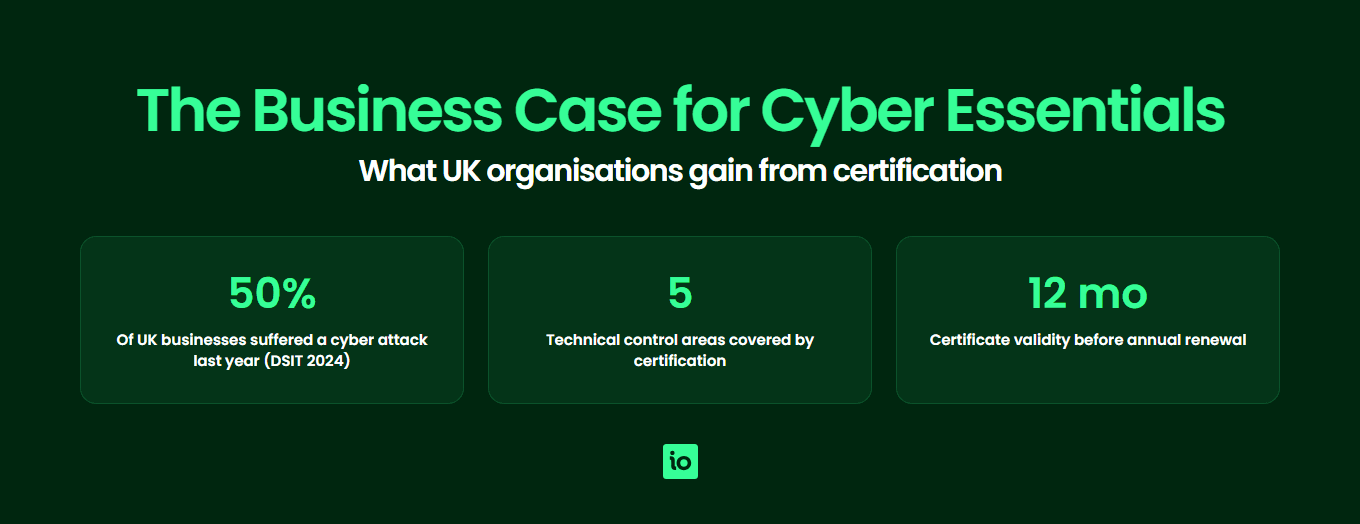
The entry price for the self-assessed Cyber Essentials level is genuinely low, particularly for the smallest organisations. The certification covers five technical controls that most well-run businesses should already have in place: secure configuration, user access control, security update management, malware protection and firewalls. The work is not in passing the assessment; it is in honestly evidencing what you have and closing the gaps you discover along the way.
So the value of Cyber Essentials is not really about the certificate itself. It is about three commercial outcomes: eligibility for contracts that mandate it, faster procurement cycles because you can answer security questionnaires with a single document, and a baseline of cyber hygiene that reduces the chance of a damaging incident. The certificate is the receipt; the controls are the product.
What direct benefits do you actually get from certification?
The direct benefits are the ones you can put a number against. They are the reasons most UK businesses pursue certification in the first place, and the easiest to justify to a finance director who wants to see a return on investment.
Eligibility for UK government and public sector contracts
Since 2014, Cyber Essentials has been mandatory for suppliers bidding on UK central government contracts that involve handling certain personal information or sensitive operational data. Under the Cabinet Office’s procurement rules, affected suppliers must hold valid certification before the contract is awarded. Without it, you cannot win the work.
This extends far beyond central government. The Ministry of Defence (MoD) requires Cyber Essentials (and often Cyber Essentials Plus) for suppliers under the Defence Cyber Protection Partnership scheme. NHS suppliers are increasingly expected to hold the certificate as part of the Data Security and Protection Toolkit alignment. Local councils, universities and Crown Commercial Service framework agreements routinely list it as a mandatory or strongly preferred requirement.
Stronger position in private sector supply chains
Large UK enterprises increasingly cascade Cyber Essentials requirements down to their suppliers. Banks, insurers, professional services firms and tech companies use it as a baseline screening question in third-party risk assessments. Holding the certificate often shortens the procurement cycle dramatically — instead of completing a 200-question security questionnaire, you attach the certificate and answer perhaps 20 follow-up questions.
A credible trust signal for prospects
Cyber Essentials is recognised by UK buyers and uses the IASME and NCSC branding that prospects find on the official NCSC website. Placing the badge on your website, proposal templates and email signatures signals that you have taken a structured approach to cyber security and have been independently verified against a recognised standard. That matters when a prospect is choosing between you and a competitor who has not bothered.

Start your free trial
Want to explore?
Sign up for your free trial today and get hands on with all the compliance features that ISMS.online has to offer
What about the indirect benefits and the real ROI?
The indirect benefits often matter more over the long run than the direct ones, but they are harder to quantify in advance. Together they shift Cyber Essentials from a tick-box exercise into something that genuinely changes how exposed your business is.
Cyber insurance premium discounts and free cover
Eligible UK organisations can qualify for IASME-backed cyber liability insurance included with certification, provided the certificate covers the whole organisation and they meet IASME’s UK turnover eligibility criteria; confirm the current criteria and cover levels directly with IASME. Beyond that included cover, many commercial cyber insurers either require Cyber Essentials as a precondition for cover or offer measurable premium discounts to certified organisations, so the certification cost is often recovered at the first insurance renewal.
GDPR and data protection alignment
The UK GDPR requires organisations to implement “appropriate technical and organisational measures” to protect personal data. The ICO has repeatedly cited Cyber Essentials as evidence of meeting that obligation for SMBs. While the certificate does not make you GDPR compliant on its own, it gives you a defensible position on Article 32 (security of processing) that a fine-issuing regulator will recognise.
A genuine reduction in breach probability
The UK Government’s Cyber Security Breaches Survey, run annually, has consistently shown that organisations with formal cyber security certifications report fewer disruptive incidents than those without. IASME’s own analysis of certified organisations indicates that the five controls block the vast majority of common, opportunistic attacks — the type of phishing, ransomware and unpatched-software exploits that account for the bulk of UK SMB breaches. You are not buying immunity; you are buying a measurable reduction in the most likely failure modes.
A low entry price as a risk-free trial
For the smallest organisations with a capped scope, Cyber Essentials is one of the cheapest formal security investments available to UK businesses. If you bid for a single public sector contract and win it because you hold the certificate, the return dwarfs the certification cost many times over. See our full Cyber Essentials cost breakdown for how pricing works and what to budget for remediation work.
How do the benefits and drawbacks actually stack up?
Here is an honest side-by-side comparison so you can weigh the decision rather than rely on marketing language.
| Benefits | Drawbacks |
|---|---|
| Mandatory for UK central government, MoD and many NHS contracts | Annual recertification required — not a one-off cost |
| Often shortens enterprise procurement cycles by replacing long questionnaires | Self-assessed Cyber Essentials is less rigorous than Cyber Essentials Plus, which costs more |
| Included cyber liability insurance for eligible UK organisations | Insurance is geographically and turnover capped — not all certified orgs qualify |
| Recognised by the NCSC and ICO as evidence of baseline security measures | Does not satisfy ISO 27001, SOC 2 or international procurement frameworks on its own |
| Forces a useful security hygiene audit across five practical control areas | Remediation work (patching, MFA rollout, configuration changes) may cost more than the certificate itself |
| Recovery cost is typically a single contract win or one insurance renewal | Low brand recognition outside the UK — not useful for US, EU or international tenders |
| Trust signal on websites, proposals and tenders | Scope-creep risk if you certify part of the business and then need to extend cover later |
Who actually doesn’t need Cyber Essentials?
Not every business benefits equally. Spending the certification fee and a few weeks of staff time is wasted if none of the direct or indirect benefits apply to your situation. The honest cases where Cyber Essentials offers limited value include:
- Pure B2C businesses with no supplier obligations — If your customers are individual consumers and you never bid for B2B work, the trust signal is mostly internal-facing and the procurement-cycle benefit disappears
- Organisations operating entirely outside the UK — Cyber Essentials has low brand recognition in the US, mainland Europe and Asia. ISO 27001 or SOC 2 will serve you better for international procurement
- Businesses that already hold full-scope ISO 27001 — You already satisfy the substance of the Cyber Essentials controls (and more) under ISO 27001. The only reason to add Cyber Essentials is if a UK government contract specifically names it as mandatory, in which case Cyber Essentials Plus is usually the right level
- Very early-stage startups with no revenue or customers yet — Wait until you have a first commercial contract or a clear procurement reason. The certificate has a 12-month validity, so timing matters
Get started easily with a personal product demo
One of our onboarding specialists will walk you through our platform to help you get started with confidence.
How does Cyber Essentials compare to ISO 27001, SOC 2 and IASME Cyber Assurance?
Cyber Essentials is the entry point to UK cyber certification. The other frameworks address different audiences, scope and depth of assurance, and they are not direct substitutes.
| Framework | Best for | Typical effort |
|---|---|---|
| Cyber Essentials | UK SMBs needing a baseline trust signal and public sector eligibility | 1–4 weeks |
| Cyber Essentials Plus | UK organisations needing independent technical verification, MoD suppliers | 2–6 weeks |
| IASME Cyber Assurance | UK SMBs wanting a mid-tier governance and risk framework beyond technical controls | 2–3 months |
| ISO 27001 | Mid-market and enterprise needing internationally recognised information security management | 6–12 months |
| SOC 2 | Tech companies selling into US enterprise markets | 6–12 months plus observation period |
If you are choosing between Cyber Essentials and ISO 27001, see our detailed comparison of Cyber Essentials vs ISO 27001. For most UK SMBs the answer is to do Cyber Essentials first as a quick baseline, then add ISO 27001 if and when international or enterprise procurement requires it. For a side-by-side view across all five UK schemes (CE, CE Plus, ISO 27001, SOC 2 and NIS 2), see our UK cyber security certification guide.
What are the common objections and how do they hold up?
Four objections come up repeatedly from UK businesses weighing the decision. Here is how each one stacks up against the evidence.
“We already do most of this stuff, so what is the point of the certificate?”
This is the most common objection, and it is partly true. Most well-run businesses are already doing much of what Cyber Essentials requires. The point of the certificate is the independent verification, which procurement teams need to see. Without it, your strong internal practices are not commercially visible.
“Our customers have never asked for it.”
This is often a timing issue rather than a permanent state. Procurement requirements are rising year on year, particularly in financial services, professional services and any business that supplies to government either directly or via a prime contractor. Being ahead of the request is much easier than scrambling when a tender deadline lands on your desk.
“We do not bid for government work.”
Many businesses end up serving the public sector indirectly without realising it. If you sell to a consultancy, an IT services firm or a professional services partner, and any part of their revenue comes from government, the requirement will cascade down to you eventually.
“The remediation costs more than the certificate.”
This is true and important to acknowledge. If you are missing multi-factor authentication, regular patching or proper user access control, the remediation cost will dwarf the certificate fee. But you would need to do that work anyway to meet UK GDPR and basic cyber insurance underwriting standards. The certificate just forces the conversation. See our Cyber Essentials small business guide for what to realistically budget for remediation.
Why Choose ISMS.online for Cyber Essentials?
- Structured readiness assessment — ISMS.online maps every Cyber Essentials control area to evidence requirements, so you know exactly what to gather before you start the formal assessment
- Pre-built policies and procedures — Template documents for access control, patching, malware protection and secure configuration mean you are not starting from a blank page
- Evidence management in one place — Upload, version and link evidence directly to the control it supports, making audit and recertification dramatically faster
- Multi-framework support — If you are planning to add ISO 27001, SOC 2 or NIS 2 later, ISMS.online maps controls across frameworks so you assess once and satisfy multiple standards
- Annual recertification ready — All your evidence and assessment data carries forward year on year, so recertification takes hours, not weeks
- Helps you achieve certification with an assessment body — ISMS.online is not a certification body; we help you get audit-ready and present a clean, evidenced submission to your assessor of choice
- Trusted by thousands of UK businesses — From early-stage startups to FTSE 250 organisations, ISMS.online supports the full UK compliance journey
Related Cyber Essentials guides
Continue your Cyber Essentials journey with the other guides in this series:
- Cyber Essentials Requirements — The five control areas, scope decisions and what evidence assessors look for.
- Cyber Essentials Cost — What drives Cyber Essentials cost, Plus pricing factors and how to budget.
- Cyber Essentials Plus Requirements — The technical audit, vulnerability scans and what Plus delivers over the basic certification.
- Cyber Essentials Self Assessment — The SASQ workflow, scope, evidence and common pitfalls.
- How Long Does Cyber Essentials Take? — Typical UK timeline, fast-track options and what slows the process.
- Cyber Essentials Renewal — The 12-month cycle, control changes and how to prepare ahead of expiry.
- Cyber Essentials for Small Business — SMB-specific scope and the cost-benefit case.
- Cyber Essentials vs ISO 27001 — Scope, cost, time and recognition compared.
FAQs
Is Cyber Essentials worth it for a very small business with fewer than 10 staff?
Usually yes, particularly if you sell B2B or to the public sector. At the low entry-level price, plus the included cyber liability insurance for eligible UK organisations and the trust signal on your website, the payback is often a single contract win or one insurance renewal. The only common case where it is not worth it is a pure consumer-facing business with no supplier obligations and no need for the insurance benefit.
How long does Cyber Essentials certification last?
A Cyber Essentials certificate is valid for 12 months from the date of issue. You then need to recertify annually to maintain it and to keep the included cyber liability insurance (where applicable). Most organisations find recertification much faster than the first assessment because the evidence and policies are already in place.
Do I need Cyber Essentials or Cyber Essentials Plus?
For most procurement requirements, the standard self-assessed Cyber Essentials is sufficient. Cyber Essentials Plus adds an independent technical audit and is required for some MoD suppliers and a small number of high-assurance public sector contracts. If you are unsure, start with the standard certification and upgrade only when a specific contract or buyer requires Plus.
Can I get Cyber Essentials if I do not have an in-house IT team?
Yes. Many certified businesses outsource their IT to a managed service provider. As long as someone in the organisation can answer the assessment questions accurately and confirm that the controls are in place, you do not need internal technical staff. ISMS.online structures the evidence-gathering so non-technical owners can manage the process.
Will Cyber Essentials cover all of my GDPR obligations?
No, but it covers a meaningful portion of the “appropriate technical and organisational measures” required by Article 32 of the UK GDPR. The ICO has cited Cyber Essentials as evidence of meeting that security obligation for SMBs. You still need separate work on lawful basis, data subject rights, records of processing and breach notification, but Cyber Essentials gives you a defensible technical baseline.
What is the typical real-world ROI of Cyber Essentials for a UK SMB?
For UK SMBs that sell B2B or to the public sector, payback is typically achieved within the first 12 months through a combination of contract eligibility, insurance discounts and shortened procurement cycles. A single public sector contract or one cyber insurance renewal usually recovers the certification cost many times over. The harder-to-measure return is the reduction in breach probability across the five control areas, which translates into avoided incident-response costs.






