





































ISO 27001 A.6.5 Responsibilities After Termination or Change of Employment Checklist
Implementing A.6.5 Responsibilities After Termination or Change of Employment is essential for safeguarding an organisation’s sensitive information and ensuring that former employees do not have residual access to company resources.
This control involves a series of steps that must be meticulously managed to prevent data breaches and unauthorised access.
Challenges can arise at each stage, but with the right tools and strategies, organisations can achieve robust compliance. Leveraging ISMS.online features can significantly streamline this process, making it more efficient and effective.
ISO 27001 made easy
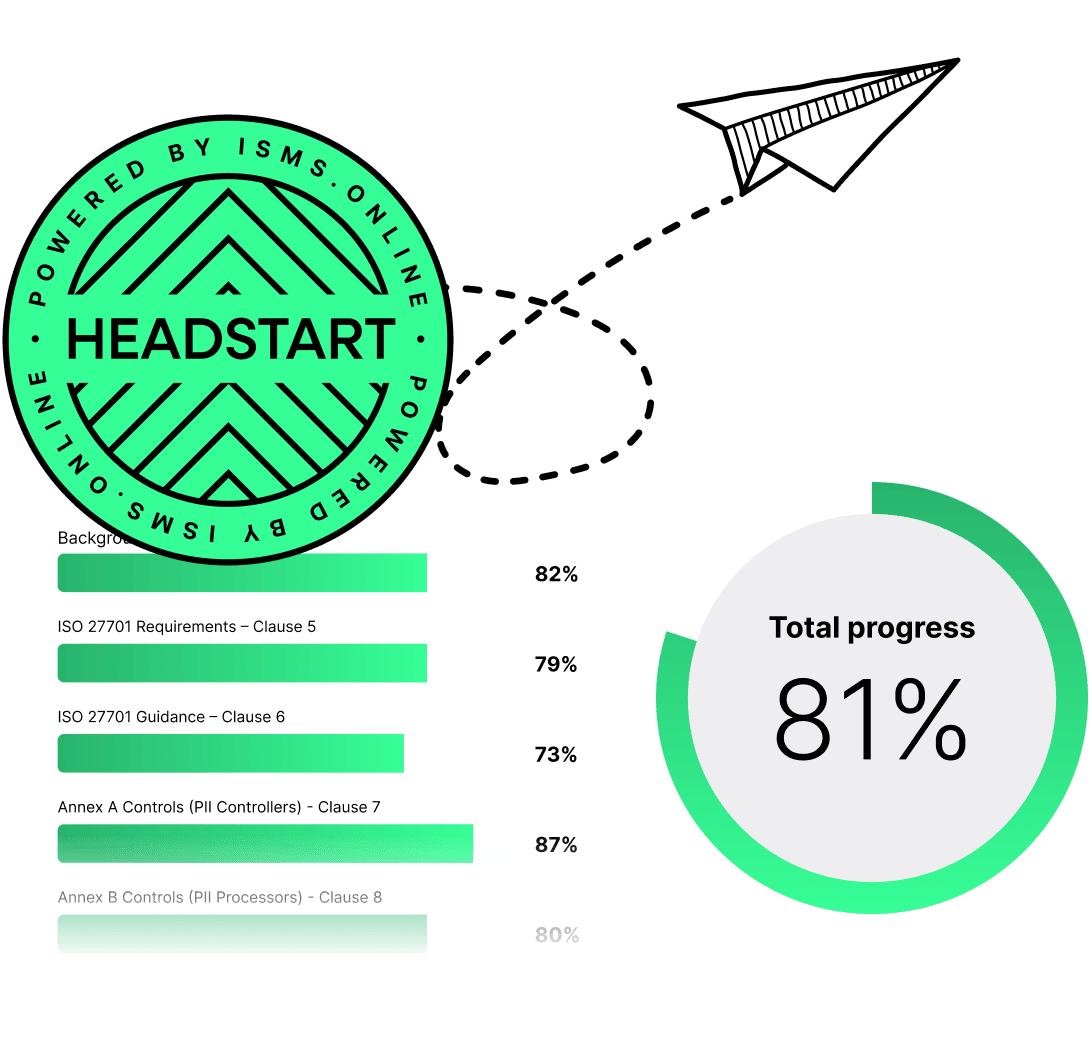
An 81% Headstart from day one
We’ve done the hard work for you, giving you an 81% Headstart from the moment you log on. All you have to do is fill in the blanks.
Why Should You Comply With Annex A.6.5? Key Aspects and Common Challenges
Access Revocation
Objective: Ensure that all access rights to systems, networks, and data are promptly revoked upon the termination or change of employment. This includes disabling user accounts, removing physical access, and retrieving any company-issued devices.
Challenges:
- Identifying all access points and systems the employee had access to can be complex.
- Ensuring timely communication between HR and IT departments to deactivate access immediately.
- Managing access rights for remote workers or those using personal devices.
Solutions:
- Implement an automated access management system integrated with HR processes to track and revoke access rights promptly.
- Use a centralised identity and access management (IAM) system to maintain an up-to-date record of user access.
- Regularly audit access rights and update access control lists to ensure accuracy.
Related ISO 27001 Clauses:
- Clause 9.2: Internal Audit
- Clause 7.5: Documented Information
Return of Assets
Objective: Ensure the return of all organisational assets, such as laptops, mobile devices, access cards, documents, and other company property. This helps in preventing unauthorised access and potential data breaches.
Challenges:
- Tracking all assets assigned to the employee, especially if there is no centralised asset management system.
- Ensuring employees return assets promptly, particularly in remote or offsite scenarios.
- Handling the condition and data sanitisation of returned assets.
Solutions:
- Maintain a detailed asset registry and update it regularly.
- Use asset tracking tools with check-in/check-out features for better accountability.
- Implement a clear policy for the return of assets and include this in the exit process.
Related ISO 27001 Clauses:
- Clause 8.1: Operational Planning and Control
- Clause 8.2: Risk Assessment
Confidentiality Agreements
Objective: Reinforce any existing confidentiality or non-disclosure agreements that extend beyond the period of employment. Employees should be reminded of their ongoing obligations to protect the organisation’s sensitive information even after leaving the company.
Challenges:
- Ensuring that employees fully understand their ongoing confidentiality obligations.
- Keeping track of signed agreements and ensuring they are up-to-date and legally binding.
- Addressing potential legal disputes regarding confidentiality breaches.
Solutions:
- Conduct regular training sessions to remind employees of their confidentiality obligations.
- Use electronic signature tools to maintain and track signed agreements.
- Engage legal counsel to review and update agreements periodically.
Related ISO 27001 Clauses:
- Clause 7.3: Awareness
- Clause 7.4: Communication
Knowledge Transfer
Objective: Facilitate the transfer of knowledge and responsibilities to other employees or new hires. This helps in maintaining business continuity and ensures that critical information and tasks are not lost during the transition.
Challenges:
- Ensuring a smooth transfer of knowledge without losing critical information.
- Managing the transition process effectively, especially during sudden or unplanned departures.
- Ensuring that remaining employees are adequately trained to take over new responsibilities.
Solutions:
- Develop a structured knowledge transfer plan that includes documentation and training sessions.
- Use collaborative tools like wikis or internal knowledge bases to store and share information.
- Schedule overlap periods where outgoing employees work with their replacements.
Related ISO 27001 Clauses:
- Clause 7.2: Competence
- Clause 7.5: Documented Information
Exit Interviews
Objective: Conduct exit interviews to discuss any outstanding security concerns and ensure that the departing employee is aware of their continuing responsibilities. This can also provide insights into potential security improvements.
Challenges:
- Conducting thorough and consistent exit interviews across the organisation.
- Addressing feedback constructively and implementing necessary improvements.
- Ensuring that all security concerns are documented and followed up on.
Solutions:
- Develop a standardised exit interview process and checklist.
- Assign dedicated personnel to conduct exit interviews and handle feedback.
- Document feedback and track the implementation of suggested improvements.
Related ISO 27001 Clauses:
- Clause 9.3: Management Review
- Clause 10.2: Nonconformity and Corrective Action
Monitoring and Auditing
Objective: Monitor and audit the processes related to termination or change of employment to ensure compliance with security policies. This includes verifying that access has been revoked and assets have been returned.
Challenges:
- Keeping accurate records of all termination-related activities for audit purposes.
- Conducting regular audits to identify gaps or non-compliance issues.
- Ensuring that corrective actions are implemented and tracked.
Solutions:
- Implement a robust record-keeping system to track all termination activities.
- Schedule regular audits and use audit management tools to streamline the process.
- Develop a system for tracking and following up on corrective actions.
Related ISO 27001 Clauses:
- Clause 9.2: Internal Audit
- Clause 10.2: Nonconformity and Corrective Action

Free yourself from a mountain of spreadsheets
Embed, expand and scale your compliance, without the mess. IO gives you the resilience and confidence to grow securely.
ISMS.online Features for Demonstrating Compliance with A.6.5
ISMS.online offers several features that can be instrumental in demonstrating compliance with A.6.5:
User Management
- Access Control: Manage and revoke access rights effectively through detailed user access logs and role-based access controls.
- Identity Management: Ensure the comprehensive management of user identities, including the prompt deactivation of accounts and removal of privileges.
Asset Management
- Asset Registry: Track and manage organisational assets assigned to employees, ensuring they are returned upon termination or change of employment.
- Labeling System: Facilitate the tracking and retrieval of assets through systematic labeling and categorisation.
Policy Management
- Policy Templates: Implement and communicate confidentiality agreements and other relevant policies clearly to ensure understanding and compliance.
- Document Control: Maintain and update confidentiality agreements, ensuring they are signed and acknowledged by all employees.
Incident Management
- Incident Tracker: Log and manage any incidents related to termination or change of employment, ensuring a structured and documented approach to addressing security concerns.
- Workflow: Streamline the exit process with predefined workflows that ensure all necessary steps, such as access revocation and asset return, are completed.
Audit Management
- Audit Templates: Regularly audit termination processes using customisable templates to ensure adherence to policies and identify areas for improvement.
- Corrective Actions: Document and implement corrective actions derived from exit interviews or audits, enhancing the overall process.
Communication
- Notification System: Automate notifications to relevant departments when an employee’s status changes, ensuring timely action for access revocation and asset return.
- Collaboration Tools: Facilitate communication between HR, IT, and other relevant departments to ensure seamless execution of termination procedures.
Detailed Annex A.6.5 Compliance Checklist
To ensure compliance with A.6.5, the following checklist can be used:
Access Revocation
Return of Assets
Confidentiality Agreements
Knowledge Transfer
Exit Interviews
Monitoring and Auditing
Additional Best Practices for Annex A.6.5
- Document Everything: Ensure all processes, decisions, and actions are well-documented. This helps in auditing and demonstrating compliance.
- Regular Training: Provide regular training to HR and IT staff on the importance and procedures for handling terminations and changes in employment.
- Continuous Improvement: Use feedback from exit interviews and audits to continuously improve the termination process.
- Legal Compliance: Ensure all actions comply with local labour laws and regulations regarding termination and employment changes.
By effectively leveraging these ISMS.online features and addressing the common challenges faced during implementation, organisations can ensure comprehensive compliance with the A.6.5 control, minimising risks associated with employee terminations or role changes and maintaining robust information security.

Manage all your compliance, all in one place
ISMS.online supports over 100 standards and regulations, giving you a single platform for all your compliance needs.
Every Annex A Control Checklist Table
| ISO 27001 Control Number | ISO 27001 Control Checklist |
|---|---|
| Annex A.6.1 | Screening Checklist |
| Annex A.6.2 | Terms and Conditions of Employment Checklist |
| Annex A.6.3 | Information Security Awareness, Education and Training Checklist |
| Annex A.6.4 | Disciplinary Process Checklist |
| Annex A.6.5 | Responsibilities After Termination or Change of Employment Checklist |
| Annex A.6.6 | Confidentiality or Non-Disclosure Agreements Checklist |
| Annex A.6.7 | Remote Working Checklist |
| Annex A.6.8 | Information Security Event Reporting Checklist |
| ISO 27001 Control Number | ISO 27001 Control Checklist |
|---|---|
| Annex A.7.1 | Physical Security Perimeters Checklist |
| Annex A.7.2 | Physical Entry Checklist |
| Annex A.7.3 | Securing Offices, Rooms, and Facilities Checklist |
| Annex A.7.4 | Physical Security Monitoring Checklist |
| Annex A.7.5 | Protecting Against Physical and Environmental Threats Checklist |
| Annex A.7.6 | Working in Secure Areas Checklist |
| Annex A.7.7 | Clear Desk and Clear Screen Checklist |
| Annex A.7.8 | Equipment Siting and Protection Checklist |
| Annex A.7.9 | Security of Assets Off-Premises Checklist |
| Annex A.7.10 | Storage Media Checklist |
| Annex A.7.11 | Supporting Utilities Checklist |
| Annex A.7.12 | Cabling Security Checklist |
| Annex A.7.13 | Equipment Maintenance Checklist |
| Annex A.7.14 | Secure Disposal or Re-Use of Equipment Checklist |
How ISMS.online Help With A.6.5
Implementing robust information security measures is critical in today’s digital landscape. Ensuring compliance with ISO 27001:2022, particularly with controls like A.6.5 Responsibilities After Termination or Change of Employment, can be challenging but is essential for protecting your organisation’s sensitive information.
ISMS.online provides a comprehensive platform with the tools and features necessary to streamline this process and ensure thorough compliance.
Ready to elevate your information security and compliance strategies?
Contact ISMS.online today to learn how our platform can support your organisation’s needs. Book a demo now and experience firsthand how ISMS.online can simplify and enhance your compliance efforts.






