














What is Control 7.1?
Control 7.1 in the new ISO 27002:2022 covers the need for organisations to define and set security perimeters and use these parameters to protect areas that contain information and other associated assets.
Information and Information Security Assets Explained
Information can be defined as any data, information or knowledge that has value to your organisation or business. This includes any data collected about individuals, customers, partners, employees and other stakeholders.
Information security assets can be divided broadly into:
Data
Data is often confused with information but there is a difference between data and information. Data is raw, unprocessed and often unusable in its current state whereas information is data that has been processed into usable pieces of information such as an email address or phone number.
Infrastructure
Infrastructure refers to all of the components that make up a network including servers and other devices such as printers and routers etc.
Infrastructure can also include software such as operating systems and applications which should be protected from cyber attacks just as much as hardware does as both need to be kept up-to-date with patches and fixes for vulnerabilities discovered by hackers so they can’t be exploited by malicious hackers who want to gain access to sensitive data.
Physical Security Perimeters Explained
Physical security refers to all the physical measures that protect an organisation’s facilities and assets. Physical security is the most basic and important part of information security. It is not just about locking the door but also knowing who has access to what, when, where and how.
Physical security perimeters are used to identify the physical boundaries of a building or area and control access to it. Physical security perimeters may include fences, walls, gates and other barriers that prevent unauthorised access by people or vehicles. In addition to physical barriers, electronic surveillance equipment such as closed circuit television cameras can be used to monitor activity outside the facility.
Physical security perimeters provide a first line of defence against intruders who might try to enter your computer system through the network cable or wireless connection in an organisation. They are often used in conjunction with other types of information security controls such as identity management, access control and intrusion detection systems.
ISO 27001 made easy
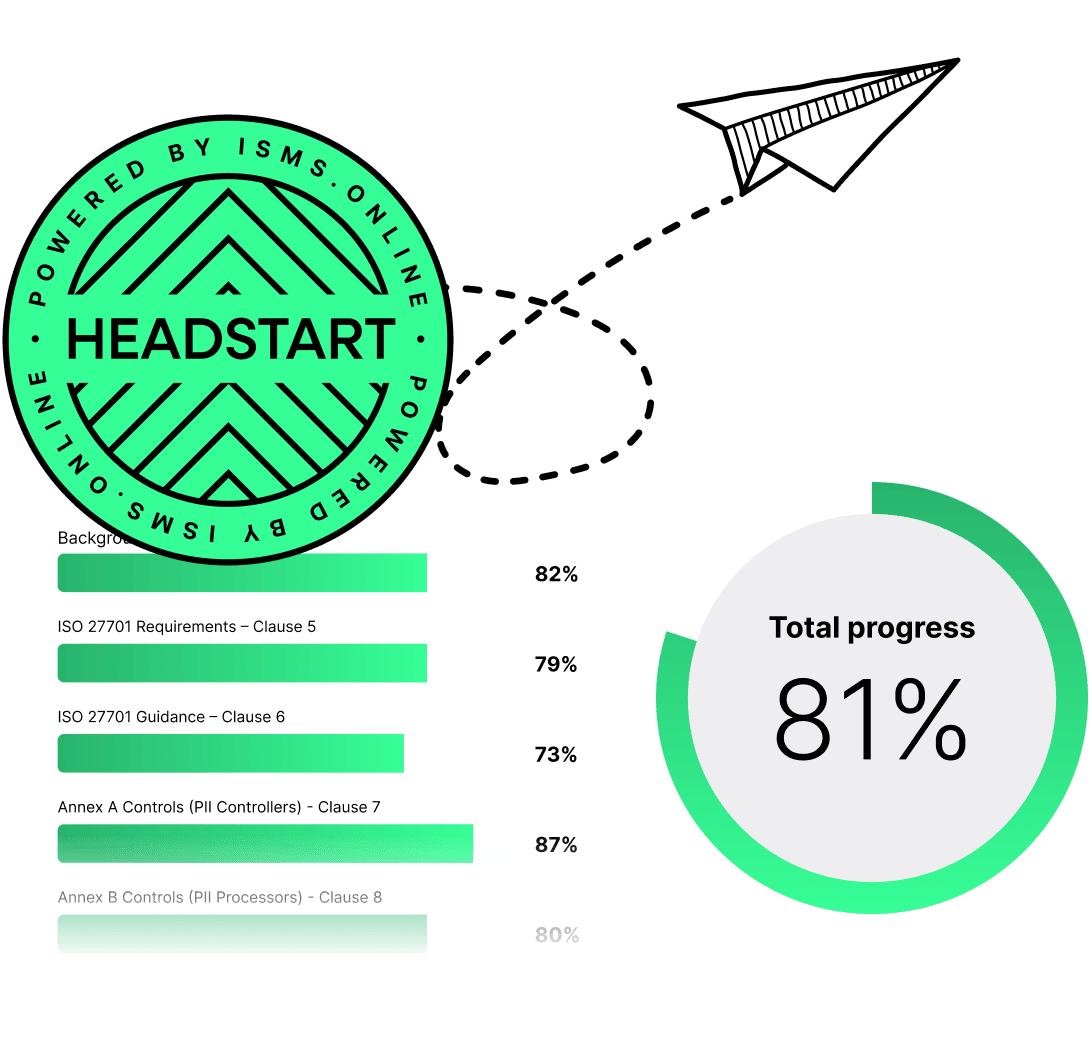
An 81% Headstart from day one
We’ve done the hard work for you, giving you an 81% Headstart from the moment you log on. All you have to do is fill in the blanks.
Attributes Table of Control 7.1
Attributes are a way to classify controls. Attributes allow you to rapidly match your control selection with typical industry specification and terminology. The following controls are available in control 7.1.
| Control Type | Information Security Properties | Cybersecurity Concepts | Operational Capabilities | Security Domains |
|---|---|---|---|---|
| #Preventive | #Confidentiality | #Protect | #Physical Security | #Protection |
| #Integrity | ||||
| #Availability |
Control 7.1 ensures that an organisation can demonstrate that it has adequate physical security perimeters in place to prevent unauthorised physical access to information and other associated assets.
This includes preventing:
- Unauthorised entry to buildings, rooms or areas containing information assets;
- Unauthorised removal of assets from premises;
- Unauthorised use of assets on premises (e.g., computers and computer related devices); and
- Unauthorised access to electronic communications equipment such as telephones, fax machines and computer terminals (e.g., unauthorised tampering).
Physical security perimeters can be implemented through the following two categories:
Physical access control: Provides controls over the entry into facilities and buildings, as well as the movement within them. These controls include locking doors, using alarms on doors, using fences or barriers around facilities, etc.
Hardware security: Provides controls over physical equipment (e.g., computers) used by an organisation to process data such as printers and scanners that may contain sensitive information.
Implementing this control may also cover the unauthorised use of facility space, equipment and supplies in order to protect information and other associated assets, such as confidential documents, records and equipment.
What Is Involved and How to Meet the Requirements
The following guidelines should be considered and implemented where appropriate for physical security perimeters:
- Defining security perimeters and the siting and strength of each of the perimeters in accordance with the information security requirements related to the assets within the perimeter.
- Having physically sound perimeters for a building or site containing information processing facilities (i.e. there should be no gaps in the perimeter or areas where a break-in can easily occur).
- The exterior roofs, walls, ceilings and flooring of the site should be of solid construction and all external doors should be suitably protected against unauthorised access with control mechanisms (e.g. bars, alarms, locks).
- Doors and windows should be locked when unattended and external protection should be considered for windows, particularly at ground level; ventilation points should also be considered.
You can get more information on what is involved in meeting the requirements for the control in the ISO 27002:2022 standard document.

Free yourself from a mountain of spreadsheets
Embed, expand and scale your compliance, without the mess. IO gives you the resilience and confidence to grow securely.
Changes and Differences from ISO 27002:2013
The new 2022 revision of ISO 27002 was published on February 15, 2022, and is an upgrade of ISO 27002:2013.
11 new controls were added to this version of ISO 27002. However, control 7.1 is not a new control, rather, it is a modified version of control 11.1.1 in the 2013 version of ISO 27002. The major difference between the 2013 and 2022 version is the change of control number.
The control number 11.1.1 was replaced with 7.1. Apart from that, the context and meaning are largely similar, even though that phraseology is different.
Another difference between both controls is that the implementation requirements were reduced in the 2022 version.
The following requirements which are available in control 11.1.1 of ISO 27002:2013 are missing in control 7.1:
- A manned reception area or other means to control physical access to the site or building should be in place.
- Access to sites and buildings should be restricted to authorised personnel only.
- Physical barriers should, where applicable, be built to prevent unauthorised physical access and environmental contamination.
- Suitable intruder detection systems should be installed to national, regional or international standards and regularly tested to cover all external doors and accessible windows.
- Unoccupied areas should be alarmed at all times.
- Cover should also be provided for other areas, e.g. computer room or communications rooms.
- Information processing facilities managed by the organisation should be physically separated from those managed by external parties.
These omissions do not in any way make the new standard less effective, instead they were removed to make the new control more user-friendly.
Who Is in Charge of This Process?
The chief information officer is the person in charge of information security. This individual is responsible for implementing policies and procedures to protect the company’s data and systems. The CIO typically works with other executives, such as the chief financial officer and chief executive officer, to ensure that security measures are taken into account during business decisions.
The chief financial officer is also involved in making decisions regarding physical security perimeters. He or she works with other members of the C-suite — including the CIO — to determine how much money should be allocated to physical security measures like surveillance cameras, access controls and alarms.

Manage all your compliance, all in one place
ISMS.online supports over 100 standards and regulations, giving you a single platform for all your compliance needs.
What Do These Changes Mean for You?
The new ISO 27002:2022 is not a major revision. Therefore, you do not need to implement any serious changes to be compliant with the latest version of ISO 27002.
However, you should consider reviewing your current implementation and making sure that it aligns with the new requirements. In particular, if you have made any changes since the previous version was published in 2013. It is worth taking a look at those changes again to see whether they are still valid or if they need to be amended.
That said, you can get more information on how the new ISO 27002 will affect your information security processes and ISO 27001 certification by reading our ISO 27002:2022 guide.
New ISO 27002 Controls
| ISO/IEC 27002:2022 Control Identifier | ISO/IEC 27002:2013 Control Identifier | Control Name |
|---|---|---|
| 5.7 | NEW | Threat intelligence |
| 5.23 | NEW | Information security for use of cloud services |
| 5.30 | NEW | ICT readiness for business continuity |
| 7.4 | NEW | Physical security monitoring |
| 8.9 | NEW | Configuration management |
| 8.10 | NEW | Information deletion |
| 8.11 | NEW | Data masking |
| 8.12 | NEW | Data leakage prevention |
| 8.16 | NEW | Monitoring activities |
| 8.23 | NEW | Web filtering |
| 8.28 | NEW | Secure coding |
| ISO/IEC 27002:2022 Control Identifier | ISO/IEC 27002:2013 Control Identifier | Control Name |
|---|---|---|
| 6.1 | 07.1.1 | Screening |
| 6.2 | 07.1.2 | Terms and conditions of employment |
| 6.3 | 07.2.2 | Information security awareness, education and training |
| 6.4 | 07.2.3 | Disciplinary process |
| 6.5 | 07.3.1 | Responsibilities after termination or change of employment |
| 6.6 | 13.2.4 | Confidentiality or non-disclosure agreements |
| 6.7 | 06.2.2 | Remote working |
| 6.8 | 16.1.2, 16.1.3 | Information security event reporting |
| ISO/IEC 27002:2022 Control Identifier | ISO/IEC 27002:2013 Control Identifier | Control Name |
|---|---|---|
| 7.1 | 11.1.1 | Physical security perimeters |
| 7.2 | 11.1.2, 11.1.6 | Physical entry |
| 7.3 | 11.1.3 | Securing offices, rooms and facilities |
| 7.4 | NEW | Physical security monitoring |
| 7.5 | 11.1.4 | Protecting against physical and environmental threats |
| 7.6 | 11.1.5 | Working in secure areas |
| 7.7 | 11.2.9 | Clear desk and clear screen |
| 7.8 | 11.2.1 | Equipment siting and protection |
| 7.9 | 11.2.6 | Security of assets off-premises |
| 7.10 | 08.3.1, 08.3.2, 08.3.3, 11.2.5 | Storage media |
| 7.11 | 11.2.2 | Supporting utilities |
| 7.12 | 11.2.3 | Cabling security |
| 7.13 | 11.2.4 | Equipment maintenance |
| 7.14 | 11.2.7 | Secure disposal or re-use of equipment |
How ISMS.Online Helps
ISMS.online can also help with demonstrating ISO 27002 compliance by providing you with an online system that allows you to store all of your documents in one place and make them available to anyone who needs them. The system also allows you to create checklists for each document so that it’s easy for everyone involved in making changes or reviewing documents to see what needs doing next and when it should be done.
Want to see how it works?
Get in touch today to book a demo.