














Purpose of Control 8.7
Malware represents the single largest threat to business continuity and information security faced by businesses in the digital age.
The global commercial community faces innumerable daily threats from a broad range of attack vectors that seek to gain unauthorised access to sensitive systems and data, extract information and money, dupe unassuming employees and leverage ransomed data for extortionate sums of money.
An organisation’s approach to malware protection should be front and centre of any information security policy.
Control 8.7 contains an array of measures that helps organisations to educate their employees as to the dangers of malicious software, and implement meaningful practical measures that stop internal and external attacks before they have a chance to cause disruption and data loss.
Attributes Table of Control 8.7
Control 8.7 is a triple-purpose preventive, detective and corrective control that maintains risk by implementing policies and procedures that ensure an organisation’s information, data and assets are protected against malware.
| Control Type | Information Security Properties | Cybersecurity Concepts | Operational Capabilities | Security Domains |
|---|---|---|---|---|
| #Preventive | #Confidentiality | #Protect | #System and Network Security | #Protection |
| #Detective | #Integrity | #Detect | #Information Protection | #Defence |
| #Corrective | #Availability |
Ownership of Control 8.7
Whilst malware protection involves practical steps that need to be taken by ICT admin staff and standard users, the topic itself is wide-ranging and encompasses multiple distinct business functions with differing levels of risk and numerous additional ISO controls. As such, ownership of Control 8.7 should reside with the Chief Information Security Officer, or organisational equivalent.
ISO 27001 made easy
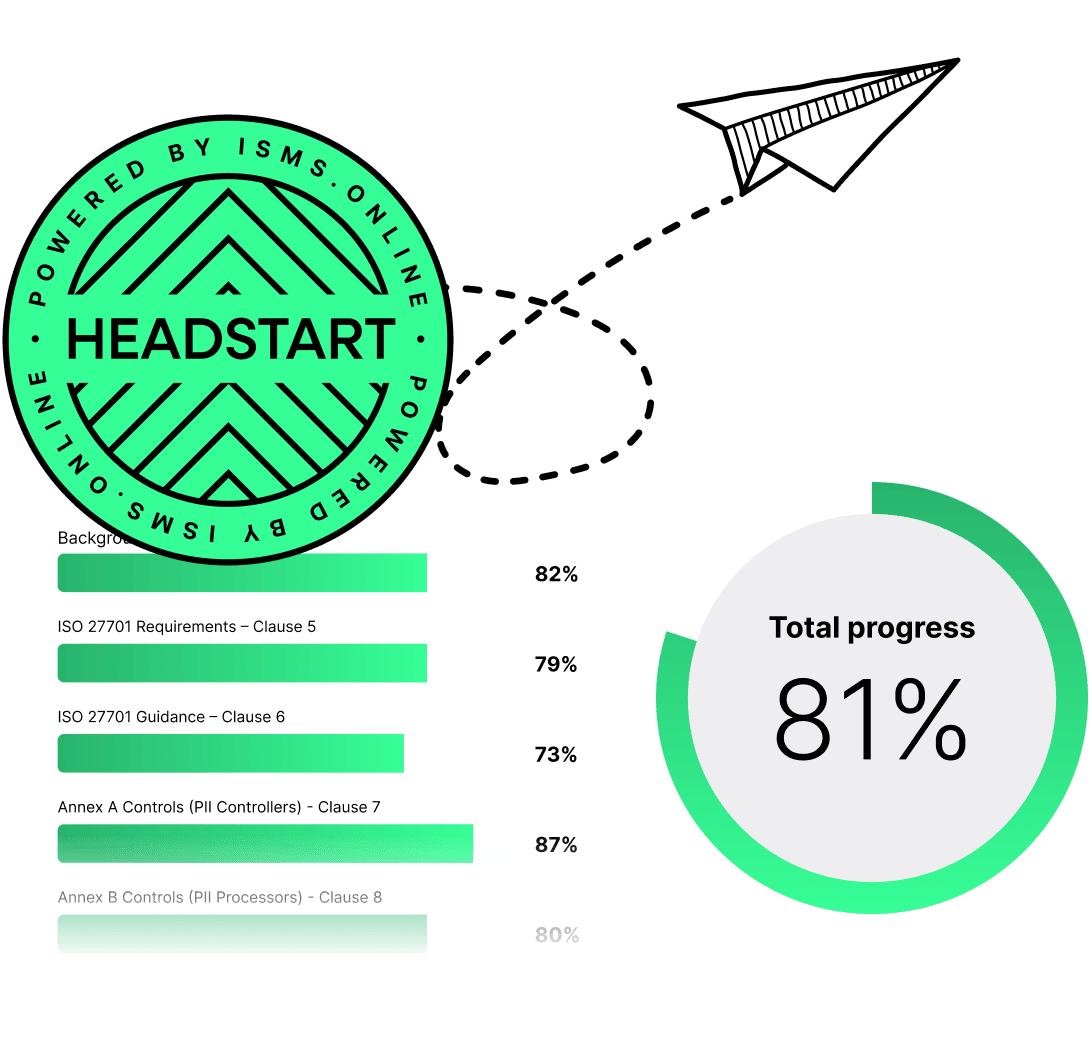
An 81% Headstart from day one
We’ve done the hard work for you, giving you an 81% Headstart from the moment you log on. All you have to do is fill in the blanks.
General Guidance on Compliance
Control 8.7 asks organisations to adopt an approach to malware protection that encompasses four key areas:
- Anti-malware software
- Organisational information security awareness (user training)
- Controlled systems and account access
- Change management
ISO categorically points out that it is a mistake to assume that anti malware software alone represents an adequate set of measures. Control 8.7 instead asks organisations to take an end-to-end approach to malware protection that begins with user education and ends with a tightly-controlled network that minimises the risk of intrusion across a variety of attack vectors.
To achieve this goal, organisations should implement controls that:
- Prevent the use of unauthorised software (see Controls 8.19 and 8.32).
- Block traffic to malicious or inappropriate websites.
- Minimise the amount of vulnerabilities resident on their network that have the potential to be exploited by malware or malicious intent (see Controls 8.8 and 8.19).
- Carry out regular software audits that scan the network for unauthorised software, system amendments and/or data.
- Ensure that data and applications are obtained with minimal risk, either internally or as an external acquisition.
- Establish a malware detection policy that includes regular and thorough scans of all relevant systems and files, based upon the unique risks of each area to be scanned. Organisations should adopt a ‘defence in depth’ approach that encompasses endpoint devices and gateway controls, and takes into consideration a broad range of attack vectors (e.g. ransomware).
- Protect against intrusions that emanate from emergency procedures and protocols – especially during an incident or high-risk maintenance activities.
- Draft a process that allows for technical staff to disable some or all anti malware efforts, especially when such activities are hampering the organisation’s ability to do business.
- Implement a robust backup and disaster recovery (BUDR) plan that allows the organisation to resume operational activity as quickly as possible, following disruption (see Control 8.13). This should include procedures that deal with software which isn’t able to be covered by anti malware software (i.e. machinery software).
- Partition off areas of the network and/or digital and virtual working environments that may cause catastrophic disruption in the event of an attack.
- Provide all relevant employees with anti malware awareness training that educates users on a broad range of topics, including (but not limited to):
- Social engineering
- Email security
- Installing malicious software
- Collect industry-related information about the latest developments in malware protection.
- Ensure that notifications about potential malware attacks (particularly from software and hardware vendors) originate from a trusted source and are accurate.
Supporting Controls
- 8.13
- 8.19
- 8.32
- 8.8

Manage all your compliance, all in one place
ISMS.online supports over 100 standards and regulations, giving you a single platform for all your compliance needs.
Changes and Differences from ISO 27002:2013
ISO 27002:2022-8.7 replaces ISO 27002:2003-12.2.1 (Controls against malware).
27002:2022-8.7 contains the same basic guidance points as 27002:2003-12.2.1, and elevates some of the supplementary guidance to general guidance points, in line with their importance to an organisation’s anti malware efforts, notably:
- Protecting against malware during maintenance periods.
27002:2003-12.2.1 also asks organisations to consider using two separate anti malware platforms, whereas 27002:2022-8.7 is content with a single unified solution.
New ISO 27002 Controls
| ISO/IEC 27002:2022 Control Identifier | ISO/IEC 27002:2013 Control Identifier | Control Name |
|---|---|---|
| 5.7 | NEW | Threat intelligence |
| 5.23 | NEW | Information security for use of cloud services |
| 5.30 | NEW | ICT readiness for business continuity |
| 7.4 | NEW | Physical security monitoring |
| 8.9 | NEW | Configuration management |
| 8.10 | NEW | Information deletion |
| 8.11 | NEW | Data masking |
| 8.12 | NEW | Data leakage prevention |
| 8.16 | NEW | Monitoring activities |
| 8.23 | NEW | Web filtering |
| 8.28 | NEW | Secure coding |
| ISO/IEC 27002:2022 Control Identifier | ISO/IEC 27002:2013 Control Identifier | Control Name |
|---|---|---|
| 6.1 | 07.1.1 | Screening |
| 6.2 | 07.1.2 | Terms and conditions of employment |
| 6.3 | 07.2.2 | Information security awareness, education and training |
| 6.4 | 07.2.3 | Disciplinary process |
| 6.5 | 07.3.1 | Responsibilities after termination or change of employment |
| 6.6 | 13.2.4 | Confidentiality or non-disclosure agreements |
| 6.7 | 06.2.2 | Remote working |
| 6.8 | 16.1.2, 16.1.3 | Information security event reporting |
| ISO/IEC 27002:2022 Control Identifier | ISO/IEC 27002:2013 Control Identifier | Control Name |
|---|---|---|
| 7.1 | 11.1.1 | Physical security perimeters |
| 7.2 | 11.1.2, 11.1.6 | Physical entry |
| 7.3 | 11.1.3 | Securing offices, rooms and facilities |
| 7.4 | NEW | Physical security monitoring |
| 7.5 | 11.1.4 | Protecting against physical and environmental threats |
| 7.6 | 11.1.5 | Working in secure areas |
| 7.7 | 11.2.9 | Clear desk and clear screen |
| 7.8 | 11.2.1 | Equipment siting and protection |
| 7.9 | 11.2.6 | Security of assets off-premises |
| 7.10 | 08.3.1, 08.3.2, 08.3.3, 11.2.5 | Storage media |
| 7.11 | 11.2.2 | Supporting utilities |
| 7.12 | 11.2.3 | Cabling security |
| 7.13 | 11.2.4 | Equipment maintenance |
| 7.14 | 11.2.7 | Secure disposal or re-use of equipment |
How ISMS.online Helps
Our platform provides you with customisable dashboards that give you real-time visibility into your compliance status.
You can monitor and manage all aspects of your ISO 27002 compliance journey from one place – audit management, gap analysis, training management, risk assessment etc.
It provides an easy-to-use, integrated solution that can be accessed on a 24/7 basis via any device with an internet connection. The platform allows all employees to work together seamlessly and securely to manage security risks and track the organisation’s compliance, as well as the journey towards ISO 27001 certification.
Get in touch today to book a demo.