















Purpose of Control 5.24
Control 5.24 deals with information security under the umbrella of Incident Management.
Control 5.24 outlines how organisations should manage information security incidents through adequate planning and preparation, by creating efficient processes and detailing how staff should respond to incidents based on clearly defined roles and responsibilities.
Throughout the guidance, an emphasis is placed on constructive communication and promoting a professional response to what are often high-pressure scenarios, especially when dealing with commercially sensitive data, or PII.
5.24 is a corrective control that maintains risk by establishing a common set of Incident Management procedures that mitigate any commercial or operational damage caused by critical information security events.
Attributes of Control 5.24
| Control Type | Information Security Properties | Cybersecurity Concepts | Operational Capabilities | Security Domains |
|---|---|---|---|---|
| #Corrective | #Confidentiality | #Respond | #Governance | #Defence |
| #Integrity | #Recover | #Information Security Event Management | ||
| #Availability |
Ownership of Control 5.24
Incident Management, in broader terms, is usually applicable to service-related incidents. Given that Control 5.24 deals specifically with information security-related incidents and breaches, taking into account the highly sensitive nature of these events, ownership of Control 5.24 should ideally reside with a CISO, or organisational equivalent.
Given that CISOs are usually only seen within larger companies and enterprise-level organisations, ownership could also reside with the COO, or Service Manager, depending on the nature of the organisation.
ISO 27001 made easy
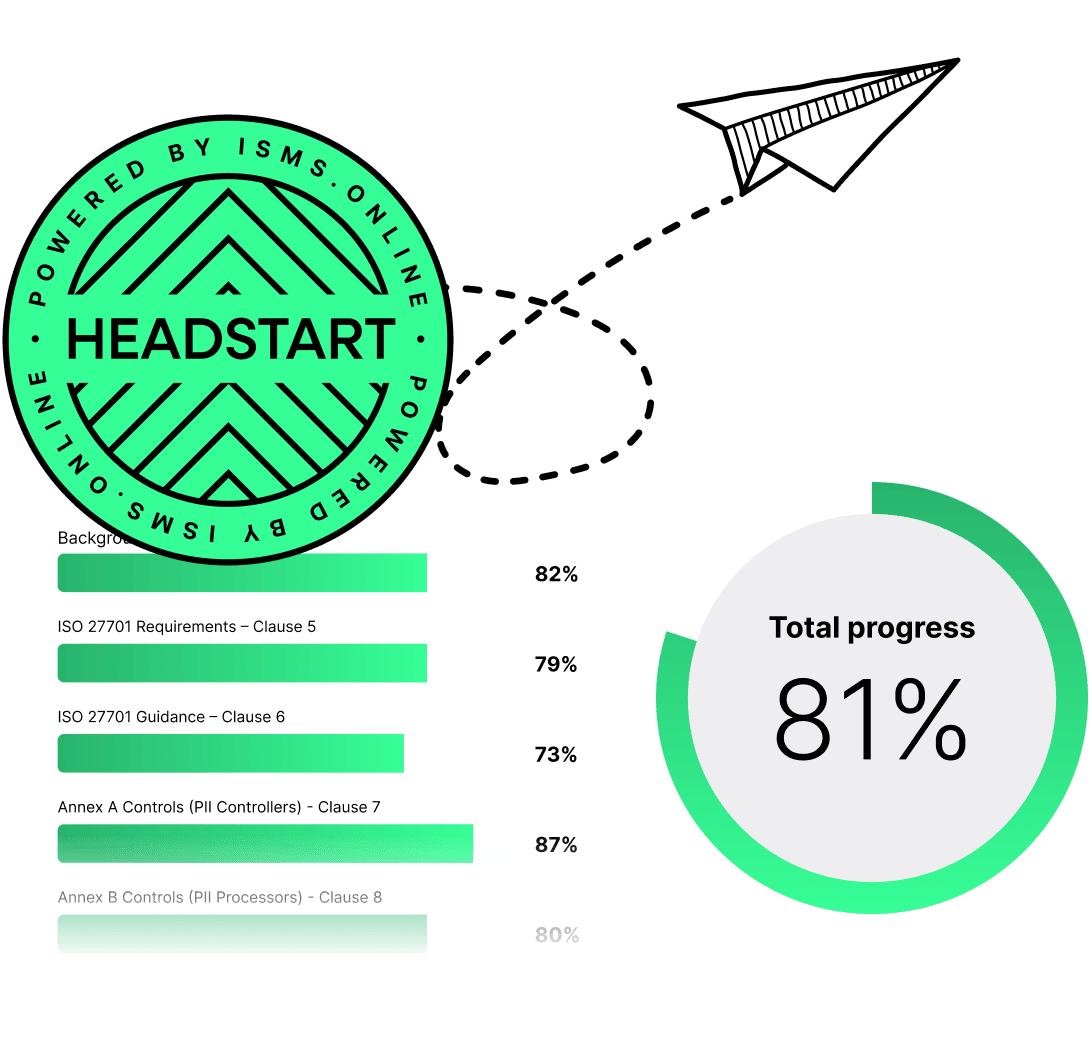
An 81% Headstart from day one
We’ve done the hard work for you, giving you an 81% Headstart from the moment you log on. All you have to do is fill in the blanks.
Guidance – Roles and Responsibilities
Incident Management yields the best results when an organisation’s staff are working together to resolve a specific problem.
In order to achieve that, Control 5.24 specifics 5 main guidance points that help organisations to create a cohesive, efficient IM operation.
Organisations should:
- Agree upon and document a homogenous method for reporting information security events. This should also involve establishing a main point of contact for all such events to be reported to.
- Establish a series of Incident Management processes that manage information security related incidents within the sphere of various technical and administrative functions:
a) Administration
b) Documentation
c) Detection
d) Triage
e) Prioritisation
f) Analysis
g) Communication - Formulate an incident response procedure that enables the organisation to assess and respond to incidents. Organisations should also be mindful of the need to learn from incidents once they’re resolved, to mitigate any recurrence and provide staff with historical context in future scenarios.
- Limit the involvement in incidents to trained and competent personnel, who enjoy full access to procedural documentation and benefit from regular refresher training specifically relating to information security incidents.
- Establish a process that identifies the training needs of each member of staff involved in resolving information security-related incidents. This should include any vendor-specific or professional certifications, and provide staff with the opportunity to highlight any professional development needs, as related to information security.

Free yourself from a mountain of spreadsheets
Embed, expand and scale your compliance, without the mess. IO gives you the resilience and confidence to grow securely.
Guidance – Incident Management
The objective of an organisation’s incident management process should be to ensure that all those responsible for resolving information security incidents have a firm understanding of three main areas:
- The time it takes to resolve an incident
- Any potential consequences
- The severity of the incident
All processes should work in harmony to ensure these three variables remain a top priority.
Control 5.24 outlines 8 main activities that should be addressed when attempting to resolve information security-related incidents.
- Potential information security events should be assessed in accordance with a strict criteria that validates them as an approved incident.
- The management of information security events and incidents should be categorised into 5 main sub-topics, either manually or via process automation:
a) Monitoring (see Controls 8.15 and 8.16)
b) Detection (see Control 8.16)
c) Classification ( see Control 5.25)
d) Analysis
e) Reporting (see Control 6.8) - When attempting to bring information security incidents to a successful conclusion, organisations should implement procedures that enact the following:
a) Response and escalation (see Control 5.26) in accordance with the type of incident
b) Activation of crisis management plans or business continuity plans, on a case-by-case basis
c) Managed recovery from an incident that mitigates any operational/financial damage caused
d) Thorough communication of incident-related events to all internal and external parties - Collaborative working with internal and external personnel (see Controls 5.5 and 5.6).
- Thorough, accessible and transparent logging of all incident managed-based activities.
- Responsible handling of evidence (including data and conversations), in accordance with internal and external guidelines and regulations (see Control 5.28).
- Root cause analysis, and a thorough review procedure, once the incident has been resolved.
- A comprehensive record of any improvements that are required to prevent the incident from reoccurring, including any amendments to the incident management process itself.
Guidance – Reporting
Reporting is an essential element of any Incident Management policy that ensures information is accurately disseminated throughout an organisation. Reporting activities should be focused around 4 main areas:
- Any actions that need to be taken once an information security event occurs.
- Incident forms that offer a clear and concise means of recording information and supporting personnel in carrying out their duties.
- Feedback processes to ensure that personnel are notified of the outcome of information security events, once the incident has been resolved.
- Incident reports that document all relevant information pertaining to an incident.
It should be noted that Control 5.24 doesn’t contain any guidance on how to meet external requirements on how incidents are reported (e.g. regulatory guidelines and/or prevailing legislation), but organisations should take steps to share information concerning incidents with all relevant parties, and coordinate a response that meets all regulatory, sector-specific and legal requirements.
Supporting controls
- 5.25
- 5.26
- 5.5
- 5.6
- 6.8
- 8.15
- 8.16

Manage all your compliance, all in one place
ISMS.online supports over 100 standards and regulations, giving you a single platform for all your compliance needs.
Changes and Differences from ISO 27002:2013
27002:2022-5.24 replaces 27002:2013-16.1.1 (Management of information security incidents and improvements – Responsibilities and procedures).
27002:2022-5.24 acknowledges the need for organisations to undergo thorough preparation, in order to remain resilient and compliant in the face of potential information security incidents.
As such, 27002:2022-5.24 offers a far more comprehensive breakdown of the steps that organisations need to take across role delegation, incident management and reporting functions, with specific reference given to other ISO controls that help organisations to gain a more rounded view of incident management as a whole, not merely related to information security events.
To help organisation compartmentalise their incident management operations, 27002:2022-5.24 deviates from 27002:2013-16.1.1 by focusing on three distinct areas for consideration:
- Roles and responsibilities
- Incident management processes
- Reporting
New ISO 27002 Controls
| ISO/IEC 27002:2022 Control Identifier | ISO/IEC 27002:2013 Control Identifier | Control Name |
|---|---|---|
| 5.7 | NEW | Threat intelligence |
| 5.23 | NEW | Information security for use of cloud services |
| 5.30 | NEW | ICT readiness for business continuity |
| 7.4 | NEW | Physical security monitoring |
| 8.9 | NEW | Configuration management |
| 8.10 | NEW | Information deletion |
| 8.11 | NEW | Data masking |
| 8.12 | NEW | Data leakage prevention |
| 8.16 | NEW | Monitoring activities |
| 8.23 | NEW | Web filtering |
| 8.28 | NEW | Secure coding |
| ISO/IEC 27002:2022 Control Identifier | ISO/IEC 27002:2013 Control Identifier | Control Name |
|---|---|---|
| 6.1 | 07.1.1 | Screening |
| 6.2 | 07.1.2 | Terms and conditions of employment |
| 6.3 | 07.2.2 | Information security awareness, education and training |
| 6.4 | 07.2.3 | Disciplinary process |
| 6.5 | 07.3.1 | Responsibilities after termination or change of employment |
| 6.6 | 13.2.4 | Confidentiality or non-disclosure agreements |
| 6.7 | 06.2.2 | Remote working |
| 6.8 | 16.1.2, 16.1.3 | Information security event reporting |
| ISO/IEC 27002:2022 Control Identifier | ISO/IEC 27002:2013 Control Identifier | Control Name |
|---|---|---|
| 7.1 | 11.1.1 | Physical security perimeters |
| 7.2 | 11.1.2, 11.1.6 | Physical entry |
| 7.3 | 11.1.3 | Securing offices, rooms and facilities |
| 7.4 | NEW | Physical security monitoring |
| 7.5 | 11.1.4 | Protecting against physical and environmental threats |
| 7.6 | 11.1.5 | Working in secure areas |
| 7.7 | 11.2.9 | Clear desk and clear screen |
| 7.8 | 11.2.1 | Equipment siting and protection |
| 7.9 | 11.2.6 | Security of assets off-premises |
| 7.10 | 08.3.1, 08.3.2, 08.3.3, 11.2.5 | Storage media |
| 7.11 | 11.2.2 | Supporting utilities |
| 7.12 | 11.2.3 | Cabling security |
| 7.13 | 11.2.4 | Equipment maintenance |
| 7.14 | 11.2.7 | Secure disposal or re-use of equipment |
How ISMS.online Helps
When you use ISMS.online, you will be able to:
- Create an ISMS that is compatible with ISO 27001 standards.
- Perform tasks and submit proof to indicate that they have met the requirements of the standard.
- Allocate tasks and track progress toward compliance with the law.
- Get access to a specialised team of advisors that will assist you throughout your path towards compliance.
Get in touch today to book a demo.