















Purpose of Control 8.6
Capacity management, in the context of ICT, isn’t limited to ensuring that organisations have adequate space on servers and associated storage media for data access and Backup and Disaster Recovery (BUDR) purposes.
Organisations need to ensure that they have the ability to operate with a set of resources that cater to a broad range of business functions, including HR, information processing, the management of physical office locations and attached facilities.
All of these functions have the ability to adversely affect an organisation’s information management controls.
Control 8.6 is a dual-purpose preventative and detective control that maintains risk by implementing detective controls which identify and maintain adequate capacity for processing information across the organisation.
Attributes Table of Control 8.6
| Control Type | Information Security Properties | Cybersecurity Concepts | Operational Capabilities | Security Domains |
|---|---|---|---|---|
| #Preventive | #Integrity | #Protect | #Continuity | #Governance and Ecosystem |
| #Detective | #Availability | #Identify | #Protection | |
| #Detect |
Ownership of Control 8.6
Control 8.6 deals with an organisation’s ability to operate as a business on an ongoing basis.
As such, ownership should reside with the Chief Operating Officer (or organisational equivalent), with responsibility for the day-to-day integrity and efficiency of an organisation’s business functions.
ISO 27001 made easy
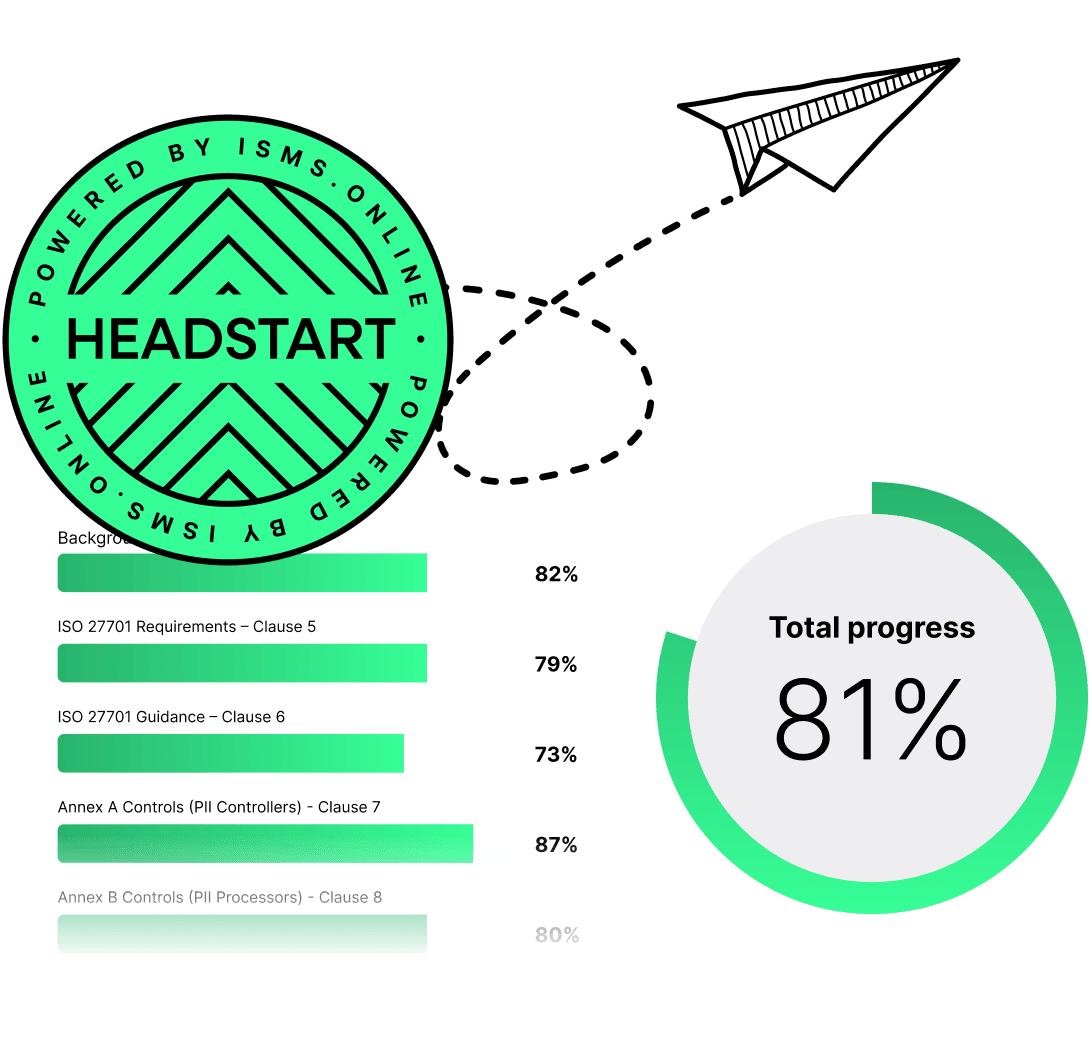
An 81% Headstart from day one
We’ve done the hard work for you, giving you an 81% Headstart from the moment you log on. All you have to do is fill in the blanks.
General Guidance on Control 8.6
In broad terms that aren’t unique to one particular type of resource, Control 8.6 contains 7 general guidance points:
- Organisations should consider business continuity as a top priority when implementing capacity management controls, including the wholesale implementation of detective controls that flag up potential issues before they occur.
- Capacity management should be based upon the proactive functions of tuning and monitoring. Both of these elements should work in harmony to ensure that systems and business functions are not compromised.
- In operational terms, organisations should perform regular stress tests that interrogate a systems ability to cater to overall business needs. Such tests should be formulated on a case-by-case basis and be relevant to the area of operation that they are targeted at.
- Capacity management controls should not be limited to an organisation’s current data or operational needs, and should include any plans for commercial and technical expansion (both from a physical and digital perspective) in order to remain as future-proof as is realistically possible.
- Expanding organisational resources is subject to varying lead times and costs, depending on the system or business function in question. Resources that are more expensive and more difficult to expand should be subject to a higher degree of scrutiny, in order to safeguard business continuity.
- Senior Management should be mindful of single points of failure relating to a dependency on key personnel or individual resources. Should any difficulties arise with either of these factors, it can often lead to complications that are markedly more difficult to rectify.
- Formulate a capacity management plan that deals specifically with business critical systems and business functions.
Guidance – Managing Demand
27002:2022-8.6 advocates for an dual-fronted approach to capacity management that either increases capacity, or reduces demand upon a resource, or set of resources.
When attempting to increase capacity, organisations should:
- Consider hiring new employees to carry out a business function.
- Purchase, lease or rent new facilities or office space.
- Purchase, lease or rent additional processing, data storage and RAM (either on-premise or cloud-hosted).
- Consider using elastic and scalable cloud resources that expand with the computational needs of the organisation, with minimal intervention.
When attempting to reduce demand, organisations should:
- Delete obsolete data to free up storage space on servers and attached media.
- Securely dispose of any hard copies of information that the organisation no longer needs, and is not legally required to obtain, either by law or via a regulatory body.
- Decommission any ICT resources, applications or virtual environments that are no longer required.
- Scrutinise scheduled ICT tasks (including reports, automated maintenance functions and batch processes) to optimise memory resources and reduce the storage space taken up by outputted data.
- Optimise any application code or database queries that are run on a regular enough basis to have an effect on the organisation’s operational capacity.
- Limit the amount of bandwidth that is allocated to non-critical activities within the boundaries of the organisation’s network. This can include restricting Internet access and preventing video/audio streaming from work devices.

Manage all your compliance, all in one place
ISMS.online supports over 100 standards and regulations, giving you a single platform for all your compliance needs.
Changes and Differences from ISO 27002:2013
27002:2022-8.6 replaces 27002:2013-12.1.3 (Capacity management).
27002:2022-8.6 contains a far more comprehensive set of guidelines that instruct organisations on how to either increase capacity or reduce demand.
Further to this, 27002:2013-12.1.3 contains no specific guidance on how to increase capacity, in contrast to 27002:2022-8.6 that outlines specific courses of action that lead to more operational breathing space.
27002:2013-12.1.3 also contains no guidance on how to stress test operational capacity, or otherwise audit an organisation’s ability to manage capacity on an ongoing basis, outside of recommending a capacity management plan.
In accordance with the meteoric rise of cloud computing over the past decade, 27002:2022-8.6 is explicit in its advice to organisations to use cloud-based resources that automatically scale with business requirements.
27002:2013-12.1.3 makes no such mention of off site storage or compute facilities.
New ISO 27002 Controls
| ISO/IEC 27002:2022 Control Identifier | ISO/IEC 27002:2013 Control Identifier | Control Name |
|---|---|---|
| 5.7 | NEW | Threat intelligence |
| 5.23 | NEW | Information security for use of cloud services |
| 5.30 | NEW | ICT readiness for business continuity |
| 7.4 | NEW | Physical security monitoring |
| 8.9 | NEW | Configuration management |
| 8.10 | NEW | Information deletion |
| 8.11 | NEW | Data masking |
| 8.12 | NEW | Data leakage prevention |
| 8.16 | NEW | Monitoring activities |
| 8.23 | NEW | Web filtering |
| 8.28 | NEW | Secure coding |
| ISO/IEC 27002:2022 Control Identifier | ISO/IEC 27002:2013 Control Identifier | Control Name |
|---|---|---|
| 6.1 | 07.1.1 | Screening |
| 6.2 | 07.1.2 | Terms and conditions of employment |
| 6.3 | 07.2.2 | Information security awareness, education and training |
| 6.4 | 07.2.3 | Disciplinary process |
| 6.5 | 07.3.1 | Responsibilities after termination or change of employment |
| 6.6 | 13.2.4 | Confidentiality or non-disclosure agreements |
| 6.7 | 06.2.2 | Remote working |
| 6.8 | 16.1.2, 16.1.3 | Information security event reporting |
| ISO/IEC 27002:2022 Control Identifier | ISO/IEC 27002:2013 Control Identifier | Control Name |
|---|---|---|
| 7.1 | 11.1.1 | Physical security perimeters |
| 7.2 | 11.1.2, 11.1.6 | Physical entry |
| 7.3 | 11.1.3 | Securing offices, rooms and facilities |
| 7.4 | NEW | Physical security monitoring |
| 7.5 | 11.1.4 | Protecting against physical and environmental threats |
| 7.6 | 11.1.5 | Working in secure areas |
| 7.7 | 11.2.9 | Clear desk and clear screen |
| 7.8 | 11.2.1 | Equipment siting and protection |
| 7.9 | 11.2.6 | Security of assets off-premises |
| 7.10 | 08.3.1, 08.3.2, 08.3.3, 11.2.5 | Storage media |
| 7.11 | 11.2.2 | Supporting utilities |
| 7.12 | 11.2.3 | Cabling security |
| 7.13 | 11.2.4 | Equipment maintenance |
| 7.14 | 11.2.7 | Secure disposal or re-use of equipment |
How ISMS.online Helps
ISO 27002 implementation is simpler with our step-by-step checklist that guides you through the whole process. Your complete compliance solution for ISO/IEC 27002:2022.
- Up to 81% progress from when you log in
- Simple and total compliance solution
Get in touch today to book a demo.