





































ISO 27013: Where True Integration Ends the Compliance Bottleneck
Most compliance programmes promise structure; few actually deliver harmony across information security and IT service operations. ISO 27013 is the standard designed to end the disorder, bringing together your Information Security Management System (ISMS) and IT Service Management (ITSM) in one unified, PDCA-powered engine.
| Fragmented Approach | ISO 27013 Unified Model |
|---|---|
| Manual evidence duplication | Consolidated proof in a single dashboard |
| Multiple owner confusion | Clear role and task assignment |
| Lost time before audits | Real-time readiness all year |
Why Should Leaders Target ISO 27013 Now?
The rapid evolution of regulatory requirements exposes weaknesses in fragmented approaches—redundant policies, duplicated evidence, and audit changes that catch teams unprepared. An integrated framework is more than a checkbox. It’s the basis for showing your board a living system, not a patchwork.
- Shape a single source for controls, risk, policies, and evidence.
- Close the loop on operational blind spots that consume cycles and budget.
- Achieve measurable improvements in audit cycle time and operational integrity.
Your peers operating under ISO 27013 frameworks are reporting more predictable audits and lower compliance costs while unlocking bandwidth for true strategic projects.
Book a demoPDCA Cycle: The Mechanism Behind Continuous Progress
The Plan-Do-Check-Act loop is not a ritual—it’s how your systems stay relevant no matter how fast risks change or regulations update. When your team moves from static checklists to real-time improvement cycles, compliance becomes a byproduct of daily operations.
How Does PDCA Change Your Compliance Reality?
Every effectiveness gain starts with a specific action against risk.
Plan: Identify applicable requirements for both ISMS and ITSM, then assign them to verifiable, named controls across your teams.
Do: Deploy those requirements using standardised tasks, built-in reminders, and mapped evidence capture that’s available for every stakeholder—no more “who last updated this?”
Check: Conduct real audits with up-to-date statistics; audit fatigue disappears when every process is evidence-backed.
Act: Automate corrective action logging so every gap is closed, captured, and rolled into your operational history.
Improvement is what you track, not what you hope for at the next audit.
Leaders using integrated cycles unlock transparency, shut down evidence chases, and build a naturally auditable system.
ISO 27001 made easy
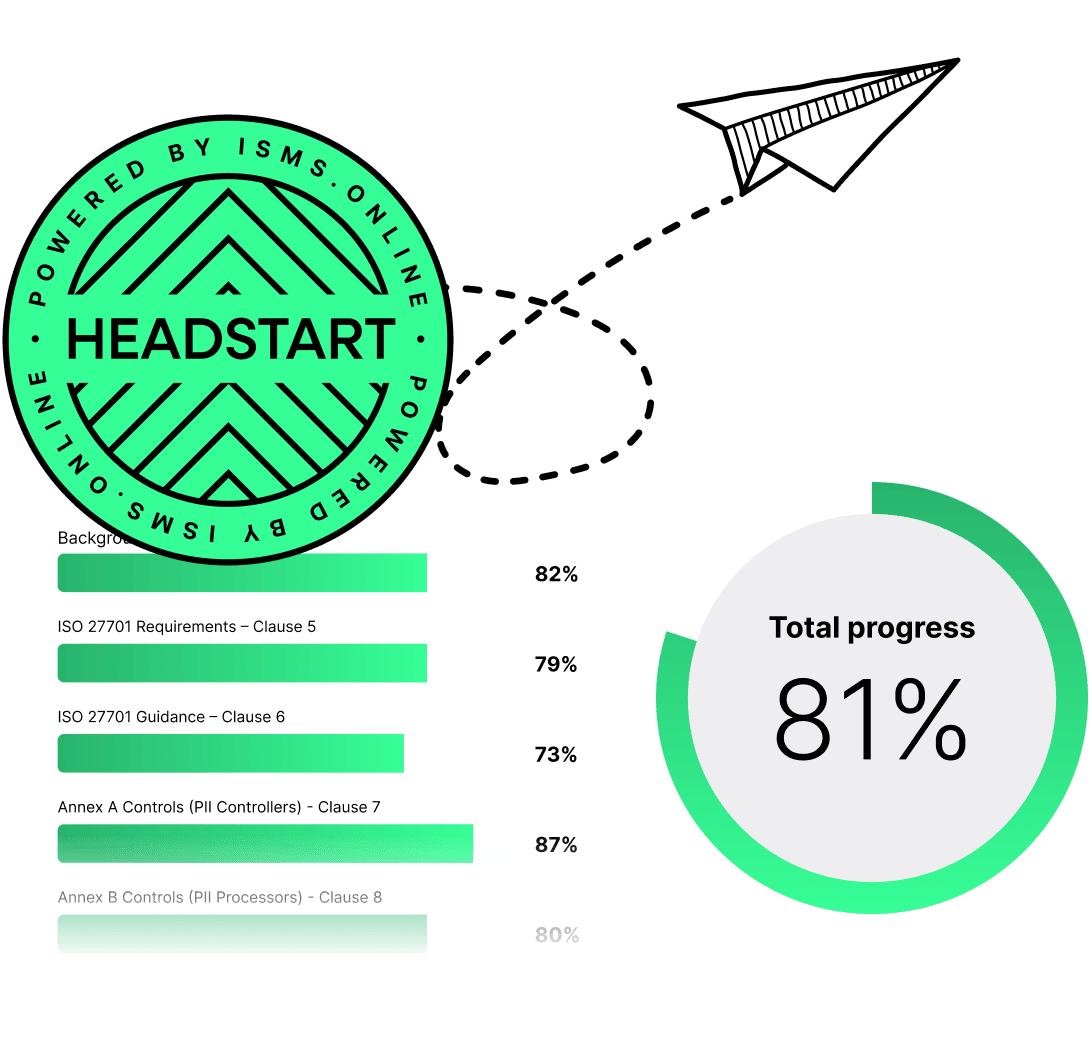
An 81% Headstart from day one
We’ve done the hard work for you, giving you an 81% Headstart from the moment you log on. All you have to do is fill in the blanks.
Constructing the Unified Management Framework: No More Siloed Controls
What separates operationally mature teams from laggards is a system where policy, risk, control ownership, and evidence are not just documented—they’re interconnected in real time.
What Building Blocks Support Lasting Integration?
- Policies and Controls: Instead of copying between formats, create policies that serve ISMS and ITSM simultaneously; edits cascade across all linked compliance elements.
- Risk Assessment Tools: Real-time risk dashboards prioritise cross-domain threats by impact, giving every control practical context.
- Evidence Management: Centralised evidence ensures nothing gets lost in file shares or email chains. Compliance Officers and IT Managers can both see, assign, and verify actions.
- Access and Role Mapping: Permission-based dashboards show each user only their relevant responsibilities and required tasks.
Integration Operationalization
- Align policy actions to evidence and audit trails with traceable logs.
- Sync role assignments and task reminders based on active user activity, not static monthly schedules.
Every disconnect in your current system is a gap an auditor will probe. Integrated frameworks don’t just minimise these—they make them visible and actionable.
The Payoff of True Integration
Leaders who transition from fragmented to ISO 27013-aligned governance realise benefits that go beyond compliance paperwork.
What Do You Actually Measure?
- Reduced Time to Audit Readiness: Median 30% drop in prep hours; every piece of evidence is one click away.
- Improved Accountability: Fewer roles, clearer assignment, and zero duplication means you can answer “who owns this?” at audit speed.
- Optimised Cost: Eliminate external consulting spend with in-house visibility and automation.
- Custom Reporting: Generate executive summaries and board-facing risk metrics without translation or generalisation.
You’re not ready when the forms are printed. You’re ready when leadership can see gaps before they widen.
Direct ROI Table
| Measured Gain | Average Reported Improvement |
|---|---|
| Audit readiness time | 30–40% faster |
| Evidence duplication | 25–50% less |
| Consultant spend | 20–40% reduced |
| Executive confidence | Unlocked with real-time stats |
The competitive edge is simplicity that scales and clarity your board can bank on.

Free yourself from a mountain of spreadsheets
Embed, expand and scale your compliance, without the mess. IO gives you the resilience and confidence to grow securely.
Accelerating Progress: Real Continuous Improvement With ISO 27013
When continuous improvement is systemized—not left to chance—teams experience incremental, compounding ROI in both compliance and business velocity.
What Are The Steps That Move You Past Compliance Fatigue?
- Regular PDCA Loops: Embed cycles into workflows so feedback and change never stall on “quarterly review.”
- Integrated Audit Practices: Leverage always-on performance metrics, not static audit day checklists.
- Corrective Action Tracing: Every issue automatically triggers logging, resolution, and re-testing so you close process loops faster.
Evolving With Your Environment
- Adjust for regulatory shifts instantly across all mapped processes.
- Roll out changes to all teams with a single update, logging every acceptance and impact.
- Verify that new controls deliver measurable risk reduction through built-in analytics.
As your organisation expands, ISO 27013’s logic follows—never scrambling to patch workflows or update compliance silos under pressure.
Calculating Value: Tangible Benefits for Compliance Leaders
Some investments show up as “soft gains.” Integrated compliance doesn’t. Outcomes are measured across risk, time, cost, and accountability—every value point supporting your reputation as a leader with a system that doesn’t just claim audit-readiness, but proves it.
Which Metrics Move the Needle?
- 25–40% less time spent in mock audits and pre-boarding exercises.
- 3x reduction in duplicated evidence and policy mapping efforts.
- Real-time audit readiness instead of last-minute chaos.
- Board-facing trust: dashboards, live KPIs, and risk summaries that cut through the noise.
Boards don’t want reassurances—they want evidence. Integrated systems give both, every day of the year.
Metrics Table
| Metric | Non-Integrated Avg | ISO 27013-Driven Avg |
|---|---|---|
| Days to compile audit pack | 18 | 7 |
| Redundant evidence submission rate | 1 in 3 | 1 in 10 |
| External consultant utilisation (annual cost) | £12,000 | £7,000 |
| Board KPI alignment (measured on live dashboards) | Monthly | Instantly |
The only credible defence against shifting risks and regulatory tides is a compliance system that never falls behind—and shows its work.

Manage all your compliance, all in one place
ISMS.online supports over 100 standards and regulations, giving you a single platform for all your compliance needs.
Tactical Solutions to Overcome Modern Compliance Obstacles
Challenges in compliance aren’t isolated to “busy work.” They manifest as missed risks, late audits, and operational drag. Solving them requires explicit action and visibility—not more theory.
Your Next Steps to Unifying Compliance, Risk, and Evidence
- Centralization: Merge all compliance functions—policy, risk, evidence—into one role-accessible system. Reduce audit prep from weeks to days.
- Intelligent Automation: Rule-based reminders, real-time status tracking, and dashboard views let every stakeholder see what matters and what’s next.
- Clarity Over Compliance Jargon: Reduce jargon fatigue with clause-by-clause explanations, in-platform help, and pre-written, auditor-validated policies.
- Evidence Mapping: Connect every task, policy, and risk assignment directly to current evidence—and surface what’s missing at all times.
The Antidote: Systematic Process Enhancement
- Assign owners and deadlines dynamically based on urgency and operational impact.
- Deploy proactive reporting to leadership so silent risks are surfaced before they become findings.
These aren’t abstract “efficiencies”—they’re reductions in downtime, audit rework, and reputational exposure. Teams who act on these principles shift from compliance headache to compliance advantage.
Lead the Standard: Position Your Organisation Years Ahead
ISO 27013 is the blueprint for compliance architecture that supports scale—not just today’s certifications, but tomorrow’s acquisitions, geographic expansions, and regulatory waves.
Regulators react. Leaders prepare in advance.
By adopting a unified ISMS + ITSM management system now, your organisation earns the reputation of being not just audit-ready, but audit-resilient. ISMS.online is architected to make that transition seamless. You become recognised for dominance in compliance—teams that always know who owns what, and leadership that compresses audit cycles for any standard you adopt.
Step to the place where others chase audit deadlines—you set them. Unlock systems that scale with your reputation and ambition.
Frequently Asked Questions
What is ISO 27013 and how does it shift your compliance baseline?
ISO 27013 establishes an integrated foundation by aligning your information security and IT service management efforts through one continuous framework. Instead of duplicating policies or chasing after split audit trails, you build a single operational system where risk, evidence, and procedures connect via the PDCA cycle. This standard isn’t about checking an extra box—it’s about engineering a traceable, live compliance environment that raises your organisation’s credibility with every audit.
By using ISO 27013, your organisation moves past the tangle of disjointed platforms. Accountabilities become clear, gaps are surfaced early, and the pressure of reactivity fades as compliance becomes an embedded practice. Adopting this standard gives you confidence that your internal controls, third-party relationships, and business continuity measures stand ready not just for certification, but for the next risk or surprise audit.
How does this impact your bottom line?
- You coordinate all risk and service policies in a single structure, ending the confusion of “who owns what.”
- Documentation builds automatically, with fewer handoffs and no more scrambling for missing records.
- Audit trails are always at hand, eliminating the cycle of last-minute document recovery or “shadow” controls.
| Fragmented Compliance | ISO 27013 Unified System |
|---|---|
| Duplicated policies | One control, many roles |
| Hidden gaps | Live monitoring |
| Audit scramble | Continuous readiness |
What’s engineered into the baseline today becomes your edge in tomorrow’s audit.
How does the PDCA cycle in ISO 27013 transform your operational reliability?
Think of the PDCA (Plan-Do-Check-Act) cycle as your organisation’s ongoing tune-up—not a one-off fix. Every cycle, you purposely set risk priorities, assign owners, deploy controls, and—crucially—close feedback with real evidence. This structure means you spot issues before a certification slips away, and you stand ready for oversight with confidence, not fear.
Decoding the PDCA Cycle:
- Plan: Your policies and objectives are harmonised across ISMS and ITSM. You assign precise accountabilities for evidence, ownership, and review.
- Do: Controls are rolled out with prompts and escalation logic built in, so nothing stalls unnoticed.
- Check: Audits shift from sporadic headaches to always-on health checks, with dashboards surfacing risks in real time.
- Act: Corrective actions happen at the moment of discovery, captured in an auditable stream that proves your system adapts to every threat and requirement.
Organisations using ISO 27013 report faster prep cycles, better audit outcomes, and leadership that knows where things stand even in the face of supplier or regulatory change.
Reliability is set by your system, not by hoping your team will patch gaps under deadline.
What are the most essential elements of a unified ISMS/IMS under ISO 27013?
The value in ISO 27013 isn’t just the promise of integration—it’s the engineering of every compliance-critical part into a system that stands up under scrutiny. You rely on:
- A unified, version-controlled policy library: that eliminates duplication and tracks every update.
- A consolidated risk register: so every risk is visible, owned, and traceable.
- A single evidence vault: for all documentation, certifications, and attestations—no more lost records.
- An at-a-glance Statement of Applicability (SoA): for fast control coverage reviews and regulator-ready documentation.
- Granular, role-based permissions: so responsibility never blurs or drops out of sight.
The result? When an auditor or board member challenges your readiness, your response isn’t anecdotal. Every policy, test, and fix is logged—and tied to a real person in your chain of command.
What’s the new expectation?
You don’t just survive audits; you lead with insight, using that same infrastructure to anticipate, report, and support growth—no matter how regulations or services expand.
Why is integrating ISMS with service management now essential for your organisation’s velocity and trust?
Every disconnect between security and IT service management multiplies resource waste, blind spots, and audit risk. ISO 27013 erases this inefficiency by building a compliance lattice where improvement is a shared goal and every control is multi-purpose. If your IT team and your security lead are running on different tracks, the risk isn’t just missed detail—it’s forgotten gaps that stay invisible until they’re public.
Here’s why unity matters:
- Reduced redundancy: By combining security and ITSM, every process serves multiple priorities, shrinking workload.
- Stronger governance: Live dashboards reveal status at-a-glance, so you don’t find out about issues from your auditor or the press.
- Compounded ROI: Instead of adding more people or vendors as the business grows, you build a responsive, learning system that scales without proportional headcount.
| Issue | Fragmented | Unified (ISO 27013) |
|---|---|---|
| Policy overload | High | Low |
| Risk registers | Multiple | Single, linked |
| Real-time accountability | Undercut | Embedded |
A single integrated approach signals to clients and partners that your company is built for growth and reliability—key markers of leadership in regulated industries.
Connected systems do more than pass audits; they build the credibility that wins contracts and earns long-term trust.
How can you harness the PDCA cycle for continuous improvement with ISO 27013?
When systems run in loops, progress becomes predictable—not just a lucky break. Under ISO 27013, every cycle through Plan-Do-Check-Act locks in concrete gains in risk posture, evidence completeness, and audit defensibility.
Application in practice:
- Plan: Set objectives in lockstep with emerging risks, threats, and business updates.
- Do: Execute controls with reminders and escalations so every action is backed up—nothing is forgotten.
- Check: Real-time dashboards eliminate the lag between action and insight, minimising the chance for error to creep.
- Act: Improvements are systematised, not left to chance, so auditors recognise maturity rather than disorder.
Integrating continuous improvement doesn’t just reduce your exposure—it raises your internal reputation and the confidence of leaders betting their careers on operational integrity.
Table: Continuous Improvement Outcomes
| Phase | Old Model | PDCA + ISO 27013 |
|---|---|---|
| Audit | Reactive, stressed | Proactive, managed |
| Gap Fix | Slow, ad hoc | Fast, system-driven |
| Value | Unclear, temporary | Traceable, sustained |
If you don’t systemize improvement, you incentivize drift. Integrated processes build a future where audits are predictable, not feared.
What direct and measurable benefits can you expect from ISO 27013?
Quantifying results isn’t abstract—and with ISO 27013, the numbers speak:
- Prep cycles trimmed by 30–50%.: Documentation and evidence are live, linked, and role-assigned, which eliminates prep marathons and panicked searches.
- Audit pass rates up.: First-pass success grows as errors and missed details shrink—live SoAs and evidence repositories make proof automatic.
- Resource multiplier effect.: Instead of stacking headcount or external consultants, your team manages more standards and services with the same footprint.
- Stakeholder assurance.: Your board, your clients, and your suppliers recognise readiness before incidents happen.
| Metric | Before Integration | After ISO 27013 |
|---|---|---|
| Audit prep hours | 180+ | <100 |
| Missed evidence findings | 4+ | <1 |
| Unowned risks | Dozens | Tracked, owned |
| Supplier compliance delay | Weeks | Days |
Identity flows from proof, not promotion: when you lead with outcome-centric data, reputation is a byproduct of system structure.
How do industry leaders overcome complex compliance roadblocks with ISO 27013?
Complexity isn’t beaten by brute force. Leaders using ISO 27013 consolidate, automate, and assign proof—so the system carries more of the compliance weight than individuals or last-minute initiatives ever could.
Overcoming bottlenecks:
- Centralization: Move all compliance tracking, policy, and evidence into unified, permission-based systems. Say goodbye to file sprawl, data loss, and version confusion.
- Live alerts and escalation: Automated assignment, notification, and role-mapping mean gaps get handled the day they appear, not months later.
- Role clarity: Handovers, departures, or role changes don’t sink accountability. The system drives who owns what, and when.
- Routine scenario drills: Instead of audit drills, you’re running real-world incident and change tests, with outcomes auto-logged for future proof.
Operational discipline becomes your culture—not a seasonal strain—while regulatory shifts or new service lines become internal wins, not shocks.
Organisations that treat compliance as a baseline function position themselves for controlled growth in any regulatory environment. Audit resilience is the difference between survival and sustained leadership.






