














ISO 27002 Control 7.8: Best Practices for Equipment Siting and Protection
While cyber threats such as malware attacks, SQL injection, and traffic interception are becoming more sophisticated and pose a great risk to the security of information assets.
The risk landscape is not limited to software-based cyber attacks:
- Physical and environmental threats to IT equipment such as servers, computers, hard drives, and removable storage media may also compromise the availability, confidentiality, and integrity of information assets.
For example, spillage of a drink onto a server, a shutdown of a computer system due to high temperature, and unauthorised access to a computer system not located in a secure area are all examples of physical threats to equipment housing information assets.
Control 7.8 addresses how organisations can eliminate and mitigate risks arising out of physical and environmental threats to equipment hosting information assets.
Purpose of Control 7.8
Control 7.8 enables organisations to eliminate and/or mitigate two types of risks to equipment containing information assets:
- Physical and environmental threats to equipment such as lighting, power outages, theft, communications interference, and electrical interference. These threats also include changes in environmental conditions like humidity and temperature levels that may disrupt the information processing activities.
- Unauthorised access to, use of, damage to, and destruction of equipment that are not stored in secure areas.
Attributes Table of Control 7.8
Control 7.8 is a preventive type of control that requires organisations to maintain the integrity, availability, and confidentiality of information assets by protecting equipment containing information assets against physical and environmental threats.
| Control Type | Information Security Properties | Cybersecurity Concepts | Operational Capabilities | Security Domains |
|---|---|---|---|---|
| #Preventive | #Confidentiality | #Protect | #Physical Security | #Protection |
| #Integrity | #Asset Management | |||
| #Availability |
ISO 27001 made easy
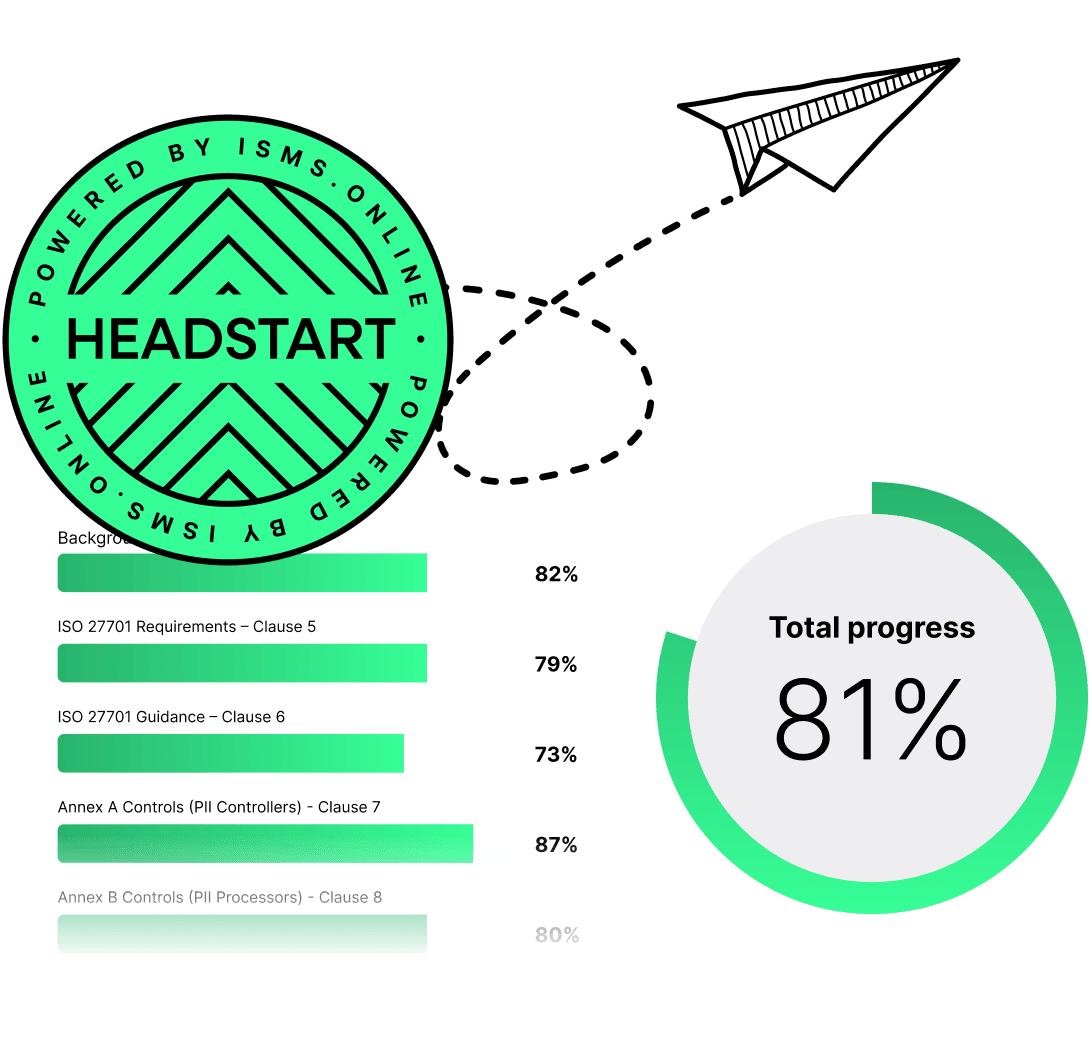
An 81% Headstart from day one
We’ve done the hard work for you, giving you an 81% Headstart from the moment you log on. All you have to do is fill in the blanks.
Ownership of Control 7.8
Compliance with Control 7.8 entails the creation of an inventory of equipment hosting information assets, siting of all equipment in secure areas and implementation of appropriate measures to prevent physical and environmental threats.
Therefore, information security managers should be responsible for establishing, implementing, and maintaining necessary measures and guidelines on secure siting and protection of equipment.
General Guidance on Compliance
Control 7.8 prescribes nine specific requirements that should be taken into account for compliance:
- Equipment should be sited in secure areas so that unauthorised persons cannot gain access to equipment.
- Tools used for processing sensitive information such as computers, monitors, and printers should be positioned in a way that unauthorised persons cannot see information displayed on screens without permission.
- Appropriate measures should be put in place to eliminate and/or mitigate risks arising out of physical and environmental threats such as explosives, communications interferences, fire, dust, and electromagnetic radiation.
- For example, a Lightning rod can be an effective control against lightning strikes.
- Guidelines on eating and drinking around equipment should be established and communicated to all relevant parties.
- Environmental conditions that may disrupt the information processing operations should be continuously monitored. These may include temperature and humidity levels.
- Lightning protection mechanisms should be implemented in all buildings and offices. Furthermore, lightning protection filters should be built into all incoming power lines, including communication lines.
- If equipment is located in an industrial environment, special protection controls such as keyboard membranes should be used if needed.
- Electromagnetic emanation may result in the leakage of sensitive information. Therefore, equipment housing sensitive or critical information assets should be secured to prevent such risk.
- IT equipment owned and controlled by an organisation should be clearly segregated from those not owned and controlled by the organisation.

Manage all your compliance, all in one place
ISMS.online supports over 100 standards and regulations, giving you a single platform for all your compliance needs.
Changes and Differences from ISO 27002:2013
27002:2022/7.8 replaces 27002:2013/(11.2.1)
While the 2022 and the 2013 versions are similar to a great extent, there is one key difference to be highlighted:
In contrast to the 2013 Version, Control 7.8 in 2022 Version introduces the following requirement:
- IT equipment owned and controlled by an organisation should be clearly segregated from those not owned and controlled by the organisation.
New ISO 27002 Controls
| ISO/IEC 27002:2022 Control Identifier | ISO/IEC 27002:2013 Control Identifier | Control Name |
|---|---|---|
| 5.7 | NEW | Threat intelligence |
| 5.23 | NEW | Information security for use of cloud services |
| 5.30 | NEW | ICT readiness for business continuity |
| 7.4 | NEW | Physical security monitoring |
| 8.9 | NEW | Configuration management |
| 8.10 | NEW | Information deletion |
| 8.11 | NEW | Data masking |
| 8.12 | NEW | Data leakage prevention |
| 8.16 | NEW | Monitoring activities |
| 8.23 | NEW | Web filtering |
| 8.28 | NEW | Secure coding |
| ISO/IEC 27002:2022 Control Identifier | ISO/IEC 27002:2013 Control Identifier | Control Name |
|---|---|---|
| 6.1 | 07.1.1 | Screening |
| 6.2 | 07.1.2 | Terms and conditions of employment |
| 6.3 | 07.2.2 | Information security awareness, education and training |
| 6.4 | 07.2.3 | Disciplinary process |
| 6.5 | 07.3.1 | Responsibilities after termination or change of employment |
| 6.6 | 13.2.4 | Confidentiality or non-disclosure agreements |
| 6.7 | 06.2.2 | Remote working |
| 6.8 | 16.1.2, 16.1.3 | Information security event reporting |
| ISO/IEC 27002:2022 Control Identifier | ISO/IEC 27002:2013 Control Identifier | Control Name |
|---|---|---|
| 7.1 | 11.1.1 | Physical security perimeters |
| 7.2 | 11.1.2, 11.1.6 | Physical entry |
| 7.3 | 11.1.3 | Securing offices, rooms and facilities |
| 7.4 | NEW | Physical security monitoring |
| 7.5 | 11.1.4 | Protecting against physical and environmental threats |
| 7.6 | 11.1.5 | Working in secure areas |
| 7.7 | 11.2.9 | Clear desk and clear screen |
| 7.8 | 11.2.1 | Equipment siting and protection |
| 7.9 | 11.2.6 | Security of assets off-premises |
| 7.10 | 08.3.1, 08.3.2, 08.3.3, 11.2.5 | Storage media |
| 7.11 | 11.2.2 | Supporting utilities |
| 7.12 | 11.2.3 | Cabling security |
| 7.13 | 11.2.4 | Equipment maintenance |
| 7.14 | 11.2.7 | Secure disposal or re-use of equipment |
How ISMS.online Helps
Our platform is intuitive and easy-to-use. It’s not just for highly technical people; it’s for everyone in your organisation. We encourage you to involve staff at all levels of your business in the process of building your ISMS, because that helps you to build a truly sustainable system.
Some of the key benefits of using ISMS.online include:
- You can build your ISO 27001 compliant ISMS within the platform.
- Users can complete tasks and submit evidence to demonstrate compliance with the standard.
- It’s easy to delegate responsibilities and monitor progress towards compliance.
- The extensive risk assessment toolset saves time and effort throughout the process.
- We have a dedicated team of consultants on hand to support you throughout your journey to compliance.
Get in touch today to book a demo.