














ISO 27001:2022 Annex A 8.32 (Change management) is the control that puts changes to information processing facilities and information systems through defined change management procedures. Each change is assessed for impact, authorised, communicated, tested, deployed with a fall-back plan and recorded, so that information security holds while systems change.
What is change management in ISO 27001 Annex A 8.32?
In an information security management system, change management is the controlled way an organisation proposes, assesses, approves, tests, implements and records changes to its systems and facilities. Its aim is to stop a change from weakening the confidentiality, integrity or availability of the information those systems hold or process.
Changes to information systems, such as replacing a network device, creating a new database instance or upgrading software, are often needed to improve performance, reduce costs and work more efficiently. If they are not carried out correctly, they can put the data stored or processed in those systems at risk.
ISO 27001:2022 Annex A 8.32 covers how organisations set up and run change management procedures to monitor, review and manage changes to their information processing facilities and systems.
What is the purpose of Annex A 8.32?
This page explains the ISO 27001 requirement. For the supporting implementation guidance, see our page on ISO 27002 control 8.32 change management.
Who owns Annex A 8.32?
ISO 27002 does not name a single role as the owner of 8.32. It asks for management responsibilities and procedures to be in place so that every change is properly controlled. A practical choice is for the Chief Information Security Officer (or whoever leads information security), working with domain experts, to design and enforce change control procedures that apply at every stage of the information system life cycle.
What does Annex A 8.32 require?
New systems, and major changes to existing ones, need agreed rules and a formal process: the change is documented and specified, then goes through testing, quality control and a managed implementation.
Where practical, organisations should run one joined-up set of change control procedures for software and ICT infrastructure.
The ISO 27002:2022 guidance for 8.32 lists nine components the change management procedure should include:
- Impact assessment: plan each proposed change and assess its likely effect, taking every dependency into account.
- Authorisation: make sure each change is approved by the appropriate person before it goes ahead.
- Communication: tell the relevant internal and external interested parties about the change.
- Testing: test the change and get the test results accepted, in line with Annex A 8.29 (security testing in development and acceptance).
- Deployment: implement the change following a deployment plan.
- Fall-back: plan for emergencies and contingencies, including a procedure for rolling the change back.
- Records: keep a record of every change and its linked activities, covering steps 1 to 6 above.
- Documentation review: update operating documentation (Annex A 5.37) and user procedures wherever the change leaves them out of date.
- ICT continuity update: review ICT continuity plans and the related response and recovery procedures (Annex A 5.30), and update them where the change affects them.
What does the supplementary guidance add?
ISO 27002 notes that poor control of changes to systems and facilities is a frequent cause of system and security failures. Changes to the production environment, which includes operating systems, databases and middleware, can affect the integrity and availability of applications, particularly when software moves from development into live use. Changes to software can also affect the production environment, and the other way round.
Good practice is to test ICT components in an environment kept separate from both development and production (Annex A 8.31). This gives the organisation control over new software and extra protection for any operational information used in testing, and it should apply to patches, service packs and other updates too.
The control applies to changes to applications and to infrastructure alike.
ISO 27001 made easy
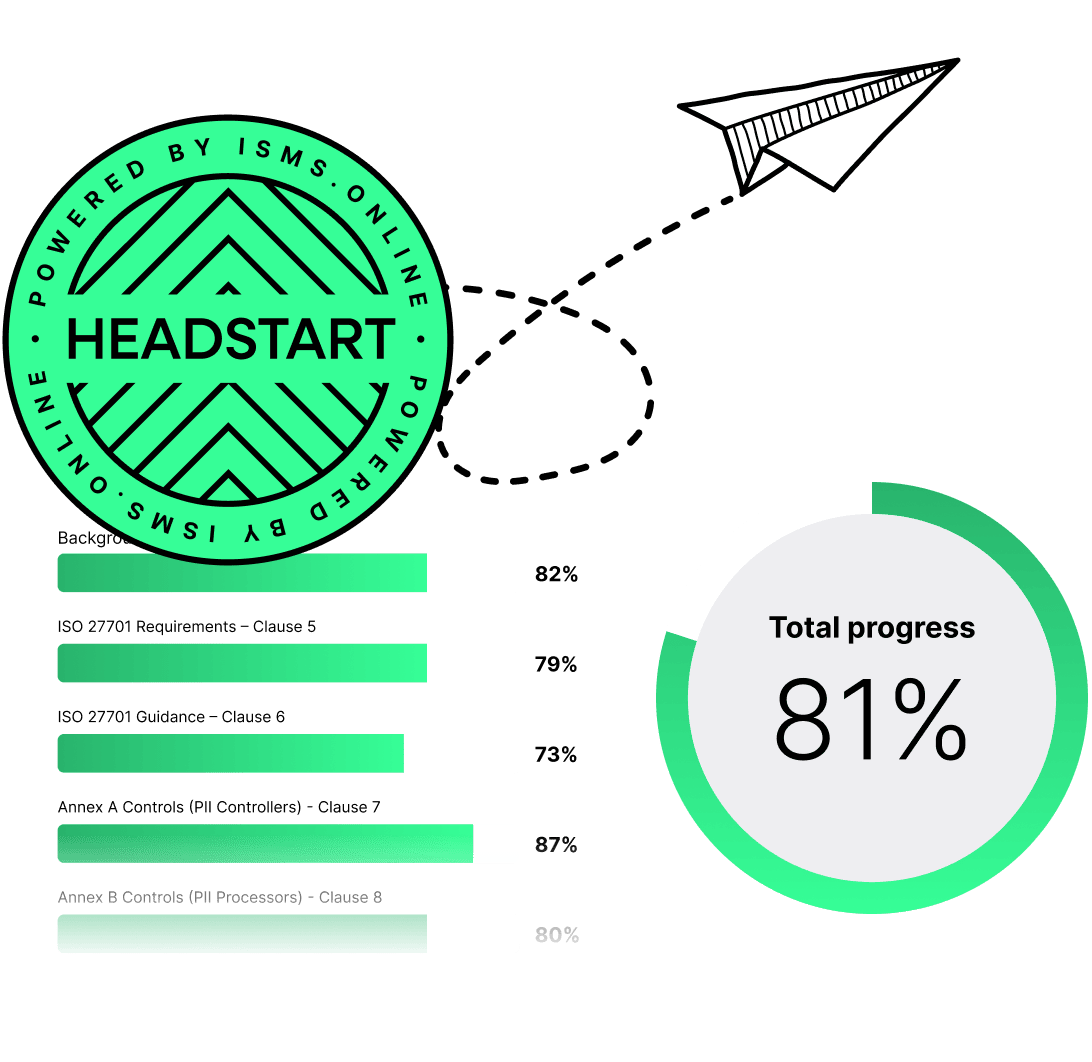
An 81% Headstart from day one
We’ve done the hard work for you, giving you an 81% Headstart from the moment you log on. All you have to do is fill in the blanks.
What should an ISO 27001 change management policy include?
Annex A 8.32 asks for documented change control procedures; it does not require a document called a change management policy. If you choose to write one to set the rules your procedures follow, this outline covers the points the control, its guidance and related controls raise:
- Purpose and scope: which information systems and processing facilities the policy covers (applications and infrastructure), and that new systems are in scope as well as changes to existing ones.
- Roles and responsibilities: who owns the process and who can raise, authorise and implement a change.
- The change procedure: the nine components above, from impact assessment through to the ICT continuity update.
- Security requirements: how security requirements are identified and approved when a change adds or alters an application (see application security requirements Annex A 8.26).
- Testing rules: where changes are tested, who accepts the results, and how test environments are kept separate (Annex A 8.29 and 8.31).
- Emergency changes and fall-back: how urgent changes are handled and how a failed change is rolled back.
- Records: what is recorded for each change and where the records are kept.
- Follow-on updates: keeping operating documentation, user procedures and ICT continuity plans in step with each change.
Changes to the information security management system itself are a separate requirement: ISO 27001:2022 clause 6.3 (planning of changes) covers those, while Annex A 8.32 covers changes to systems and facilities.
How does a change request move through the process?
The standard does not prescribe a workflow, but the nine components fit a simple sequence like this one:
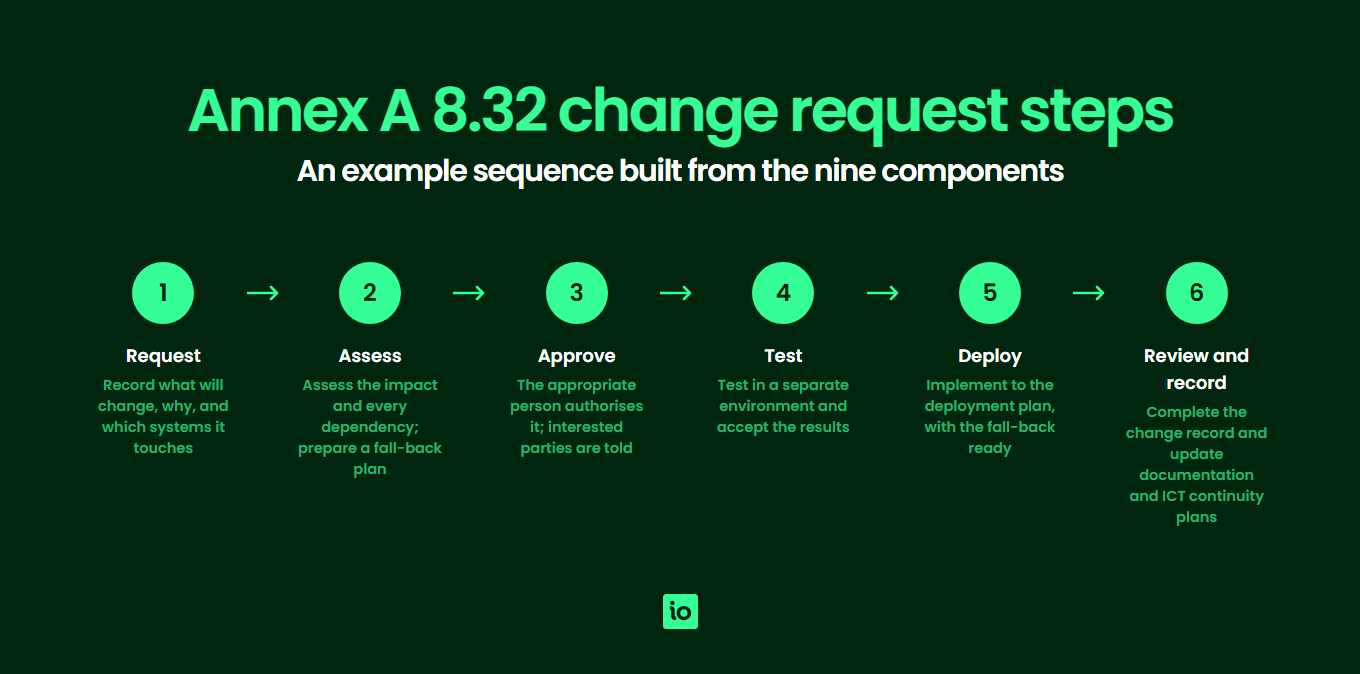
- Request: the person proposing the change records what will change, why, and which systems it touches.
- Assess: the impact and every dependency are assessed, and a fall-back plan is prepared.
- Approve: the appropriate person authorises the change, and interested parties are told about it.
- Test: the change is tested in a separate environment and the results are accepted.
- Deploy: the change is implemented to its deployment plan, with the fall-back ready.
- Review and record: the outcome is checked, the change record is completed, and operating documentation, user procedures and ICT continuity plans are updated where needed.
What do the steps look like for common changes?
The table below shows which parts of the procedure tend to matter most for some everyday changes. These are examples, not a complete list.
| Example change | What to watch for | Annex A 8.32 steps that matter most |
|---|---|---|
| Creating a new database instance | Applications and services that will depend on it; how the information in it is protected | Impact assessment across dependencies; authorisation; testing in a separate environment; records |
| Replacing a network device | Loss of availability during the switch-over; users and suppliers affected by downtime | Communication to interested parties; deployment plan; fall-back to the old device; operating documentation update |
| Upgrading software or an operating system | Applications that stop working or behave differently after the upgrade | Testing and acceptance (Annex A 8.29); fall-back; user procedure update |
| Applying patches or service packs | Unexpected effects on live systems | Testing in an environment separate from development and production (Annex A 8.31); records |
| Retiring an old server | Information left on the server; services that still rely on it | Impact assessment; authorisation; ICT continuity update; secure removal of stored data (see information deletion Annex A 8.10) |

Free yourself from a mountain of spreadsheets
Embed, expand and scale your compliance, without the mess. IO gives you the resilience and confidence to grow securely.
What changed from ISO 27001:2013?
Annex A 8.32 replaces four controls from ISO 27001:2013 (see our guide to the ISO 27001:2022 update):
- ISO 27001:2013 Annex A 12.1.2 Change management
- ISO 27001:2013 Annex A 14.2.2 System change control procedures
- ISO 27001:2013 Annex A 14.2.3 Technical review of applications after operating platform changes
- ISO 27001:2013 Annex A 14.2.4 Restrictions on changes to software packages
The 2013 control 12.1.2 applied to changes to the organisation and its business processes as well as to information processing facilities and systems. The 2022 control 8.32 is worded around information processing facilities and information systems only. There are three further differences.
Was the 2013 change procedure more detailed?
The guidance behind the 2013 controls described change control procedures in more detail than the 2022 guidance does. Both editions list what a change procedure should include without presenting the list as complete.
The 2013 guidance included points the 2022 list does not mention:
- Identify and review security-critical code to address any weaknesses.
- Organisations should maintain version control for all software changes.
- Organisations should create and record a list of hardware and software components requiring alteration and updating.
What happened to changes to operating platforms?
Annex A 14.2.3 of ISO 27001:2013 required business-critical applications to be reviewed and tested after an operating platform change, so that the change did not harm operations or security.
ISO 27001:2022 has no separate control for operating platform changes. They now fall under 8.32, which applies to changes to applications and infrastructure; its supplementary guidance names operating systems, databases and middleware as part of the production environment.
What happened to changes to software packages?
Annex A 14.2.4 of ISO 27001:2013 (Restrictions on changes to software packages) said changes to software packages should be discouraged, kept to what was necessary and tightly controlled. ISO 27001:2022 has no separate control for this; changes to software are handled through the general change management procedures in 8.32.
Where can you find every ISO 27001:2022 Annex A control?
In the table below you’ll find more information on each individual ISO 27001:2022 Annex A Control.
| Annex A Control Type | ISO/IEC 27001:2022 Annex A Identifier | ISO/IEC 27001:2013 Annex A Identifier | Annex A Name |
|---|---|---|---|
| Organisational Controls | Annex A 5.1 |
Annex A 5.1.1 Annex A 5.1.2 |
Policies for Information Security |
| Organisational Controls | Annex A 5.2 | Annex A 6.1.1 | Information Security Roles and Responsibilities |
| Organisational Controls | Annex A 5.3 | Annex A 6.1.2 | Segregation of Duties |
| Organisational Controls | Annex A 5.4 | Annex A 7.2.1 | Management Responsibilities |
| Organisational Controls | Annex A 5.5 | Annex A 6.1.3 | Contact With Authorities |
| Organisational Controls | Annex A 5.6 | Annex A 6.1.4 | Contact With Special Interest Groups |
| Organisational Controls | Annex A 5.7 | NEW | Threat Intelligence |
| Organisational Controls | Annex A 5.8 |
Annex A 6.1.5 Annex A 14.1.1 |
Information Security in Project Management |
| Organisational Controls | Annex A 5.9 |
Annex A 8.1.1 Annex A 8.1.2 |
Inventory of Information and Other Associated Assets |
| Organisational Controls | Annex A 5.10 |
Annex A 8.1.3 Annex A 8.2.3 |
Acceptable Use of Information and Other Associated Assets |
| Organisational Controls | Annex A 5.11 | Annex A 8.1.4 | Return of Assets |
| Organisational Controls | Annex A 5.12 | Annex A 8.2.1 | Classification of Information |
| Organisational Controls | Annex A 5.13 | Annex A 8.2.2 | Labelling of Information |
| Organisational Controls | Annex A 5.14 |
Annex A 13.2.1 Annex A 13.2.2 Annex A 13.2.3 |
Information Transfer |
| Organisational Controls | Annex A 5.15 |
Annex A 9.1.1 Annex A 9.1.2 |
Access Control |
| Organisational Controls | Annex A 5.16 | Annex A 9.2.1 | Identity Management |
| Organisational Controls | Annex A 5.17 |
Annex A 9.2.4 Annex A 9.3.1 Annex A 9.4.3 |
Authentication Information |
| Organisational Controls | Annex A 5.18 |
Annex A 9.2.2 Annex A 9.2.5 Annex A 9.2.6 |
Access Rights |
| Organisational Controls | Annex A 5.19 | Annex A 15.1.1 | Information Security in Supplier Relationships |
| Organisational Controls | Annex A 5.20 | Annex A 15.1.2 | Addressing Information Security Within Supplier Agreements |
| Organisational Controls | Annex A 5.21 | Annex A 15.1.3 | Managing Information Security in the ICT Supply Chain |
| Organisational Controls | Annex A 5.22 |
Annex A 15.2.1 Annex A 15.2.2 |
Monitoring, Review and Change Management of Supplier Services |
| Organisational Controls | Annex A 5.23 | NEW | Information Security for Use of Cloud Services |
| Organisational Controls | Annex A 5.24 | Annex A 16.1.1 | Information Security Incident Management Planning and Preparation |
| Organisational Controls | Annex A 5.25 | Annex A 16.1.4 | Assessment and Decision on Information Security Events |
| Organisational Controls | Annex A 5.26 | Annex A 16.1.5 | Response to Information Security Incidents |
| Organisational Controls | Annex A 5.27 | Annex A 16.1.6 | Learning From Information Security Incidents |
| Organisational Controls | Annex A 5.28 | Annex A 16.1.7 | Collection of Evidence |
| Organisational Controls | Annex A 5.29 |
Annex A 17.1.1 Annex A 17.1.2 Annex A 17.1.3 |
Information Security During Disruption |
| Organisational Controls | Annex A 5.30 | NEW | ICT Readiness for Business Continuity |
| Organisational Controls | Annex A 5.31 |
Annex A 18.1.1 Annex A 18.1.5 |
Legal, Statutory, Regulatory and Contractual Requirements |
| Organisational Controls | Annex A 5.32 | Annex A 18.1.2 | Intellectual Property Rights |
| Organisational Controls | Annex A 5.33 | Annex A 18.1.3 | Protection of Records |
| Organisational Controls | Annex A 5.34 | Annex A 18.1.4 | Privacy and Protection of PII |
| Organisational Controls | Annex A 5.35 | Annex A 18.2.1 | Independent Review of Information Security |
| Organisational Controls | Annex A 5.36 |
Annex A 18.2.2 Annex A 18.2.3 |
Compliance With Policies, Rules and Standards for Information Security |
| Organisational Controls | Annex A 5.37 | Annex A 12.1.1 | Documented Operating Procedures |
| Annex A Control Type | ISO/IEC 27001:2022 Annex A Identifier | ISO/IEC 27001:2013 Annex A Identifier | Annex A Name |
|---|---|---|---|
| People Controls | Annex A 6.1 | Annex A 7.1.1 | Screening |
| People Controls | Annex A 6.2 | Annex A 7.1.2 | Terms and Conditions of Employment |
| People Controls | Annex A 6.3 | Annex A 7.2.2 | Information Security Awareness, Education and Training |
| People Controls | Annex A 6.4 | Annex A 7.2.3 | Disciplinary Process |
| People Controls | Annex A 6.5 | Annex A 7.3.1 | Responsibilities After Termination or Change of Employment |
| People Controls | Annex A 6.6 | Annex A 13.2.4 | Confidentiality or Non-Disclosure Agreements |
| People Controls | Annex A 6.7 | Annex A 6.2.2 | Remote Working |
| People Controls | Annex A 6.8 |
Annex A 16.1.2 Annex A 16.1.3 |
Information Security Event Reporting |
| Annex A Control Type | ISO/IEC 27001:2022 Annex A Identifier | ISO/IEC 27001:2013 Annex A Identifier | Annex A Name |
|---|---|---|---|
| Physical Controls | Annex A 7.1 | Annex A 11.1.1 | Physical Security Perimeters |
| Physical Controls | Annex A 7.2 |
Annex A 11.1.2 Annex A 11.1.6 |
Physical Entry |
| Physical Controls | Annex A 7.3 | Annex A 11.1.3 | Securing Offices, Rooms and Facilities |
| Physical Controls | Annex A 7.4 | NEW | Physical Security Monitoring |
| Physical Controls | Annex A 7.5 | Annex A 11.1.4 | Protecting Against Physical and Environmental Threats |
| Physical Controls | Annex A 7.6 | Annex A 11.1.5 | Working In Secure Areas |
| Physical Controls | Annex A 7.7 | Annex A 11.2.9 | Clear Desk and Clear Screen |
| Physical Controls | Annex A 7.8 | Annex A 11.2.1 | Equipment Siting and Protection |
| Physical Controls | Annex A 7.9 | Annex A 11.2.6 | Security of Assets Off-Premises |
| Physical Controls | Annex A 7.10 |
Annex A 8.3.1 Annex A 8.3.2 Annex A 8.3.3 Annex A 11.2.5 |
Storage Media |
| Physical Controls | Annex A 7.11 | Annex A 11.2.2 | Supporting Utilities |
| Physical Controls | Annex A 7.12 | Annex A 11.2.3 | Cabling Security |
| Physical Controls | Annex A 7.13 | Annex A 11.2.4 | Equipment Maintenance |
| Physical Controls | Annex A 7.14 | Annex A 11.2.7 | Secure Disposal or Re-Use of Equipment |
| Annex A Control Type | ISO/IEC 27001:2022 Annex A Identifier | ISO/IEC 27001:2013 Annex A Identifier | Annex A Name |
|---|---|---|---|
| Technological Controls | Annex A 8.1 |
Annex A 6.2.1 Annex A 11.2.8 |
User Endpoint Devices |
| Technological Controls | Annex A 8.2 | Annex A 9.2.3 | Privileged Access Rights |
| Technological Controls | Annex A 8.3 | Annex A 9.4.1 | Information Access Restriction |
| Technological Controls | Annex A 8.4 | Annex A 9.4.5 | Access to Source Code |
| Technological Controls | Annex A 8.5 | Annex A 9.4.2 | Secure Authentication |
| Technological Controls | Annex A 8.6 | Annex A 12.1.3 | Capacity Management |
| Technological Controls | Annex A 8.7 | Annex A 12.2.1 | Protection Against Malware |
| Technological Controls | Annex A 8.8 |
Annex A 12.6.1 Annex A 18.2.3 |
Management of Technical Vulnerabilities |
| Technological Controls | Annex A 8.9 | NEW | Configuration Management |
| Technological Controls | Annex A 8.10 | NEW | Information Deletion |
| Technological Controls | Annex A 8.11 | NEW | Data Masking |
| Technological Controls | Annex A 8.12 | NEW | Data Leakage Prevention |
| Technological Controls | Annex A 8.13 | Annex A 12.3.1 | Information Backup |
| Technological Controls | Annex A 8.14 | Annex A 17.2.1 | Redundancy of Information Processing Facilities |
| Technological Controls | Annex A 8.15 |
Annex A 12.4.1 Annex A 12.4.2 Annex A 12.4.3 |
Logging |
| Technological Controls | Annex A 8.16 | NEW | Monitoring Activities |
| Technological Controls | Annex A 8.17 | Annex A 12.4.4 | Clock Synchronization |
| Technological Controls | Annex A 8.18 | Annex A 9.4.4 | Use of Privileged Utility ProgramsAccess Rights |
| Technological Controls | Annex A 8.19 |
Annex A 12.5.1 Annex A 12.6.2 |
Installation of Software on Operational Systems |
| Technological Controls | Annex A 8.20 | Annex A 13.1.1 | Networks Security |
| Technological Controls | Annex A 8.21 | Annex A 13.1.2 | Security of Network Services |
| Technological Controls | Annex A 8.22 | Annex A 13.1.3 | Segregation of Networks |
| Technological Controls | Annex A 8.23 | NEW | Web filtering |
| Technological Controls | Annex A 8.24 |
Annex A 10.1.1 Annex A 10.1.2 |
Use of Cryptography |
| Technological Controls | Annex A 8.25 | Annex A 14.2.1 | Secure Development Life Cycle |
| Technological Controls | Annex A 8.26 |
Annex A 14.1.2 Annex A 14.1.3 |
Application Security Requirements |
| Technological Controls | Annex A 8.27 | Annex A 14.2.5 | Secure System Architecture and Engineering PrinciplesLearning From Information Security Incidents |
| Technological Controls | Annex A 8.28 | NEW | Secure Coding |
| Technological Controls | Annex A 8.29 |
Annex A 14.2.8 Annex A 14.2.9 |
Security Testing in Development and Acceptance |
| Technological Controls | Annex A 8.30 | Annex A 14.2.7 | Outsourced Development |
| Technological Controls | Annex A 8.31 |
Annex A 12.1.4 Annex A 14.2.6 |
Separation of Development, Test and Production Environments |
| Technological Controls | Annex A 8.32 |
Annex A 12.1.2 Annex A 14.2.2 Annex A 14.2.3 Annex A 14.2.4 |
Change Management |
| Technological Controls | Annex A 8.33 | Annex A 14.3.1 | Test Information |
| Technological Controls | Annex A 8.34 | Annex A 12.7.1 | Protection of Information Systems During Audit Testing |
Why choose ISMS.online for Annex A 8.32?
ISMS.online gives you a ready-made home for your change management and the rest of your ISO 27001 work. It helps you:
- Start from a cloud platform with a clear structure of information security measures.
- Get an 81% Headstart from the moment you log on, so all you have to do is fill in the blanks.
- Work through your ISMS process step by step, ticking off each part as you go.
- Check your work against the ISO 27001 requirements as you progress.
- Embed, expand and scale your compliance without the mess of spreadsheets.
- Achieve certification efficiently and with minimal resources.
To see how ISMS.online can help you control changes under Annex A 8.32, book a demo.
FAQs
How is ISO 27001 Annex A 8.32 different from ISO 27002 control 8.32?
ISO 27001:2022 Annex A 8.32 is the control itself: changes to your information systems and processing facilities must follow change management procedures. ISO 27002:2022 control 8.32 is the supporting guidance on how to put that in place, including the nine components a change procedure should cover.
Who issues the ISO 27001 certificate?
No. ISMS.online helps you achieve certification efficiently. The certificate itself is issued by an accredited certification body.