













ISO 27001:2022 Annex A 5.19 (Information security in supplier relationships) is a preventive control that asks an organisation to run processes and procedures for managing the information security risks that come from using suppliers’ products and services, including cloud services. It is usually written down as a topic-specific supplier security policy owned by senior management.
What Is ISO 27001 Annex A 5.19?
It requires processes and procedures for handling the information security risk that suppliers (including cloud providers) bring, from choosing a supplier through to ending the relationship. The ISO 27002:2022 guidance recommends a topic-specific policy to set this out.
- See ISO 27002 control 5.19 guidance for more information.
- For practical steps, see how to implement Annex A 5.19.
The aim is to protect the organisation’s valuable assets that suppliers can access or affect. We also recommend that you consider other key relationships too, for example partners who are not suppliers but still have an impact on your assets that a contract alone might not cover. On this page, “supplier” and “vendor” mean the same thing.
This is an important part of the information security management system (ISMS), especially if you’d like to achieve ISO 27001 certification. Let’s look at those requirements and what they mean in more depth.
Suppliers are used for two main reasons: one, you want them to do work that you have chosen not to do internally yourself; or two, you can’t easily do the work as well or as cost effectively as the suppliers.
There are many important things to consider in supplier selection and management, but one size does not fit all and some suppliers will be more important than others. Your controls and policies should reflect that too, and a segmentation of the supply chain is sensible. We advocate four categories of supplier based on the value and risk in the relationship, ranging from those who are business critical through to vendors who have no material impact on your organisation.
How Can You Group Suppliers by Risk?
The table below shows an example of the four categories. ISO 27001 does not set these categories or review intervals; use them as a starting point and adjust them to your own risk assessment.
| Category | Example suppliers | Level of checks before you sign | How often to review |
|---|---|---|---|
| Business critical | Cloud hosting, core software platforms, outsourced IT or payroll handling sensitive data | Full checks: security questionnaire, certificates or audit reports, contract security terms, exit plan | Ongoing monitoring plus a formal review at least once a year |
| Important | Software tools holding customer or staff data, managed services with system access | Security questionnaire and evidence of key controls, contract security terms | Formal review once a year |
| Standard | Suppliers with limited access to internal information, such as marketing or recruitment agencies | Short questionnaire and standard contract terms | Review at contract renewal or when the service changes |
| Low impact | Office supplies, catering, suppliers with no access to your information or systems | Basic checks at onboarding | Review only if the service or access changes |
What Is the Purpose of ISO 27001:2022 Annex A 5.19?
The ISO 27002:2022 guidance describes the purpose as keeping information security in supplier relationships at an agreed level.
A good policy describes supplier segmentation, selection, management and exit, and how information assets around suppliers are controlled to reduce the associated risks while still enabling business goals and objectives to be achieved. Smart organisations will wrap their information security policy for suppliers into a broader relationship framework and look beyond security alone.
Who Has Ownership of Annex A 5.19?
Whilst ISO 27001 Annex A Control 5.19 contains a lot of guidance on the use of ICT services, the broader scope of the control covers many other aspects of an organisation’s relationship with its supplier base, including supplier types such as logistics, utilities, financial services and infrastructure components.
As such, ownership of Annex A Control 5.19 should rest with a member of senior management who oversees an organisation’s commercial operation and maintains a direct relationship with its suppliers, such as a Chief Operating Officer.
ISO 27001 made easy
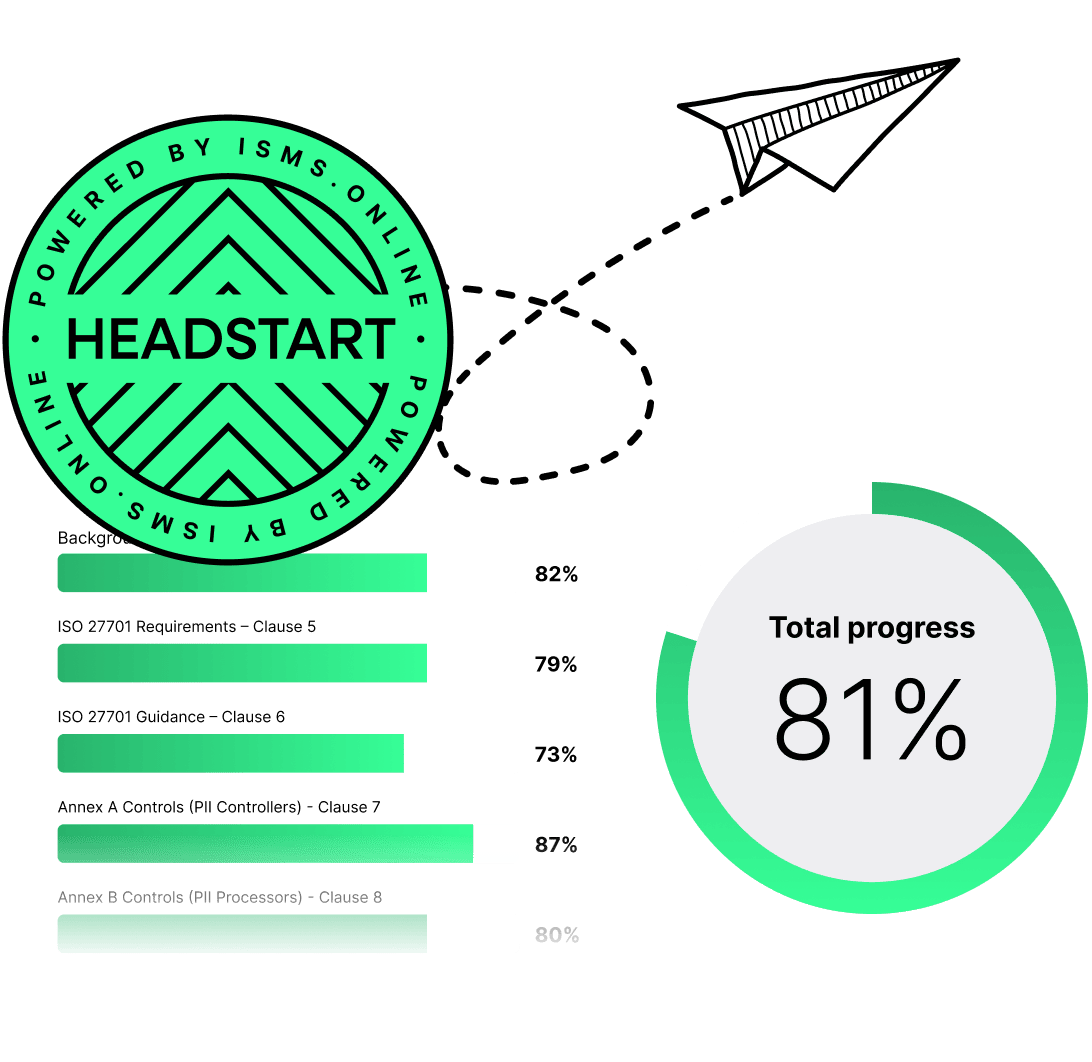
An 81% Headstart from day one
We’ve done the hard work for you, giving you an 81% Headstart from the moment you log on. All you have to do is fill in the blanks.
What Does Annex A 5.19 Require in Practice?
An organisation may want suppliers to access and contribute to certain high value information assets (e.g. software code development, accounting payroll information). It would therefore need clear agreements on exactly what access it is allowing, so it can control the security around it. The detail of those agreements is covered by information security within supplier agreements (Annex A 5.20), and technology suppliers further down the chain by managing the ICT supply chain (Annex A 5.21).
This is especially important as more and more information management, processing and technology services are outsourced. That means having a place to show management of the relationship is happening: contracts, contacts, incidents, relationship activity, risk management and so on. Where the supplier is closely involved in the organisation but may not have its own certified ISMS, it is also worth showing that supplier staff are aware of security and trained on your policies.
A topic-specific policy covers one subject, here supplier relationships, and sits under the organisation’s overall information security policy, so its rules can be aimed at the people and suppliers they apply to.
It’s important to note that ISO 27001 Annex A Control 5.19 asks the organisation to implement policies and procedures that not only govern its own use of supplier resources and cloud platforms, but also form the basis of how it expects its suppliers to conduct themselves before and throughout the term of the commercial relationship.
Where bringing on or changing a supplier is part of a larger project, you may also need to apply Annex A 5.8 (information security in project management).
What Are the Stages of the Supplier Lifecycle?
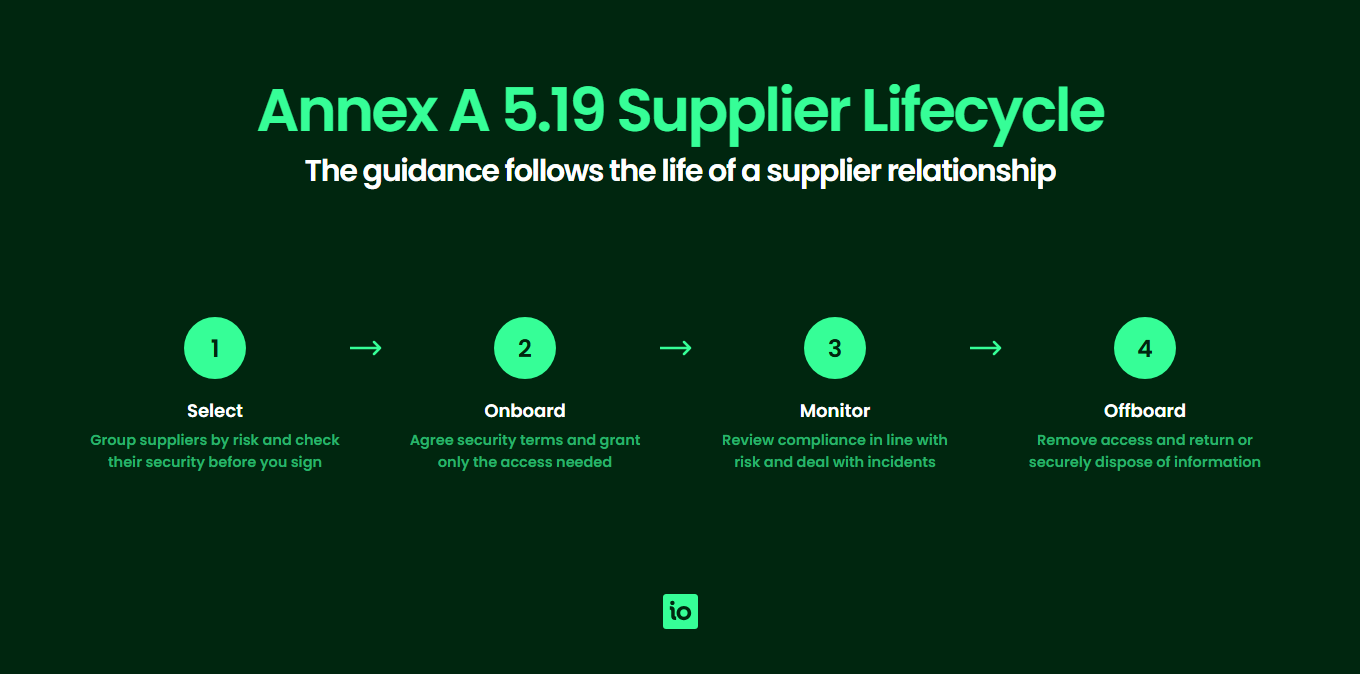
The guidance points below follow the life of a supplier relationship:
- Select – group suppliers by type and risk, check their security before you sign and decide what they will be allowed to access.
- Onboard – agree security terms, grant only the access needed and brief the staff who will work with the supplier.
- Monitor – review compliance in line with the supplier’s risk level, deal with incidents and act on any non-compliance.
- Offboard – remove access, return or securely dispose of information and assets, and keep confidentiality terms in force.
What Are the 14 Guidance Points for Annex A 5.19?
The ISO 27002:2022 guidance for control 5.19 lists 14 points (a to n) for organisations to address:
1) Maintain an accurate record of supplier types (e.g. ICT services, logistics, utilities, financial services) that could affect the confidentiality, integrity or availability of your information.
Compliance – Draft a list of any and all suppliers that your organisation works with, categorise them according to their business function and add categories to those supplier types as and when required.
2) Understand how to vet suppliers, based on the level of risk inherent for their supplier type.
Compliance – Different supplier types will require different due diligence checks. Consider using vetting methods on a supplier-by-supplier basis (e.g. industry references, financial statements, onsite assessments, certifications).
3) Identify suppliers that have pre-existing information security controls in place.
Compliance – Ask to see copies of suppliers’ relevant information security governance procedures, in order to evaluate the risk to your own organisation. If they don’t have any, it’s not a good sign.
4) Identify and define the specific areas of your organisation’s ICT infrastructure that your suppliers will be able to either access, monitor or make use of themselves.
Compliance – It’s important to establish from the outset precisely how your suppliers are going to interact with your ICT assets – be they physical or virtual – and what levels of access they’re granted in line with their contractual obligations.
5) Define the types of ICT infrastructure and services your suppliers provide that could affect your own data.
Compliance – An organisation’s first obligation is to its own set of information security standards. Supplier ICT assets need to be reviewed in line with their potential to affect up-time and integrity throughout your organisation.
6) Identify and manage the various information security risks attached to:
a. Supplier use of confidential information or protected assets (including risks from malicious supplier staff).
b. Faulty supplier hardware or malfunctioning software platforms associated with on-premise or cloud based services.
Compliance – Organisations need to be continually mindful of the information security risks associated with catastrophic events, such as nefarious supplier-side user activity or major unforeseen software incidents, and their impact on organisational information security.
7) Monitor information security compliance by supplier type and by the kind of access each supplier has.
Compliance – Organisations need to appreciate the information security implications inherent within each supplier type, and adjust their monitoring activity to accommodate varying levels of risk.
8) Limit the amount of damage and/or disruption caused through non-compliance.
Compliance – Where non-compliance is discovered, either proactively or reactively, immediate action should be taken.
9) Maintain a robust incident management procedure that addresses a reasonable range of contingencies.
Compliance – Organisations should understand precisely how to react when faced with a broad range of events relating to the supply of third party products and services, and outline remedial actions that include both the supplier and the organisation.
10) Enact measures that cater to the availability and processing of the supplier’s information, wherever it’s used, thereby protecting the availability of the organisation’s own information.
11) Draft a thorough training plan that offers guidance on how staff should interact with supplier personnel and information on a supplier-by-supplier basis, or on a type-by-type basis.
Compliance – Training should cover the full spectrum of governance between an organisation and its suppliers, including engagement, granular risk management controls and topic-specific procedures.
12) Understand and manage the level of risk inherent when transferring information and physical and virtual assets between the organisation and its suppliers.
Compliance – Organisations should map out each stage of the transfer process and educate staff as to the risks associated with moving assets and information from one source to another.
13) Ensure that supplier relationships are terminated with information security in mind, including removing access rights and the ability to access organisational information.
Compliance – Your ICT teams should have a clear understanding of how to revoke a supplier’s access to information, including:
- Granular analysis of any associated domain and/or cloud-based accounts.
- Deciding who owns any intellectual property developed during the relationship.
- The porting of information between suppliers, or back to your organisation.
- Records management.
- Returning assets to their original owner.
- Adequate disposal of physical and virtual assets, including information.
- Adherence to any contractual requirements, including confidentiality clauses and/or external agreements.
14) Outline precisely the level of personnel and physical security you expect from the supplier’s staff and premises.
Compliance – Organisations should set clear expectations from the outset of any commercial relationship, that specify how supplier-side personnel are expected to conduct themselves when interacting with your staff or any relevant assets.

Free yourself from a mountain of spreadsheets
Embed, expand and scale your compliance, without the mess. IO gives you the resilience and confidence to grow securely.
What If a Supplier Will Not Accept Your Requirements?
It is not always possible to place your full set of requirements on a supplier. For those cases, the ISO 27002:2022 guidance for control 5.19 suggests two things: let the guidance above shape your decision on whether to choose that supplier and its product or service, and put compensating controls in place where your risk assessment shows they are needed.
In other words, a gap in a supplier’s terms is a risk decision for you to record and manage, not a reason to ignore the control.
What Evidence Might an Auditor or Customer Ask For?
An auditor or a customer doing due diligence may ask to see how you put Annex A 5.19 into practice. Useful records to keep include:
- A supplier register showing each supplier, its type, its risk category and the owner of the relationship.
- Supplier risk assessments and the checks you carried out before signing.
- Signed agreements that include the information security terms you set.
- Records of supplier reviews, monitoring and any follow-up on non-compliance or incidents.
- Exit plans and records showing access was removed and information returned or disposed of when a relationship ended.
What Are the Changes From ISO 27001:2013?
ISO 27001:2022 Annex A 5.19 replaces ISO 27001:2013 Annex A 15.1.1 (Information security policy for supplier relationships). For the earlier version, see ISO 27001:2013 Annex A 15.1.1.
ISO 27001:2022 Annex A 5.19 broadly follows the same underlying concepts as the 2013 control, but does contain several additional guidance areas that are either omitted from ISO 27001:2013 Annex A 15.1.1, or at the very least not covered in as much detail, including:
- The vetting of suppliers based on their supplier type and risk level.
- The need to ensure the integrity of supplier information in order to secure their own data, and ensure business continuity.
- The various steps required when ending a supplier relationship, including the decommissioning of access rights, IP ownership, contractual agreements etc.
ISO 27001:2022 Annex A 5.19 also acknowledges the highly variable nature of supplier relationships (based on type, sector and risk level), and gives organisations a degree of leeway where a guidance point cannot be applied to a given supplier (see ‘What If a Supplier Will Not Accept Your Requirements?’ above).
What Are All the ISO 27001:2022 Annex A Controls?
In the table below you’ll find more information on each individual ISO 27001:2022 Annex A Control.
| Annex A Control Type | ISO/IEC 27001:2022 Annex A Identifier | ISO/IEC 27001:2013 Annex A Identifier | Annex A Name |
|---|---|---|---|
| Organisational Controls | Annex A 5.1 |
Annex A 5.1.1 Annex A 5.1.2 |
Policies for Information Security |
| Organisational Controls | Annex A 5.2 | Annex A 6.1.1 | Information Security Roles and Responsibilities |
| Organisational Controls | Annex A 5.3 | Annex A 6.1.2 | Segregation of Duties |
| Organisational Controls | Annex A 5.4 | Annex A 7.2.1 | Management Responsibilities |
| Organisational Controls | Annex A 5.5 | Annex A 6.1.3 | Contact With Authorities |
| Organisational Controls | Annex A 5.6 | Annex A 6.1.4 | Contact With Special Interest Groups |
| Organisational Controls | Annex A 5.7 | NEW | Threat Intelligence |
| Organisational Controls | Annex A 5.8 |
Annex A 6.1.5 Annex A 14.1.1 |
Information Security in Project Management |
| Organisational Controls | Annex A 5.9 |
Annex A 8.1.1 Annex A 8.1.2 |
Inventory of Information and Other Associated Assets |
| Organisational Controls | Annex A 5.10 |
Annex A 8.1.3 Annex A 8.2.3 |
Acceptable Use of Information and Other Associated Assets |
| Organisational Controls | Annex A 5.11 | Annex A 8.1.4 | Return of Assets |
| Organisational Controls | Annex A 5.12 | Annex A 8.2.1 | Classification of Information |
| Organisational Controls | Annex A 5.13 | Annex A 8.2.2 | Labelling of Information |
| Organisational Controls | Annex A 5.14 |
Annex A 13.2.1 Annex A 13.2.2 Annex A 13.2.3 |
Information Transfer |
| Organisational Controls | Annex A 5.15 |
Annex A 9.1.1 Annex A 9.1.2 |
Access Control |
| Organisational Controls | Annex A 5.16 | Annex A 9.2.1 | Identity Management |
| Organisational Controls | Annex A 5.17 |
Annex A 9.2.4 Annex A 9.3.1 Annex A 9.4.3 |
Authentication Information |
| Organisational Controls | Annex A 5.18 |
Annex A 9.2.2 Annex A 9.2.5 Annex A 9.2.6 |
Access Rights |
| Organisational Controls | Annex A 5.19 | Annex A 15.1.1 | Information Security in Supplier Relationships |
| Organisational Controls | Annex A 5.20 | Annex A 15.1.2 | Addressing Information Security Within Supplier Agreements |
| Organisational Controls | Annex A 5.21 | Annex A 15.1.3 | Managing Information Security in the ICT Supply Chain |
| Organisational Controls | Annex A 5.22 |
Annex A 15.2.1 Annex A 15.2.2 |
Monitoring, Review and Change Management of Supplier Services |
| Organisational Controls | Annex A 5.23 | NEW | Information Security for Use of Cloud Services |
| Organisational Controls | Annex A 5.24 | Annex A 16.1.1 | Information Security Incident Management Planning and Preparation |
| Organisational Controls | Annex A 5.25 | Annex A 16.1.4 | Assessment and Decision on Information Security Events |
| Organisational Controls | Annex A 5.26 | Annex A 16.1.5 | Response to Information Security Incidents |
| Organisational Controls | Annex A 5.27 | Annex A 16.1.6 | Learning From Information Security Incidents |
| Organisational Controls | Annex A 5.28 | Annex A 16.1.7 | Collection of Evidence |
| Organisational Controls | Annex A 5.29 |
Annex A 17.1.1 Annex A 17.1.2 Annex A 17.1.3 |
Information Security During Disruption |
| Organisational Controls | Annex A 5.30 | NEW | ICT Readiness for Business Continuity |
| Organisational Controls | Annex A 5.31 |
Annex A 18.1.1 Annex A 18.1.5 |
Legal, Statutory, Regulatory and Contractual Requirements |
| Organisational Controls | Annex A 5.32 | Annex A 18.1.2 | Intellectual Property Rights |
| Organisational Controls | Annex A 5.33 | Annex A 18.1.3 | Protection of Records |
| Organisational Controls | Annex A 5.34 | Annex A 18.1.4 | Privacy and Protection of PII |
| Organisational Controls | Annex A 5.35 | Annex A 18.2.1 | Independent Review of Information Security |
| Organisational Controls | Annex A 5.36 |
Annex A 18.2.2 Annex A 18.2.3 |
Compliance With Policies, Rules and Standards for Information Security |
| Organisational Controls | Annex A 5.37 | Annex A 12.1.1 | Documented Operating Procedures |
| Annex A Control Type | ISO/IEC 27001:2022 Annex A Identifier | ISO/IEC 27001:2013 Annex A Identifier | Annex A Name |
|---|---|---|---|
| People Controls | Annex A 6.1 | Annex A 7.1.1 | Screening |
| People Controls | Annex A 6.2 | Annex A 7.1.2 | Terms and Conditions of Employment |
| People Controls | Annex A 6.3 | Annex A 7.2.2 | Information Security Awareness, Education and Training |
| People Controls | Annex A 6.4 | Annex A 7.2.3 | Disciplinary Process |
| People Controls | Annex A 6.5 | Annex A 7.3.1 | Responsibilities After Termination or Change of Employment |
| People Controls | Annex A 6.6 | Annex A 13.2.4 | Confidentiality or Non-Disclosure Agreements |
| People Controls | Annex A 6.7 | Annex A 6.2.2 | Remote Working |
| People Controls | Annex A 6.8 |
Annex A 16.1.2 Annex A 16.1.3 |
Information Security Event Reporting |
| Annex A Control Type | ISO/IEC 27001:2022 Annex A Identifier | ISO/IEC 27001:2013 Annex A Identifier | Annex A Name |
|---|---|---|---|
| Physical Controls | Annex A 7.1 | Annex A 11.1.1 | Physical Security Perimeters |
| Physical Controls | Annex A 7.2 |
Annex A 11.1.2 Annex A 11.1.6 |
Physical Entry |
| Physical Controls | Annex A 7.3 | Annex A 11.1.3 | Securing Offices, Rooms and Facilities |
| Physical Controls | Annex A 7.4 | NEW | Physical Security Monitoring |
| Physical Controls | Annex A 7.5 | Annex A 11.1.4 | Protecting Against Physical and Environmental Threats |
| Physical Controls | Annex A 7.6 | Annex A 11.1.5 | Working In Secure Areas |
| Physical Controls | Annex A 7.7 | Annex A 11.2.9 | Clear Desk and Clear Screen |
| Physical Controls | Annex A 7.8 | Annex A 11.2.1 | Equipment Siting and Protection |
| Physical Controls | Annex A 7.9 | Annex A 11.2.6 | Security of Assets Off-Premises |
| Physical Controls | Annex A 7.10 |
Annex A 8.3.1 Annex A 8.3.2 Annex A 8.3.3 Annex A 11.2.5 |
Storage Media |
| Physical Controls | Annex A 7.11 | Annex A 11.2.2 | Supporting Utilities |
| Physical Controls | Annex A 7.12 | Annex A 11.2.3 | Cabling Security |
| Physical Controls | Annex A 7.13 | Annex A 11.2.4 | Equipment Maintenance |
| Physical Controls | Annex A 7.14 | Annex A 11.2.7 | Secure Disposal or Re-Use of Equipment |
| Annex A Control Type | ISO/IEC 27001:2022 Annex A Identifier | ISO/IEC 27001:2013 Annex A Identifier | Annex A Name |
|---|---|---|---|
| Technological Controls | Annex A 8.1 |
Annex A 6.2.1 Annex A 11.2.8 |
User Endpoint Devices |
| Technological Controls | Annex A 8.2 | Annex A 9.2.3 | Privileged Access Rights |
| Technological Controls | Annex A 8.3 | Annex A 9.4.1 | Information Access Restriction |
| Technological Controls | Annex A 8.4 | Annex A 9.4.5 | Access to Source Code |
| Technological Controls | Annex A 8.5 | Annex A 9.4.2 | Secure Authentication |
| Technological Controls | Annex A 8.6 | Annex A 12.1.3 | Capacity Management |
| Technological Controls | Annex A 8.7 | Annex A 12.2.1 | Protection Against Malware |
| Technological Controls | Annex A 8.8 |
Annex A 12.6.1 Annex A 18.2.3 |
Management of Technical Vulnerabilities |
| Technological Controls | Annex A 8.9 | NEW | Configuration Management |
| Technological Controls | Annex A 8.10 | NEW | Information Deletion |
| Technological Controls | Annex A 8.11 | NEW | Data Masking |
| Technological Controls | Annex A 8.12 | NEW | Data Leakage Prevention |
| Technological Controls | Annex A 8.13 | Annex A 12.3.1 | Information Backup |
| Technological Controls | Annex A 8.14 | Annex A 17.2.1 | Redundancy of Information Processing Facilities |
| Technological Controls | Annex A 8.15 |
Annex A 12.4.1 Annex A 12.4.2 Annex A 12.4.3 |
Logging |
| Technological Controls | Annex A 8.16 | NEW | Monitoring Activities |
| Technological Controls | Annex A 8.17 | Annex A 12.4.4 | Clock Synchronization |
| Technological Controls | Annex A 8.18 | Annex A 9.4.4 | Use of Privileged Utility ProgramsAccess Rights |
| Technological Controls | Annex A 8.19 |
Annex A 12.5.1 Annex A 12.6.2 |
Installation of Software on Operational Systems |
| Technological Controls | Annex A 8.20 | Annex A 13.1.1 | Networks Security |
| Technological Controls | Annex A 8.21 | Annex A 13.1.2 | Security of Network Services |
| Technological Controls | Annex A 8.22 | Annex A 13.1.3 | Segregation of Networks |
| Technological Controls | Annex A 8.23 | NEW | Web filtering |
| Technological Controls | Annex A 8.24 |
Annex A 10.1.1 Annex A 10.1.2 |
Use of Cryptography |
| Technological Controls | Annex A 8.25 | Annex A 14.2.1 | Secure Development Life Cycle |
| Technological Controls | Annex A 8.26 |
Annex A 14.1.2 Annex A 14.1.3 |
Application Security Requirements |
| Technological Controls | Annex A 8.27 | Annex A 14.2.5 | Secure System Architecture and Engineering PrinciplesLearning From Information Security Incidents |
| Technological Controls | Annex A 8.28 | NEW | Secure Coding |
| Technological Controls | Annex A 8.29 |
Annex A 14.2.8 Annex A 14.2.9 |
Security Testing in Development and Acceptance |
| Technological Controls | Annex A 8.30 | Annex A 14.2.7 | Outsourced Development |
| Technological Controls | Annex A 8.31 |
Annex A 12.1.4 Annex A 14.2.6 |
Separation of Development, Test and Production Environments |
| Technological Controls | Annex A 8.32 |
Annex A 12.1.2 Annex A 14.2.2 Annex A 14.2.3 Annex A 14.2.4 |
Change Management |
| Technological Controls | Annex A 8.33 | Annex A 14.3.1 | Test Information |
| Technological Controls | Annex A 8.34 | Annex A 12.7.1 | Protection of Information Systems During Audit Testing |
Why Choose ISMS.online for Annex A 5.19?
ISMS.online helps you put Annex A 5.19 into practice and show an auditor how you manage your suppliers. With it you can:
- Show that your supplier relationships are carefully selected, well managed throughout their life, and monitored and reviewed, using our Accounts relationships (e.g. supplier) area.
- Use collaborative project workspaces for supplier onboarding, joint initiatives and offboarding, which the auditor can also view when required.
- Use Policy Packs to share the specific policies and controls you want supplier staff to follow, and keep evidence that they have read them and committed to comply.
- Quickly implement an Information Security Management System (ISMS).
- Easily manage the documentation of your ISMS.
- Manage all aspects of information security, from risk management to security awareness training.
- Communicate throughout your organisation using our built-in communication functionality.
To see how ISMS.online can help you manage information security in your supplier relationships, book a demo.
FAQs
Is Annex A 5.19 the same as ISO 27002 control 5.19?
They share a number and a title but do different jobs. Annex A 5.19 in ISO 27001:2022 is the control your information security management system has to address. ISO 27002:2022 control 5.19 is the supporting guidance: it gives the purpose, the 14 points (a to n) and what to do when a supplier will not accept your requirements.
Do you need a separate security policy for every supplier?
No. The ISO 27002:2022 guidance recommends one topic-specific policy for supplier relationships, which sits under your overall information security policy. Within it, you scale your checks and reviews to each supplier’s type and risk, for example using categories from business critical down to low impact.
Does a supplier have to be ISO 27001 certified?
Not always. Certifications are one way to vet a supplier, alongside industry references, financial statements and onsite assessments. Where a supplier is closely involved in your organisation but has no certified ISMS of its own, it is worth showing that its staff are aware of security and trained on your policies.

NHS Professionals achieves ISO 27001 certification and improves their infosec management
Facing a tight six-month deadline and multiple existing frameworks to integrate, NHS Professionals needed a platform that could incorporate ISO 27001 without duplicating policies or adding risk to their already complex compliance landscape.

Xergy tool Proteus generates growth through ISO 27001 compliance using ISMS.online
As a start-up building software for highly regulated engineering sectors, Xergy needed ISO 27001 to generate growth through trust — and a proven external partner to handle the rigorous requirements without diverting the dev team.

How MAAS Aviation Built a Robust and Sustainable ISO 27001-Compliant ISMS
MAAS Aviation required strong technical foundations to support ISO 27001 alignment, and a platform to centralise compliance management.

How Blue Services Achieved Triple ISO Certification Success
Blue Services needed external support to guide them through ISO 27001, ISO 9001 and ISO 14001 implementation and best practices, and a platform to centralise their overall compliance management.

How Evolution Funding Cruised to ISO 27001 Certification Success
Achieving ISO 27001 certification was a core objective for Evolution Funding. The team needed a centralised platform with which they could implement the ISO 27001 standard and work through the compliance process.

How 4way Consulting Paved the Road to ISO 27001 Success
Handling sensitive client data across multiple standards, 4way needed a cost and time-efficient way to pursue ISO 27001 – without building an ISMS from scratch or relying on expensive external consultants.