

































ISO 27001:2022 Annex A 8.24 (Use of Cryptography) is the Annex A control that asks an organisation to set and apply rules for using cryptography properly, and those rules must cover how cryptographic keys are managed. In practice that means a cryptography policy, approved algorithms and cipher strengths, and controlled key management matched to how sensitive the information is.
Does ISO 27001 Require Encryption at Rest and in Transit?
Not as a blanket rule. ISO 27001:2022 does not say that all data must be encrypted at rest and in transit. Control 8.24 asks you to decide and apply your own rules on when and how cryptography is used, and your risk assessment and information classification decide where encryption is needed.
Under clause 6.1.3, your risk treatment process selects the controls you need, and your Statement of Applicability records whether control 8.24 applies and why. The ISO 27002 guidance for 8.24 specifically asks you to consider cryptography for information held on mobile devices and storage media, and for information sent over networks to them. An auditor or customer doing due diligence may ask how you reached your decisions on encrypting laptops, removable media and network traffic, so record those decisions and the reasons for them in your cryptography policy.
How Does Cryptography Protect Information Under Annex A 8.24?
When transmitting information between networks and devices, cyber attackers may attempt to steal sensitive data, alter content, imitate senders/recipients to gain unauthorised access, or intercept the exchange.
Cyber criminals may employ man-in-the-middle (MITM) attacks, intercepting data transmissions and masquerading as the server to get the sender to reveal login credentials. With these credentials, they can gain access to systems and jeopardise sensitive data.
Cryptography, such as encryption, can protect the confidentiality, integrity and authenticity of information while it is in transit.
Cryptographic techniques can also keep information assets secure when they are stored and not in use, protecting the data from unauthorised access or modification. Encryption is also a building block of a zero trust model, which our guide to cryptography and zero trust explains.
For more detail on this control, see:
- our guide to ISO 27002 Control 8.24 use of cryptography
- our step-by-step guide on how to implement Annex A 8.24
What Is the Purpose of Annex A 8.24?
ISO 27001:2022 Annex A 8.24 exists so that cryptography is applied correctly and actually works. It aims to protect three properties of information:
- Confidentiality: keeping information private from anyone not authorised to see it.
- Authenticity: confirming that information really comes from where it claims to.
- Integrity: showing that information has not been altered.
The rules you set should reflect:
- your business requirements for protecting information.
- your information security requirements.
- any legal, statutory, regulatory and contractual obligations that affect how you use cryptography.
Who Owns Annex A 8.24?
The standard does not name a specific role as the owner. A sensible choice is to give overall ownership of the cryptography and key management rules to the Chief Information Security Officer (CISO) or an equivalent security lead, and then define who puts the rules into practice and who handles keys, as the ISO 27002 guidance suggests.
ISO 27001 made easy
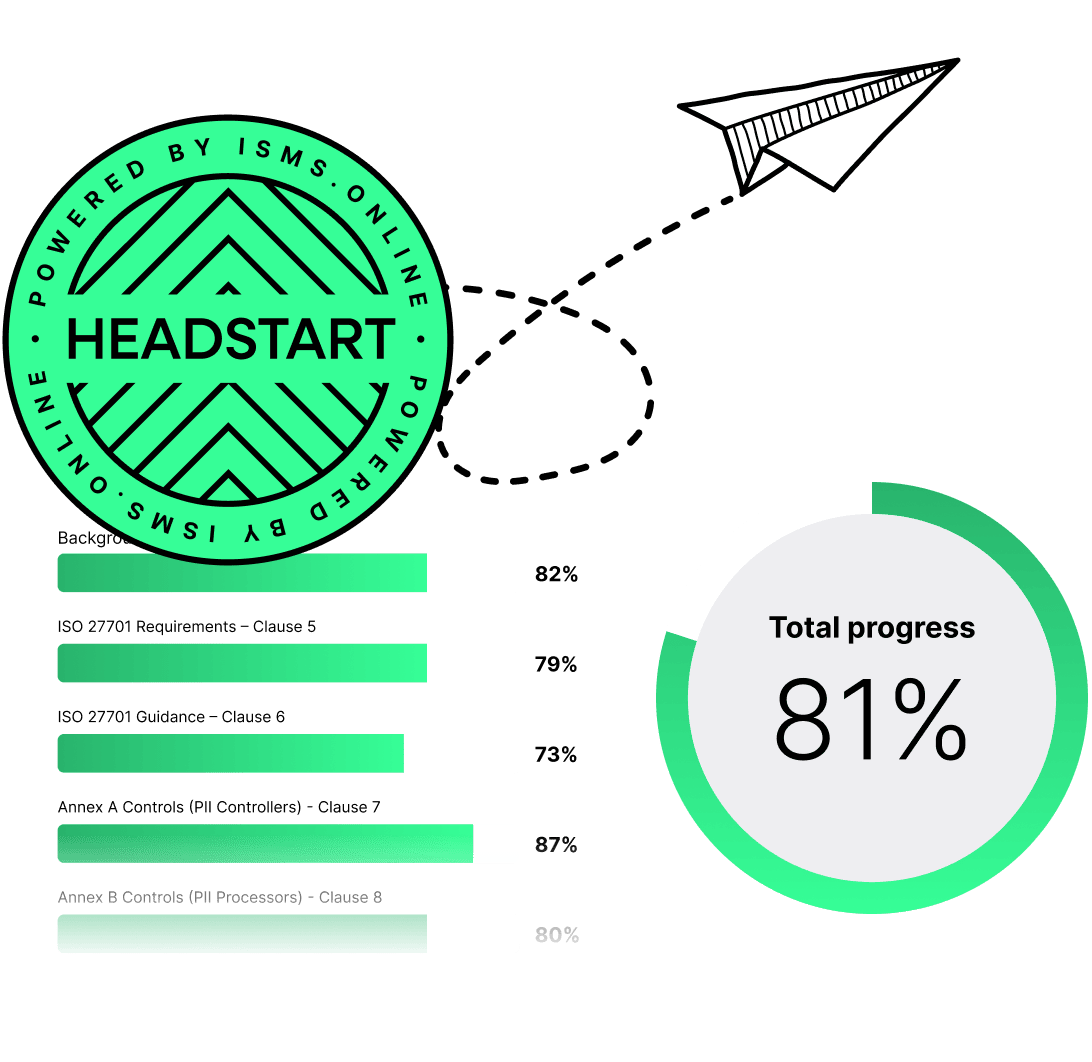
An 81% Headstart from day one
We’ve done the hard work for you, giving you an 81% Headstart from the moment you log on. All you have to do is fill in the blanks.
What Does the ISO 27002 Guidance Say About Annex A 8.24?
ISO 27001:2022 Annex A lists the control itself. The supporting guidance in ISO 27002:2022 lists seven points to consider when using cryptography:
- A topic-specific policy on cryptography that sets out your general principles for protecting information. The policy helps you get the most from cryptography, reduce its risks and avoid using it wrongly.
- The level of protection the information needs and its classification. Together they decide which cryptographic algorithms you need, and how strong and good quality they must be.
- Using cryptography to protect information held on mobile devices and storage media, and information sent over networks to those devices or media.
- Your approach to key management, including how keys are generated and protected, and how encrypted information is recovered if keys are lost, compromised or damaged.
- Roles and responsibilities for:
- putting the rules for using cryptography into practice.
- key management, including key generation.
- The standards, algorithms, cipher strengths, cryptographic solutions and usage practices that your organisation approves or requires.
- The effect of encrypted information on controls that rely on inspecting content, such as malware detection or content filtering.
The guidance also says that organisations should take into account the laws and national restrictions on cryptography that can apply in different countries, and the issues raised when encrypted information crosses borders.
Agreements with external providers of cryptographic services, such as a certification authority, should cover liability, reliability of the service and response times.
What Should a Cryptography Policy Include?
ISO 27002 does not prescribe a template, but an example outline for a cryptography policy could cover:
- Scope: the systems, information and locations the policy applies to.
- When to encrypt: which information classifications need encryption at rest, in transit and on mobile devices or removable media.
- Approved algorithms: the algorithms, cipher strengths and cryptographic solutions you allow, and those you do not.
- Key lifecycle: how keys are generated, distributed, stored, changed, revoked and destroyed (see the table below).
- Roles: who owns the policy, who applies it and who handles keys.
- Legal and cross-border rules: restrictions that affect cryptography in the countries where you operate.
- Exceptions: how exceptions are requested, approved and reviewed.
If your organisation is also in scope of NIS 2, see our NIS 2 cryptography implementing guidance.
What Does the Guidance Say About Key Management?
Good key management needs secure processes for every stage of a key’s life, from generating, storing and archiving keys through to retrieving, distributing, retiring and destroying them.
The ISO 27002 guidance says a key management system should rest on standards, procedures and secure methods that the organisation has agreed. The table below sets out each stage and what your rules should cover.
| Key lifecycle stage | What your rules should cover |
|---|---|
| Generate | How keys are created for different cryptographic systems and applications. |
| Issue certificates | How public key certificates are issued and obtained. |
| Distribute and activate | How keys reach the intended people or systems, and how they are activated on receipt. |
| Store and access | Where keys are kept and how authorised users get access to them. |
| Change or rotate | When keys are changed or updated, and how. |
| Handle compromise | What happens when a key has been compromised. |
| Revoke | How keys are withdrawn or deactivated, for example after a compromise or when a user leaves the organisation (when a user leaves, their keys should also be archived). |
| Recover | How lost or corrupted keys are recovered. |
| Back up and archive | How keys are backed up or archived. |
| Destroy | How keys are destroyed. |
| Log and audit | How key management activities are logged and audited. |
| Set validity dates | Activation and deactivation dates, so each key is only used for the period your key management rules allow. |
| Respond to legal requests | How requests for access to keys are handled, for example when encrypted information must be produced in unencrypted form as evidence in a court case. |
The guidance also sets out how the keys themselves should be protected:
- Every cryptographic key needs protecting so it cannot be changed or lost.
- Secret and private keys also need protecting against unauthorised use and disclosure.
- The equipment that generates, stores or archives keys should be protected with physical security measures.
- As well as their integrity, the authenticity of public keys should be considered in many cases. This is usually handled through public key management processes that use certificate authorities and public key certificates.

Manage all your compliance, all in one place
ISMS.online supports over 100 standards and regulations, giving you a single platform for all your compliance needs.
What Are the Benefits of Cryptography?
The ISO 27002 guidance for 8.24 gives four examples of information security objectives that cryptography can help you meet. Encryption on its own mainly protects confidentiality; other cryptographic techniques cover the other three:
- Confidentiality: encryption protects sensitive or critical information, whether it is stored or transmitted.
- Integrity or authenticity: digital signatures and message authentication codes show that stored or transmitted information is genuine and has not been changed. Algorithms can also be used to check file integrity.
- Non-repudiation: cryptographic techniques provide evidence that an event or action did or did not take place.
- Authentication: cryptographic techniques confirm the identity of users and other system entities that request access to systems and resources.
What Changed from ISO 27001:2013?
ISO 27001:2022 Annex A 8.24 replaces ISO 27001:2013 Annex A 10.1.1 and 10.1.2 in the revised 2022 standard.
The content of the two is nearly the same, though there are some structural modifications.
Whereas the 2013 version had two separate controls, 10.1.1 (Policy on the use of cryptographic controls) and 10.1.2 (Key management), the 2022 version consolidated these into one Annex A control, 8.24. If you still work with the older edition, our guide to ISO 27001:2013 Annex A 10 cryptography covers both earlier controls.
What Are All the ISO 27001:2022 Annex A Controls?
In the table below you’ll find more information on each individual ISO 27001:2022 Annex A Control.
| Annex A Control Type | ISO/IEC 27001:2022 Annex A Identifier | ISO/IEC 27001:2013 Annex A Identifier | Annex A Name |
|---|---|---|---|
| Organisational Controls | Annex A 5.1 |
Annex A 5.1.1 Annex A 5.1.2 |
Policies for Information Security |
| Organisational Controls | Annex A 5.2 | Annex A 6.1.1 | Information Security Roles and Responsibilities |
| Organisational Controls | Annex A 5.3 | Annex A 6.1.2 | Segregation of Duties |
| Organisational Controls | Annex A 5.4 | Annex A 7.2.1 | Management Responsibilities |
| Organisational Controls | Annex A 5.5 | Annex A 6.1.3 | Contact With Authorities |
| Organisational Controls | Annex A 5.6 | Annex A 6.1.4 | Contact With Special Interest Groups |
| Organisational Controls | Annex A 5.7 | NEW | Threat Intelligence |
| Organisational Controls | Annex A 5.8 |
Annex A 6.1.5 Annex A 14.1.1 |
Information Security in Project Management |
| Organisational Controls | Annex A 5.9 |
Annex A 8.1.1 Annex A 8.1.2 |
Inventory of Information and Other Associated Assets |
| Organisational Controls | Annex A 5.10 |
Annex A 8.1.3 Annex A 8.2.3 |
Acceptable Use of Information and Other Associated Assets |
| Organisational Controls | Annex A 5.11 | Annex A 8.1.4 | Return of Assets |
| Organisational Controls | Annex A 5.12 | Annex A 8.2.1 | Classification of Information |
| Organisational Controls | Annex A 5.13 | Annex A 8.2.2 | Labelling of Information |
| Organisational Controls | Annex A 5.14 |
Annex A 13.2.1 Annex A 13.2.2 Annex A 13.2.3 |
Information Transfer |
| Organisational Controls | Annex A 5.15 |
Annex A 9.1.1 Annex A 9.1.2 |
Access Control |
| Organisational Controls | Annex A 5.16 | Annex A 9.2.1 | Identity Management |
| Organisational Controls | Annex A 5.17 |
Annex A 9.2.4 Annex A 9.3.1 Annex A 9.4.3 |
Authentication Information |
| Organisational Controls | Annex A 5.18 |
Annex A 9.2.2 Annex A 9.2.5 Annex A 9.2.6 |
Access Rights |
| Organisational Controls | Annex A 5.19 | Annex A 15.1.1 | Information Security in Supplier Relationships |
| Organisational Controls | Annex A 5.20 | Annex A 15.1.2 | Addressing Information Security Within Supplier Agreements |
| Organisational Controls | Annex A 5.21 | Annex A 15.1.3 | Managing Information Security in the ICT Supply Chain |
| Organisational Controls | Annex A 5.22 |
Annex A 15.2.1 Annex A 15.2.2 |
Monitoring, Review and Change Management of Supplier Services |
| Organisational Controls | Annex A 5.23 | NEW | Information Security for Use of Cloud Services |
| Organisational Controls | Annex A 5.24 | Annex A 16.1.1 | Information Security Incident Management Planning and Preparation |
| Organisational Controls | Annex A 5.25 | Annex A 16.1.4 | Assessment and Decision on Information Security Events |
| Organisational Controls | Annex A 5.26 | Annex A 16.1.5 | Response to Information Security Incidents |
| Organisational Controls | Annex A 5.27 | Annex A 16.1.6 | Learning From Information Security Incidents |
| Organisational Controls | Annex A 5.28 | Annex A 16.1.7 | Collection of Evidence |
| Organisational Controls | Annex A 5.29 |
Annex A 17.1.1 Annex A 17.1.2 Annex A 17.1.3 |
Information Security During Disruption |
| Organisational Controls | Annex A 5.30 | NEW | ICT Readiness for Business Continuity |
| Organisational Controls | Annex A 5.31 |
Annex A 18.1.1 Annex A 18.1.5 |
Legal, Statutory, Regulatory and Contractual Requirements |
| Organisational Controls | Annex A 5.32 | Annex A 18.1.2 | Intellectual Property Rights |
| Organisational Controls | Annex A 5.33 | Annex A 18.1.3 | Protection of Records |
| Organisational Controls | Annex A 5.34 | Annex A 18.1.4 | Privacy and Protection of PII |
| Organisational Controls | Annex A 5.35 | Annex A 18.2.1 | Independent Review of Information Security |
| Organisational Controls | Annex A 5.36 |
Annex A 18.2.2 Annex A 18.2.3 |
Compliance With Policies, Rules and Standards for Information Security |
| Organisational Controls | Annex A 5.37 | Annex A 12.1.1 | Documented Operating Procedures |
| Annex A Control Type | ISO/IEC 27001:2022 Annex A Identifier | ISO/IEC 27001:2013 Annex A Identifier | Annex A Name |
|---|---|---|---|
| People Controls | Annex A 6.1 | Annex A 7.1.1 | Screening |
| People Controls | Annex A 6.2 | Annex A 7.1.2 | Terms and Conditions of Employment |
| People Controls | Annex A 6.3 | Annex A 7.2.2 | Information Security Awareness, Education and Training |
| People Controls | Annex A 6.4 | Annex A 7.2.3 | Disciplinary Process |
| People Controls | Annex A 6.5 | Annex A 7.3.1 | Responsibilities After Termination or Change of Employment |
| People Controls | Annex A 6.6 | Annex A 13.2.4 | Confidentiality or Non-Disclosure Agreements |
| People Controls | Annex A 6.7 | Annex A 6.2.2 | Remote Working |
| People Controls | Annex A 6.8 |
Annex A 16.1.2 Annex A 16.1.3 |
Information Security Event Reporting |
| Annex A Control Type | ISO/IEC 27001:2022 Annex A Identifier | ISO/IEC 27001:2013 Annex A Identifier | Annex A Name |
|---|---|---|---|
| Physical Controls | Annex A 7.1 | Annex A 11.1.1 | Physical Security Perimeters |
| Physical Controls | Annex A 7.2 |
Annex A 11.1.2 Annex A 11.1.6 |
Physical Entry |
| Physical Controls | Annex A 7.3 | Annex A 11.1.3 | Securing Offices, Rooms and Facilities |
| Physical Controls | Annex A 7.4 | NEW | Physical Security Monitoring |
| Physical Controls | Annex A 7.5 | Annex A 11.1.4 | Protecting Against Physical and Environmental Threats |
| Physical Controls | Annex A 7.6 | Annex A 11.1.5 | Working In Secure Areas |
| Physical Controls | Annex A 7.7 | Annex A 11.2.9 | Clear Desk and Clear Screen |
| Physical Controls | Annex A 7.8 | Annex A 11.2.1 | Equipment Siting and Protection |
| Physical Controls | Annex A 7.9 | Annex A 11.2.6 | Security of Assets Off-Premises |
| Physical Controls | Annex A 7.10 |
Annex A 8.3.1 Annex A 8.3.2 Annex A 8.3.3 Annex A 11.2.5 |
Storage Media |
| Physical Controls | Annex A 7.11 | Annex A 11.2.2 | Supporting Utilities |
| Physical Controls | Annex A 7.12 | Annex A 11.2.3 | Cabling Security |
| Physical Controls | Annex A 7.13 | Annex A 11.2.4 | Equipment Maintenance |
| Physical Controls | Annex A 7.14 | Annex A 11.2.7 | Secure Disposal or Re-Use of Equipment |
| Annex A Control Type | ISO/IEC 27001:2022 Annex A Identifier | ISO/IEC 27001:2013 Annex A Identifier | Annex A Name |
|---|---|---|---|
| Technological Controls | Annex A 8.1 |
Annex A 6.2.1 Annex A 11.2.8 |
User Endpoint Devices |
| Technological Controls | Annex A 8.2 | Annex A 9.2.3 | Privileged Access Rights |
| Technological Controls | Annex A 8.3 | Annex A 9.4.1 | Information Access Restriction |
| Technological Controls | Annex A 8.4 | Annex A 9.4.5 | Access to Source Code |
| Technological Controls | Annex A 8.5 | Annex A 9.4.2 | Secure Authentication |
| Technological Controls | Annex A 8.6 | Annex A 12.1.3 | Capacity Management |
| Technological Controls | Annex A 8.7 | Annex A 12.2.1 | Protection Against Malware |
| Technological Controls | Annex A 8.8 |
Annex A 12.6.1 Annex A 18.2.3 |
Management of Technical Vulnerabilities |
| Technological Controls | Annex A 8.9 | NEW | Configuration Management |
| Technological Controls | Annex A 8.10 | NEW | Information Deletion |
| Technological Controls | Annex A 8.11 | NEW | Data Masking |
| Technological Controls | Annex A 8.12 | NEW | Data Leakage Prevention |
| Technological Controls | Annex A 8.13 | Annex A 12.3.1 | Information Backup |
| Technological Controls | Annex A 8.14 | Annex A 17.2.1 | Redundancy of Information Processing Facilities |
| Technological Controls | Annex A 8.15 |
Annex A 12.4.1 Annex A 12.4.2 Annex A 12.4.3 |
Logging |
| Technological Controls | Annex A 8.16 | NEW | Monitoring Activities |
| Technological Controls | Annex A 8.17 | Annex A 12.4.4 | Clock Synchronization |
| Technological Controls | Annex A 8.18 | Annex A 9.4.4 | Use of Privileged Utility ProgramsAccess Rights |
| Technological Controls | Annex A 8.19 |
Annex A 12.5.1 Annex A 12.6.2 |
Installation of Software on Operational Systems |
| Technological Controls | Annex A 8.20 | Annex A 13.1.1 | Networks Security |
| Technological Controls | Annex A 8.21 | Annex A 13.1.2 | Security of Network Services |
| Technological Controls | Annex A 8.22 | Annex A 13.1.3 | Segregation of Networks |
| Technological Controls | Annex A 8.23 | NEW | Web filtering |
| Technological Controls | Annex A 8.24 |
Annex A 10.1.1 Annex A 10.1.2 |
Use of Cryptography |
| Technological Controls | Annex A 8.25 | Annex A 14.2.1 | Secure Development Life Cycle |
| Technological Controls | Annex A 8.26 |
Annex A 14.1.2 Annex A 14.1.3 |
Application Security Requirements |
| Technological Controls | Annex A 8.27 | Annex A 14.2.5 | Secure System Architecture and Engineering PrinciplesLearning From Information Security Incidents |
| Technological Controls | Annex A 8.28 | NEW | Secure Coding |
| Technological Controls | Annex A 8.29 |
Annex A 14.2.8 Annex A 14.2.9 |
Security Testing in Development and Acceptance |
| Technological Controls | Annex A 8.30 | Annex A 14.2.7 | Outsourced Development |
| Technological Controls | Annex A 8.31 |
Annex A 12.1.4 Annex A 14.2.6 |
Separation of Development, Test and Production Environments |
| Technological Controls | Annex A 8.32 |
Annex A 12.1.2 Annex A 14.2.2 Annex A 14.2.3 Annex A 14.2.4 |
Change Management |
| Technological Controls | Annex A 8.33 | Annex A 14.3.1 | Test Information |
| Technological Controls | Annex A 8.34 | Annex A 12.7.1 | Protection of Information Systems During Audit Testing |
Why Choose ISMS.online for Annex A 8.24?
ISMS.online is ISO 27001 management system software that helps you meet ISO 27001:2022, including control 8.24, and helps you achieve certification from an accredited certification body. With it you get:
- help to make sure your security policies and procedures line up with ISO 27001:2022.
- a cloud-based platform with a set of tools to implement an Information Security Management System (ISMS) in line with ISO 27001.
- an 81% headstart from the moment you log on: the hard work is done, so you fill in the blanks.
- support for over 100 standards and regulations in a single platform.
- a way to embed, expand and scale your compliance without the mess.
See it for yourself and book a demonstration today.
FAQs
Is Annex A 8.24 the same as ISO 27002 control 8.24?
They share a number but do different jobs. ISO 27001:2022 Annex A lists control 8.24 itself, while ISO 27002:2022 gives the supporting guidance on how to put it into practice, such as the seven points to consider and the key management stages on this page.
Can encryption get in the way of other security controls?
Yes. Encrypted information is harder to inspect, so the ISO 27002 guidance asks you to consider its effect on controls that rely on checking content, such as malware detection or content filtering. Plan for this when you decide where to encrypt.
Do the rules on cryptography change from country to country?
They can. Laws and national restrictions on cryptography differ between countries, and sending encrypted information across borders can raise its own issues. If you operate in more than one country, cover these rules in your cryptography policy.