

































ISO 27001:2022 Annex A 5.15 (Access control) requires an organisation to establish and implement rules that control physical and logical access to its information and other associated assets, based on business and information security requirements. The rules sit in a topic-specific access control policy and cover people and non-human entities such as devices and services.
What Is ISO 27001:2022 Annex A 5.15?
Annex A 5.15 is concerned with access control rules and procedures. Its purpose is to make sure only authorised entities reach information and other associated assets, and to prevent unauthorised access, so that employees only have access to the information they need to perform their duties.
ISO/IEC 27001:2022 states the control in a single sentence; the detailed implementation guidance for it sits in ISO/IEC 27002:2022 control 5.15. This page covers the ISO 27001 requirement view; for the guidance side, see our ISO 27002 control 5.15 guidance.
It is one of the essential elements of an information security management system (ISMS), especially if you are planning to achieve ISO 27001 certification.
Getting this part right is a critical component of ISO 27001 certification and one where many companies require assistance. To better understand these requirements, let’s take a closer look at what they entail.
What Must an Access Control Policy Cover for Annex A 5.15?
To manage access to assets within the scope of an organisation, an access control policy must be developed, documented, and periodically reviewed.
Access control governs how human and non-human entities on a network access data, IT resources, and applications.
Information security risks associated with the information and the organisation’s appetite for managing them should be reflected in the rules, rights and restrictions and the depth of controls used. It is simply a matter of deciding who has access to what, how much, and who does not.
It is possible to set up digital and physical access controls, such as limiting user account permissions or restricting access to specific physical locations (aligned with the Annex A 7 physical controls). The policy should take the following into account:
- It is essential to align the security requirements of business applications with the information classification scheme in use per Annex A 5.10, 5.12 & 5.13.
- Identify who requires access to, knowledge of, and the use of information – accompanied by clearly defined procedures and responsibilities.
- Ensure that access rights and privilege access rights (more power – see below) are managed effectively, including the addition of changes in life (e.g. controls for super users/administrators) and periodic reviews (e.g. periodic internal audits per requirement Annex A 5.15, 5.16, 5.17, 5.18 & 8.2).
- A formal procedure and defined responsibilities should support the access control rules.
It is vital to review access control as roles change, especially during exits, in line with Annex A 5.18 (Access rights).
How Does Annex A 5.15 Apply to Networks and Network Services?
A general approach to protection is that of least access rather than unlimited access and superuser rights without careful consideration.
Consequently, users should only be provided access to networks and network services required to fulfil their responsibilities. The policy needs to address:
- The networks and network services in scope for access.
- Authorisation procedures for showing who (role-based) is permitted access to what and when.
- Management controls and procedures to prevent access and monitor it in the event of an incident.
How the network services themselves are secured is covered separately in Annex A 8.21 security of network services.
On-boarding and off-boarding should also take this issue into account, as it is closely related to the access control policy.
What Is the Purpose of ISO 27001:2022 Annex A 5.15?
As a preventive control, Annex A 5.15 improves an organisation’s underlying ability to control access to data and assets.
A concrete set of commercial and informational security needs must be met before access to resources can be granted and amended under Annex A Control 5.15.
ISO 27001 made easy
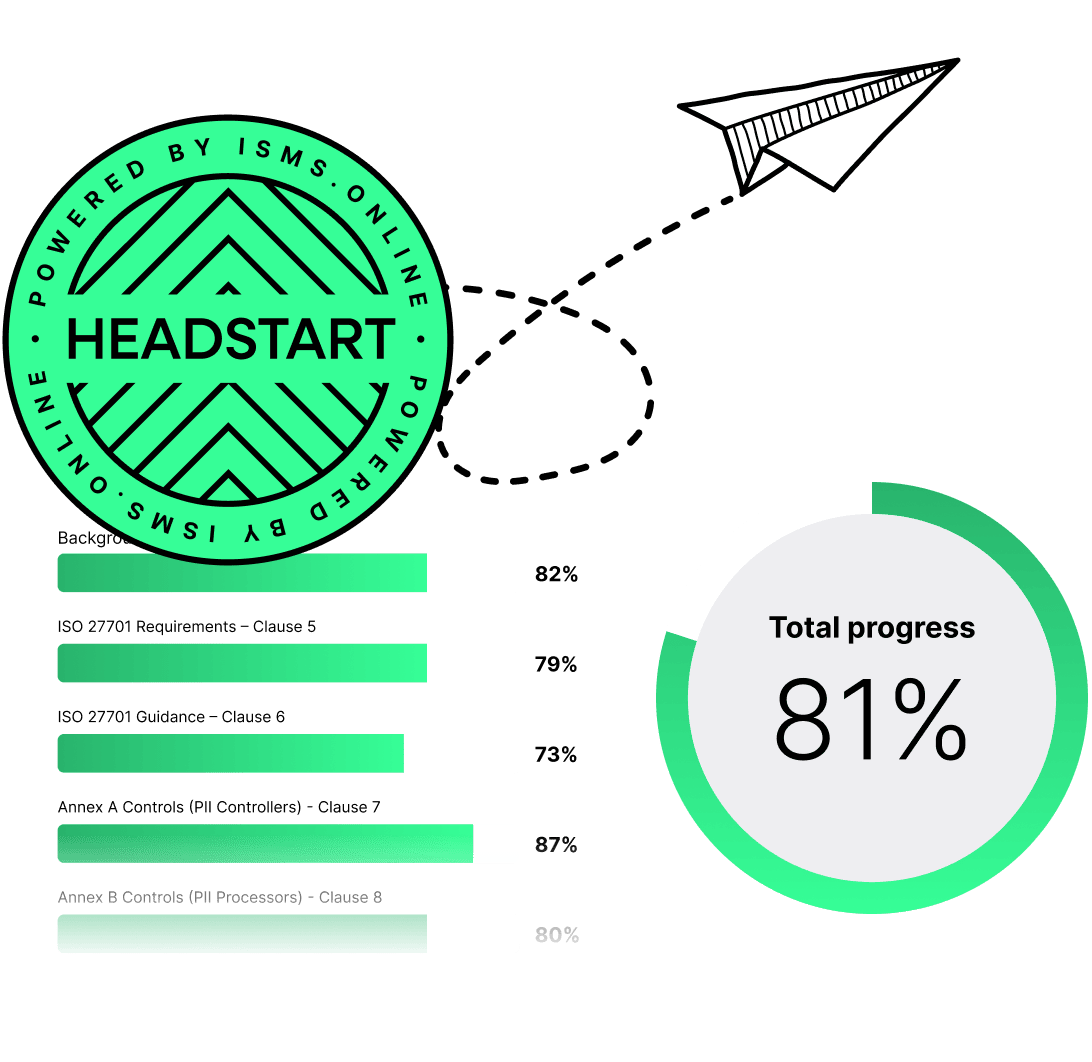
An 81% Headstart from day one
We’ve done the hard work for you, giving you an 81% Headstart from the moment you log on. All you have to do is fill in the blanks.
Who Owns Annex A 5.15?
Under the 5.15 guidance, the owners of information and other associated assets decide the business and security requirements for access to them. Management staff across various parts of an organisation must maintain a thorough understanding of which resources need to be accessed. For example, HR informs employees about their job roles, which dictate their RBAC parameters, while access rights are ultimately a maintenance function controlled by network administrators.
An organisation’s Annex A 5.15 ownership should rest with a member of senior management who has overarching technical authority over the company’s domains, subdomains, applications, resources, and assets. This could be the head of IT.
What 11 Points Should Access Control Policies Consider?
ISO 27001:2022 Annex A Control 5.15 calls for a topic-specific policy on access control: a policy on that one subject, approved by the appropriate level of management, that sits beneath the overall information security policy. Some organisations call this an issue-specific policy.
The 5.15 guidance lists 11 points that the access control requirements and the topic-specific policy should consider. Some of these overlap with other controls, so consult the related controls named in brackets on a case-by-case basis:
- Which entities need access: identify which entities require which type of access to assets and information. Maintaining a record of job roles and data access requirements in line with your organisational structure is the easiest way to keep track.
- Security of applications (linked to Control 8.26): a formal risk assessment could be conducted to assess the security characteristics of individual applications.
- Physical access to a site (linked to Controls 7.2, 7.3 and 7.4): your organisation should be able to demonstrate a robust set of building and room access controls, including managed entry systems, security perimeters and visitor procedures, where appropriate.
- Need to know and classification (linked to 5.10, 5.12 and 5.13): apply the “need to know” principle to the distribution, security and categorisation of information, and avoid blanket access to data across the organisation’s hierarchy.
- Restricted privileged access (linked to 8.2): monitor and audit the access privileges of users who hold access to data above and beyond that of a standard user.
- Legal, regulatory and contractual obligations (see 5.31, 5.32, 5.33, 5.34 and Annex A 8.3 information access restriction): tailor access control policies to any legislation, sector-specific rules or contracts that limit access to data, assets and resources.
- Segregation of duties (linked to 5.3): watch for potential conflicts of interest and include controls that stop one individual from compromising a broader access control function through their access levels (for example, an employee who can request, authorise and implement changes to a network).
- Segregated access control functions: handle the three main functions – requests, authorisations and administration – independently. Access control is one process made up of several steps, each with its own requirements.
- Formal authorisation of access requests (linked to 5.16 and 5.18): conduct access requests in a structured, formal manner, with documented approval from the appropriate personnel.
- Managing access rights (linked to Annex A 5.18 access rights): use periodic audits, HR oversight of leavers and job-specific changes (e.g. departmental moves and changes to roles) to keep access in step with each person’s role.
- Logging (linked to 8.15): collect and store data on access events (e.g. file activity), safeguard security event logs against unauthorised access, and follow a comprehensive incident management strategy.
Supplementary Guidance on Annex 5.15
The supplementary guidance for control 5.15 names, without limiting itself to, four ways of implementing access control:
| Access control model | How access is decided | Typical example |
|---|---|---|
| Mandatory Access Control (MAC) | A central security authority sets the rules; individual data owners cannot change them. | Military-style classification, where a data owner cannot decide who holds a top-secret clearance. |
| Discretionary Access Control (DAC) | The owner of an object decides who can access it and what they can do with it. | A file owner granting colleagues permission to read or edit a shared file. |
| Role-Based Access Control (RBAC) | Permissions are attached to predefined roles or job functions, and users receive them by holding a role. | A finance role that grants access to the accounting system for everyone in that team. |
| Attribute-Based Access Control (ABAC) | Policies combine attributes of the user, the resource and the environment to grant or deny each request. | Allowing access only when a user’s department, the data’s classification and the user’s location all meet the policy. |

Manage all your compliance, all in one place
ISMS.online supports over 100 standards and regulations, giving you a single platform for all your compliance needs.
What Should You Consider When Implementing Access Control Rules?
In defining and enacting your organisation’s access control rules, the Annex A 5.15 guidance asks you to consider the following four factors:
- Access rights must stay consistent with how the information is classified.
- Access rights must stay consistent with your organisation’s physical perimeter security needs.
- In a distributed computing environment (such as a cloud-based environment), consider every type of connection, so entities can only reach the information, assets, networks and network services they are authorised to use.
- Consider how dynamic access control can be reflected in your rules (for example, rules that weigh past access or values from the user’s environment).
Which Procedures and Responsibilities Support Access Control Rules?
According to the guidance for ISO 27001:2022 Annex A Control 5.15, access control rules should be backed by documented procedures and defined responsibilities. It points to the following related controls:
Documentation
- ISO 27001:2022 Annex A 5.16
- ISO 27001:2022 Annex A 5.17
- ISO 27001:2022 Annex A 5.18
- ISO 27001:2022 Annex A 8.2
- ISO 27001:2022 Annex A 8.3
- ISO 27001:2022 Annex A 8.4
- ISO 27001:2022 Annex A 8.5
- ISO 27001:2022 Annex A 8.18
Responsibilities
- ISO 27001:2022 Annex A 5.2
- ISO 27001:2022 Annex A 5.17
Granularity
Control 5.15 of Annex A provides organisations with significant freedom in specifying the granularity of their access control rules, which can range from whole networks or systems down to individual data fields.
The guidance says business requirements and risk considerations should decide which rules apply and how detailed they need to be.
Specifically, the Annex A 5.15 guidance acknowledges that tighter, more detailed rules usually cost more.
Access control, unless carefully managed, can get out of hand very quickly. It is wise to simplify access control rules to ensure they are easier to manage and more cost-effective.

NHS Professionals achieves ISO 27001 certification and improves their infosec management
Facing a tight six-month deadline and multiple existing frameworks to integrate, NHS Professionals needed a platform that could incorporate ISO 27001 without duplicating policies or adding risk to their already complex compliance landscape.

Xergy tool Proteus generates growth through ISO 27001 compliance using ISMS.online
As a start-up building software for highly regulated engineering sectors, Xergy needed ISO 27001 to generate growth through trust — and a proven external partner to handle the rigorous requirements without diverting the dev team.

How MAAS Aviation Built a Robust and Sustainable ISO 27001-Compliant ISMS
MAAS Aviation required strong technical foundations to support ISO 27001 alignment, and a platform to centralise compliance management.

How Blue Services Achieved Triple ISO Certification Success
Blue Services needed external support to guide them through ISO 27001, ISO 9001 and ISO 14001 implementation and best practices, and a platform to centralise their overall compliance management.

How Evolution Funding Cruised to ISO 27001 Certification Success
Achieving ISO 27001 certification was a core objective for Evolution Funding. The team needed a centralised platform with which they could implement the ISO 27001 standard and work through the compliance process.

How 4way Consulting Paved the Road to ISO 27001 Success
Handling sensitive client data across multiple standards, 4way needed a cost and time-efficient way to pursue ISO 27001 – without building an ISMS from scratch or relying on expensive external consultants.
What Changed From ISO 27001:2013 (A.9.1.1 and A.9.1.2)?
Annex A 5.15 in 27001:2022 is an amalgamation of two similar controls in 27001:2013 – Annex A 9.1.1 (Access control policy) and Annex A 9.1.2 (Access to networks and network services).
- See ISO 27001:2013 Annex A 9.1.1 for more information.
- See ISO 27001:2013 Annex A 9.1.2 for more information.
The underlying themes of A.9.1.1 and A.9.1.2 are similar to those in Annex A 5.15, except for some subtle operational differences.
As in 2022, both controls relate to administering access to information, assets and resources and operate on the principle of “need to know”, in which corporate data is treated as a commodity that requires careful management and protection.
There are 11 governing guidelines in 27001:2013 Annex A 9.1.1, all of which follow the same general principles as 27001:2022 Annex A Control 5.15 with a slightly greater emphasis on perimeter security and physical security.
There are generally the same implementation guidelines for access control, but the 2022 control provides much more concise and practical guidance across its four implementation guidelines.
Types of Access Controls Used in ISO 27001:2013 Annex A 9.1.1 Have Changed
The 2022 guidance names four ways to implement access control (MAC, DAC, RBAC and ABAC), whereas in 27001:2013 Annex A Control 9.1.1, the primary method of commercial access control at that time was RBAC.
Level of Granularity
The 2013 controls do not contain meaningful guidelines for how an organisation should approach granular access controls in light of technological changes that provide organisations with enhanced control over their data.
What Are All the ISO 27001:2022 Annex A Controls?
In the table below you’ll find more information on each individual ISO 27001:2022 Annex A Control.
| Annex A Control Type | ISO/IEC 27001:2022 Annex A Identifier | ISO/IEC 27001:2013 Annex A Identifier | Annex A Name |
|---|---|---|---|
| Organisational Controls | Annex A 5.1 |
Annex A 5.1.1 Annex A 5.1.2 |
Policies for Information Security |
| Organisational Controls | Annex A 5.2 | Annex A 6.1.1 | Information Security Roles and Responsibilities |
| Organisational Controls | Annex A 5.3 | Annex A 6.1.2 | Segregation of Duties |
| Organisational Controls | Annex A 5.4 | Annex A 7.2.1 | Management Responsibilities |
| Organisational Controls | Annex A 5.5 | Annex A 6.1.3 | Contact With Authorities |
| Organisational Controls | Annex A 5.6 | Annex A 6.1.4 | Contact With Special Interest Groups |
| Organisational Controls | Annex A 5.7 | NEW | Threat Intelligence |
| Organisational Controls | Annex A 5.8 |
Annex A 6.1.5 Annex A 14.1.1 |
Information Security in Project Management |
| Organisational Controls | Annex A 5.9 |
Annex A 8.1.1 Annex A 8.1.2 |
Inventory of Information and Other Associated Assets |
| Organisational Controls | Annex A 5.10 |
Annex A 8.1.3 Annex A 8.2.3 |
Acceptable Use of Information and Other Associated Assets |
| Organisational Controls | Annex A 5.11 | Annex A 8.1.4 | Return of Assets |
| Organisational Controls | Annex A 5.12 | Annex A 8.2.1 | Classification of Information |
| Organisational Controls | Annex A 5.13 | Annex A 8.2.2 | Labelling of Information |
| Organisational Controls | Annex A 5.14 |
Annex A 13.2.1 Annex A 13.2.2 Annex A 13.2.3 |
Information Transfer |
| Organisational Controls | Annex A 5.15 |
Annex A 9.1.1 Annex A 9.1.2 |
Access Control |
| Organisational Controls | Annex A 5.16 | Annex A 9.2.1 | Identity Management |
| Organisational Controls | Annex A 5.17 |
Annex A 9.2.4 Annex A 9.3.1 Annex A 9.4.3 |
Authentication Information |
| Organisational Controls | Annex A 5.18 |
Annex A 9.2.2 Annex A 9.2.5 Annex A 9.2.6 |
Access Rights |
| Organisational Controls | Annex A 5.19 | Annex A 15.1.1 | Information Security in Supplier Relationships |
| Organisational Controls | Annex A 5.20 | Annex A 15.1.2 | Addressing Information Security Within Supplier Agreements |
| Organisational Controls | Annex A 5.21 | Annex A 15.1.3 | Managing Information Security in the ICT Supply Chain |
| Organisational Controls | Annex A 5.22 |
Annex A 15.2.1 Annex A 15.2.2 |
Monitoring, Review and Change Management of Supplier Services |
| Organisational Controls | Annex A 5.23 | NEW | Information Security for Use of Cloud Services |
| Organisational Controls | Annex A 5.24 | Annex A 16.1.1 | Information Security Incident Management Planning and Preparation |
| Organisational Controls | Annex A 5.25 | Annex A 16.1.4 | Assessment and Decision on Information Security Events |
| Organisational Controls | Annex A 5.26 | Annex A 16.1.5 | Response to Information Security Incidents |
| Organisational Controls | Annex A 5.27 | Annex A 16.1.6 | Learning From Information Security Incidents |
| Organisational Controls | Annex A 5.28 | Annex A 16.1.7 | Collection of Evidence |
| Organisational Controls | Annex A 5.29 |
Annex A 17.1.1 Annex A 17.1.2 Annex A 17.1.3 |
Information Security During Disruption |
| Organisational Controls | Annex A 5.30 | NEW | ICT Readiness for Business Continuity |
| Organisational Controls | Annex A 5.31 |
Annex A 18.1.1 Annex A 18.1.5 |
Legal, Statutory, Regulatory and Contractual Requirements |
| Organisational Controls | Annex A 5.32 | Annex A 18.1.2 | Intellectual Property Rights |
| Organisational Controls | Annex A 5.33 | Annex A 18.1.3 | Protection of Records |
| Organisational Controls | Annex A 5.34 | Annex A 18.1.4 | Privacy and Protection of PII |
| Organisational Controls | Annex A 5.35 | Annex A 18.2.1 | Independent Review of Information Security |
| Organisational Controls | Annex A 5.36 |
Annex A 18.2.2 Annex A 18.2.3 |
Compliance With Policies, Rules and Standards for Information Security |
| Organisational Controls | Annex A 5.37 | Annex A 12.1.1 | Documented Operating Procedures |
| Annex A Control Type | ISO/IEC 27001:2022 Annex A Identifier | ISO/IEC 27001:2013 Annex A Identifier | Annex A Name |
|---|---|---|---|
| People Controls | Annex A 6.1 | Annex A 7.1.1 | Screening |
| People Controls | Annex A 6.2 | Annex A 7.1.2 | Terms and Conditions of Employment |
| People Controls | Annex A 6.3 | Annex A 7.2.2 | Information Security Awareness, Education and Training |
| People Controls | Annex A 6.4 | Annex A 7.2.3 | Disciplinary Process |
| People Controls | Annex A 6.5 | Annex A 7.3.1 | Responsibilities After Termination or Change of Employment |
| People Controls | Annex A 6.6 | Annex A 13.2.4 | Confidentiality or Non-Disclosure Agreements |
| People Controls | Annex A 6.7 | Annex A 6.2.2 | Remote Working |
| People Controls | Annex A 6.8 |
Annex A 16.1.2 Annex A 16.1.3 |
Information Security Event Reporting |
| Annex A Control Type | ISO/IEC 27001:2022 Annex A Identifier | ISO/IEC 27001:2013 Annex A Identifier | Annex A Name |
|---|---|---|---|
| Physical Controls | Annex A 7.1 | Annex A 11.1.1 | Physical Security Perimeters |
| Physical Controls | Annex A 7.2 |
Annex A 11.1.2 Annex A 11.1.6 |
Physical Entry |
| Physical Controls | Annex A 7.3 | Annex A 11.1.3 | Securing Offices, Rooms and Facilities |
| Physical Controls | Annex A 7.4 | NEW | Physical Security Monitoring |
| Physical Controls | Annex A 7.5 | Annex A 11.1.4 | Protecting Against Physical and Environmental Threats |
| Physical Controls | Annex A 7.6 | Annex A 11.1.5 | Working In Secure Areas |
| Physical Controls | Annex A 7.7 | Annex A 11.2.9 | Clear Desk and Clear Screen |
| Physical Controls | Annex A 7.8 | Annex A 11.2.1 | Equipment Siting and Protection |
| Physical Controls | Annex A 7.9 | Annex A 11.2.6 | Security of Assets Off-Premises |
| Physical Controls | Annex A 7.10 |
Annex A 8.3.1 Annex A 8.3.2 Annex A 8.3.3 Annex A 11.2.5 |
Storage Media |
| Physical Controls | Annex A 7.11 | Annex A 11.2.2 | Supporting Utilities |
| Physical Controls | Annex A 7.12 | Annex A 11.2.3 | Cabling Security |
| Physical Controls | Annex A 7.13 | Annex A 11.2.4 | Equipment Maintenance |
| Physical Controls | Annex A 7.14 | Annex A 11.2.7 | Secure Disposal or Re-Use of Equipment |
| Annex A Control Type | ISO/IEC 27001:2022 Annex A Identifier | ISO/IEC 27001:2013 Annex A Identifier | Annex A Name |
|---|---|---|---|
| Technological Controls | Annex A 8.1 |
Annex A 6.2.1 Annex A 11.2.8 |
User Endpoint Devices |
| Technological Controls | Annex A 8.2 | Annex A 9.2.3 | Privileged Access Rights |
| Technological Controls | Annex A 8.3 | Annex A 9.4.1 | Information Access Restriction |
| Technological Controls | Annex A 8.4 | Annex A 9.4.5 | Access to Source Code |
| Technological Controls | Annex A 8.5 | Annex A 9.4.2 | Secure Authentication |
| Technological Controls | Annex A 8.6 | Annex A 12.1.3 | Capacity Management |
| Technological Controls | Annex A 8.7 | Annex A 12.2.1 | Protection Against Malware |
| Technological Controls | Annex A 8.8 |
Annex A 12.6.1 Annex A 18.2.3 |
Management of Technical Vulnerabilities |
| Technological Controls | Annex A 8.9 | NEW | Configuration Management |
| Technological Controls | Annex A 8.10 | NEW | Information Deletion |
| Technological Controls | Annex A 8.11 | NEW | Data Masking |
| Technological Controls | Annex A 8.12 | NEW | Data Leakage Prevention |
| Technological Controls | Annex A 8.13 | Annex A 12.3.1 | Information Backup |
| Technological Controls | Annex A 8.14 | Annex A 17.2.1 | Redundancy of Information Processing Facilities |
| Technological Controls | Annex A 8.15 |
Annex A 12.4.1 Annex A 12.4.2 Annex A 12.4.3 |
Logging |
| Technological Controls | Annex A 8.16 | NEW | Monitoring Activities |
| Technological Controls | Annex A 8.17 | Annex A 12.4.4 | Clock Synchronization |
| Technological Controls | Annex A 8.18 | Annex A 9.4.4 | Use of Privileged Utility ProgramsAccess Rights |
| Technological Controls | Annex A 8.19 |
Annex A 12.5.1 Annex A 12.6.2 |
Installation of Software on Operational Systems |
| Technological Controls | Annex A 8.20 | Annex A 13.1.1 | Networks Security |
| Technological Controls | Annex A 8.21 | Annex A 13.1.2 | Security of Network Services |
| Technological Controls | Annex A 8.22 | Annex A 13.1.3 | Segregation of Networks |
| Technological Controls | Annex A 8.23 | NEW | Web filtering |
| Technological Controls | Annex A 8.24 |
Annex A 10.1.1 Annex A 10.1.2 |
Use of Cryptography |
| Technological Controls | Annex A 8.25 | Annex A 14.2.1 | Secure Development Life Cycle |
| Technological Controls | Annex A 8.26 |
Annex A 14.1.2 Annex A 14.1.3 |
Application Security Requirements |
| Technological Controls | Annex A 8.27 | Annex A 14.2.5 | Secure System Architecture and Engineering PrinciplesLearning From Information Security Incidents |
| Technological Controls | Annex A 8.28 | NEW | Secure Coding |
| Technological Controls | Annex A 8.29 |
Annex A 14.2.8 Annex A 14.2.9 |
Security Testing in Development and Acceptance |
| Technological Controls | Annex A 8.30 | Annex A 14.2.7 | Outsourced Development |
| Technological Controls | Annex A 8.31 |
Annex A 12.1.4 Annex A 14.2.6 |
Separation of Development, Test and Production Environments |
| Technological Controls | Annex A 8.32 |
Annex A 12.1.2 Annex A 14.2.2 Annex A 14.2.3 Annex A 14.2.4 |
Change Management |
| Technological Controls | Annex A 8.33 | Annex A 14.3.1 | Test Information |
| Technological Controls | Annex A 8.34 | Annex A 12.7.1 | Protection of Information Systems During Audit Testing |
Why Choose ISMS.online for Annex A 5.15 Access Control?
Annex A 5.15 is probably the most talked about control within Annex A, and some argue it is the most significant. Your information security management system (ISMS) aims to give the right people access to the right information at the right time, and getting it wrong, such as revealing what everyone in the organisation is paid to the wrong people, can have serious consequences. ISMS.online helps you:
- Work in a platform that follows the entire structure of ISO 27001.
- Adopt, adapt and enrich the content we provide for you.
- Get a considerable head start, with the hard work done for you so you can fill in the blanks.
- Use a single platform for all your compliance needs, with support for over 100 standards and regulations.
- Embed, expand and scale your compliance without the mess of spreadsheets.
- Grow securely, with resilience and confidence.
To see how ISMS.online can help you control access to your information and assets, book a free demo.
FAQs
Is ISO 27001 Annex A 5.15 the same as ISO 27002 control 5.15?
They share a number but do different jobs. ISO/IEC 27002:2022 control 5.15 holds the detailed guidance on how to put it into practice, including the 11 points and the four access control models covered on this page.
Who should approve the access control policy?
The access control policy is a topic-specific policy, so the appropriate level of management should approve it. It sits beneath your overall information security policy.